
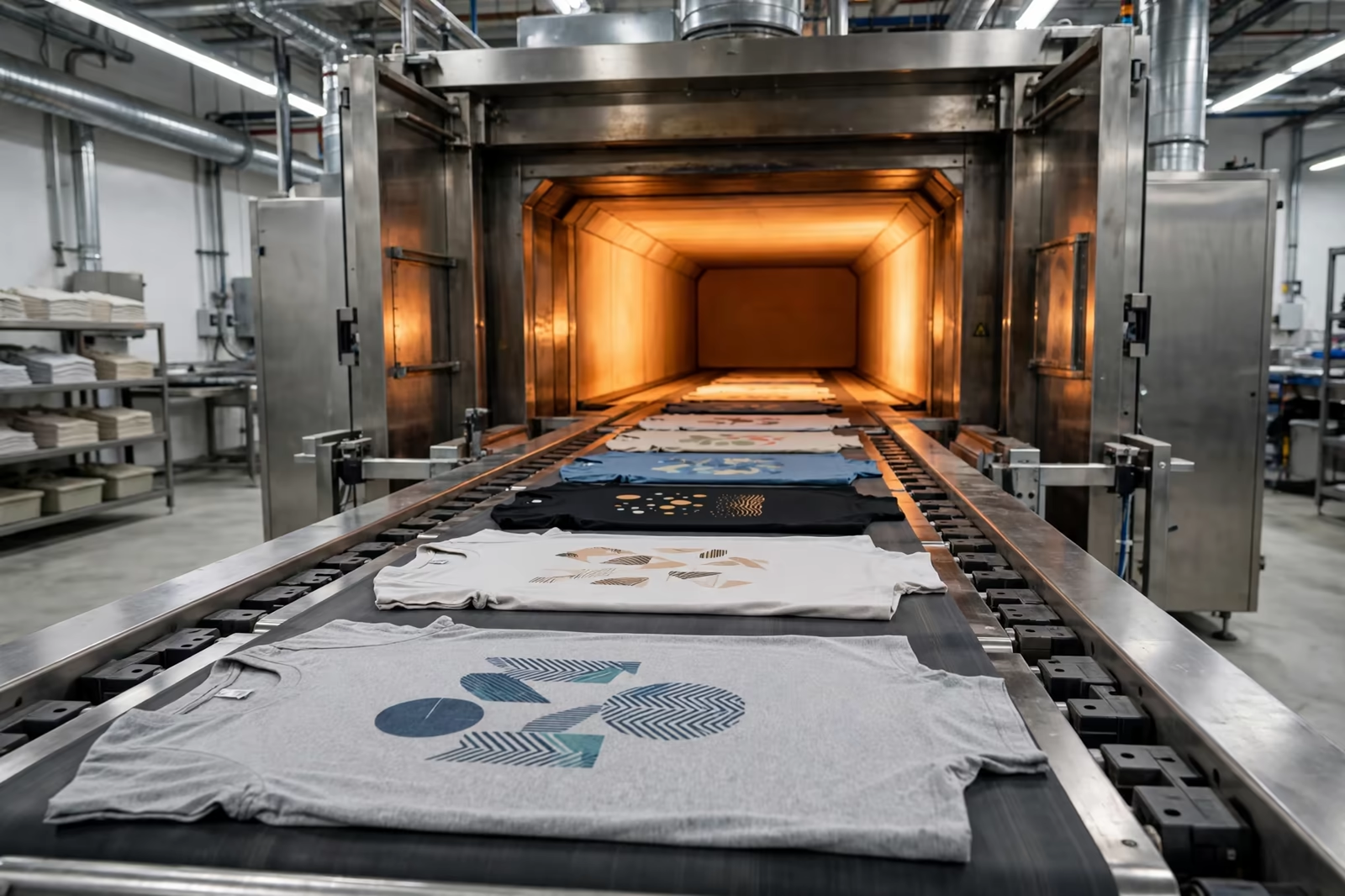
Print failures announce themselves in the wash, weeks after the boxes were sealed and the invoice was paid: a logo cracking into islands, a colour washing pale, an edge lifting and peeling like old paint. Buyers blame the ink, the garment or the laundry in turn, but cracking, fading and peeling are almost always process stories, each failure mode pointing at a specific step in how the print was made, cured or matched to its fabric.
Print durability is tested in Bangladesh with wash checks for buyers in the USA, Australia and the Middle East, because a print that cracks is a reorder that never happens.
This guide reads those failure stories the way a print room does, inside our screen printing work on garments such as the premium heavyweight t-shirt, and it connects each failure to the controls in our wider services that keep it out of a buyer’s program.
Three Failures, Three Different Causes
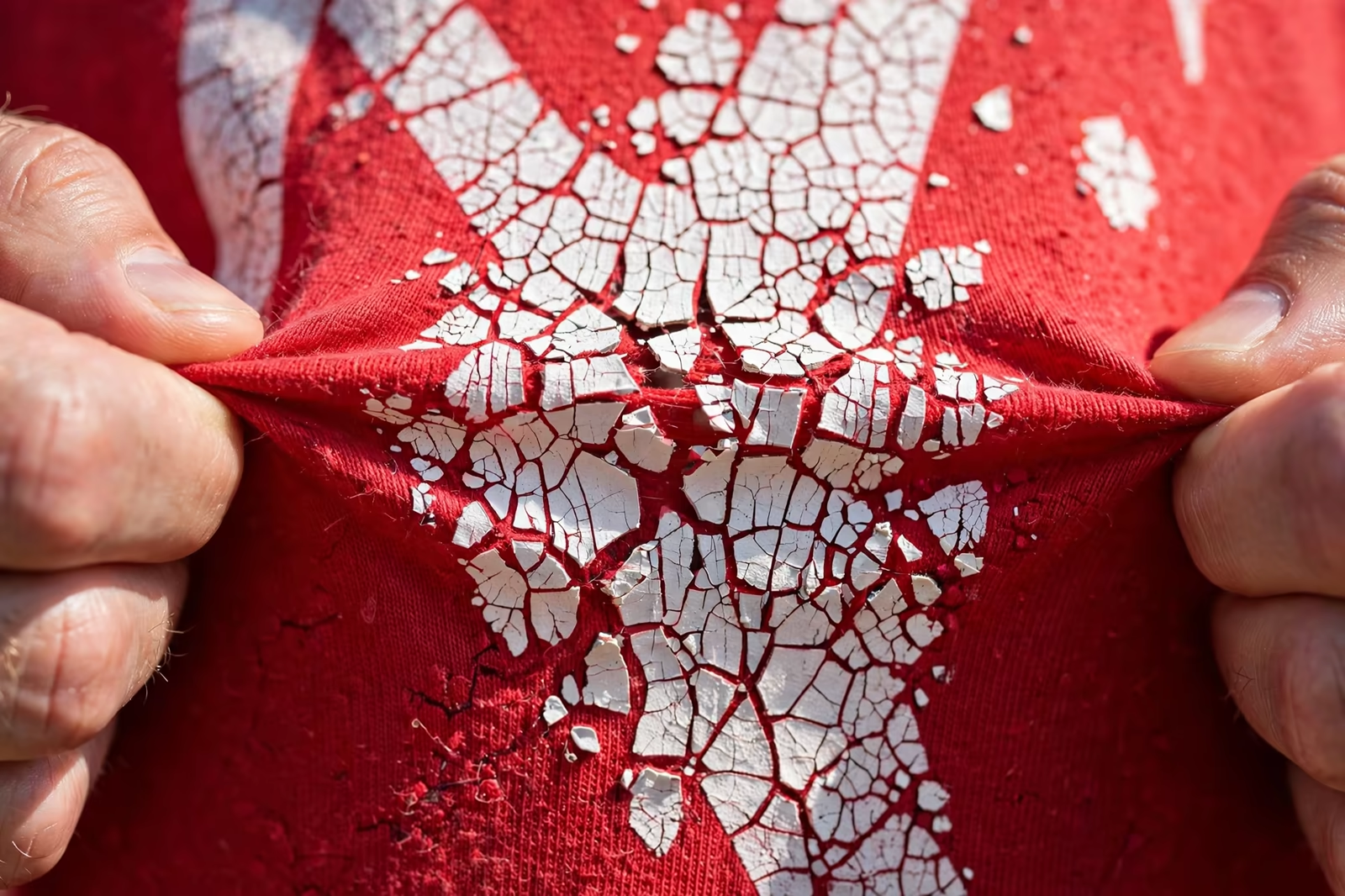
Cracking, fading and peeling look related and are not. Cracking is a flexibility failure: the cured ink film cannot stretch with the fabric, so it fractures across the print’s widest spans, usually in a pattern that follows the garment’s stretch direction. Fading is a pigment or cure failure: colour leaves the print gradually, through washing, sunlight or both, because the ink never fully locked or the pigment itself is fugitive.
Peeling is an adhesion failure: the print releases from the fabric in sheets or at edges, which means it never truly bonded in the first place. Sorting a complaint into the right family is the first diagnostic step, because the fixes are entirely different – more flexibility, a fuller cure, or a better bond – and applying the wrong one wastes a reprint.
Under-Curing: The Cause Behind Most Print Failures
More print failures trace back to the dryer than to any other machine in the building. Screen inks cure by reaching a target temperature through the whole ink film and holding it long enough for the binder to set completely. A print that feels dry at the dryer exit can still be under-cured inside, especially on thick deposits, because the surface skins over and insulates the layer beneath.
The treacherous part is that under-cured prints pass inspection. They look right, feel right and fold right; the failure is scheduled for the customer’s third wash, when the unset binder lets go of pigment and the film turns brittle. Honest print rooms test cure rather than assume it: wash tests on production samples, stretch tests on the print, and dryer temperatures verified against the ink maker’s specification rather than the dial’s optimism.
Why Prints Crack: Film Thickness and Stretch
A cured ink film has a stretch limit, and cracking begins where the garment asks for more. Thick deposits are the usual culprit: heavy underbases and multi-hit colours build a film that behaves like a plate, and plates crack across their span when the knit beneath them flexes. Large solid areas on stretchy garments are the highest-risk combination in the trade.
The defences are designed in, not inspected in. Finer mesh and thinner deposits keep the film supple; stretch additives exist for garments that genuinely move; artwork with breaks and texture tolerates flex better than unbroken slabs of colour. A buyer whose design is one vast solid block on a fitted garment should hear about crack risk at sampling, from the printer, before the bulk makes the argument louder.
Why Prints Fade: Pigment, Cure and Sunlight
Colour leaves a print by three roads. The first is wash-out of under-cured ink, pigment carried away because its binder never set, which shows in the first few washes and then stabilises at a paler shade. The second is abrasion: the print surface rubs against itself and the world, and microscopically thin layers of colour wear away, fastest on raised, coarse fabrics.
The third road is light. Ultraviolet breaks down some pigments faster than others – certain reds and fluorescents are famously short-lived outdoors – and garments worn outside for work or sport live under that sentence daily. Ink makers publish lightfastness by range, and programs destined for sun exposure should specify accordingly rather than discover the ranking on a scaffold or a playing field.
Why Prints Peel: Adhesion and Fabric Finishes
Peeling means the bond failed, and bonds fail for surface reasons. Silicone softeners, durable water-repellent finishes and some easy-care treatments leave a film on the fabric that ink cannot grip; the print cures beautifully onto the finish and then leaves with it. Smooth synthetics offer little mechanical key, so adhesion there depends on ink chemistry matched to the fibre.
Contamination does quieter damage: dust, lint and handling oils interrupt the bond in patches, and the print peels in islands months later. The print room’s countermeasures are unglamorous – fabric checks before printing, test prints on the actual garment with its actual finish, and adhesion checks after curing – and they are exactly what separates factories that see peeling from factories that explain it.
Dye Migration: The Stain That Looks Like Fading
On polyester and richly dyed blends, a print can discolour without losing any ink at all: dye from the garment migrates up into the print under heat, tinting white ink pink on a red shirt or greying bright colours on dark grounds. It often appears days after printing, sometimes after packing, which makes it feel like a haunting rather than a defect.
Migration is managed, not cursed: low-bleed inks, barrier underbases, cure temperatures held at the lowest effective point, and care with how hot printed garments are stacked and packed. A buyer shown a migrated sample should ask which of those controls the reprint will change, because printing the same way and hoping is not among the recognised remedies.
The Laundry’s Share: Wash Temperature and Tumble Drying
Not every failure is born in the factory. Prints are tested to a care standard, and laundry beyond that standard – very hot washes, aggressive detergents, tumble drying at full heat, ironing directly on the print – shortens any print’s life, however well it was made. Heat is the common thread: it re-softens ink films, accelerates dye movement and stresses the bond between ink and fibre.
The fair division of responsibility is written on the care label, which should be specified for the print system actually used and the garment’s real life. A workwear program washed industrially needs that declared at quotation, because the print specification – ink choice, cure, testing – changes with the laundry it must survive. Failures investigated honestly usually find their cause on one side of that line or the other, and the line only exists if someone drew it.
How Print Rooms Test Before Bulk
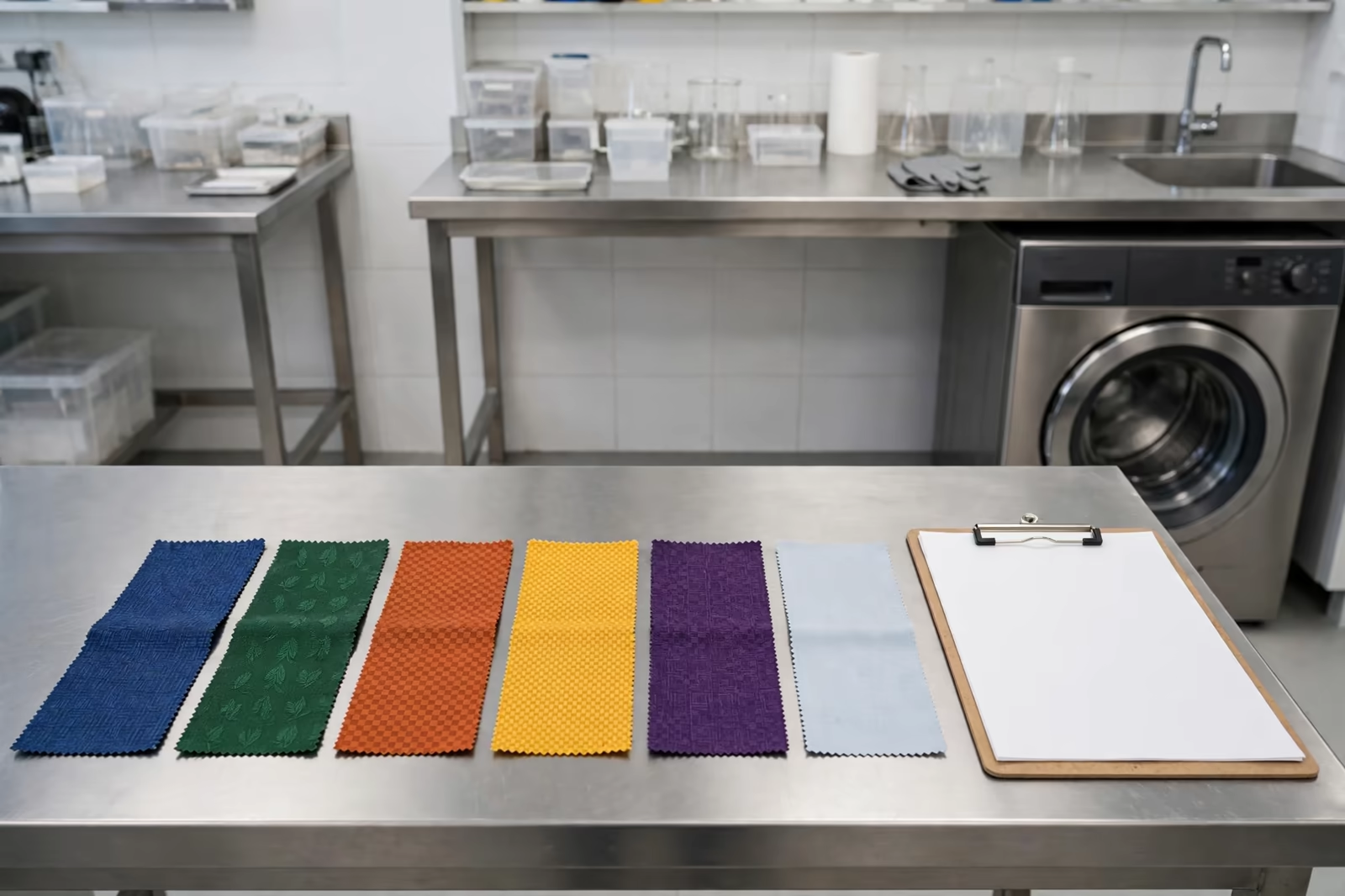
The buyer’s practical protection is a testing sequence done on production fabric before bulk, not on the failed bulk afterwards. Wash testing runs the printed sample through repeated cycles at the program’s care standard and checks colour, cracking and adhesion against the unwashed standard. A stretch test pulls the print across its widest span; a rub test works the surface dry and wet.
None of this is exotic equipment or heroic cost. It is a sample, a washing machine, a tape measure and the discipline to fail a print in the sampling room rather than in the market. Buyers should ask what tests a factory runs and see results on their own strike-offs, because a print room that tests will say so in specifics, and one that does not will answer in adjectives.
Results belong in the order file, beside the formula and the signed strike-off: which tests ran, at what settings, on which fabric batch, and what the sample looked like afterwards. That page of paper is what turns a later complaint from a quarrel into a comparison, because either side can hold the bulk against the tested sample and see, in minutes, whether production drifted or the laundry did, and the argument is over before it becomes a claim.
What a Buyer Should Do When Prints Fail
Start with evidence, not adjectives: photograph the failure beside an unworn garment, keep failed pieces unwashed from the moment they are noticed, and record the laundry they actually received. That evidence sorts the failure into its family – crack, fade or peel – and each family points at its short list of causes, which is where the conversation with the factory becomes technical and useful.
Then judge the response. A professional factory will want the failed pieces, will test them against retained standards, and will name the cause it finds, including when the cause sits in the laundry rather than the print room. Programs with retained samples and recorded formulas can reproduce and interrogate a failure; programs without them can only argue. The time to build that record is the first order, not the first complaint.
Building Failure Prevention into Your Print Program
Prevention is a specification, written before the first screen is made: the ink system named for the fabric, cure verified by test rather than by feel, migration controls on dyed synthetics, care standards declared and matched on the label, and strike-off testing – wash, stretch, rub – passed before bulk and kept on file. Quantities follow our standard minimum of 1,200 pieces per style in up to two colours, with the test sequence built into sampling at no drama.
Prints fail for reasons, and reasons can be engineered out one by one. The programs that run for years without a cracking claim are not lucky; they are the ones where somebody wrote the failure modes down early and designed against each of them, which is the whole content of this guide and the whole difference between a print supplier and a print partner.
Frequently Asked Questions
Why is my print cracking after only a few washes?
Almost always a flexibility or cure problem: the ink film is too thick to stretch with the fabric, or it was under-cured and turned brittle, so it fractures across the print’s widest areas. Thick deposits on stretchy garments are the highest-risk combination. A printer should diagnose it from a failed piece and a stretch test, not from a photograph alone.
Can faded prints be restored or reprinted over?
No. Fading means pigment or binder has left the print, and overprinting a failed print traps the defect under new ink and usually fails again at the same rate. The honest remedy is replacement production with the cause corrected – fuller cure, a more lightfast ink range, or adjusted care – identified from retained samples and wash testing.
Why does the print peel on some garments but not others in the same order?
Peeling follows the fabric surface: dye lots and finish batches vary, and garments carrying more silicone softener or water-repellent finish give ink less grip. Patchy peeling inside one order usually means variable fabric finish, which pre-production adhesion tests on each fabric batch are designed to catch before bulk.
How many washes should a screen print survive?
A properly specified and cured print should hold its colour and surface for the garment’s ordinary service life under its labelled care – dozens of washes for typical apparel. Print rooms prove it with repeated wash testing at sampling, at the program’s actual care standard, rather than quoting a number no test stands behind.