
Both methods are used in Bangladesh for buyers in the UK, Germany and the USA, and the honest choice depends on the design, the fabric and the order size.
Behind almost every printed garment sits a choice most buyers never see: a printer guiding a squeegee by hand across a long table, or a carousel spinning garments past print heads at hundreds of pieces an hour. Manual and automatic screen printing produce the same family of results by very different economics, and the right answer depends on quantity, design and deadline in ways a buyer can reason about once the trade-offs are visible.
This comparison is drawn from our screen printing production in Bangladesh, where both methods run side by side, and it connects the choice to garments such as the pullover hoodie and the quoting process that assigns each order its method.
How Manual Screen Printing Works
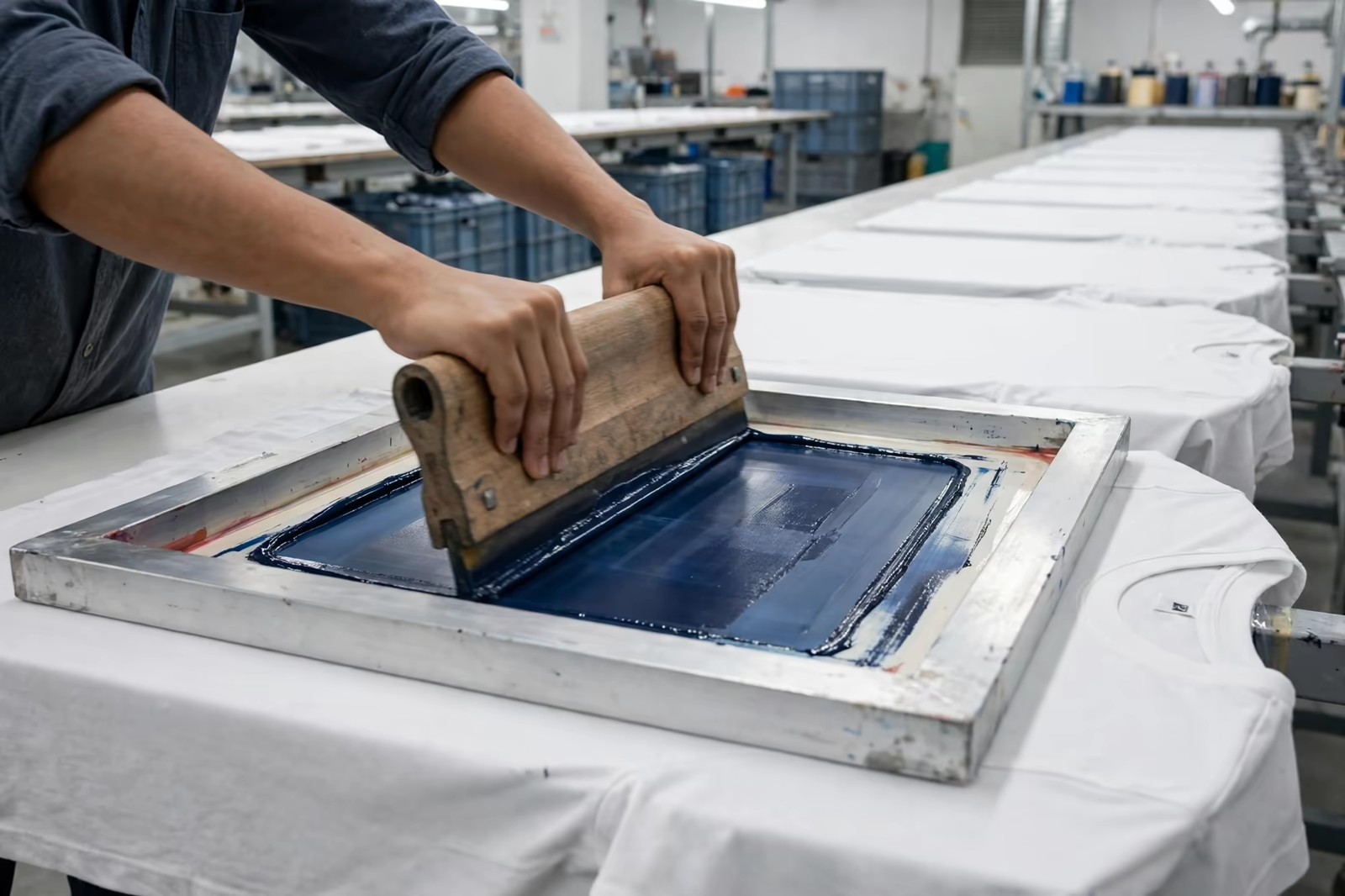
Manual printing is the craft in its original form. Garments are laid on a long table or a small hand carousel, held in register by guides, and the printer draws the squeegee across each screen by hand, colour by colour, flash-drying between hits where the design needs it. The printer’s eye and arm are the quality system: pressure, angle and speed live in a person’s judgement, adjusted garment by garment.
That human control is the method’s strength and its limit. A skilled hand printer coaxes difficult fabrics, odd placements and small runs into excellent prints, and setup is minutes rather than the better part of an hour. But output is bounded by human pace, consistency across thousands of pieces depends on one person’s stamina, and the per-piece labour cost never falls with volume.
How Automatic Screen Printing Works
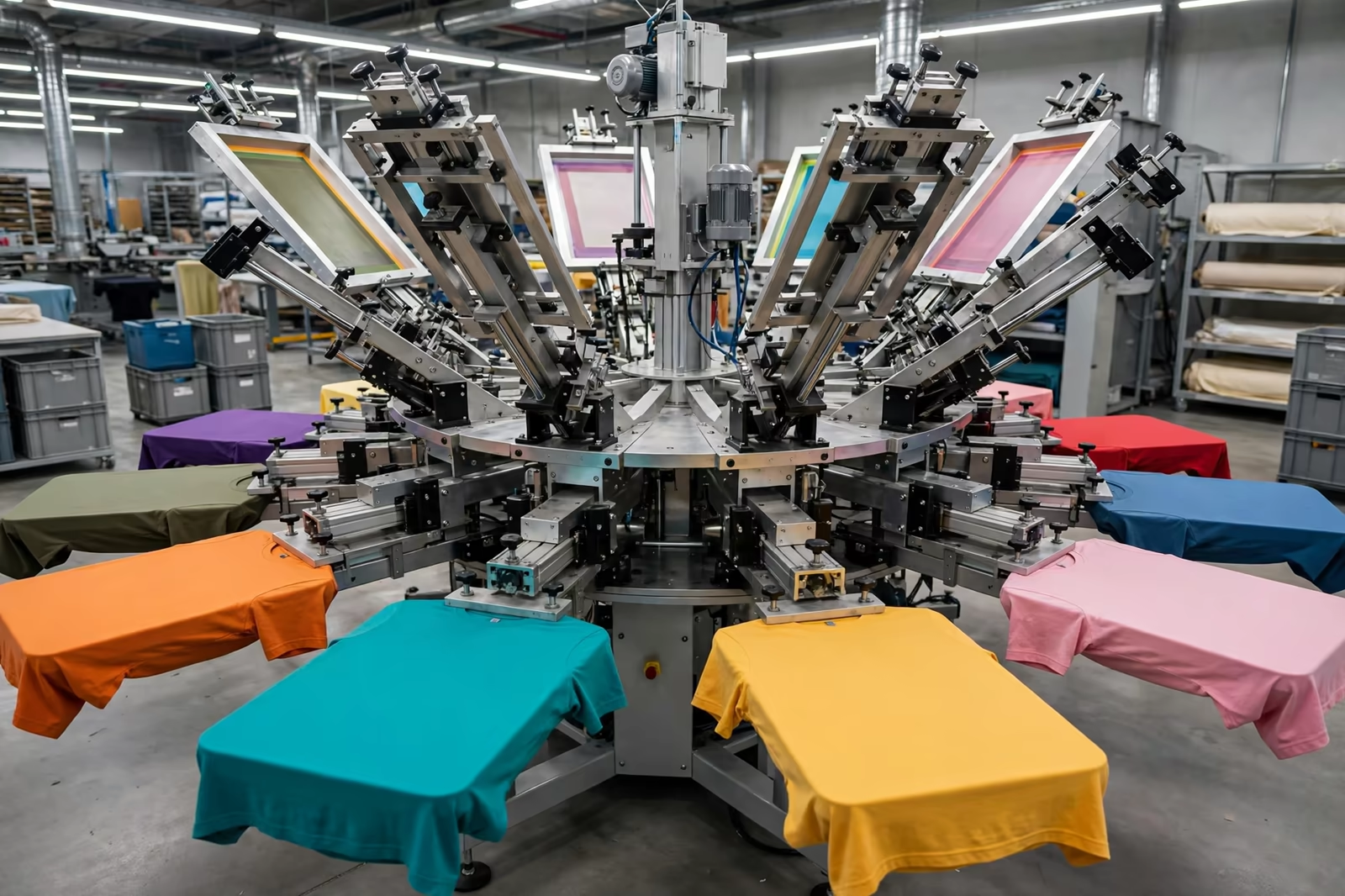
An automatic press mechanises everything except loading. Garments ride pallets around a carousel or along an oval track; print heads drive every squeegee stroke with identical pressure and speed; flash units cure between colours on a timer. Once the machine is dialled in, piece five thousand is a mechanical copy of piece five, which is precisely the point.
The machine’s bargain is setup for speed. Registering eight screens, setting pressures and proving the first print takes real time and skilled labour before a single sellable garment appears. After that investment, the press produces at a pace no table can follow, and the cost of the setup spreads thinner with every hundred pieces added to the run.
Setup Time and the Economics of Run Length
Run length is where the two methods divide the world between them. A manual table can be printing a simple one-colour design within minutes of the screens arriving, which makes short runs, samples and strike-offs cheap to start. An automatic press spends its first hour earning nothing, then outproduces the table for the rest of the shift.
The crossover sits where the automatic’s setup cost, divided across the run, falls below the manual line’s higher per-piece cost – in practice, somewhere in the low hundreds of pieces for simple designs, higher for many-coloured work where registration time grows. Below the crossover, automatic printing is an expensive way to go slowly; above it, manual printing is an expensive way to go at all, because labour dominates every piece.
Print Quality and Consistency Compared
At their best, both methods produce prints a buyer cannot tell apart on the garment. The difference is distribution: an automatic press holds its best almost indefinitely, because its variables are mechanical settings, while a manual line’s quality breathes – superb at the shift’s start, dependent on the printer’s discipline by its end, which good factories manage with rotation, checks and interval sampling.
Registration tells a similar story. Multi-colour designs with fine alignment are the automatic’s home ground, where screens return to the same position thousands of times. Manual registration is a skill that masters achieve and fatigue erodes, so complex art at volume belongs on the machine, while simple bold art forgives either method completely.
Ink deposit differs subtly between the methods as well. A hand squeegee lays ink with a pressure that varies across the stroke in ways an experienced printer exploits, coaxing coverage out of difficult mesh and fabric combinations. A machine stroke is uniform, which suits standard work perfectly and exposes any screen or ink problem identically on every piece – a diagnostic gift, because a fault appears as a pattern across the run rather than as scattered variation that a buyer’s inspection might average away.
What Each Method Does Best
Manual printing owns the awkward work: oversize and unusually placed prints, garments that will not sit flat on a pallet, very short runs, sampling, and designs needing a printer’s improvisation on difficult fabric. It is also how special effects are often proven first, one screen and one pair of hands exploring what a finish can do before anyone commits a machine to it.
Automatic printing owns volume, repetition and complexity at scale: multi-colour retail designs, long runs with tight delivery windows, and re-orders where this season’s pieces must match last season’s exactly. Its consistency is a brand-protection argument as much as a speed one, because the five-thousandth garment is the sample’s twin rather than its cousin.
Labour, Skill and the Human Factor
Neither method removes skill; they relocate it. Manual printing concentrates skill in the printer’s hands, built over years, and a factory’s manual quality is literally the quality of the people at its tables. Automatic printing moves the skill upstream into setup: the technician who registers screens, sets pressures and reads a first print decides the quality of the entire run before it starts.
For buyers, the practical question is not which factory has machines but how each factory staffs the method it proposes for their order. A great hand printer with an honest foreman will out-deliver a neglected automatic press, and a well-run automatic line will out-deliver everyone at volume. The method is a promise; the staffing is whether it is kept.
Capacity, Deadlines and Peak Season
Deadline arithmetic favours the automatic brutally: a press producing several hundred prints an hour absorbs a late order or a size-curve change that would strand a manual line for days. In peak season, when every factory’s tables are spoken for, automatic capacity is what separates a confirmed delivery date from a hopeful one.
Manual capacity flexes differently – more tables, more hands, longer hours – and for modest quantities it can be mobilised quickly without waiting for a machine slot. The honest planner quotes from the method actually assigned to the order, because a delivery date calculated on automatic speed and produced on a manual table is fiction from the day it is written.
Re-orders reveal another quiet difference. An automatic run leaves behind a complete mechanical record – screen tensions, pressures, flash times and pallet settings – that the next run dials back in, so a repeat order starts close to where the last one finished. A manual run’s record is thinner: the formula and the sample survive, but the hand that printed them may be at another table or another factory. Buyers with seasonal re-orders should ask how a factory preserves its settings, because continuity is stored in records, not intentions, and the factories that keep both are the ones whose re-orders arrive boringly identical.
Cost Structures a Buyer Actually Sees
Quotes rarely name the method, but its fingerprint is in the numbers: manual production shows higher per-piece print costs that barely move with volume, while automatic production shows setup-weighted pricing that rewards larger runs with falling unit costs. A buyer comparing quotes at two quantities will see the curves cross, which is the crossover from the setup section wearing a price tag.
The cheapest line is not always the honest one. A quote priced as if automatic, produced manually to protect the margin, buys inconsistency with the buyer’s money. Asking which method a quote assumes – and hearing a straight answer tied to the order’s quantity – is one of the simplest diligence questions in print buying.
Which Method Suits Sampling and Strike-Offs
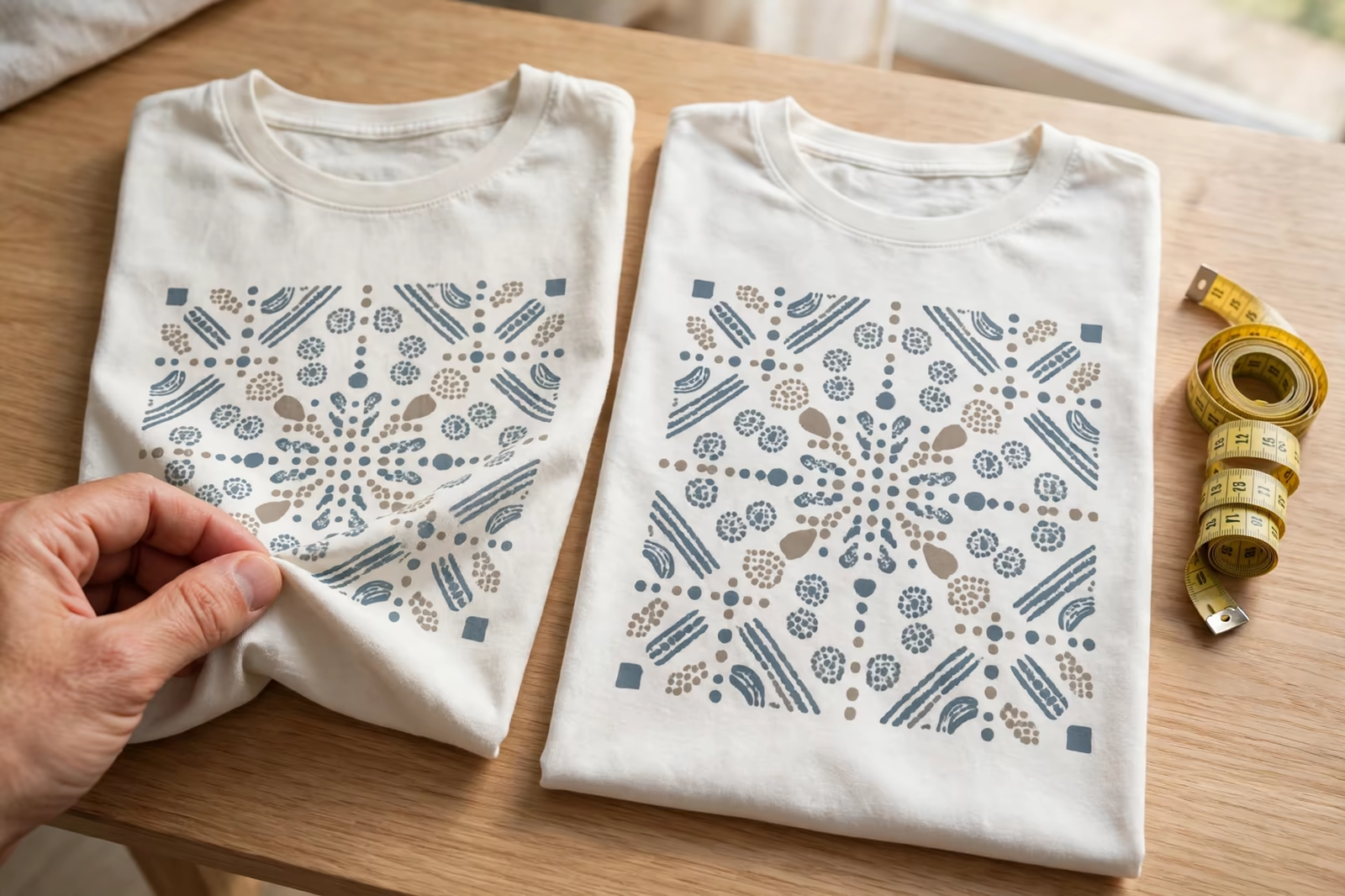
Samples live on the manual table almost everywhere, and should: a strike-off exists to prove colour, size and placement, and the table produces it fastest and cheapest. The discipline that matters is what follows – when the approved design moves to an automatic press for bulk, the first production pieces are checked against the sample as a new approval, because the machine is a new instrument playing the same music.
Factories that skip that second check occasionally discover that a colour matched by hand reads slightly differently at machine pressure, or a registration the eye forgave at the table shows at carousel precision. The check costs a quarter of an hour; the discovery it prevents costs a production run. Buyers can ask for it by name and should.
Choosing the Method for Your Program
Decide from the order outward. Small quantities, samples, difficult placements and gentle deadlines point manual. Volume, many colours, tight registration and hard deadlines point automatic. Mixed programs routinely use both, samples and short colourways by hand, core volume on the press, each design produced where its economics and its quality both make sense.
Quantities follow our standard minimum of 1,200 pieces per style in up to two colours, and at that scale most core designs sit comfortably on automatic capacity while sampling stays manual. Whatever the method, the buyer’s protections are identical: a physical approval before bulk, interval checks during it, and a factory that tells you plainly which machine your garments are on and why.
Frequently Asked Questions
Is automatic screen printing better quality than manual?
Not inherently – at their best the prints are indistinguishable. The automatic’s advantage is consistency over long runs, because its pressure, speed and registration are mechanical settings rather than a person’s stamina. Manual printing matches it piece for piece in skilled hands and handles awkward garments and placements the press cannot.
Why do small orders get printed manually?
Setup economics. An automatic press spends significant skilled time registering screens before the first garment, and that cost divided across a short run makes each piece expensive. A manual table starts within minutes, so short runs, samples and strike-offs are cheaper by hand even though the per-piece labour is higher.
Can a design move from manual sampling to automatic production?
Yes, and it is the normal route: samples are proven on the manual table, then the bulk runs on the press. The step that protects the buyer is a first-production check against the approved sample, because machine pressure and registration can shift a result slightly, and catching that on piece ten costs nothing compared with piece ten thousand.
Which method should I choose for a 1,200-piece order?
At that quantity, most multi-colour core designs belong on the automatic press, where setup spreads thin and consistency is guaranteed, while one-colour or unusually placed designs can still favour the manual table. A good factory states the method in the quote discussion rather than leaving it to be discovered.