
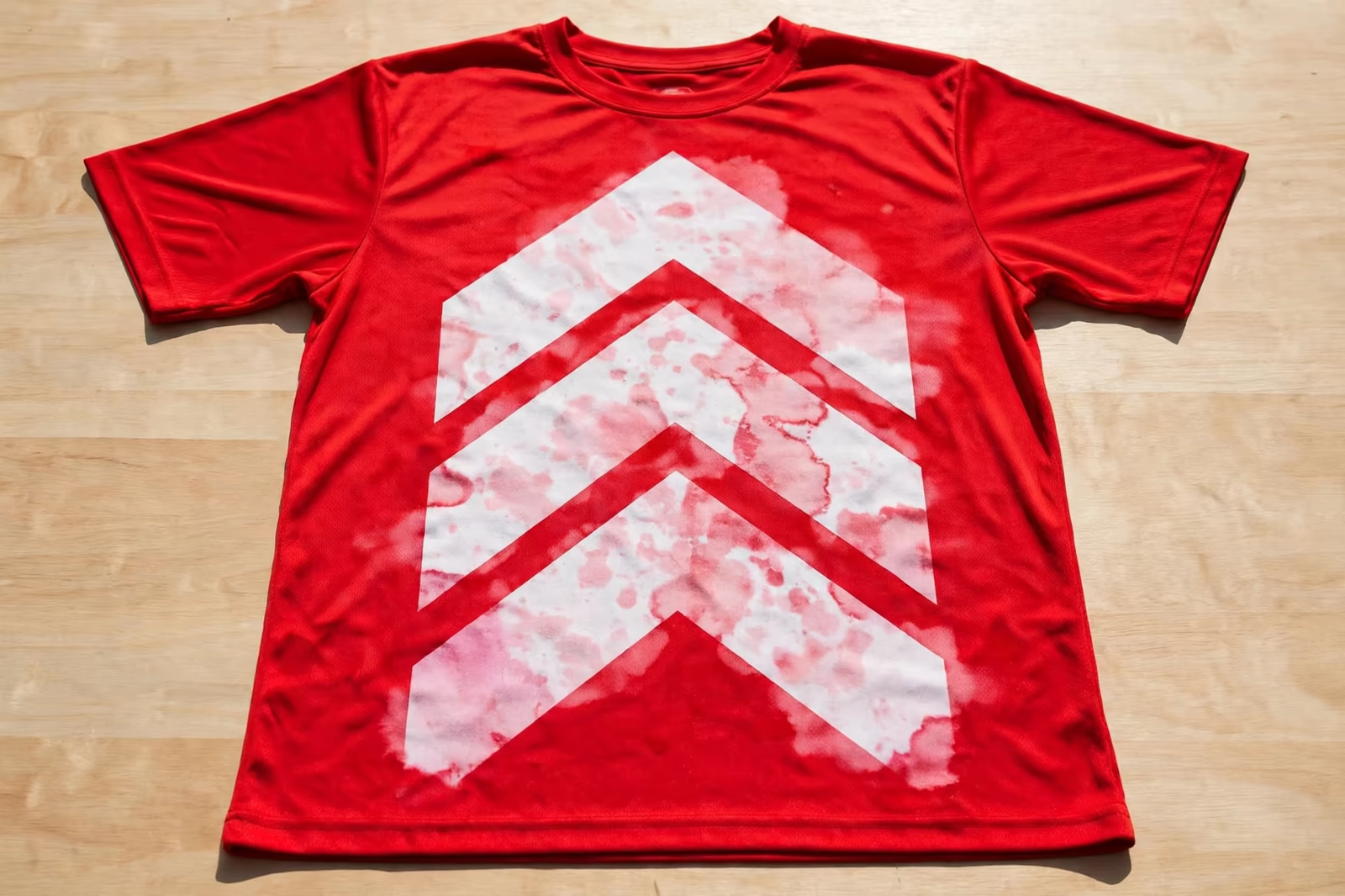
A white print leaves the press bright, passes inspection, gets packed – and turns pink in the box. That ghost is dye migration, the defining problem of printing on polyester and dyed blends, and it has ended more buyer relationships than any honest defect because it appears after everyone has signed everything. Understanding it is not optional for anyone printing sportswear, workwear or fashion on synthetic fabrics.
Polyester printing is barrier-tested in Bangladesh for sportswear buyers in the USA, Canada and Europe, so white prints stay white through curing, packing and wear.
This guide explains migration inside our screen printing programs, on garments from the oversized hoodie in blended fleece to performance polyester, and closes with the questions a buyer should ask through contact before a polyester order is printed rather than after it is packed. It is the failure nobody budgets for, which is precisely why it deserves a guide of its own.
What Dye Migration Actually Is
Polyester is coloured with disperse dyes that sit inside the fibre rather than bonding to it the way cotton dyes do. Heat persuades some of that dye to leave the fibre as a gas – sublimation, the same physics used deliberately in dye-sublimation printing – and the escaped dye travels upward into whatever sits on the garment’s surface, which is the buyer’s print.
The print becomes a dye trap. White and light inks show the contamination worst, because they provide a pale canvas for the garment’s colour to write on: red polyester stains white ink pink, black polyester greys it, and rich mid-tones shift it in ways that read as dirty colour. The ink itself has not failed; it has been dyed from below after the fact.
Why Heat Is the Trigger
Migration is a temperature story. Disperse dyes begin moving at temperatures ordinary curing reaches easily, and the hotter and longer the exposure, the more dye travels. The print room therefore lives on a narrow ridge: enough heat, held long enough, to cure the ink fully – and not one degree of enthusiasm beyond it, because every extra degree is paid for in migrated dye.
Heat also arrives after printing. Garments stacked hot from the dryer keep cooking gently in the pile; boxes stored in hot warehouses or containers continue the process for weeks. This is why migration so often appears at unpacking rather than at inspection: the print was honest when it was checked, and the journey finished the chemistry the dryer started.
Which Fabrics and Colours Migrate Worst
Pure polyester in strong colours is the highest-risk ground in the trade, with saturated reds, burgundies and blacks the classic offenders. Blends migrate in proportion to their polyester share and the depth of the dye: a dark 50-50 garment carries roughly half the problem and all of the unpredictability, because the cotton half prints and behaves like cotton while the polyester half quietly does not.
Not every polyester is equal, either. Yarn quality, dye method and the dye house’s own discipline change how much loose dye a fabric holds, and two garments with identical specifications from different mills can migrate very differently. This is why migration control starts with the actual production fabric, tested, rather than with the fabric’s name on a specification sheet.
Blends: The Middle Ground That Behaves Like Neither
Buyers often assume a blend dilutes the problem away, and at 50 percent polyester it merely halves and hides it. The cotton fibres take ink the friendly way while the polyester fibres carry their dye quietly, so a blend can print beautifully, test acceptably in a quick check, and still migrate slowly across weeks of warm storage – a slower ghost, but the same one.
Tri-blends and polyester-rich fashion blends add their own texture to the risk, because their dyes and finishes vary by fashion source rather than by technical standard. The working rule is unglamorous: any garment with meaningful polyester content gets the migration conversation, the fabric test and the barrier decision, at whatever percentage makes the printer sleep badly. Experience sets that threshold lower than optimism does.
Low-Bleed Inks and Barrier Underbases
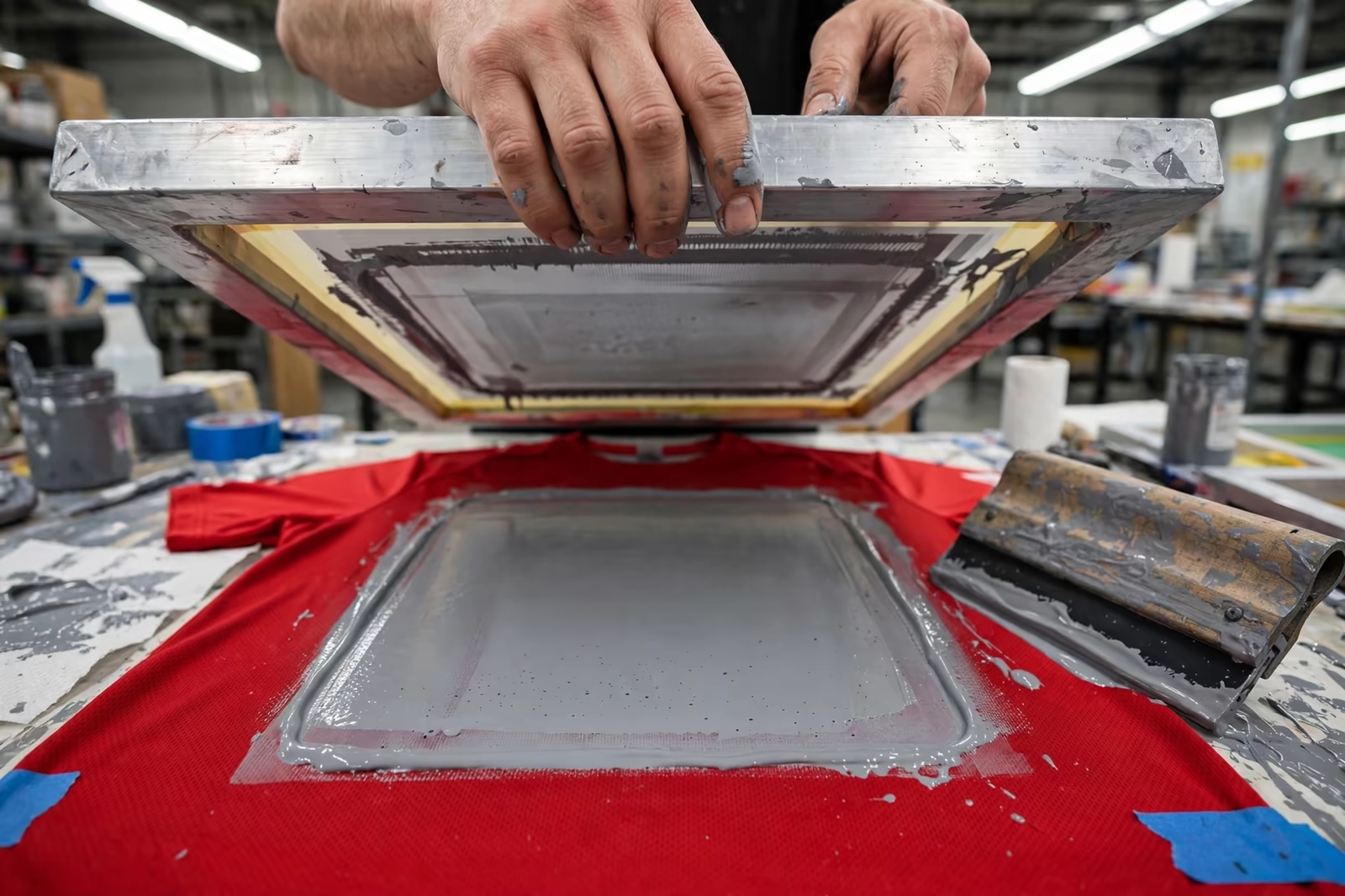
The print room’s first defence is chemistry: low-bleed inks are formulated to resist accepting migrated dye, and barrier underbases – grey or charcoal-tinted bases printed first – absorb the travelling dye before it reaches the colour the customer sees. On the worst grounds, the barrier is not an upgrade; it is the difference between a print that survives the month and one that survives the afternoon.
These defences cost screens, hits and honesty in the quote, which is why they are sometimes quietly omitted by factories competing on price. A buyer printing white on red polyester should be able to ask what stands between the garment dye and their logo, and hear a specific answer – a named ink system, a barrier base – rather than a reassurance.
Cure Management: The Lowest Effective Temperature
The second defence is discipline at the dryer. Migration-aware print rooms cure at the lowest temperature that fully sets the ink, verified by wash testing rather than by dial habit, and they resist the ancient temptation to run the dryer hot for safety, because on polyester the safety margin and the defect are the same degrees.
Handling after the dryer matters just as much: prints are cooled before stacking, stacks are kept shallow, and packing avoids sealing hot garments into plastic where warmth and dye can keep working undisturbed. None of this is technology. It is a chain of small disciplines, any one of which, skipped, can pink a production run that did everything else right.
Testing for Migration Before Bulk
Migration has one mercy: it can be provoked in advance. A printed sample of the production fabric, given a heat-and-rest test that imitates the journey – warmth, stacking, time – shows within days whether the garment’s dye is going to travel and how far. A print room that prints polyester regularly runs this test as routine, because discovering migration on a sample costs a morning and discovering it on a shipment costs the relationship.
Buyers should ask for the migration test by name on any polyester or dark blend program, and should see the tested sample beside an untested one. The comparison is unambiguous in a way that promises are not, and a factory’s willingness to show it is itself information about how the bulk will be handled.
Keep the tested sample, too. Filed beside the strike-off, it becomes the standard the bulk is judged against at final inspection, and the first exhibit if a later argument starts. A migration dispute with samples on the table is a technical discussion; without them it is two memories disagreeing across an ocean, and the side holding the sample usually turns out to be describing the shipment considerably more accurately than the side holding only an opinion.
Sublimation Printing: The Other Route on Polyester
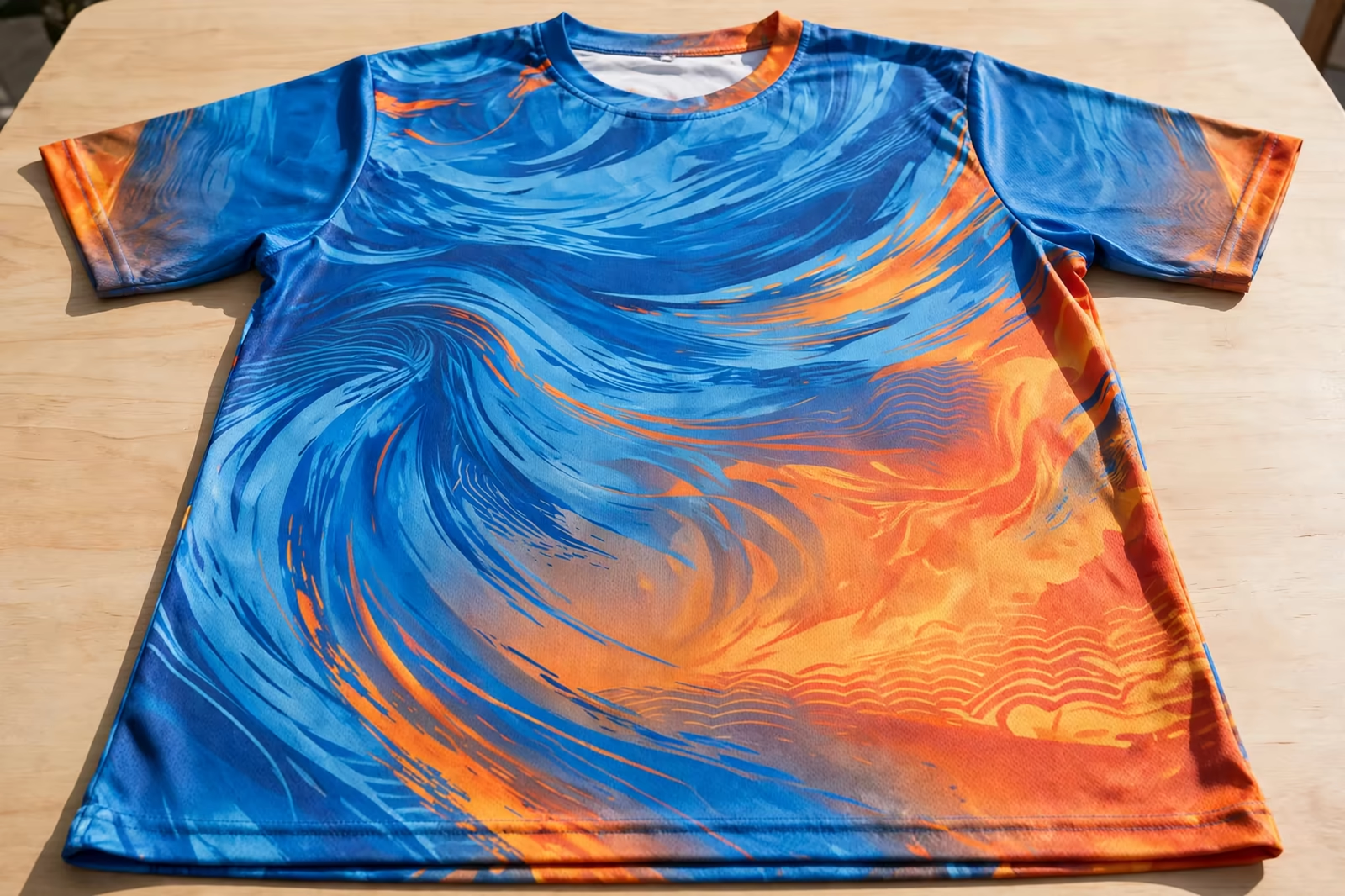
There is one printing method that migration cannot touch, because it works by the same physics: dye sublimation drives dye gas into polyester deliberately, printing the garment by dyeing it. On white or pale polyester it produces borderless, hand-feel-free prints with no ink film to stain, and for all-over sportswear designs it is often the correct technology rather than a substitute.
Its limits are equally clear: it needs polyester-rich fabric, it cannot print white or light colours onto dark garments, and it prices differently from screen work. The professional conversation is not screen versus sublimation as rivals, but which technology the garment, the colours and the design actually call for – a question a good print partner raises before the order, not after the boxes blush.
Storage, Shipping and the Container Problem
A migrated shipment is often made in transit rather than in the factory. Containers cross oceans through temperatures that turn a steel box into a slow oven, and cartons at the centre of a pallet sit warm for weeks – exactly the heat-and-time recipe migration needs. A print that left the factory inside tolerance can arrive outside it without anyone mishandling anything, which is why the argument about where it happened is usually unresolvable and always beside the point.
The defences are upstream again: controls strong enough that the journey cannot finish the chemistry – a barrier that holds under container heat, curing that left no half-set dye near the surface, and packing that lets garments travel cool and dry. Buyers receiving polyester programs should also unpack and inspect promptly on arrival, because a migration caught in week one is a conversation, while the same migration found at retail in month three is a write-off.
What Buyers Should Specify on Polyester Orders
Specify the fabric’s exact composition and colour, name the risk in the order documents, and require the migration controls as line items: low-bleed or barrier system where the ground demands it, cure verified at the lowest effective temperature, a passed migration test on the production fabric before bulk, and cooling discipline before packing. Each requirement is one sentence; together they convert a known hazard into a managed process. Ask also who owns the decision when a test result is borderline, because a borderline result waved through against a deadline is exactly how managed processes quietly become unmanaged ones.
Quantities follow our standard minimum of 1,200 pieces per style in up to two colours, and polyester programs carry their sampling time honestly in the calendar. The buyers who never meet dye migration are not the lucky ones; they are the ones whose specifications assumed it was coming and were ready.
Frequently Asked Questions
Why did my white print turn pink on red polyester shirts?
That is dye migration: heat persuaded red disperse dye out of the polyester and into your white ink, which trapped and showed it. It often appears after packing because warmth in stacks and transit continues the process. Prevention is a barrier or low-bleed ink system, curing at the lowest effective temperature, and a migration test on the production fabric before bulk.
Can dye migration be fixed once it has happened?
No. The migrated dye is inside the ink film permanently, and overprinting buries rather than removes it. Affected garments cannot be rescued by more printing. The remedy is replacement production with the controls in place, which is why the pre-bulk migration test matters so much on polyester programs.
Do all polyester garments migrate?
All polyester carries disperse dye, but the risk varies enormously with colour depth, dye quality and the fabric mill’s discipline. Pale polyester may never show migration; saturated reds and blacks from an undisciplined dye source are the worst cases. This is why testing the actual production fabric, not the specification, decides the controls.
Is sublimation better than screen printing for polyester sportswear?
For white or pale polyester with all-over designs, sublimation is excellent and immune to migration, since it dyes the fibre itself. For dark garments, spot colours, or cotton-rich blends, screen printing with migration controls is the workable route. The garment and design choose the technology, not habit.