
Every factory has a story about the order that arrived as a photograph and a sentence. The photograph showed a jacket; the sentence said “like this, but better”. What followed, samples arguing with expectations, a bulk run arguing with both, is the most expensive genre in garment manufacturing, and it has one cause: the garment existed in somebody’s head instead of on paper. The tech pack is the paper. It is the document that carries a design out of a brand’s imagination and into a factory’s hands without losing anything on the journey.
The packs dissected here are written for production in Bangladesh by brands in the UK and Canada, and they travel further than any sample in the building.
This guide explains what a tech pack contains, why factories price and sample from it rather than from artwork alone, and how detailed yours needs to be, in the context of our brands programs, the production terms on the MOQ and production page, and the questions buyers send through contact every week.
What a Tech Pack Is, in One Honest Definition
A tech pack is the complete written and drawn instruction set for making one style of garment exactly the same way every time. It names the garment, shows it from every angle that matters, measures it, specifies its materials down to the thread, and records how it is sewn, finished, labelled and packed. If a merchandiser, a pattern master and a sewing line each read only the tech pack, all three should produce the same garment without ever speaking to the designer.
That last test is the definition’s teeth. A tech pack is not a moodboard, not a sketch with measurements attached, and not a brand book; those inspire, but they do not specify. The tech pack is the garment’s legal document inside the factory, the thing samples are judged against, quotes are costed from and disputes are settled by. Brands that internalise this stop decorating their packs and start engineering them.
The Drawing: Flat Sketches That Show Construction
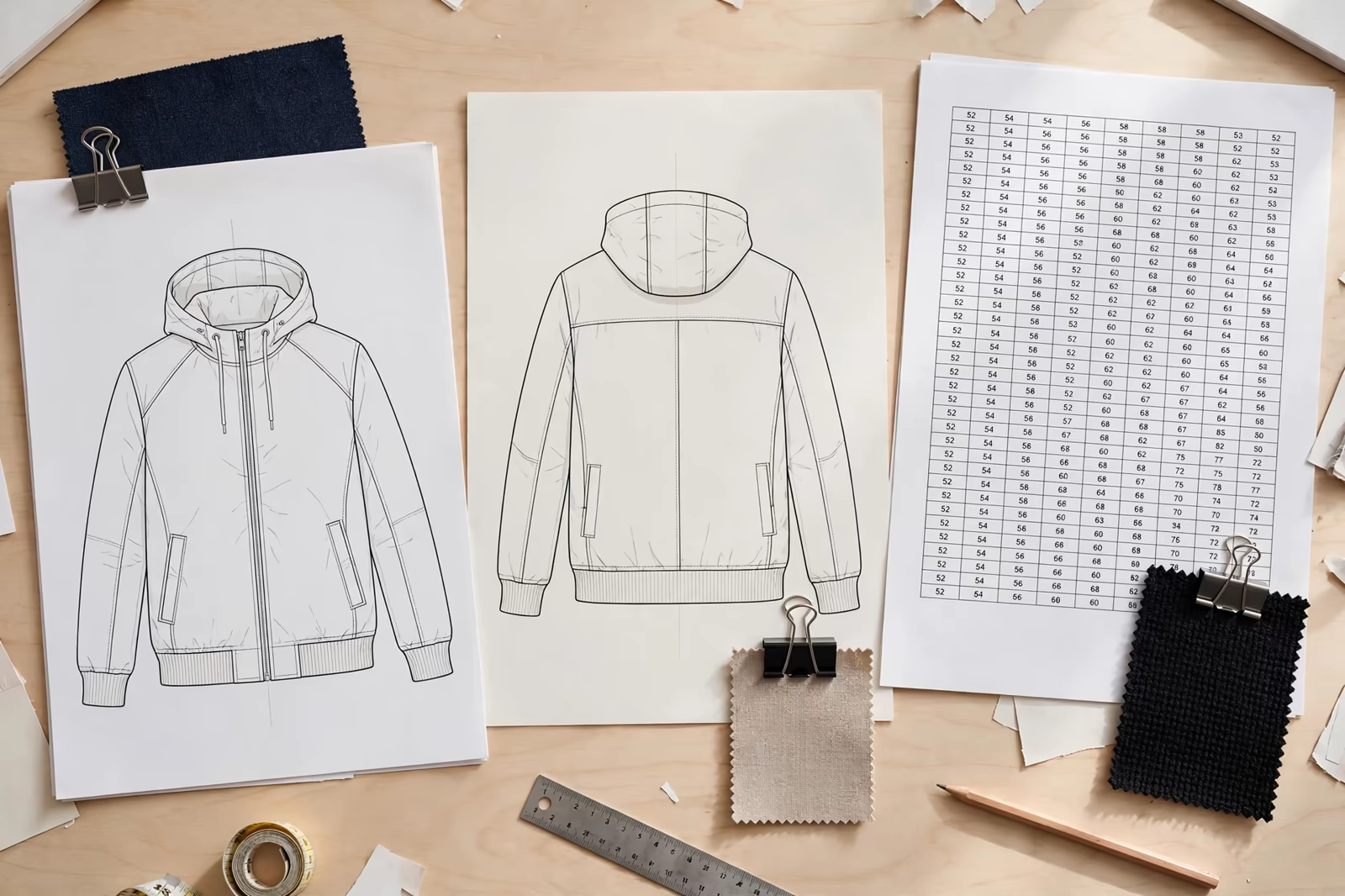
The pack opens with technical flat drawings, front, back and detail views, drawn plain and proportional rather than artistic. Their job is to show construction: where every seam runs, where pockets sit and how they are shaped, how the collar is built, where stitches show, where decoration is placed with measurements from fixed points. A fashion illustration sells the garment to a buyer; a flat sketch instructs the people who will sew ten thousand of it, and the two drawings are not interchangeable.
Details that surprise factories in samples are almost always details the flat sketch left ambiguous: a pocket drawn but not dimensioned, a placket shown but not specified. The rule is mechanical: anything a sewer must decide while looking at your drawing is a decision you have delegated, possibly to someone sewing at production speed in another language. Draw it, dimension it, or accept their version with good grace.
The Measurement Chart: The Garment in Numbers
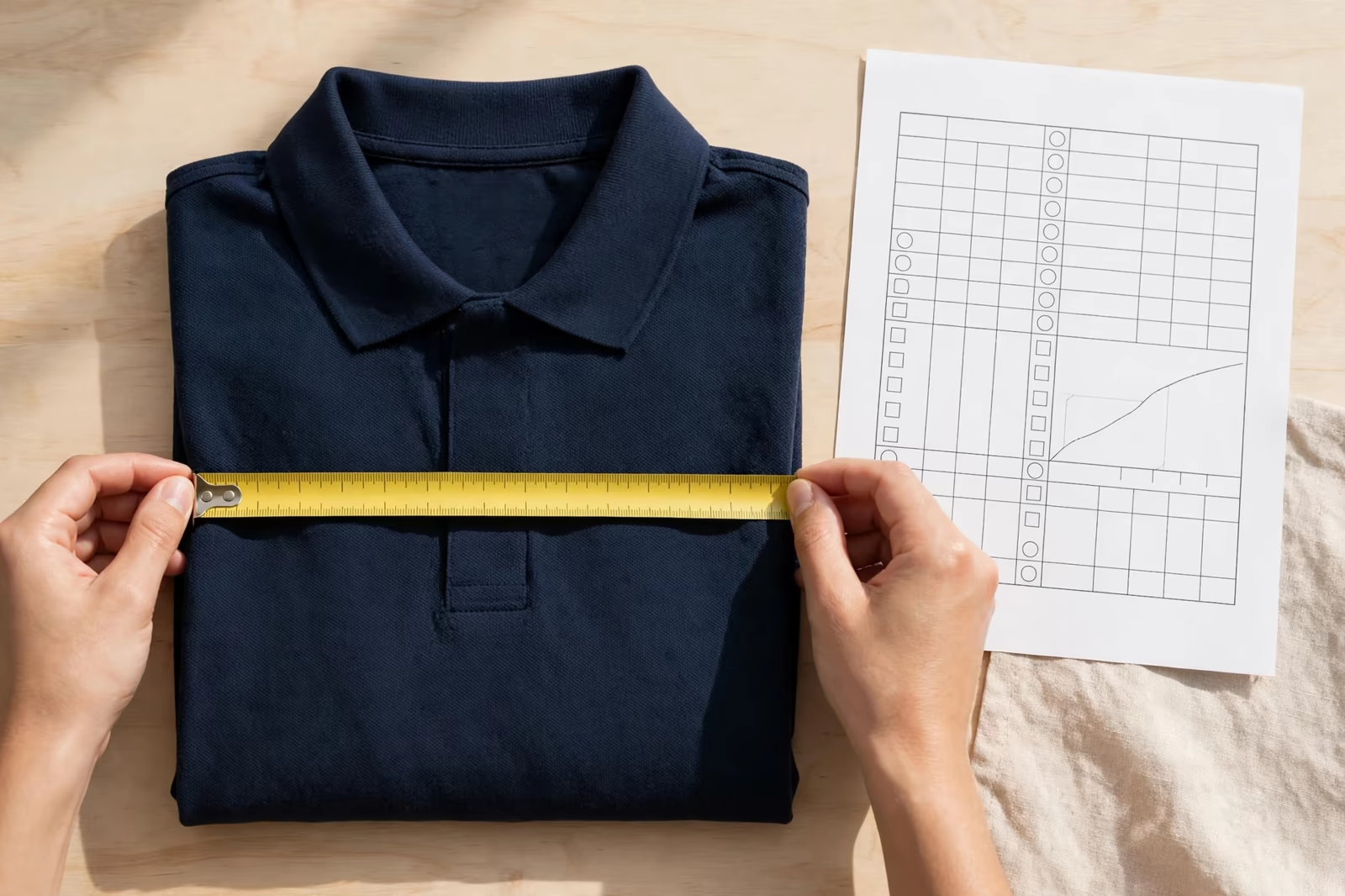
Next comes the size chart, the garment translated into numbers: every point of measure for every size, chest, length, sleeve, shoulder, and the grading between sizes, how each measurement grows from one size to the next. Alongside it sits the tolerance, the small permitted variation that honest manufacturing allows, because a garment measured to the tenth of a millimetre exists only in documents, not in cloth.
This chart is where fit actually lives. Two garments with identical sketches and different charts are different products, and the customer’s body will know which one you specified. Brands guard their charts accordingly, building them from their own fit sessions rather than copying a competitor’s numbers for a different body, and factories respect a chart that has clearly been worn, washed and argued over before it was typed.
The Bill of Materials: Every Input Named
The BOM lists everything that goes into the garment: shell fabric with composition, weight and finish; lining and interlining; thread; buttons, zips, snaps and drawcords with sizes and finishes; labels, tags and packaging. Each line carries a reference a buyer can source against, a colour code, a standard, a named quality, because “black zip” is not a specification and “soft fabric” is not a material.
Fabric deserves the fullest lines in the BOM, since it is most of the garment’s cost and all of its hand-feel: fibre content, construction, weight per square metre, colour references per colourway, and any performance finish agreed. When a quote comes back higher than hoped, the BOM is where the conversation happens, line by line, with levers a brand can actually pull, rather than an argument about a single number.
Construction and Stitch Specification
A garment is also a set of sewing decisions: seam types and allowances, stitch density, where seams are reinforced, how hems are finished, how the collar is set, what is topstitched and in what thread. The tech pack records them, briefly and precisely, because two factories sewing the same sketch with different construction produce garments that age differently, feel different and fail in different places.
New brands often leave this section thin and lean on the factory’s standard construction, which is a legitimate choice when it is a choice, recorded as such in the pack. The standard construction of an experienced manufacturer is a considered thing; what fails programs is not borrowing it but never knowing it was borrowed, so that a second factory, a year later, reproduces the sketch and none of the substance.
Artwork, Decoration and Placement
Where the garment carries print, embroidery or appliqué, the pack holds the artwork files at true size, the colour references for each element, and the placement measured from fixed garment points, centre chest so many centimetres below the neck seam, left chest centred over a measured coordinate. Decoration specified this way can be reproduced on any size, because the placement is anchored to the garment’s architecture rather than floating on a photograph.
This section earns its keep at reorder and at scale: a logo that exists only as a file name in an old email will be redrawn, resized and recoloured by memory, and the drift shows up on the customer’s chest. Artwork in the pack, versioned like everything else, is how a brand’s chest looks identical in year three to year one.
Labels, Packaging and Compliance Details
The pack closes with the garment’s identity and obligations: main label artwork and position, size and care labels with their legally required content for the destination market, fibre composition wording, country of origin marking, hangtag specification, folding and polybag instructions, carton marking. The USA, the UK, Europe, Canada and Australia each ask slightly different things of a care label, and the pack is where those differences are answered once, correctly, instead of at the packing table.
Compliance is not decoration on the document; a garment detained or relabelled at destination costs more than every other section saved. Brands selling into several markets keep market-specific label pages inside one pack, so a single style can ship to Hamburg and Houston from the same production run with only its label set changed.
How Factories Actually Use Your Pack
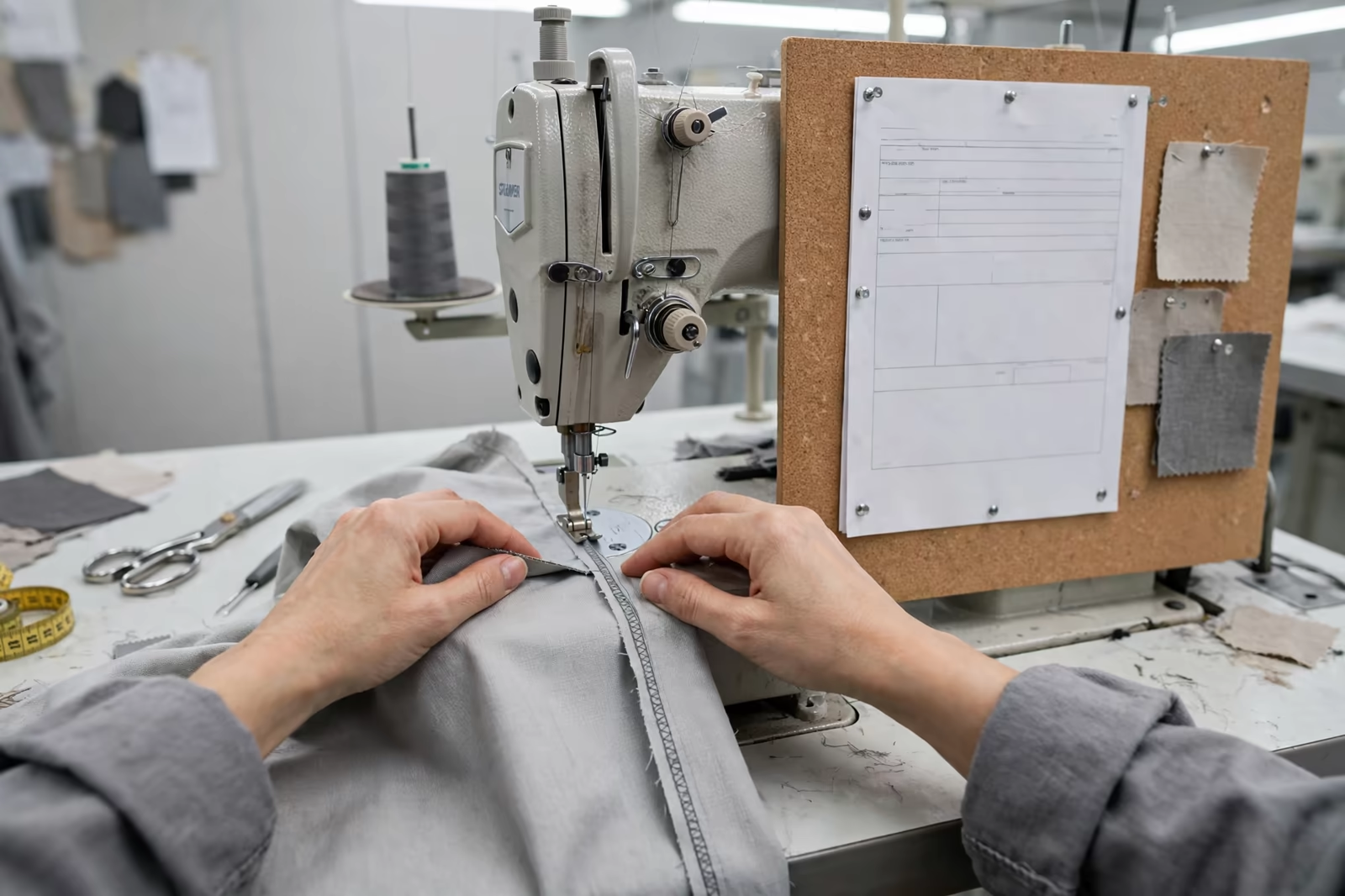
Inside the factory the pack travels. The merchandiser costs from it, since every line of the BOM and every construction note is money. The pattern master drafts or adapts from its drawings and chart. The sample room sews the first garment from it alone, deliberately, because the sample’s job is to expose the pack’s ambiguities while exposure is cheap. Production then runs against the approved sample plus the pack together, and quality inspectors measure finished garments back against its chart and tolerances.
Seen this way, a quote is a reading of your document: a precise pack earns a precise price, because the factory is costing known work; a vague pack earns either a padded price, the factory insuring itself against your ambiguities, or a low price that will be renegotiated by reality mid-production. The tech pack is not paperwork around the order. It is the order, in its most portable form.
How Much Detail Is Enough for a First Pack
Founders fear the pack must be enormous to be respected, and produce either nothing or a novel. The honest starter pack is short and complete: clean flats with the details dimensioned, a real measurement chart for the sizes you will sell, a BOM that names fabric properly, construction stated or explicitly defaulted to the factory standard, artwork at size with placements, and the label and packing page for your market. Five to eight disciplined pages beat forty loose ones, because the test is not weight; it is whether a stranger could sew from it.
Gaps are acceptable where they are declared. Writing “factory standard” beside a section is a specification; leaving the section out is a surprise. And the pack is a living document: every sample round corrects it, every approved change is written into it with a date, so that the pack the bulk is sewn from is the pack the final sample was approved against. Our own programs run at a standard minimum of 1,200 pieces per style in up to two colours, and at that scale the pack is the difference between a production run and a thousand-piece misunderstanding.
Versions: One Pack, One Truth
The most dangerous object in garment production is a second, slightly different version of the same document. The brand approves a change by message, the factory files it in a folder the sample room never opens, and bulk is sewn from last month’s truth. Tech packs therefore carry version discipline like software: a version number and date on every page, changes logged where they were made, superseded copies withdrawn rather than merely outnumbered.
The habit is cheap and the payoff is total. When a question arises mid-production, and one always does, both sides open the same version and argue about the garment instead of about which document is real. Brands that keep one truth in one pack discover that most factory misunderstandings were never misunderstandings at all; they were two honest teams sewing faithfully from two different pieces of paper.
Frequently Asked Questions
Can I order without a tech pack if I send a sample garment?
A reference sample helps enormously and many orders start from one, but the sample alone cannot carry measurements for unsampled sizes, fabric composition, tolerances or label content, and it cannot be in two places when the pattern room and the sewing line both need it. The workable route is sample plus a short pack built around it, which a good factory will help you assemble from the garment itself.
Who should write the tech pack, the brand or the factory?
The brand owns it, because it records the brand’s decisions; factories routinely help complete it, formalising their standard construction, tolerances and label requirements into the brand’s document. What matters is that one current version exists, both sides work from it, and changes are written into it rather than agreed in passing messages that the sewing line never sees.
Why did my quote change after I improved my tech pack?
Because the first quote was pricing your ambiguities. A detailed pack lets the factory cost the exact fabric, construction and trims you actually want; sometimes the price falls as padding for unknowns comes out, sometimes it rises as a requirement the vague version hid becomes visible. Either way the second number is the honest one, and it is far cheaper to meet it on paper than in bulk.
How detailed must the measurement chart be?
Detailed enough that an inspector can judge a finished garment from it alone: every point of measure that defines the fit, for every size you will sell, with the grading between sizes and a stated tolerance. If a measurement decides whether a customer keeps or returns the garment, it belongs on the chart; decorative precision on points nobody can feel is effort spent in the wrong place.