
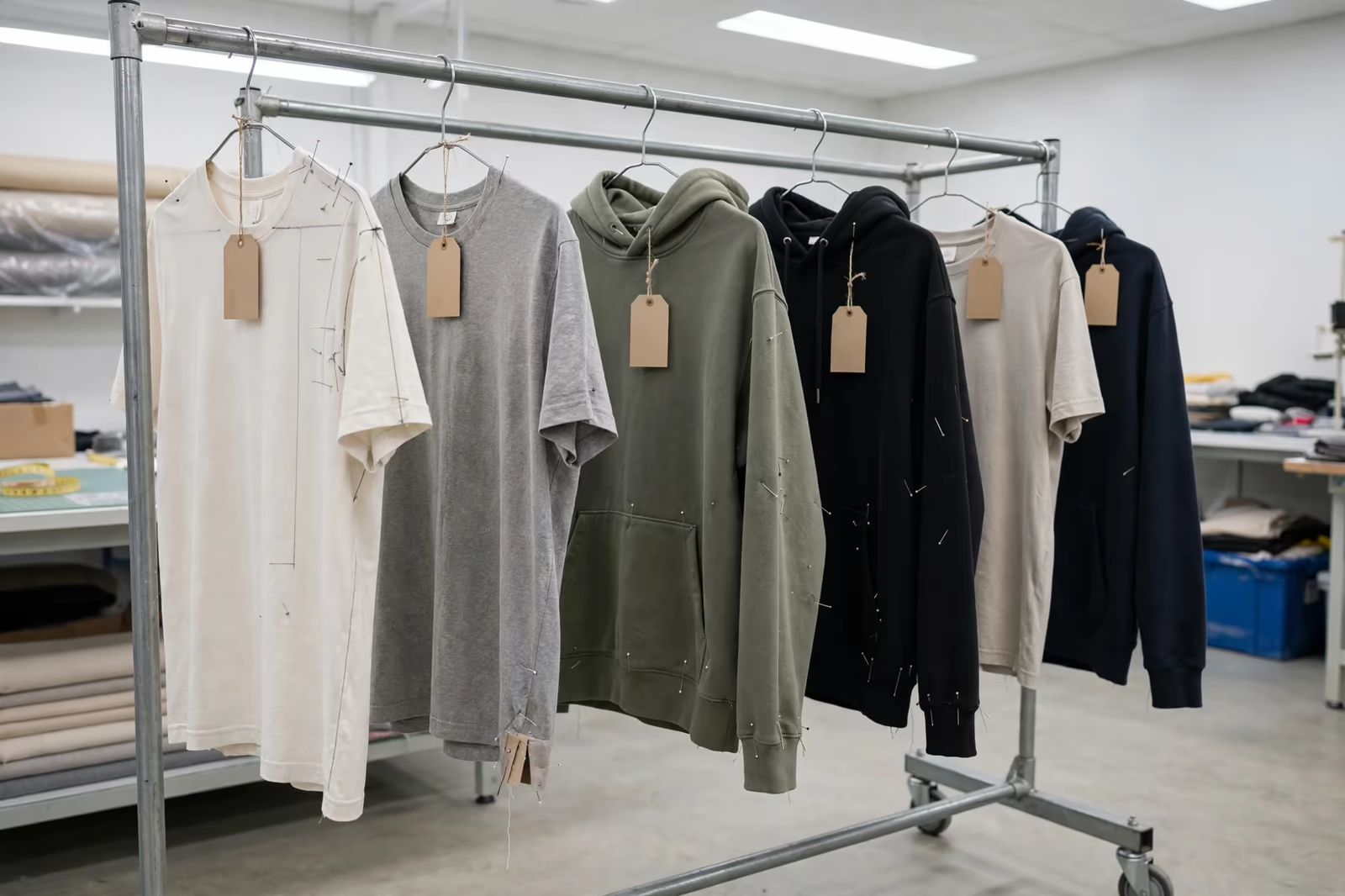
Between a brand’s idea and a container of finished garments stands a staircase nobody can skip: the samples. Each one exists to answer a different question, and the questions get more expensive as the stairs climb, which is precisely why the order matters. A change that costs an email at the first step costs a production run at the last, and the whole craft of sampling is moving every possible correction down the staircase, to where it is still cheap. Brands that understand the stages treat sampling as their highest-leverage spend; brands that rush it pay the same money later, with interest, in bulk.
The samples judged by these stages are sewn in Bangladesh for labels selling in France and the USA, and each gate keeps a weaker version out of those markets.
This guide walks the stages in order, from first proto to the pre-production sample that authorises bulk, in the context of our MOQ and production terms, the routes on the services page, and the quote that starts the whole staircase.
Stage Zero: The Brief Before Any Sewing
Sampling begins before fabric is cut, in the brief: the tech pack or its honest starter equivalent, the reference garment if one exists, the fabric chosen or the standard requested, the sizes to be sampled. Factories call the output of this stage the development package, and its quality decides everything downstream, because a sample room can only sew the garment it can read. Time spent here is not delay; it is the corrections being made at the one stage where they cost nothing but attention.
The brief also fixes the sampling plan itself: which stages this style genuinely needs, what each sample will be judged on, and who approves it on the brand’s side. A simple t-shirt in a standard fabric and an engineered jacket do not climb the same staircase, and agreeing the route in advance is how sampling stays a tool instead of becoming a toll.
The Proto: Does the Idea Work as a Garment
The first sewn sample, the proto, answers the crudest and most important question: does this design exist successfully in three dimensions. It is usually made in available fabric close to the final one, sometimes in a substitute of similar weight, because its subject is shape, not material. Fit, proportion, silhouette, the way a pocket sits, the way a collar behaves: the proto is where a drawing discovers whether it was honest.
Judge the proto on architecture and forgive it everything else. Colour will be wrong, fabric will be approximate, finishing will be sample-room rather than production standard, and none of that is the proto’s job. Brands that reject protos for their fabric waste the stage; the corrections to write down are the ones about the garment’s bones, because the next stages build on them and bones are expensive to move once muscle arrives.
The Fit Sample: The Garment on a Body
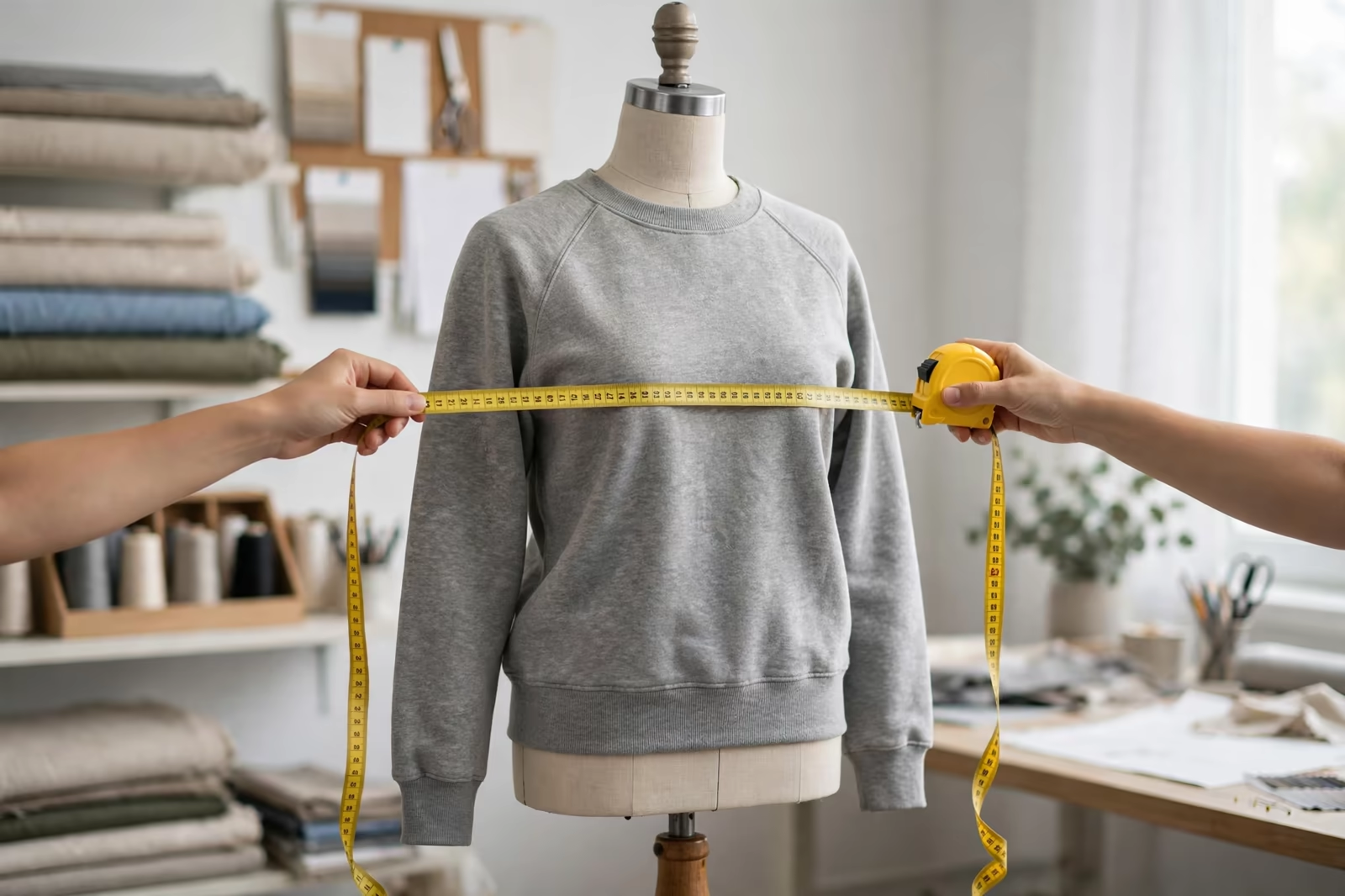
With the architecture settled, the fit sample is made to be worn, measured and moved in, ideally in the correct fabric or its nearest equal, in the size the brand fits on. This is where the size chart stops being arithmetic: the sample is measured against the chart point by point, worn by the fit model or the founder, sat in, reached in, washed once and measured again, because a garment’s true size is the one it keeps after water.
Fit corrections belong here and almost nowhere later, because they change the pattern, and the pattern is the factory the rest of the program is built from. Expect one to two fit rounds on a new style; a brand that needs five is not unlucky, it is changing its mind at pattern prices, and the honest fix is a firmer decision at the brief, not a faster sample room.
The Size Set: Grading Proved in Cloth
Once the base size fits, the size set samples the extremes of the range, the smallest and largest sizes and sometimes every size, to prove the grading: the rule by which the pattern grows. Grading errors hide in the base size and announce themselves at the edges, a neck that strangles the largest size, an armhole that swims on the smallest, so the size set is the stage that protects the customers a brand never fits on.
Not every program needs a full physical size set; experienced factories grade proven blocks with confidence, and digital checks carry part of the load. What is never optional is the brand knowing its grading rule and approving it, because the size chart’s promise to a size range of strangers is kept or broken by arithmetic done at this stage.
The Pre-Production Sample: Bulk, Rehearsed
The pre-production sample, the PP sample, is the summit of the staircase: the garment made exactly as bulk will be made, in the bulk fabric, with the bulk trims, labels and construction, from the final pattern, on production-representative machinery. Nothing about it is approximate, because its job is to be the standard: when it is approved, it is sealed, retained, and every carton of bulk will be judged against it.
Approving a PP sample is the most consequential signature in the program, and it should be slow. Check it against the tech pack line by line, measure it against the chart, wash it, wear it, photograph it beside the order’s requirements. Changes after PP approval are no longer sampling; they are renegotiating a production run, priced and scheduled accordingly. Our programs run at a standard minimum of 1,200 pieces per style in up to two colours, and at that scale the PP sample is the cheapest insurance the brand will ever buy.
Strike-Offs and Lab Dips: The Parallel Tracks
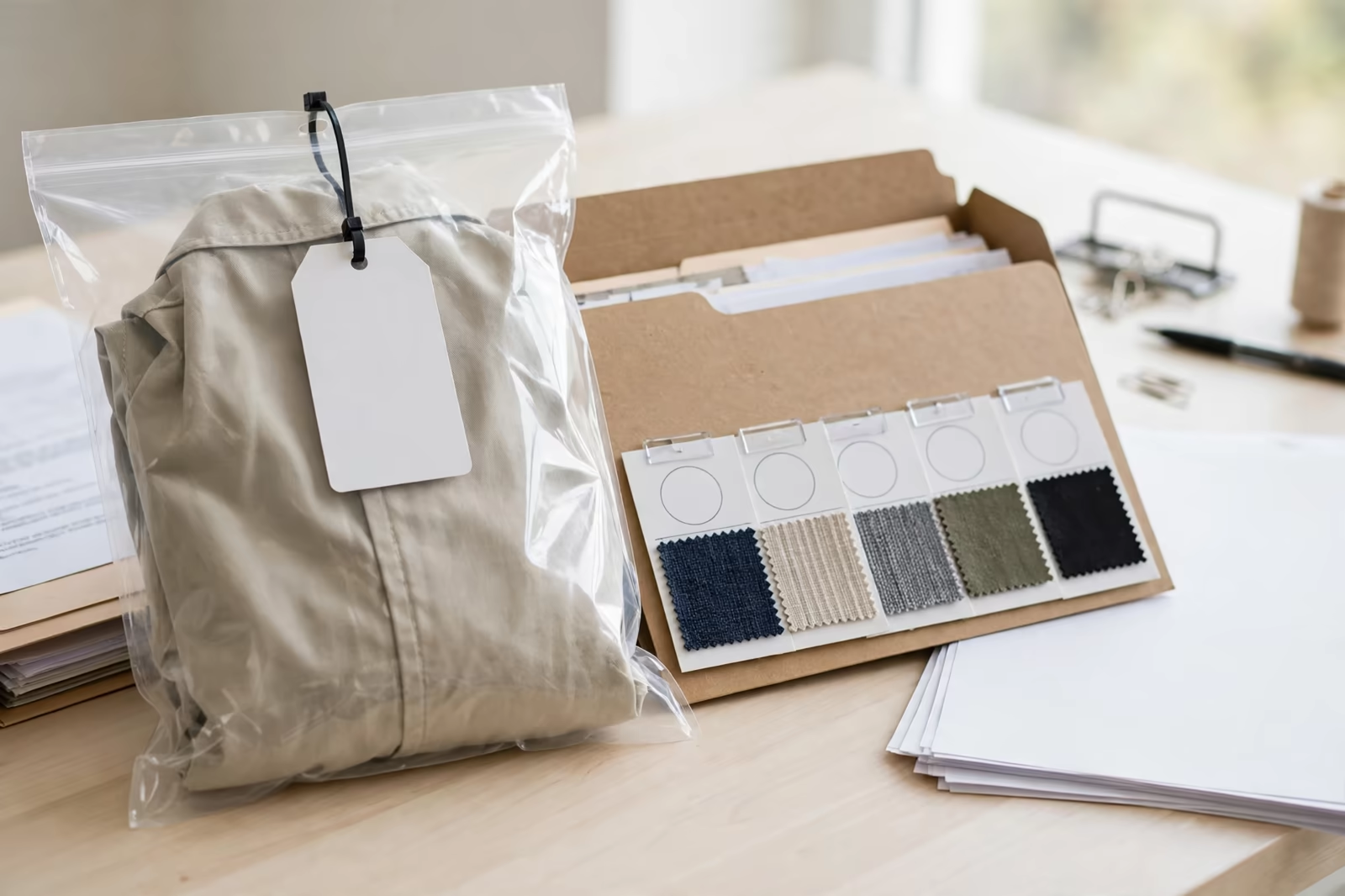
Running beside the garment stages are the approval tracks for colour and decoration. Lab dips are swatches of the fabric dyed to the required colour, submitted until the shade is approved under standard light; strike-offs are test prints of the artwork at true size on the true fabric, approved for colour, size and hand-feel before any screen meets a garment. Embroidery has its own equivalent, the sew-out, a stitched proof of the digitised design.
These tracks exist because colour and decoration fail differently from fit: silently, at scale, in perfect garments of the wrong shade. Approving them as physical objects, kept on file beside the PP sample, is what turns “the blue we discussed” into a standard a dye house and a print room can both be held to, on this order and every reorder.
What Each Round Costs and Why
Sampling charges puzzle new brands until the work is itemised: pattern time, sample-room sewing at single-piece rates, fabric bought at sample quantities, courier costs for physical approvals. A sample garment legitimately costs several times the bulk unit price to produce, because everything bulk production spreads across a run, the sample carries alone. Some factories credit sampling against the first bulk order, some charge it plainly; both are respectable, and the term belongs in the quote conversation, not the invoice surprise conversation.
The economics that matter are comparative. A full sampling program for a style, every stage climbed properly, costs less than one percent of what a wrong bulk run costs in markdowns, remakes and air freight. Sampling is not a fee factories charge before the real work; sampling is the real work, done at the only scale where mistakes are still affordable.
How Many Rounds Is Normal
Honest expectations keep sampling relationships healthy. A straightforward style in a known fabric: a proto or two, one fit round, a PP sample, roughly six to ten weeks of calendar depending on couriers and the brand’s own approval speed. A complex or engineered style: more rounds, worn patiently. The variable that most often stretches the calendar is not the factory’s sewing speed but the brand’s decision speed, samples waiting on desks for the approval only one person can give.
Two warning signs deserve naming. Endless rounds with no convergence usually mean the brief is changing, not the sample failing, and the cure is a decision, not another sample. And a program with suspiciously few rounds, PP approved from photographs of a proto, is not efficiency; it is risk being transferred quietly to the bulk, where it will introduce itself at scale.
Keeping the Standards: Sealed Samples and Files
Every approved stage leaves an artefact: the sealed PP sample, the approved lab dip and strike-off, the final tech pack version, the retained measurement records. Together they are the program’s memory, and they must live somewhere safer than a courier bag: photographed, filed, one set with the brand, one with the factory. Reorders are produced from this file, disputes are settled from it, and a second factory, if one is ever needed, can reproduce the garment from it.
This is also why approvals should be written and dated against the sample’s identity, not given as a message thread’s general enthusiasm. The sample you approved is a specific physical object; the file should say which one, when, and by whom. Factories respect brands that run their approvals this way, because it protects both sides from the most corrosive sentence in manufacturing: I thought you meant the other one.
Approving From a Distance: Couriers and Photographs
Most brand-factory sampling happens across an ocean, so the stages run on couriers and cameras. Build both into the plan: sample dispatch days agreed, tracking shared, and every sample photographed by the factory, on a body or stand and flat with a tape across the key measures, before it ships, so the brand can spot a hopeless round before paying freight on it. Photographs pre-approve; they never finally approve, because fabric hand-feel, true colour and fit live in the physical object.
The receiving discipline matters as much: measure and judge every sample within days of arrival, against the tech pack and the chart, and return comments as one consolidated list per round, not a drip of messages across a week. Sample rooms work on consolidated corrections; a round answered in fragments is a round paid for twice, once in sewing and once in the calendar.
Frequently Asked Questions
Can I skip the proto and go straight to a PP sample?
Only when almost nothing is new: a proven style, a known fabric, an existing pattern with a track record. The stages exist because each answers a question the next stage assumes settled; skipping the proto on a genuinely new design does not remove its questions, it moves them to the PP stage where the fabric is bulk fabric and the corrections cost production money. Skipping is a decision for repeat styles, not for first ones.
How long does the full sampling process take?
For a straightforward style, roughly six to ten weeks from brief to approved PP sample, including courier time and the brand’s own approval rounds; engineered styles take longer. The largest variable is decision speed on the brand’s side. Factories quote sampling calendars against their sample-room load, so ask for the stage dates with the quote and hold both sides, yourself included, to them.
Do I pay for samples, and are they refunded?
Expect to pay: a sample consumes pattern time, single-piece sewing and sample-quantity fabric, and legitimately costs several times the bulk unit price. Some factories credit sampling fees against the first bulk order, others do not; both models are normal. What matters is that the sampling terms, cost, credit and courier, are agreed with the quote, before the first proto is cut.
What happens to my approved samples after bulk ships?
They become your reorder standard. The sealed PP sample, approvals and final tech pack are retained, one set by the factory and one by you, and the next order is produced and inspected against them. Guard your set: it is the physical proof of your garment’s standard, and replacing it means re-approving from scratch, at sampling prices, on a style you already own.