
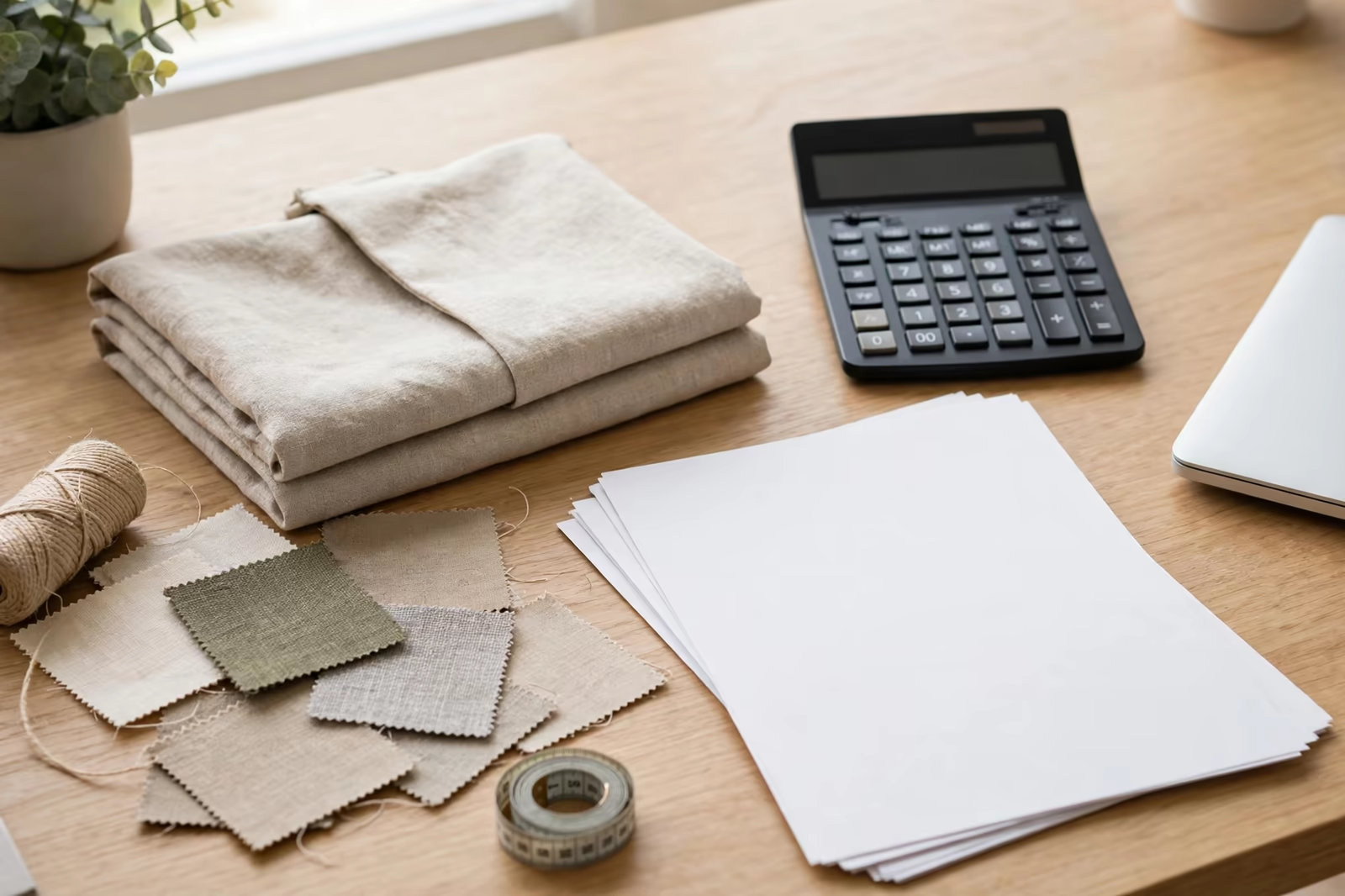
Ask the internet what it costs to start a clothing line and it will answer with a number, usually a round one, usually useless. The honest answer is a stack, not a figure: a column of separate costs, each knowable, each controllable, whose total depends on decisions only the founder can make. One garment or five, heavy fabric or light, printed or plain, sold from a spare room or a photographed studio. This guide itemises the stack in the order the bills actually arrive, so a first budget can be built from real components instead of borrowed averages.
It follows the route our brands programs run for new labels, with the money side read alongside our payment terms and the quote request where the largest line in the stack gets its real number.
Development Costs: Patterns, Samples and Patience
The first money leaves before a single sellable garment exists. Pattern work, sampling rounds, lab dips and strike-offs, courier charges flying samples across the world: development is the cost of turning an idea into a garment that can be repeated. Each style carries its own development bill, which is why the number of styles in a first range multiplies this section faster than any other.
Founders routinely underbudget development because the amounts feel small next to production, then discover that three styles sampled through four rounds each is a real line of spending, paid early, when the business has no revenue to soften it. The discipline is not to skip development, which only moves its cost into bulk errors, but to count it per style and let that count argue for a smaller, better first range.
The Production Order: The Largest Line
Bulk production is the stack’s centre of gravity: fabric, trims, cutting, sewing, finishing and packing for the full order quantity, priced per garment from the specification. Our own programs run at a standard minimum of 1,200 pieces per style in up to two colours, and that minimum is what converts a design into a production run with honest per-piece pricing. Multiply the quoted unit price by the quantity and you have the number the whole budget leans on.
What moves this line is specification, not haggling: fabric weight and composition, construction complexity, decoration count, size range width. A founder who needs the production line smaller should reach for those levers, a simpler finish, one colour instead of two, rather than pressuring the rate itself; a squeezed rate returns as squeezed quality, while a simplified specification returns as the same garment, honestly made, at a lower price.
Labels, Tags and Packaging: The Brand Layer
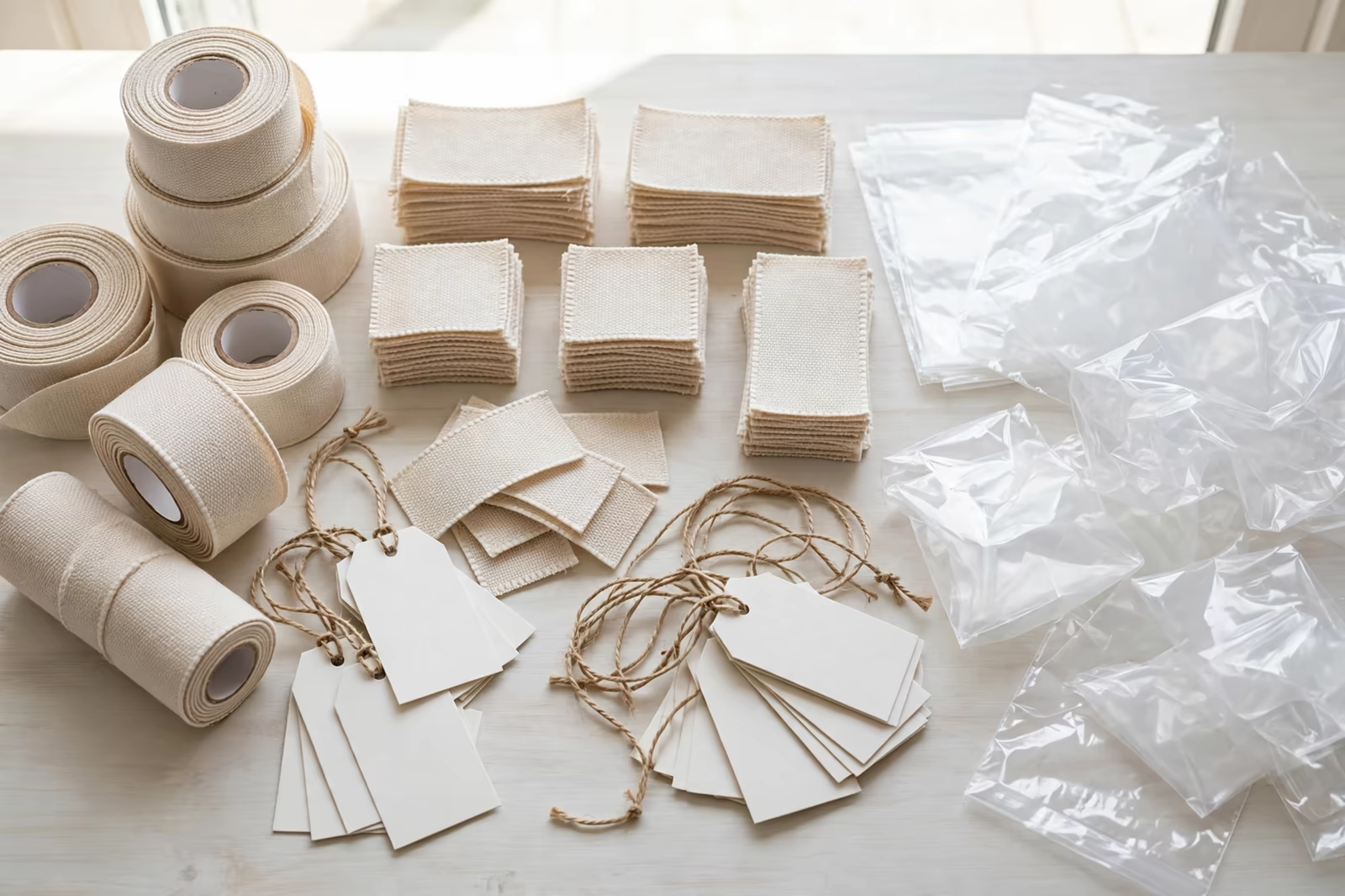
Woven labels, printed size and care labels, hangtags, polybags, tissue, stickers, cartons: the branding layer is bought per piece and per design, with its own small production runs and minimums. Individually cheap, collectively real, and always underestimated because nobody dreams of founding a brand in order to buy a hundred thousand woven labels, which is nevertheless what a label minimum can look like across a range.
This layer also carries timelines: labels and tags are manufactured items with lead times of their own, ordered late they delay finished garments, ordered wrong they cannot be unpicked cheaply. Budget them with the production order, not after it, and keep the designs stable across seasons; the cheapest label is the one whose remaining stock still matches next year’s garments.

Freight, Duty and Tax: The Border Crossing
Garments made in Bangladesh and sold in the USA, the UK, Europe, Canada or Australia cross borders, and borders charge. Sea freight or air freight, insurance, customs brokerage, import duty at the garment category’s rate, and the destination’s sales tax mechanics together form a line that first-time importers consistently estimate at half its true size, because the factory price feels like the cost and the border feels like an errand.
It is neither optional nor negotiable, only plannable: the freight mode chosen against the launch date, the duty rate confirmed against the exact garment classification before the order is placed, not after it lands. A budget built without this line is not optimistic; it is unfinished. Experienced importers cost the garment landed, at their own door, and judge every earlier line against that final figure.
Selling Costs: Photography, Shop and Marketing
Production delivers cartons; selling turns them into revenue, and selling has its own stack. Product photography, a web shop’s build and fees, payment processing percentages, packaging for dispatch, returns handling, and the marketing that makes a stranger care: none of it appears in a factory quote and all of it appears in the bank account. New brands chronically fund production to the last coin and leave selling to hope.
The proportion matters more than the items. A first range that consumes the entire budget in stock leaves nothing to tell anyone the stock exists, which is how good garments die quietly in spare rooms. Seasoned founders hold a deliberate share back for selling, sized before the production quantity is fixed, because the order quantity itself should be set by what the selling budget can honestly move.
Business Costs: The Quiet Foundation
Underneath everything sits the business itself: company formation, trademark search and registration for the brand name in its markets, bookkeeping, banking, insurance, a domain and an email address that does not end in a free provider. Small numbers, mostly, but they arrive first and repeat annually, and the trademark line in particular protects the name printed on every label the brand will ever sew.
None of this is glamorous and all of it is load-bearing. A brand is a legal and financial object before it is a creative one, and the founders who treat the foundation as part of the launch budget, rather than an annoyance around it, are the ones still trading when the second collection needs funding.
Working Capital: The Gap Between Paying and Being Paid
The stack so far is a list of costs; working capital is about their timing. Production is paid for on the manufacturer’s terms, freight on shipment, duty on arrival, while the customer’s money arrives garment by garment over a season. The gap between the last big payment out and the revenue catching up is bridged by cash the founder must hold in reserve, and underestimating that reserve is how profitable first ranges still run out of money.
This is why honest budgets are drawn as a calendar, not a column: when each line falls due against when sales realistically land. The total may look manageable while the sequence is impossible, a distinction invisible until the month the freight bill and the second production deposit arrive together.
Where Founders Overspend, and Where They Starve
Patterns repeat across first ranges. Overspending gathers at the visible edges: too many styles, too many colours per style, premium decoration on an unproven product, air freight bought to rescue a late decision. Each feels like ambition; each converts directly into stock that must be sold to recover it. Starving gathers at the invisible centre: sampling cut short, photography done badly, no reserve for reorders of the style that actually sells.
The reorder point deserves emphasis. A first range’s real success is a style that sells through, and capturing that success means funding a second production run while the first is still selling. Budgets that spend everything on launch have nothing for the moment the business first proves it works, which is the most expensive moment to be empty-handed.
Building Your Number From a Real Quote
Assembled, the method is simple to say and rare to see: fix the first product and its specification, take development per style, production at the manufacturer’s minimum, the brand layer, landed costs to your door, a selling budget with a deliberate share, the business foundation, and a working capital reserve across the calendar. Every line estimated from a document, a rate or a quote, none of them from an article’s round number.
The single largest unknown, the production line, becomes a fact the moment a manufacturer quotes your actual specification, which is why the quote request is not the end of budgeting but its foundation stone. Send the specification, receive the number, and the rest of the stack can be built around something real.
The Shape of a One-Style Budget
To see the stack stand up, picture the smallest serious launch: one style, one fabric, two colours, sold online into one market. Its budget has a development block measured in samples and couriers; a production block that outweighs everything else combined; a brand layer of labels, tags and bags bought once and used across seasons; a landed block of freight and duty that follows the production block like a shadow at a fixed proportion; a selling block the founder sizes by ambition; and a reserve, sitting deliberately unspent, waiting for the reorder.
Notice what the picture teaches: production dominates, but the smaller blocks decide whether the production block ever returns its money. Development decides whether the garment is right, the border block decides what it truly cost, the selling block decides whether anyone knows it exists. Founders who see the whole shape stop asking for the number and start building their own, which is the moment a clothing line becomes a business plan instead of a wish with a logo.
Frequently Asked Questions
What is the minimum budget to start a clothing line?
There is no universal minimum, because the floor is set by arithmetic, not opinion: one style’s development, one production run at the manufacturer’s minimum, 1,200 pieces per style in our programs, plus labels, freight, duty and selling costs. A single-product launch in a simple garment is the cheapest honest shape; every added style and colour raises the floor by its own development and production minimums.
Which cost surprises first-time founders most?
The border. Freight, duty and brokerage together regularly arrive at roughly double the first-time importer’s guess, because the factory price feels like the full cost. The second surprise is timing: working capital, the gap between paying for production and being paid by customers, breaks more young brands than any single line in the budget itself.
Should I spend more on product or on marketing?
On the product first, because marketing cannot rescue a garment customers return, but not on the product only. The working rule is a deliberate split decided before quantities are fixed: production sized to what the selling budget can move, a reserve held for reorders, and marketing funded as a real line rather than whatever is left. Ranges fail from either extreme, invisible stock and unsellable stock alike.
Can I start with less by ordering fewer pieces?
Below a manufacturer’s production minimum, the garment stops being a production run and becomes sample-room work at sample-room prices, which raises the unit cost until the retail maths breaks. The honest way to start smaller is fewer styles and colours at a real minimum, not fewer pieces of many styles. One product at a proper quantity is a business; five products below minimum are an expensive hobby.