
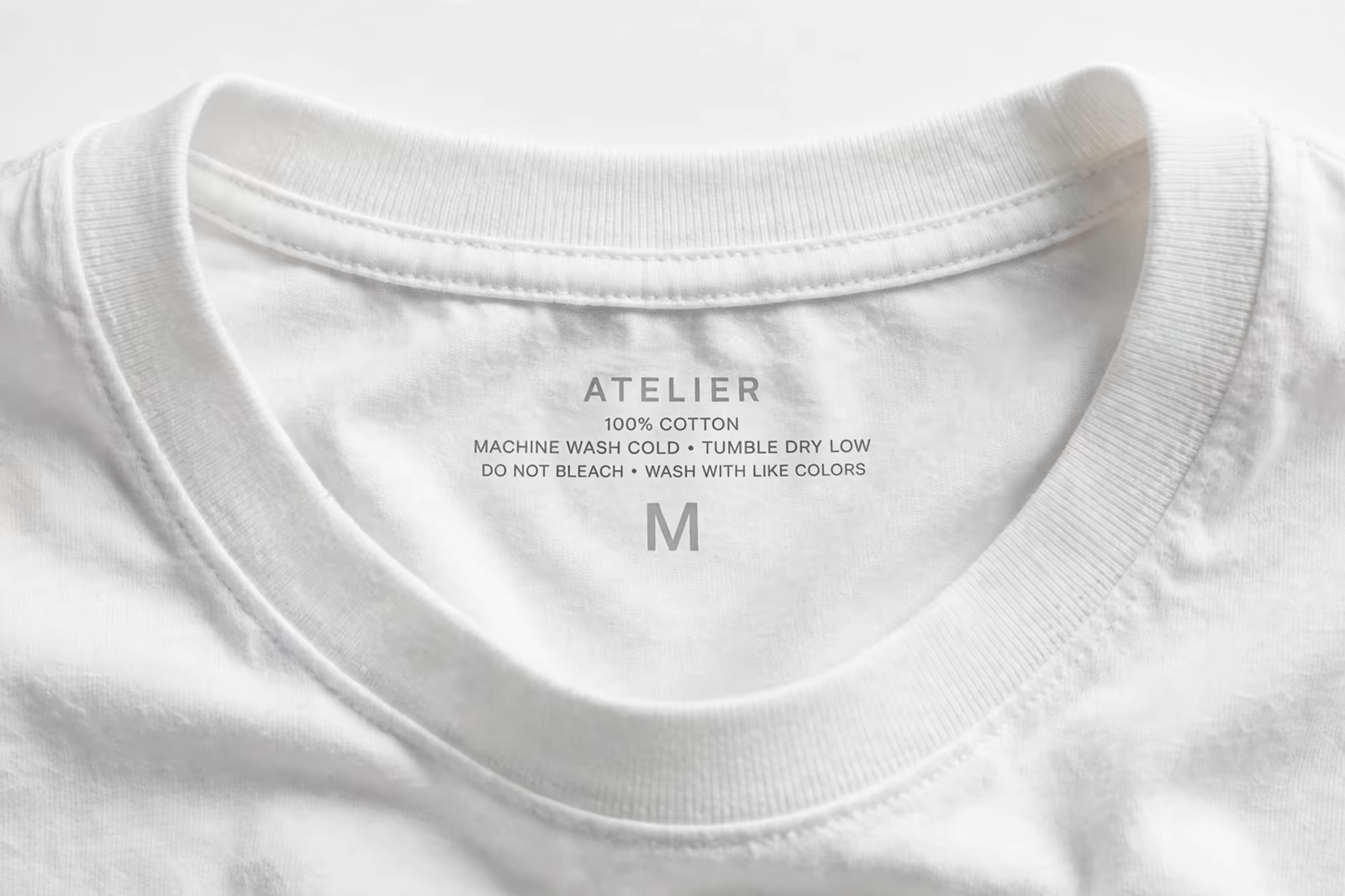
Turn a well-made t-shirt inside out at the collar and the cheapest detail in the garment is doing the loudest branding work: the inside neck print carrying the logo, the size and the care line, with no sewn label to scratch, flip or cheapen the neckline. Printed neck labels and tagless branding have become the default finish for retail and merch programs, and doing them well is a small discipline of its own.
Tagless neck prints are applied in Bangladesh for brands selling in Germany, Canada and the United States, replacing sewn labels with a soft print that carries the brand and the size.
This guide covers how neck printing works inside our screen printing production, why brands choose it for garments such as the classic crew-neck t-shirt, and the details that keep a tiny print legible through the garment’s life.
Why Brands Print the Label Instead of Sewing It
The sewn label carries three burdens a print does not. It itches, which customers remember longer than they remember the garment’s quality. It adds operations: labels to buy, stock, sew and inspect, each with its own minimums and lead times, multiplied by every size in the range. And on lightweight or fashion garments a woven label can show through, pucker the collar seam or flip outward in wear, advertising the inside of the garment to everyone but its owner.
A printed label removes all three. Nothing touches the skin but ink laid flat into the fabric, sizes change at the screen rather than in a label inventory, and the branding sits exactly where the designer put it, in the brand’s own typeface and colours. For private label programs the advantage compounds: one blank garment becomes any customer’s brand at the printing stage, with no label stock tying the production to a single buyer.
What Goes Into an Inside Neck Print
A complete neck print is a small act of information design. The essentials are the brand name or logo, the size, the fibre content, the care instructions and the country of origin, arranged in a hierarchy the wearer can read at a glance and the brand is proud to show. Retail programs add their registered marks; merch programs often keep it to logo, size and a short care line.
The discipline is completeness at small scale. Every legally required element for the destination market must be present, which makes the neck print a compliance surface as well as a branding one, and the time to confirm its content is at artwork stage, with the market’s rules in hand, rather than at final inspection with cartons open. A one-line omission discovered late costs a reprint of the smallest print on the garment and the largest delay in the program.
Ink and Print Method for Neck Labels
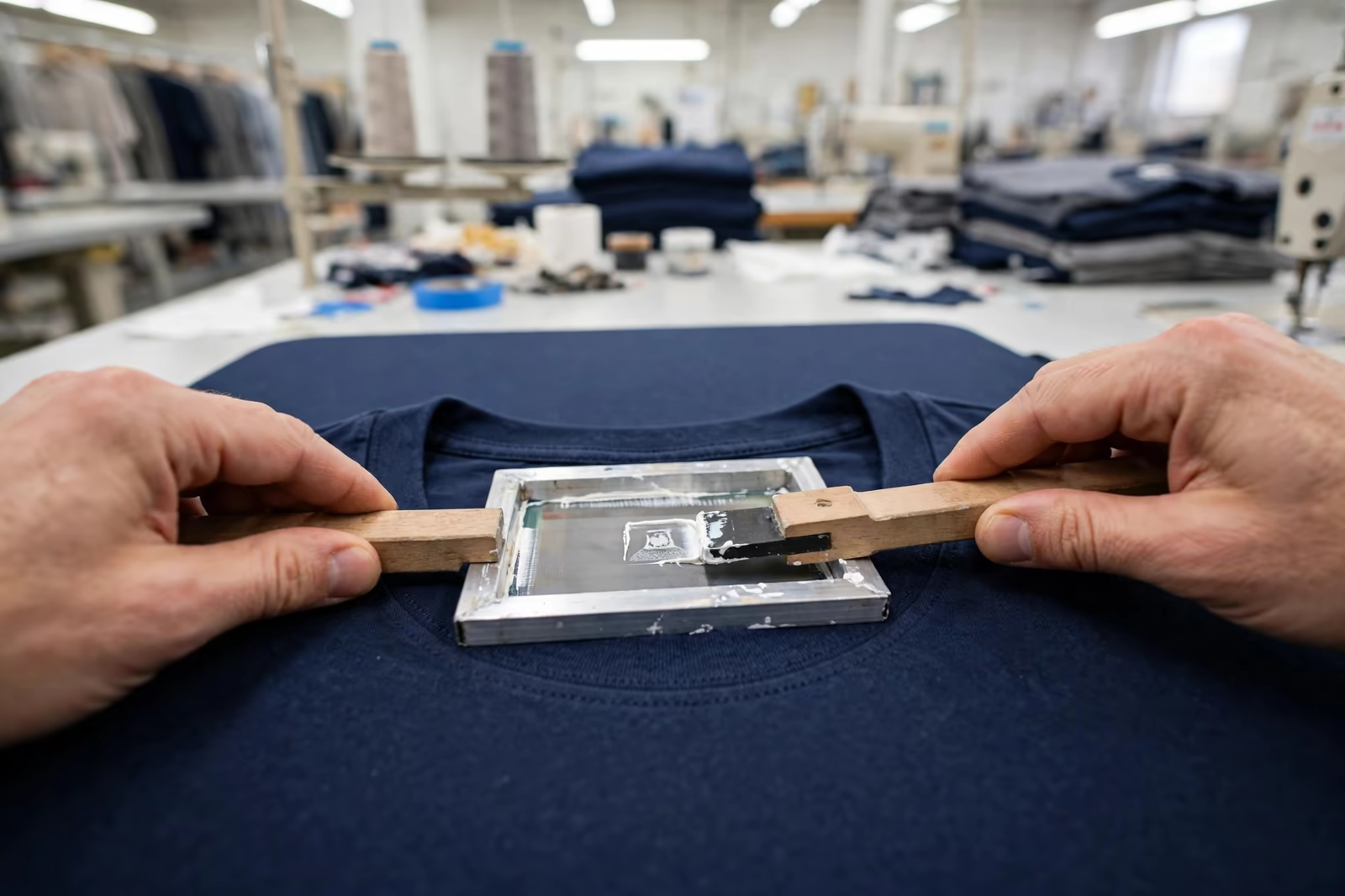
Neck prints are usually screen printed with the same systems as the garment’s main print, in a colour chosen to read against the fabric: light grey or white on dark garments, charcoal or black on light ones, always a step removed from the garment colour so the text stays legible without shouting. Water-based inks suit the job well because they leave almost no feel against the neck, the one place a wearer notices print texture all day.
The print itself is a single small screen, quick to run while the garment is already on the table or press for its main design. Placement prints through the open collar area onto the inside back neck, positioned to sit centred below the collar seam, clear of the shoulder tape and the size region the wearer’s eye expects. Factories running neck prints at volume treat the little screen with the same registration discipline as the front design, because a crooked label is visible every time the garment is hung, folded or worn.
Sizes: One Design, Every Size in the Range
The size mark is the neck print’s working part, and it is where the system’s flexibility shows. Each size is its own tiny artwork, and the printer swaps the size screen, or masks a combined screen, as the run moves through the size curve. The control that matters is matching: the printed size must be the garment’s true size, checked as sizes change on the line, because a mislabelled size is a defect no quality of printing can soften.
Programs with long size ranges, kids’ wear and unisex programs above all, benefit most, since a sewn-label system would need stock and sewing for every size while the printed system needs only the artwork set. The buyer’s part is to confirm the size list and its marks early: whether sizes print as letters, numbers or both, and exactly how each should read, because corrections after the screens are made cost a day the calendar rarely has spare.
Legibility for Life: A Print That Survives the Wash
A neck print lives a harder life than a chest design. It sits against skin, sweat and collar ribbing, gets folded at the same crease in every wash, and is read at the exact moment a customer decides whether the garment feels well made. Fine type that prints beautifully on day one can fade into a grey suggestion by the twentieth wash if the ink film is too thin or the cure was casual.
The defences are plain craftsmanship: type sized to survive, ink laid with enough body to read after washing, and curing verified rather than assumed, because a neck print is printed, cured and checked like any other print on the garment. Wash testing on the strike-off, read after washing rather than before, is the honest approval point, and buyers should ask to see the washed label, not only the fresh one.
Compliance Content: What Each Market Requires
The neck print is where the garment’s legal identity lives, and the requirements differ by destination. The European Union expects fibre composition and care information in line with its textile rules; the United States requires fibre content, country of origin and the responsible company’s identification; other markets carry their own lists. A private label program shipping to several markets designs the print around the strictest of them, or prints market variants.
Our part is to print exactly the approved content, in the approved order and wording; the buyer’s part is to supply that content confirmed for their markets before the screens are made. Neither side should improvise a care line. The standard is simple: the neck print content arrives as finished artwork from the brand, checked against its own compliance advice, and any change after approval restarts the artwork round rather than being pencilled onto a packing list.
Neck Prints Versus Sewn Labels: The Honest Cost Picture
Printed labels remove real costs: no woven labels to design, weave, ship and stock in every size, no sewing operation per garment, and no label inventory left over when a program ends or a size curve changes. Against that stand the print’s own costs: a screen per size, a print pass per garment, and the artwork discipline small type demands. On most programs the print wins comfortably, and it wins again every time the label content changes, because a screen is remade in hours while woven stock is remade in weeks.
The cases where sewn labels still earn their place are honest ones: garments where a woven label is part of the design language, heavy workwear whose buyers expect a sewn mark, or fabrics whose surface prints poorly. A good factory names those cases rather than selling the print as universal, and many programs run both, a printed neck with a small woven hem tag carrying the brand where the hand can find it.
Artwork Rules for Tiny Prints
Small type obeys strict physics. Letters need a minimum size and stroke weight to hold on fabric and survive washing; condensed faces and hairline fonts that look elegant on a website dissolve at neck-print scale. The working approach is a clean sans or a sturdy brand typeface, set at a size the printer confirms it can hold, with the hierarchy carried by weight and spacing rather than by shrinking everything that is not the logo.
Artwork arrives as vector files with the text converted and checked at true print size, printed out on paper at one hundred percent and read at arm’s length before any screen is made. That paper proof catches most failures for pennies: the care line that is technically present and practically invisible, the size mark the eye skips, the registered symbol too small to resolve. What survives paper usually survives the wash.
Specifying a Neck Print Program
A complete specification is short: the label artwork per size, the print colour per garment colour, the placement measured from the collar seam, and the markets the content must satisfy. Quantities follow our standard minimum of 1,200 pieces per style in up to two colours, with neck printing included in the garment’s print program rather than priced as an afterthought discovered at packing.
Approve the neck print as its own strike-off, washed and read, before bulk begins, and file it beside the main design approval. It is the smallest print on the garment and the one a customer reads most often, every time the garment is taken off a hanger. Programs that give it thirty minutes of specification care at the start never spend days on it at the end.
Heat Transfer Labels: The Other Tagless Route
Neck printing by screen is not the only tagless route. Heat transfer labels print the same information onto a carrier film and apply it with heat and pressure, giving crisp edges and very fine type on smooth fabrics, which is why performance sportswear, with its technical surfaces, often carries transfers rather than direct prints. The application is fast, the finish is flat, and multi-colour marks print without extra screens.
The honest comparison sits in wear and hand feel. A transfer is a film sitting on the surface, and on garments washed hot and often it can crack or lift at the edges if the application temperature, pressure or dwell time was off; a screen print sits in the fabric and ages with it. Neither is universally better. The garment’s fabric, wash life and brand finish decide, and sampling both on the real garment is a short test that settles what brochures argue about.
Frequently Asked Questions
Does a printed neck label last as long as a sewn one?
Printed with enough ink body and cured properly, a neck print stays legible through the garment’s working life, and wash testing on the strike-off proves it before bulk. A thin, under-cured print fades early, which is a workmanship issue rather than a method issue, and exactly what the washed approval sample exists to catch.
What information must a printed neck label carry?
Typically the brand, size, fibre content, care instructions and country of origin, but the exact list follows the destination market’s labelling rules, with the European Union and the United States each setting their own requirements. The content is supplied as finished, compliance-checked artwork by the brand before screens are made.
Can every size share one neck print screen?
The design is one, but the size mark changes per size, so printers either swap a small size screen as the run moves through the size curve or mask a combined screen. The control that matters is matching the printed size to the garment’s true size at every changeover on the line.
Is neck printing cheaper than sewing in woven labels?
On most programs, yes: it removes label weaving, shipping, stocking and sewing, and content changes cost a screen remake rather than new woven stock. Sewn labels still suit some designs and heavy garments. Many brands combine both, a printed neck label with a small woven hem tag.