
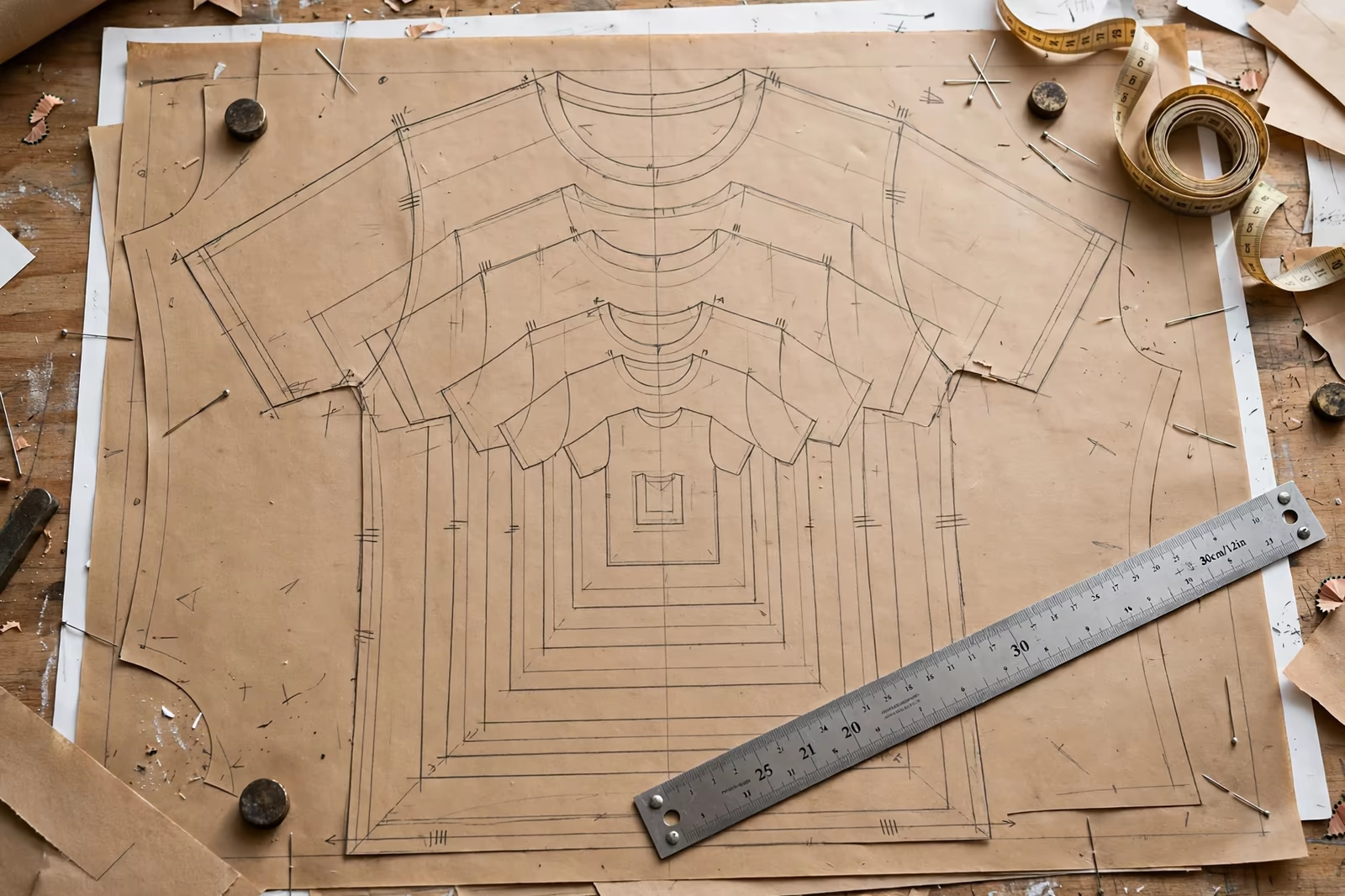
Almost every garment a brand sells exists in one size first: the sample size, fitted, argued over and approved. Every other size its customers will ever wear is not fitted at all. It is calculated, by the grading rules, the increments that grow and shrink the approved pattern into a full range. Grading is the quiet mathematics standing between one good sample and ten thousand good garments, and brands that understand it specify it, check it and own it; brands that ignore it discover its importance at the extremes of their size range, where their most loyal customers live.
The grades built from these rules are cut in Bangladesh for size ranges sold in Australia and the Middle East, where one style has to fit very different bodies honestly.
This guide explains how grading works, where it goes wrong and what to agree with your manufacturer, in the context of our MOQ and production terms, the pattern work inside our services, and the questions buyers raise through contact.
What Grading Actually Is
Grading is the systematic resizing of a pattern: each point of the approved base-size pattern is moved by set increments to create the neighbouring sizes, which are moved again for the next, building the full range from one approved truth. Chest, waist, length, sleeve, shoulder, neck: every dimension has its increment, and the collection of increments for a garment type is its grade rule.
The base size matters because everything derives from it. It is usually a middle size of the range, fitted on the brand’s fit model or stand, and its pattern carries the design’s proportions. Grading does not redesign the garment for each size; it scales the approved design by rules chosen to keep its proportions honest on different bodies, which is a subtler job than it sounds. Every size in the range is, in effect, a separate promise made from the same cloth of decisions, and grading is where those promises are either kept consistently or broken quietly at the edges.
Increments: The Numbers That Grow a Garment
A typical grade moves the chest by a fixed step between sizes, the length by a smaller one, the sleeve by its own proportion, because bodies do not grow uniformly: a customer two sizes up is wider by more than they are longer. Grade rules encode those relationships per garment type. A t-shirt’s grade differs from a tailored shirt’s, which differs again from trousers, where rise, waist and leg length each follow their own logic.
The numbers are conventional rather than sacred, refined by each market’s sizing culture: the step between sizes in one country’s high street differs measurably from another’s. This is why a brand selling into the USA, the UK and Europe with one grade rule should know it is a compromise, and why established brands keep market-specific charts where volumes justify them.
Why Bodies Are Not Photocopies
The central difficulty of grading is that a larger body is not a scaled photograph of a smaller one. Posture, proportion and the distribution of size change with the body itself: armholes need different treatment from hems, necklines widen differently from shoulders, and a grade that simply enlarges everything produces the familiar failures, the big size with a cavernous neck, the small size with a strangled armhole.
Good grade rules therefore move pattern points by different amounts in different directions, and protect certain dimensions entirely: a pocket’s size, a collar’s depth, a cuff’s width often grade barely or not at all, because they serve hands and functions that do not scale with chest size. This judgement, which points move and which stay, is the pattern master’s craft inside the mathematics.
Where Grading Goes Wrong
Grading failures announce themselves at the ends of the range, because errors compound with distance from the base. The extra-small swims where the grade shrank a dimension bodies do not shrink; the largest size pulls across the chest because the increment was borrowed from a different garment type. Between them sits the approved middle, perfect, concealing the problem from every fitting the brand actually held.
The second classic failure is the copied grade: rules taken from a competitor’s chart, a downloaded table or a different product entirely, applied to a pattern they were never written for. Grades and patterns are married; a rule is only true for the base it was derived from. The third failure is silent drift, a grade adjusted casually during a reorder until the range no longer matches its own size chart.
The Size Chart Is the Grade, Published
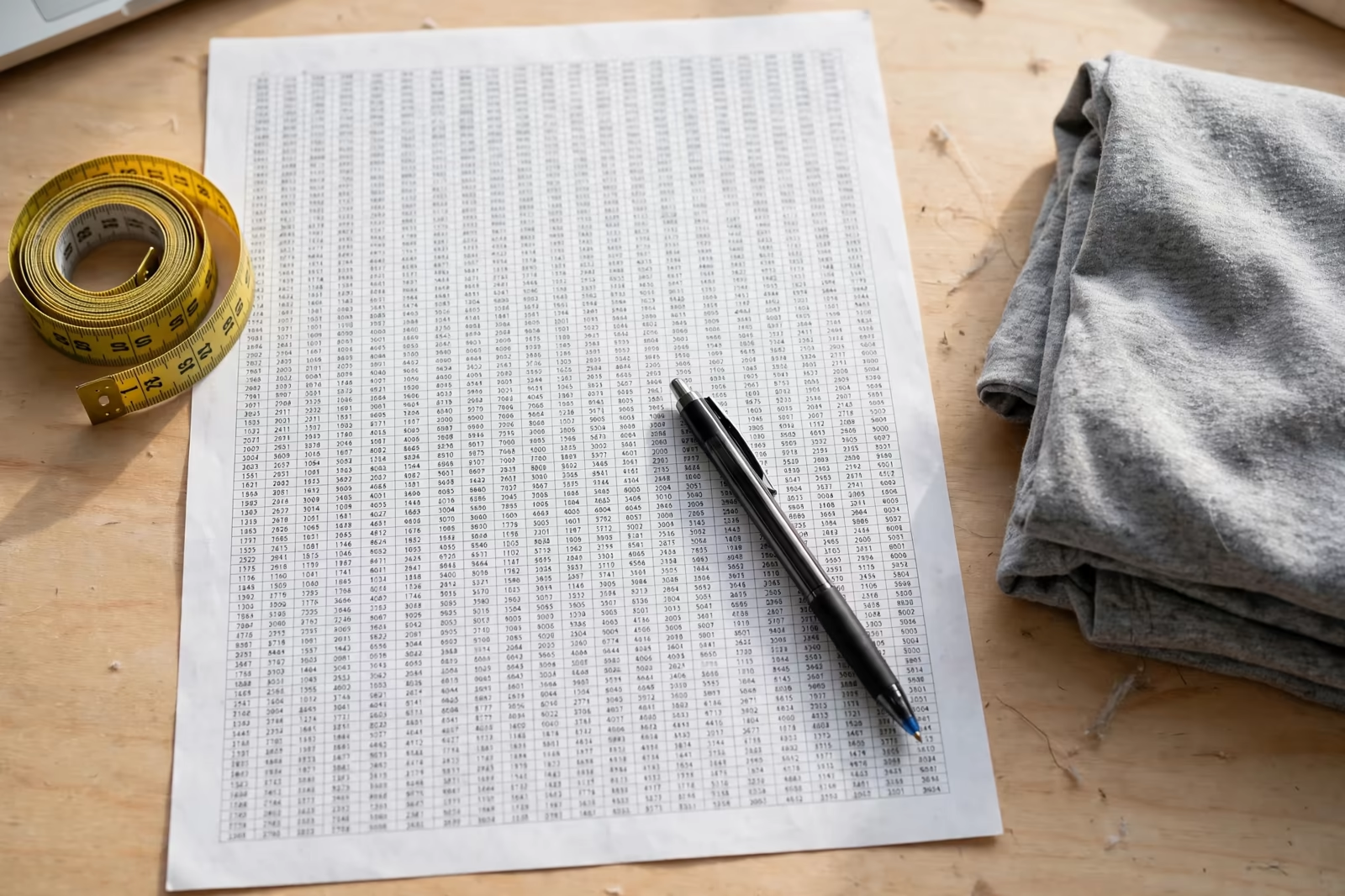
A brand’s size chart is simply its grade rule made public: the finished measurements of every size, which should equal the base measurements plus the increments, size by size. This gives brands a verification tool of real power: request the full chart, add the grade to the base yourself, and any size whose numbers break the rule is a size where pattern and promise have parted company.
The chart is also a customer contract. Shoppers buy the largest and smallest sizes from its numbers alone, never having seen the fitting, so its accuracy at the extremes is a returns-rate issue as much as a technical one. Brands that publish charts derived from measured production garments, rather than from the pattern’s intentions, see the difference in their returns data within a season.
Grading Across Fabrics and Fits
The same body in a different fabric needs a different garment: a stretch knit forgives and clings, a rigid woven does neither, so grade rules interact with fabric behaviour and with the ease built into the base pattern. A grade developed on a relaxed fit cannot be transferred to a slim block by optimism; the increments assume the proportions of the fit they serve.
Practical programs therefore grade per block and per fabric family, and re-prove the extremes when either changes. A brand extending a proven t-shirt grade to a new heavyweight fabric may keep the rule; a brand moving it to a woven shirt should expect the pattern room to rebuild the grade around the new base, and should budget the size set sampling that proves it.
The Size Set: Proof Before Bulk
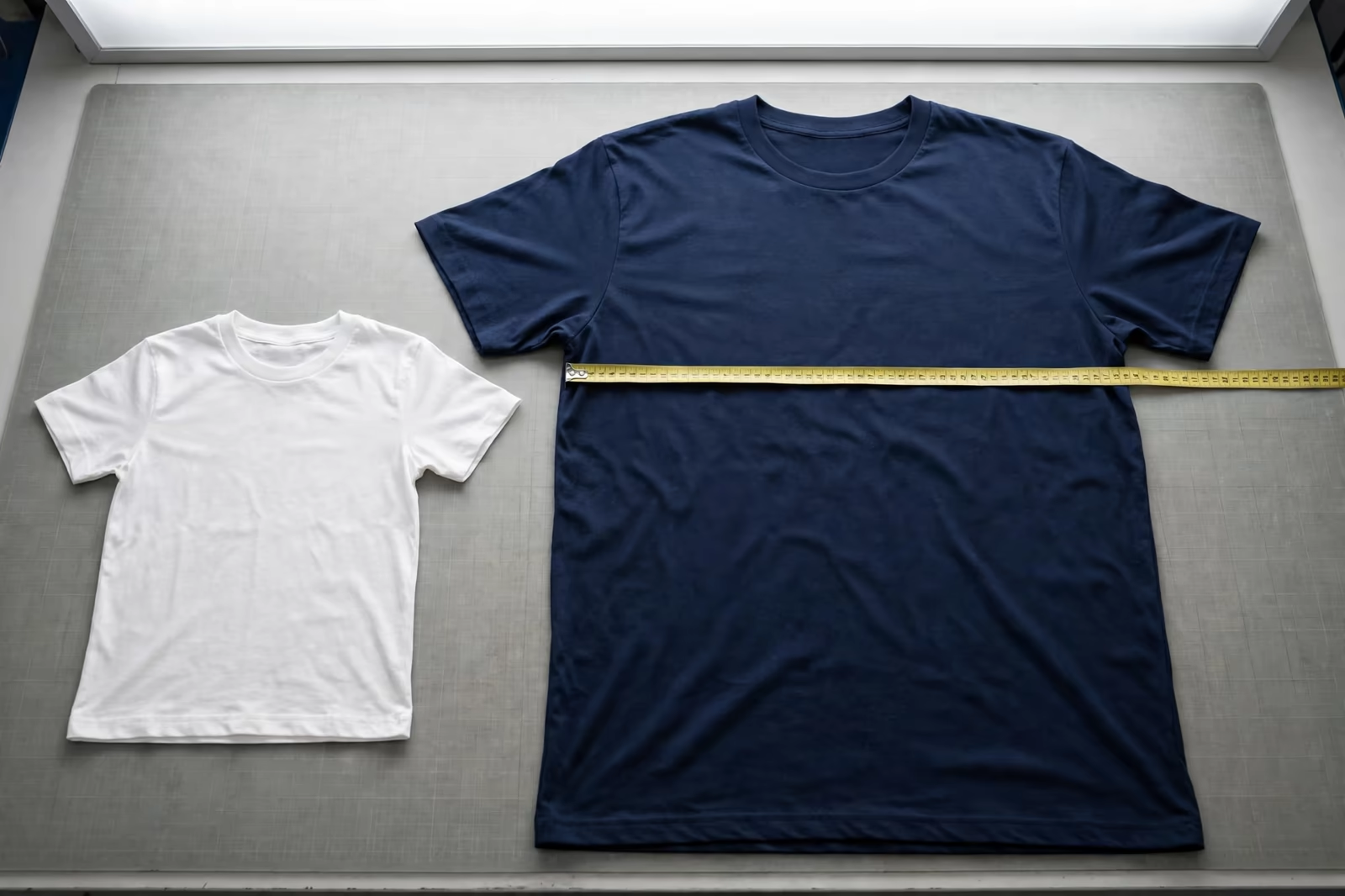
Because the extremes are where grading hides its sins, the size set exists: samples of the smallest and largest sizes, sometimes of every size, measured against the chart and tried where possible. It is the only stage where a wrong increment can be caught while it is still a number rather than a production run, and skipping it on a new block or a new fabric is economy of the most expensive kind.
Not every reorder needs fresh size sets; a proven grade on a proven block, running unchanged, has earned trust. The trigger points are change: new base pattern, new fabric family, new market with different sizing culture, or a returns pattern whispering that an extreme size is not what the chart promised.
Tolerances: The Honest Margin
No production garment measures to the tenth of a millimetre, so charts carry tolerances, the small permitted variation around each target. Tolerances belong in the grading conversation because they widen the effective range at the extremes: a largest size at the bottom of its tolerance and a base size at the top of its own can sit closer than the chart’s clean steps suggest.
Well-run programs state tolerances per measurement, tighter where fit is judged, looser where it is not, and inspect bulk against chart plus tolerance rather than chart alone. A brand arguing with a factory about half a centimetre without an agreed tolerance is having a philosophical dispute; with one, it is a measurement.
Who Owns the Grade
Like the tech pack, the grade rule is the brand’s asset wearing the factory’s handwriting. The pattern room develops it, the brand approves it through the size set, and thereafter it should be documented in the style file and frozen: every reorder runs the same grade, and any proposed change is versioned, sampled at the extremes and approved like the design change it is.
Our programs run at a standard minimum of 1,200 pieces per style in up to two colours, spread across the size range the grade defines. The founder who owns their grades owns the fit of every customer they will never meet, which is most of them; the one who leaves grading as an unexamined factory default has delegated the edges of their range, and their reputation, to arithmetic they never read.
Nested Grades and Marker Logic
Inside the factory, the finished grade becomes a nested pattern set: every size’s outline drawn together, checked for lines that cross, steps that stumble or increments that produce an impossible shape at some size nobody sampled. The nest is also what the marker is planned from, the layout that cuts all sizes from the cloth, so a clean grade is not only a fit asset but a fabric economy: erratic steps waste cloth at cutting, and cloth is the largest cost in the garment.
Brands never see the nest, and mostly need not. But asking whether the grade has been nested and checked before bulk is a fair professional question, because it separates a grade that exists as a table from a grade that has survived contact with the cutting room, which is where the range is finally made real.
Frequently Asked Questions
Can grading be done from measurements alone, without new samples?
The calculation can, and for proven blocks on unchanged fabrics it routinely is, with production garments measured to confirm. What cannot be done from numbers alone is proving a new grade: a new block, fabric family or market deserves a physical size set at the extremes, because the failures grading produces are precisely the ones invisible in the base size’s paperwork.
Why do the smallest and largest sizes fit worst in many brands?
Because they are the farthest from the fitted base size, so every error in the grade rule compounds across the most steps, and because few brands fit on bodies at the extremes. It is a process failure, not a body problem: size set sampling at both ends, measured against the chart, catches nearly all of it before bulk.
Should the same grade rule serve the USA, the UK and Europe?
It can serve as a starting point, and many young brands launch on one rule for simplicity. But sizing cultures differ measurably between markets, in the step between sizes and in the proportions assumed, so as volumes grow, market-specific charts derived from the same base pattern usually repay their development in lower returns and better fit reviews.
What should I ask my manufacturer about grading?
Ask for the grade rule itself, the increments per point of measure, the full size chart it produces, the tolerances applied, and whether a size set is included or advised for your style. A factory that answers in documents is showing you its pattern room’s discipline; the grade is part of your product, so read it the way you read your own specification.