
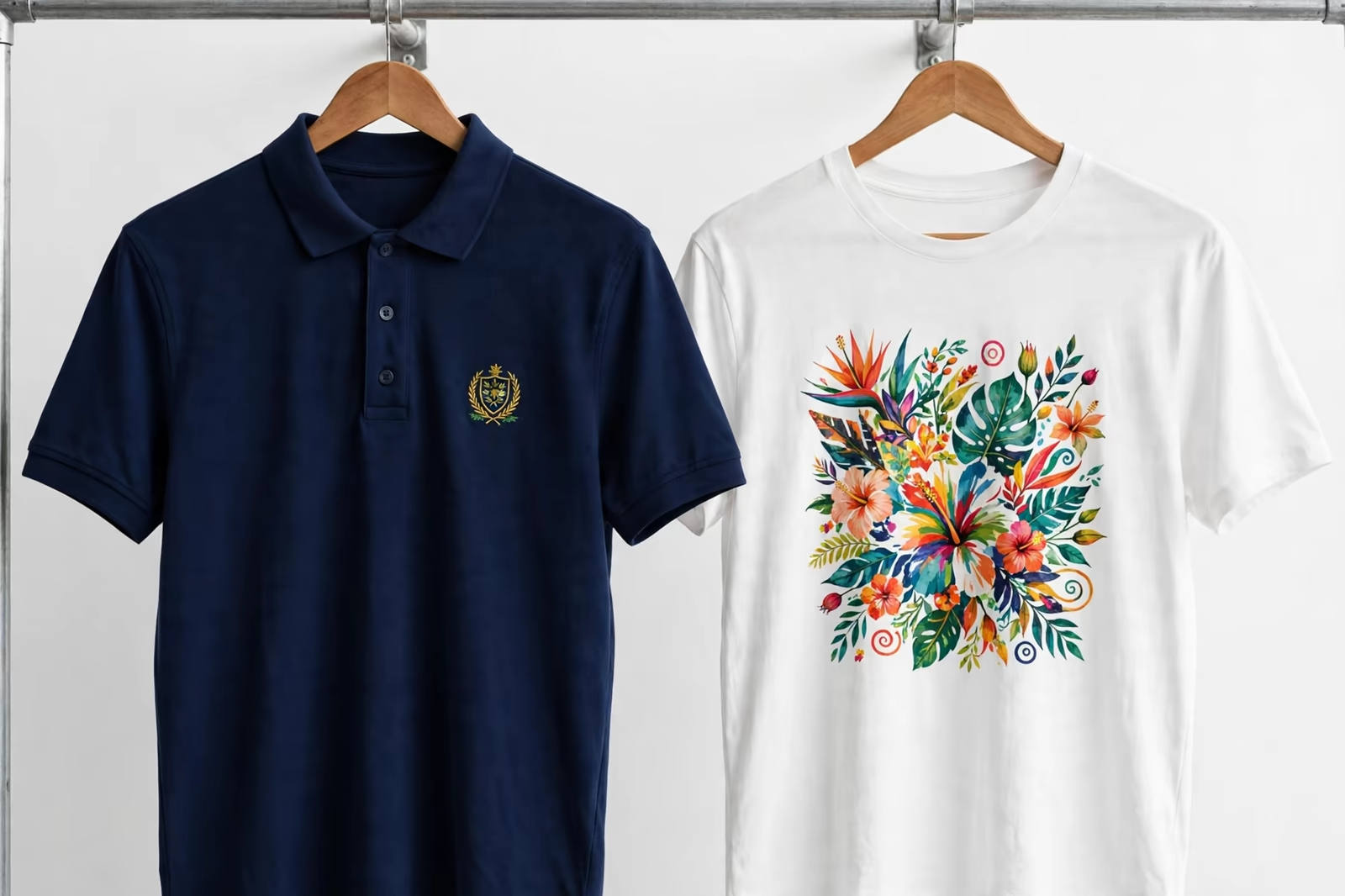
Every uniform program eventually argues with itself about decoration. Embroidery looks established and lasts; print costs less and says more, bigger. Both camps are right about their own garment and wrong about the other’s, and the argument only settles when it is run over the honest horizon: not the invoice in front of you, but the five years the uniform has to serve. Over five years the question changes shape. Unit prices shrink in importance; replacements, fading, staff turnover and the day the logo changes grow teeth.
The uniforms compared in this guide are decorated in Bangladesh for employers in Canada and Australia, and the verdict that lasts is the one their laundry rooms deliver.
This guide compares the two methods the way a uniform actually lives them, drawing on our embroidery and screen printing programs and on the garment where the argument is loudest, the classic pique polo shirt.
Year One: What the Invoice Says
On the first invoice, print usually wins. A one or two colour chest print costs less per garment than a digitized, stitched logo, and for large artwork the gap widens, because print prices by colour while embroidery prices by stitch count and size. Embroidery’s first invoice also carries its one-time digitizing fee, the file every future order will reuse. Judged on year one alone, most programs would print everything, and many do, and some of them are back within two years re-arguing the question with faded chests as evidence.
The honest year-one reading is narrower: print is cheaper to start, embroidery is cheaper to repeat, because the digitized file, once paid, serves every reorder, every addition batch and every new garment in the family. A program that knows it will reorder, and staff uniforms always reorder, should weigh the setup cost across the orders it will actually place, not across the first one only.
Durability: The Wash Is the Referee
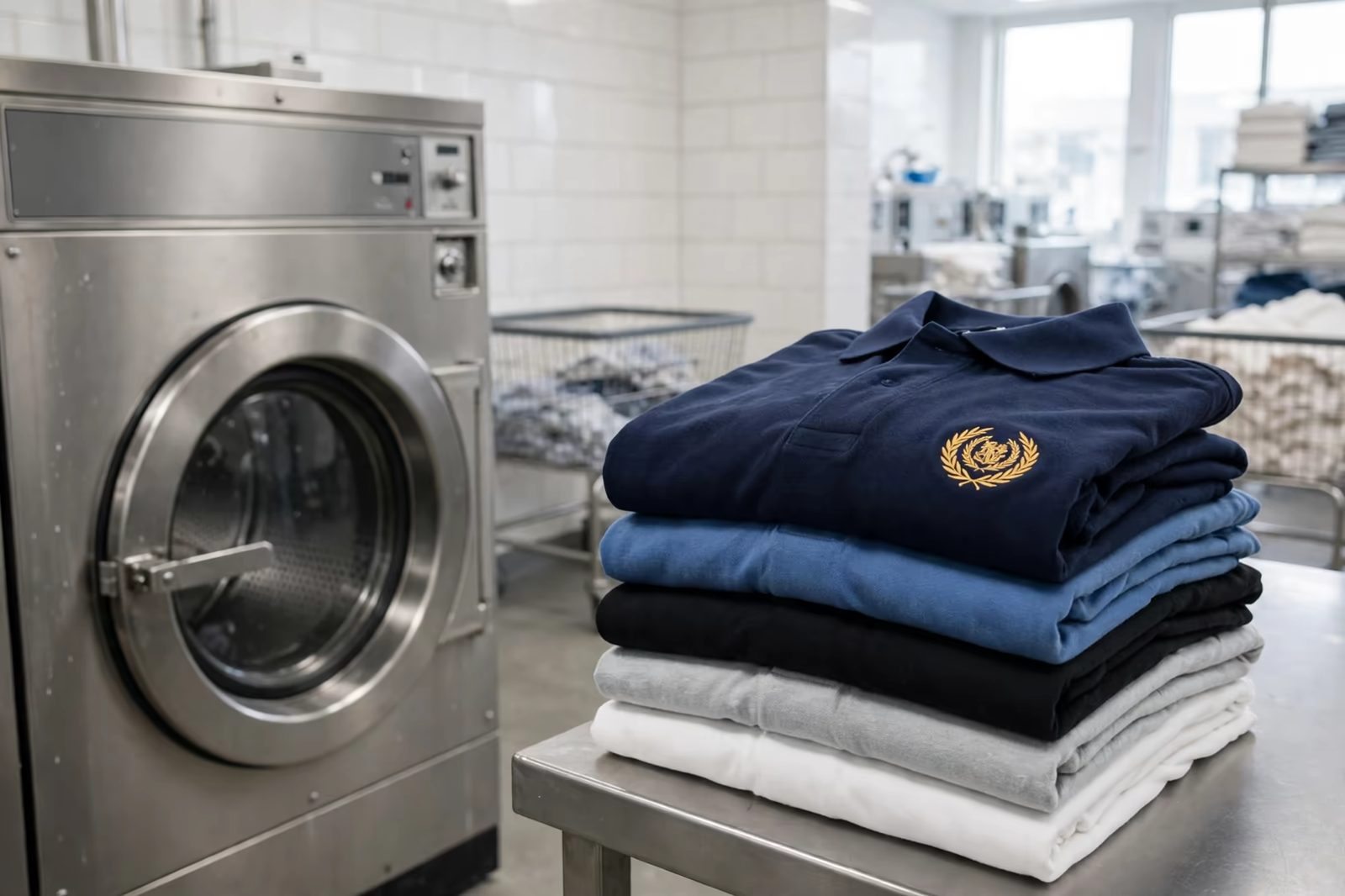
Uniforms are washed like they mean it: hot, often, with chemistry that hobby garments never meet. Embroidery is thread, and thread fades slowly and evenly, outliving the garment in most programs; the polo retires because its collar tired or its colour washed out, wearing a logo that still reads. Print is ink on a surface, and its enemies are exactly the uniform’s life: heat, abrasion, stretch over a working chest, the crackle that starts at a fold and walks.
Modern inks and curing have narrowed this gap honourably, and a well-cured print on a stable garment can serve for years. But the failure modes differ in kind, not just degree. Embroidery’s worst realistic outcome is a slightly tired sheen; print’s worst is a cracked, peeling mark on a garment that is otherwise fine, and a cracked logo on a sound garment forces a replacement the garment did not need.
Image: What Each Method Says About You
Embroidery carries weight, literally and socially. Raised thread reads as permanence: established firms, professional services, anyone whose customer must trust them at the door. It photographs as texture, catches light with a slight sheen, and sits on structured garments, polos, shirts, jackets, like it was always part of the cloth. This is why the polo shirt, the uniform of half the working world, wears embroidery by default and print by exception.
Print carries scale and freedom. It can run chest-wide, photographic, soft-handed on a t-shirt in a way thread never will, and for promotional, event and fashion-led uniforms that freedom is the point. The image risk runs the other way: a very large print on a work garment can read as advertising where the buyer wanted identity, and on formal garments it can look like the logo was applied as an afterthought. Neither method is classier in the abstract; each is classier on its own garment.
The Five-Year Cost Shape
Across five years, three forces decide the real cost. First, replacements: garments retired early because their decoration failed cost a full garment plus decoration again, and print’s decoration-first failures, rarer than they were, still outnumber embroidery’s. Second, reorders: staff turnover means addition batches every year, and each batch re-pays print setups in some programs while embroidery reuses its file for free; small, frequent batches punish per-order charges. Third, consistency: thread colours hold their references across years and suppliers; print mixes drift unless they are managed with the same discipline.
None of this makes embroidery universally cheaper; on stable, short-life or very large designs, print’s arithmetic stays better for the whole five years. It makes the comparison a program question rather than a unit question. Buyers who cost the program, garments, decoration, replacements, additions, one logo change, usually find the two methods within sight of each other, and the decision falls, correctly, to image and garment fit.
Garment by Garment: Where Each Wins
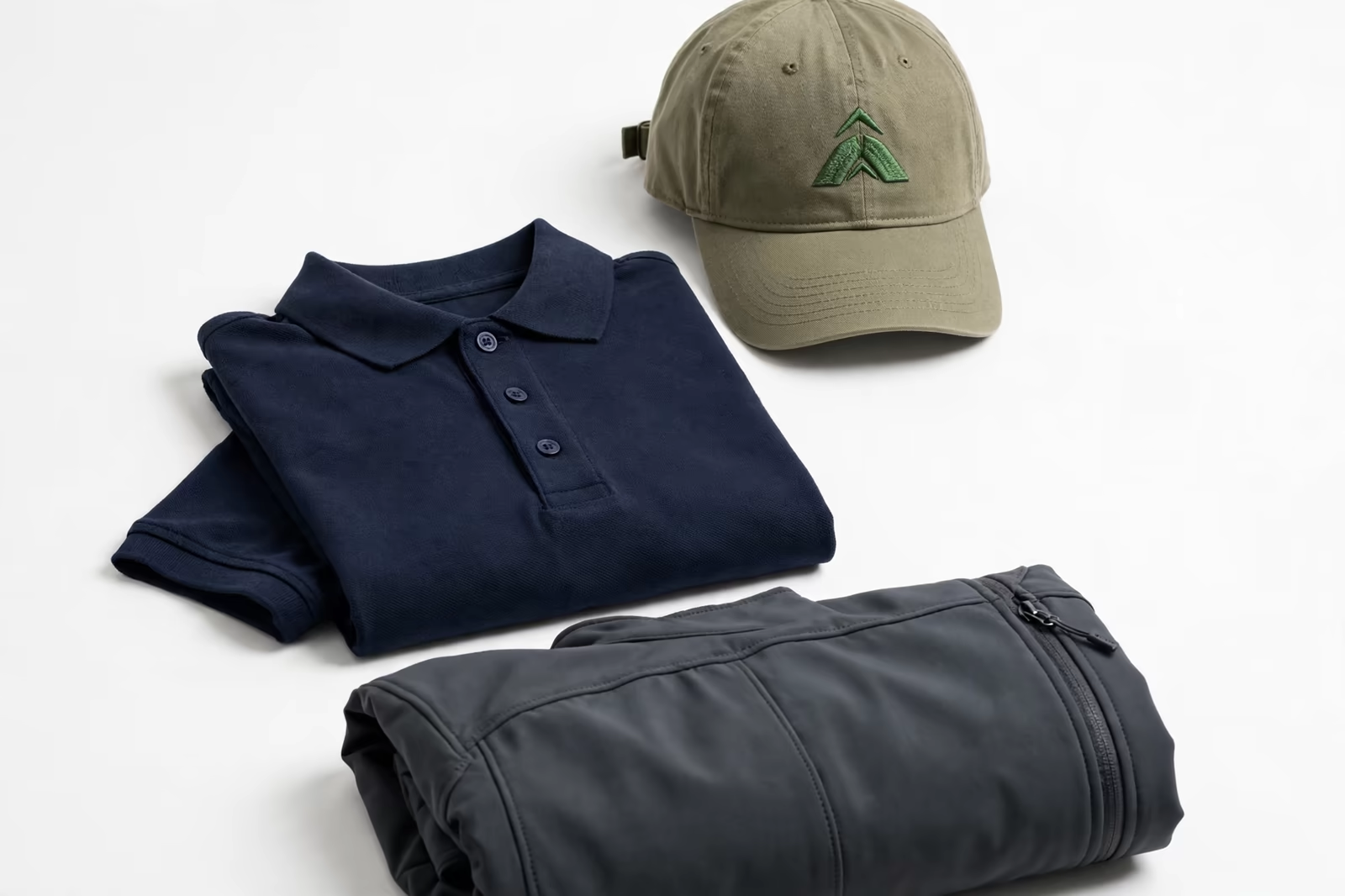
Polos and woven shirts: embroidery, for texture, structure and the collar-and-placket formality print cannot imitate. Jackets and softshells: embroidery for chest marks, since print struggles on coated shells without special inks, though large back branding on shells is often heat-applied instead. T-shirts split by purpose: staff tees worn daily lean embroidered at the chest for life; event and promotional tees lean printed for size and cost. Fleece and hoodies take both well, embroidery at the chest, print at the back, and many fleets run exactly that split.
Caps belong to embroidery outright; the curved, structured surface is thread’s home ground. Hi-vis and workwear split by zone: embroidery where the garment is stable, print or transfer where reflective and safety elements crowd the surface. The pattern underneath the list is simple: small, permanent, prestigious marks embroider; large, graphic, changeable marks print. Programs that decorate by that sentence rarely regret either method.
The Logo Change Nobody Plans
Somewhere in five years, many organisations rebrand, refresh or get acquired, and the decoration method decides how painful that Tuesday is. Embroidery files are redrawn for the new mark, a fresh digitizing fee, and the fleet transitions as garments naturally replace; the old stock cannot be converted, but neither can printed stock. The difference is subtler: embroidered garments age gracefully into the transition, still respectable while the new mark rolls out, while a cracked old print beside a crisp new one advertises the changeover’s untidiness.
Programs expecting change lean the other way on purpose: print’s lower commitment per garment makes a short-horizon fleet cheaper to retire whole. The five-year view therefore includes one question buyers dislike and should answer anyway: how certain is this logo. Certain logos deserve thread. Provisional logos deserve ink, or small embroidered marks that waste least when they go.
Staff Turnover and the Addition Batch Problem
The average fleet is not replaced; it leaks and refills. Every leaver takes garments out, every starter needs garments in, and the decoration method shapes how painful the refill is. Embroidery’s addition batches are painless in setup, file on record, thread on the shelf card, any quantity sewn in list order, though our own programs run at our standard minimum of 1,200 pieces per style in up to two colours for main orders, with additions planned under the same roof of specification. Print additions re-face screens, setups and minimum-friendly batching that can make six shirts for a new starter oddly expensive.
High-turnover sectors, hospitality, logistics, seasonal retail, feel this difference in their bones and often embroidery their core chest mark for exactly this reason, whatever their launch invoice preferred. Low-turnover professional fleets, where the same twelve people wear the same twelve polos for three years, barely meet the problem and can choose on image alone. Know your leak rate before you choose your method; it is half the five-year answer.
Care, Repair and the Midlife Refresh
Neither decoration is repairable in the true sense; neither a cracked print nor a snagged stitch field can be restored to invisible. But their midlife behaviours differ. Embroidery can be unpicked and replaced on stable garments more cleanly than print can be covered, and a refreshed name or mark over an old one is a known workshop manoeuvre. Print’s midlife option is the overprint, which works only when the new design swallows the old, a constraint that shapes rebrands more than buyers expect.
Care instructions bend slightly by method: prints ask for cooler washes and no iron on the design; embroidery asks for nothing special beyond the garment’s own care. In institutional laundries, which follow exactly one instruction set, the lowest-maintenance decoration wins quiet points every single week, and those points accumulate across five years of wash contracts into a line item of their own.
Waste and the Sustainability Ledger
Five-year thinking now includes a ledger that year-one thinking ignored: waste. Every garment retired early because its decoration failed is a whole garment of waste, fabric, dye, freight and all, and by that measure the decoration that outlives its garment wastes least. Embroidery’s thread is a small mass of polyester or rayon that leaves with the garment at its natural end; print’s early failures pull sound garments into the bin years ahead of their cloth’s schedule, and the sustainability report notices even when the invoice does not.
The counterweight is honest too: embroidery’s stabilizers and thread cones are consumables, and large printed designs on short-life event garments waste little by ending with garments that were always brief. The ledger, like the cost ledger, rewards matching method to garment life. On the garments a fleet keeps longest, the longest-lived decoration is the greenest line in the program, another quiet point that only the five-year view can see.
Mixed Programs: The Answer Most Fleets Land On
Given all of the above, the mature uniform program rarely chooses one method. It embroiders the permanent chest mark, the name, the small prestigious things, and prints the large, the graphic and the campaign layer: event tees, seasonal backs, big statements. The methods stop competing and start specialising, each doing the work its physics suits, and the five-year cost lands lower than either purist program because replacements happen where they are cheap.
If your program must choose only one, choose by your dominant garment and your honest leak rate: structured garments and high turnover point to embroidery; t-shirt-led fleets, large graphics and short horizons point to print. And whichever you choose, sample both on your actual garment before the argument is closed, because five years is a long time to wear the losing side of a decision made from a price list.
Frequently Asked Questions
Is embroidery always more expensive than print?
On the first invoice, usually; across five years, often not. Embroidery charges once for digitizing and reuses the file on every reorder and addition batch, and it rarely forces an early garment replacement, while print’s lower unit cost is re-paid in setups and in garments retired when the print fails first. Cost the whole program, not the unit.
Which looks more professional on a polo shirt?
Embroidery, in most buyers’ eyes and most customers’. Raised thread suits the polo’s structured, collared formality and reads as permanence, while chest prints on polos can look like an afterthought. Large back graphics are the exception where print belongs, and many polo programs embroider the chest and print nothing at all.
What if our logo might change in a few years?
Then weight the decision toward lower commitment: print for large marks, or a small embroidered chest mark that wastes least when retired. A certain logo deserves thread and the five-year savings that follow; a provisional one should not be locked into the most permanent decoration on the most durable garments you own.
Can one uniform program use both methods?
Yes, and most mature programs do: embroidery for the permanent chest mark and names, print for large graphics, event layers and campaign pieces. Each method does the work its physics suits, replacements happen where they are cheap, and the five-year cost usually lands lower than either single-method program.