
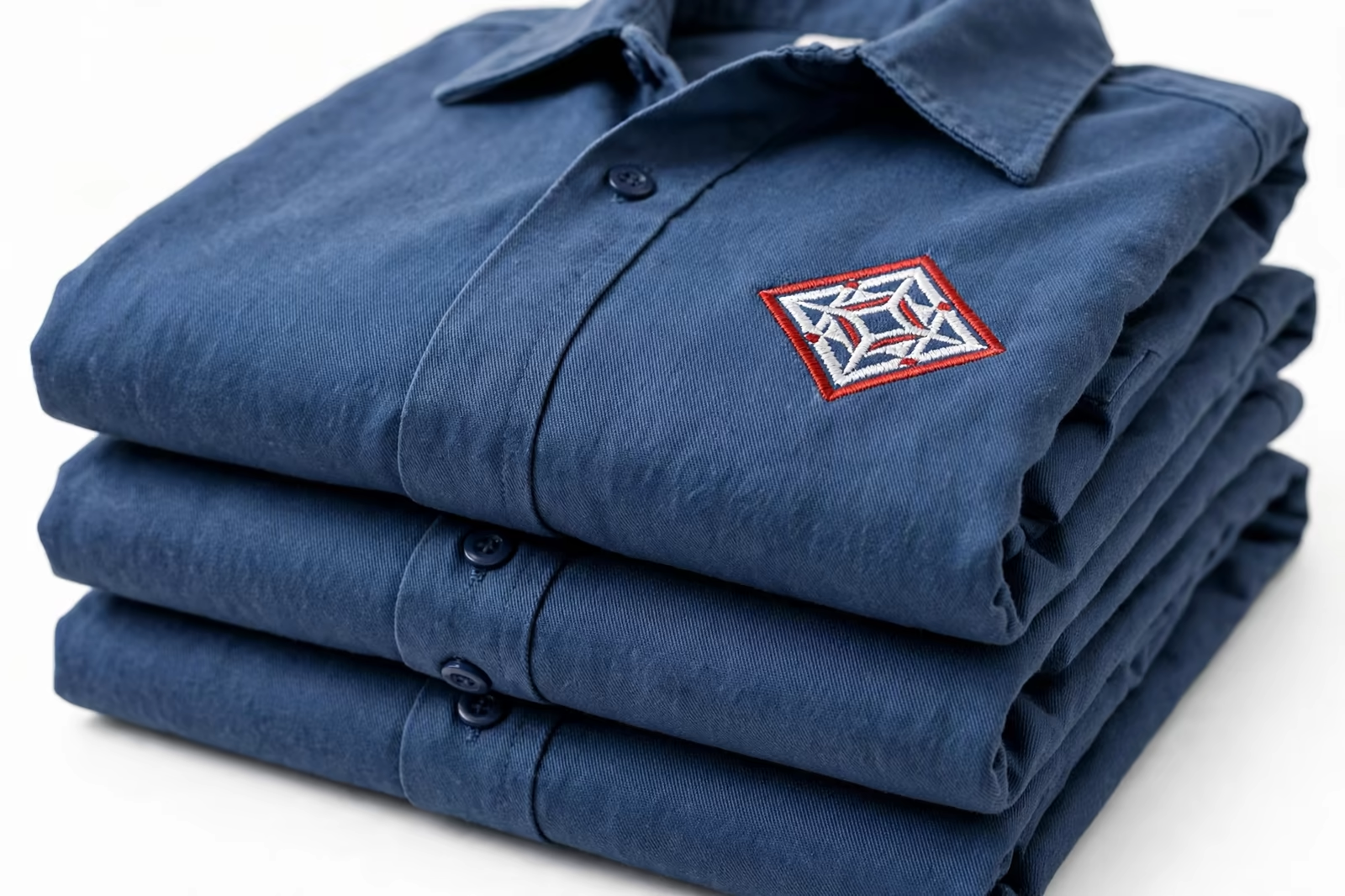
Every embroidered logo is made of one material, thread, and the choice of that material quietly decides how the logo will look on day one and in year three. The trade sews mainly with two fibres, rayon and polyester, and they are not interchangeable versions of the same thing: they differ in sheen, in strength, in how they survive bleach, sunlight and industrial washing. A buyer who specifies thread with the same care as fabric gets a logo engineered for the garment’s actual life.
Rayon and polyester threads are both run in Bangladesh for buyers in Germany, the USA and Australia, with the choice proven on a sew out of the actual logo before bulk stitching.
This guide compares the thread types inside our embroidery programs and across our wider services, on garments such as the work shirt that lives the hardest washing life of all.
Rayon: The Sheen That Made Embroidery Famous
Rayon thread is made from regenerated cellulose, and its gift is optical: a deep, silky lustre that catches light the way embroidery in shop windows has always promised. Colours in rayon read rich and slightly dimensional, and fine work, ceremonial crests, fashion logos, hospitality marks, looks its absolute best in it. For decades rayon was simply what embroidery thread meant, and its colour ranges remain the reference libraries other threads are matched against.
Its limits are chemical and mechanical. Rayon is the weaker fibre: it loses strength when wet, dislikes chlorine bleach, and fades sooner under hard laundering and strong sun. On a garment washed gently and worn indoors, none of this matters within any reasonable life. On workwear boiled weekly in bleach, rayon is being asked to survive a war it was not built for, and it answers by dulling and breaking where the work is hardest.
Polyester: The Working Thread
Polyester thread trades a little of rayon’s glow for a great deal of endurance. It is stronger stitch for stitch, holds its colour against bleach and ultraviolet light far longer, and shrugs off the industrial wash cycles that retire rayon early. Modern polyester threads have closed most of the sheen gap too; the difference is visible side by side on a shade card and barely visible across a room on a worn garment, which is where logos actually live.
This profile has made polyester the default for workwear, uniforms, sportswear and any program whose garments are laundered commercially. The logic is actuarial: the logo must outlast the garment, not merely debut well, and the thread that survives the garment’s real washing regime is the right thread whatever its showroom ranking. Specifying polyester for hard-life programs is not a compromise. It is the correct engineering answer to a laundering question.
Thread Weight: The Thickness Behind the Finish
Thread comes in weights, and the standard embroidery weight is a balance the industry settled on for good reason: thick enough for coverage at sensible density, fine enough for lettering at chest sizes. Heavier thread covers faster and reads bolder, a rustic, emphatic finish some workwear brands love, but it coarsens detail and widens the minimum letter size. Finer thread renders detail the standard weight cannot, at the cost of more stitches and more care to reach the same coverage.
Weight interacts with everything else in the specification: the digitizing is built for the weight chosen, the needle is matched to it, and a sew-out approved in standard weight does not approve the same design in a heavier hand. Buyers rarely need to speak in weights, but they should know the dial exists, because a request for bolder or finer work is answered there as much as in the artwork itself.
Colourfastness: What the Word Actually Promises
Colourfastness is not one property but three: fastness to washing, to light and to rubbing, and a thread can be strong in one and ordinary in another. Dyes sit differently in rayon and polyester fibres, which is why the same brand red behaves differently across the two materials in a bleach wash or a shopfront window. Serious thread makers publish fastness ratings per colour, and a program with a known enemy, chlorine, sunlight, abrasion, should choose its colours with those ratings open on the table.
Buyers meet colourfastness failures at the worst moment, months in, across a whole fleet of garments at once. The prevention is unglamorous: name the washing regime in the specification, sew the sample in the production thread, and wash the sew-out the way the garment will actually be washed before bulk is released. Ten honest wash cycles in the sample stage answer questions that no shade card can.
Matching Brand Colours Across Thread Types
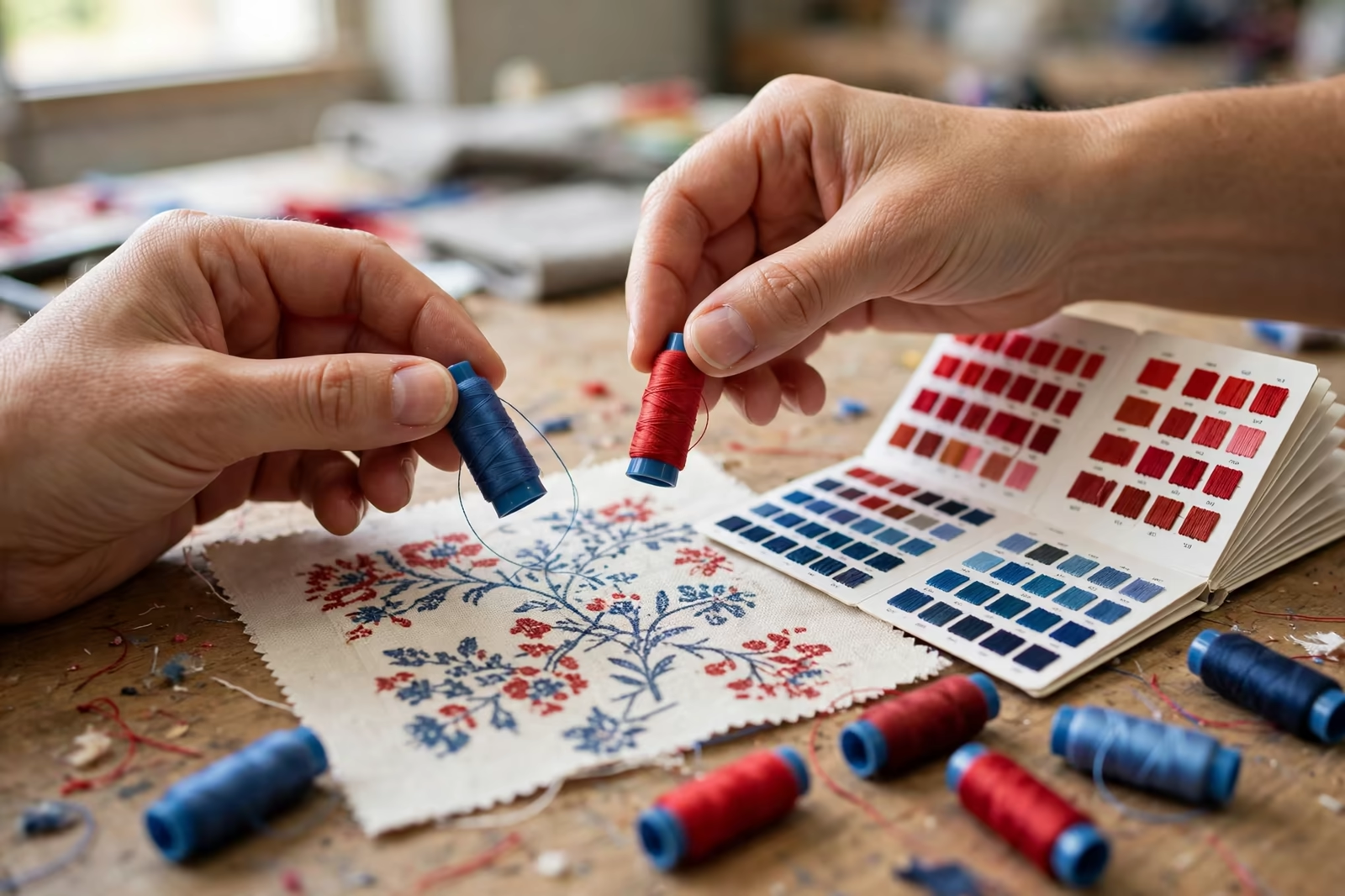
Thread colours are chosen from physical shade cards, by eye, in good light, because thread is a three-dimensional, light-playing material that screens misrepresent badly. Each maker numbers its colours in its own system, and a brand colour usually has a nearest match in both rayon and polyester ranges, close but rarely identical twins. A program that mixes thread types across garments, rayon on fashion pieces, polyester on workwear, should approve the match per type, on fabric, rather than assuming the number travels.
The reference that governs production is the approved sew-out, kept with its thread list recorded: maker, type and colour numbers per element. That record is what makes year-three repeats land on the same red, and what turns a thread conversation from memory into documentation. When a program changes factories, this record is the difference between continuity and a fresh negotiation with the shade card every time.
Specialty Threads: Metallic, Matt and Fine Weights
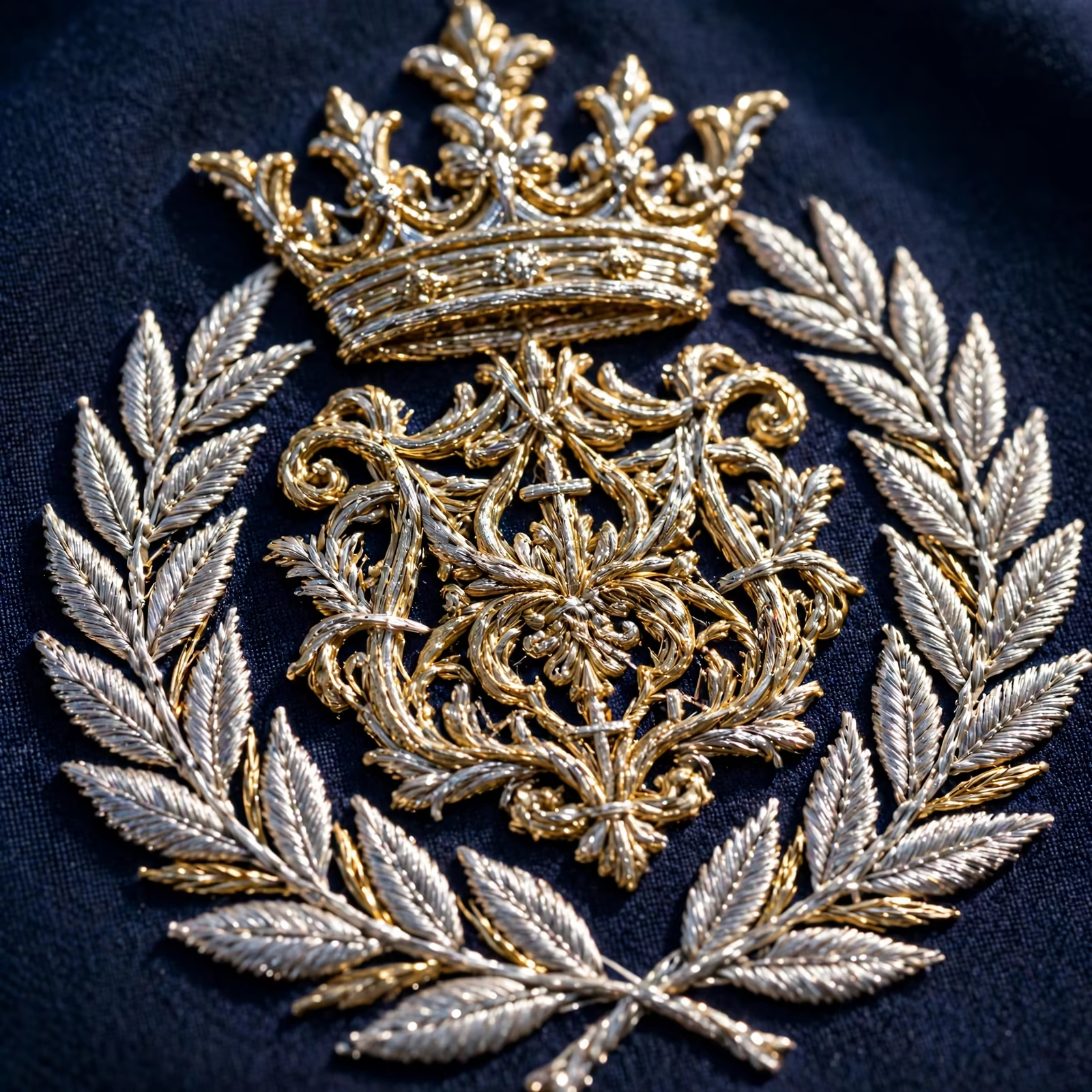
Beyond the two main fibres sit the specialists. Metallic threads wrap a coloured core in a metallic foil and deliver ceremony: crests, awards, festive work. They run slower, break more readily and feel stiffer, so they are specified where their effect earns its handling cost, usually as an accent inside a standard-thread design rather than the whole cloth. Matt polyester threads answer the opposite brief, a flat, modern, almost printed look for brands whose identity is understated.
Fine-weight threads exist for small, delicate work, allowing tighter detail than standard weights can hold, at the price of coverage that may need design adjustment. Each specialist changes the digitizing conversation too: densities, speeds and underlay are set for the thread in use, which is why the thread decision belongs at the start of a program, in the specification, and not as a substitution offered at the machine.
Cotton and Other Minor Fibres
Cotton thread appears in heritage and craft-led work, with a soft matt hand and a deliberately unpolished character that suits vintage-leaning brands. Its fastness and strength sit below both main fibres, and it is chosen for its look with its limits accepted openly. Silk is rarer still, reserved for ceremonial pieces. These fibres are seasoning, not staples: a buyer will occasionally have a real reason for one, and should hear its maintenance truth in the same conversation as its beauty.
Blended and branded performance threads fill the catalogue edges, each claiming some mix of sheen and endurance. They earn consideration when a program’s demands are unusual, and they earn it through the same test as everything else: a sew-out, washed the garment’s way, judged against the two benchmarks whose behaviour is fully known. Novelty in thread is cheap to try at sample stage and expensive to discover at fleet scale.
Bobbin Thread and the Underside of the Logo
Every top thread is locked by a bobbin thread beneath, usually a fine, plain filament chosen for strength and smoothness rather than looks. It still appears in the logo’s life: at the edges of satin columns a whisper of bobbin can show when tension drifts, and on reversible or thin garments the underside is seen in use. Tension is the craft that keeps the underside clean, top thread pulled to sit on the face, bobbin hidden in the middle of the stitch.
Programs judge this at the sew-out by turning the garment over. A tidy underside, consistent and flat against the backing, is the signature of machines in balance; loops, nests or show-through are early warnings that bulk garments will vary. It costs a buyer one flip of the sample to learn which factory they are dealing with, and it is worth the second it takes.
Choosing by Garment Life, Not by Habit
The decision procedure is short. Ask how the garment will be washed, how often, with what chemistry, and under what light it will live. Gentle domestic washing and an indoor life: rayon is free to be chosen for its beauty. Commercial laundering, bleach, outdoor work, sport: polyester, without nostalgia. Mixed fleets can run both, with the thread type recorded per garment family so repeats stay faithful. The worst specification is the absent one, where the choice falls to habit or to whatever cone is loaded.
Our programs run at our standard minimum of 1,200 pieces per style in up to two colours, and the thread type is named in every quotation we issue, because a price without a material is only half a price. Tell us the garment’s working life when you brief the logo, and the thread recommendation will come back argued from that life, with the sew-out washed accordingly before a single bulk garment is sewn.
Running the Wrong Thread: How Substitutions Happen
Most thread failures in bulk are not choices but drifts: a cone runs out mid-program and a near colour in the other fibre is loaded; a new operator threads from the wrong shelf; a repeat order is sewn from memory instead of from the recorded list. Each produces logos that pass a glance and fail a comparison, the red slightly duller, the sheen slightly different, the fleet slowly splitting into two families that no longer match side by side.
The defence is documentary and dull: the thread list fixed to the approved sew-out, cones checked against it at the start of every run, and a first-off garment from each run compared with the standard before the batch proceeds. None of this is expensive, and all of it is the difference between a program and a habit. Buyers can ask, simply, what thread type and colours are recorded against their design; the answer’s existence matters as much as its content.
Frequently Asked Questions
Which thread is better, rayon or polyester?
Neither in the abstract. Rayon wins on sheen and richness for garments washed gently and worn indoors; polyester wins on strength, bleach resistance and light fastness for workwear, uniforms and anything commercially laundered. The garment’s washing life decides, and the correct specification names the thread type openly.
Will polyester look noticeably duller than rayon?
Side by side on shade cards, slightly; on a worn garment across a room, barely. Modern polyester threads carry a respectable lustre, and the small optical difference is the price of a logo that still looks new after the kind of washing that fades and breaks rayon early in a hard-life program.
How are brand colours matched in thread?
From physical shade cards, by eye in good light, per thread type, because a brand colour’s nearest match differs slightly between rayon and polyester ranges. The approved sew-out with its recorded thread list, maker, type and colour numbers, becomes the governing reference for every repeat.
When are metallic threads worth using?
For ceremony and accent: crests, awards and festive marks where the effect earns slower running speeds and a stiffer hand. They work best as highlights inside a standard-thread design rather than as the whole logo, and the sew-out should confirm the effect justifies their handling cost.