
Stretch fabric and embroidery begin as opponents. The needle wants a still, stable ground; elastane jersey wants to move with every penetration, then spring back and drag the finished design with it. The puckered, wavy logos everyone has seen on cheap sportswear are this fight, lost. It can be won, consistently, with the right stabilizers, honest design adjustments and hooping discipline, and the garments that result, performance polos, leggings, athletic tops, carry embroidery as clean as any woven shirt. This is the engineering behind that result.
Made in Bangladesh for sportswear and uniform brands in the USA, Germany and Australia, each stretch style is stabilised to its approved sample.
Our embroidery programs cover stretch garments across our services, including the performance polo shirt whose fabric moves in every direction at once.
Why Stretch Fabric Fights the Needle
Every stitch pulls. In a stable woven, the fabric resists and the stitch sits where it was placed; in a knit with elastane, the fabric yields as the design forms, stretching under hoop tension and stitch pull, then relaxes when the hoop comes off, carrying the embroidery into ripples, ovals that were circles and letters that lean. The denser the design, the more penetrations pull, which is why heavy logos on light stretch fabric are the worst combination in the trade.
The fabric’s stretch direction matters as much as its amount. A two-way stretch moves across the body; a four-way moves everywhere, and a design’s fills will pull along the direction their stitches run. Digitizing for stretch is therefore directional thinking: underlay and fill angles chosen against the fabric’s give, compensation added where pull is predicted, so the finished shape after relaxation is the shape that was drawn, not the shape that was sewn.
Stabilizers: The Temporary Skeleton
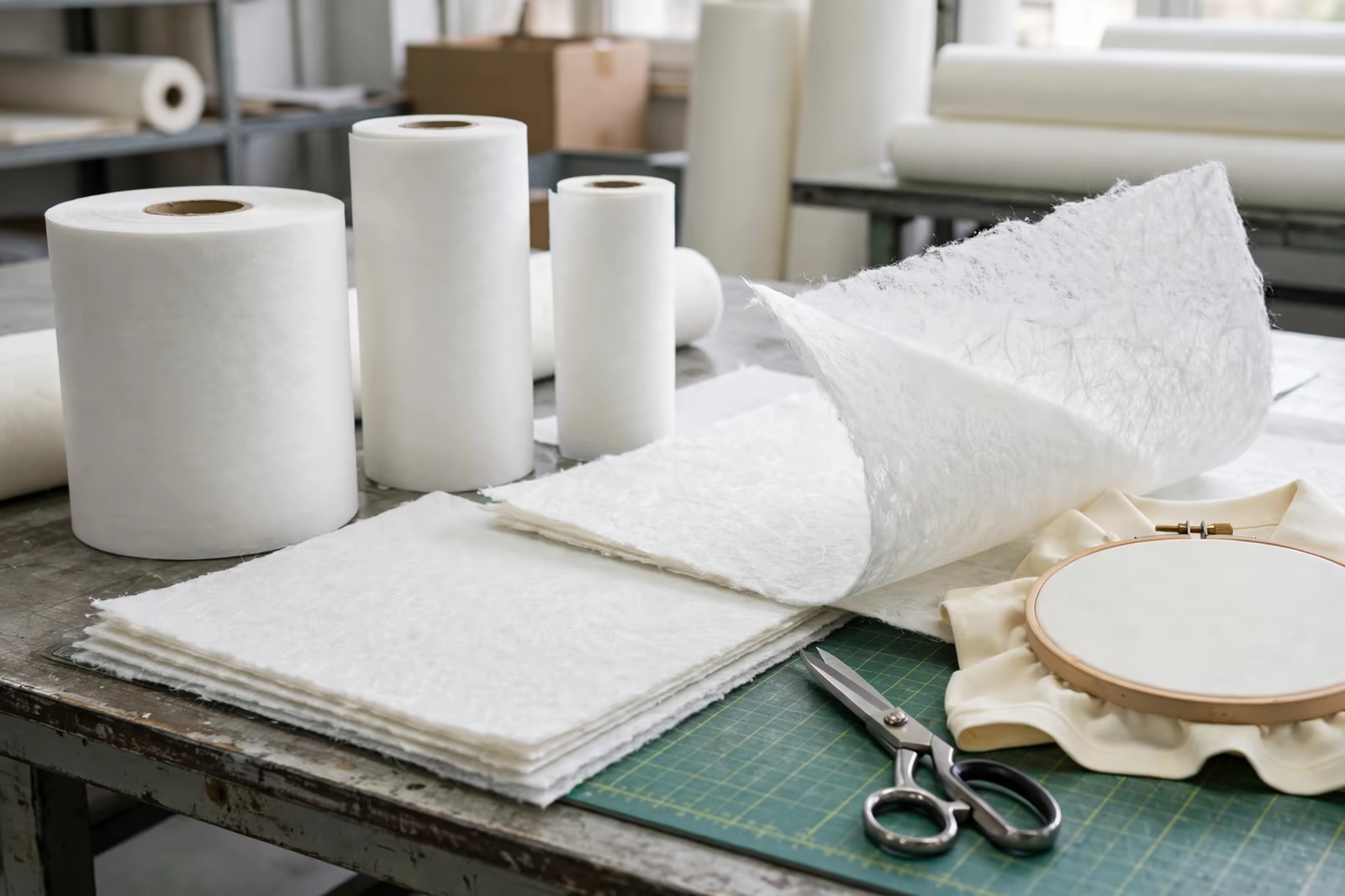
The stabilizer, the backing material hooped with the garment, is what lends stretch fabric temporary stability: a skeleton the stitches form against, which either stays in the garment for life or is removed when its work is done. On stretch knits the default answer is cut-away, in weights matched to the design’s density, because it keeps supporting the embroidery through every wash and wear the garment will ever have; tear-away on elastane is a debt that comes due as distortion within weeks.
Heavy designs on very mobile fabric may take two layers, crossed at angles, and slippery performance fabrics add a further problem, the garment sliding against the stabilizer inside the hoop, answered with temporary adhesive or fusible stabilizer grades that bond the pair into one stable sheet for the duration of the run. None of this is visible in the finished price conversation unless the buyer asks, which is exactly why asking what stabilizer a program uses on stretch fabric is such a revealing question.
Toppings: Keeping Stitches on the Surface
Stretch garments often carry textured surfaces, pique, brushed fleece, performance mesh, into which fine stitches sink and disappear. A water-soluble topping film laid over the embroidery area holds the stitches up on the surface while they form, then washes away, leaving lettering and detail standing clean. It is a small material with an outsized effect on exactly the elements stretch programs struggle with: small text, fine outlines and the edges of satin columns.
Topping is not a substitute for stabilizer; the two work on opposite faces of the same problem, one holding the fabric still from behind, the other holding the thread up from the front. Programs that use both produce on a performance knit a result that buyers routinely assume required a woven garment, and programs that skip either produce the familiar evidence on the other side of the comparison.
Design Adjustments: Building for Movement
Some designs simply must change for stretch fabric. Density comes down: lighter fills with proper underlay cover without pulling the ground into waves. Satin columns widen slightly and gain edge underlay so their borders survive the fabric’s movement. Small elements grow or go, because a detail at the edge of legibility on a woven falls off it on a knit. Logos are drawn a breath larger in the direction the fabric will pull them back, compensation the digitizer calculates per fabric, so the relaxed result measures true.
Stitch types shift too: fills step rather than march in long runs that act like tow ropes, borders use techniques that anchor without sawing at the fabric, and total stitch count per area is budgeted with the same respect a tailor gives ease in a pattern. A design digitized for a woven shirt and sewn unchanged onto elastane is not the same design; it is a draft of one, and the sew-out on the production fabric is where the real version is written.
Hooping Stretch Fabric Without Pre-Stretching It
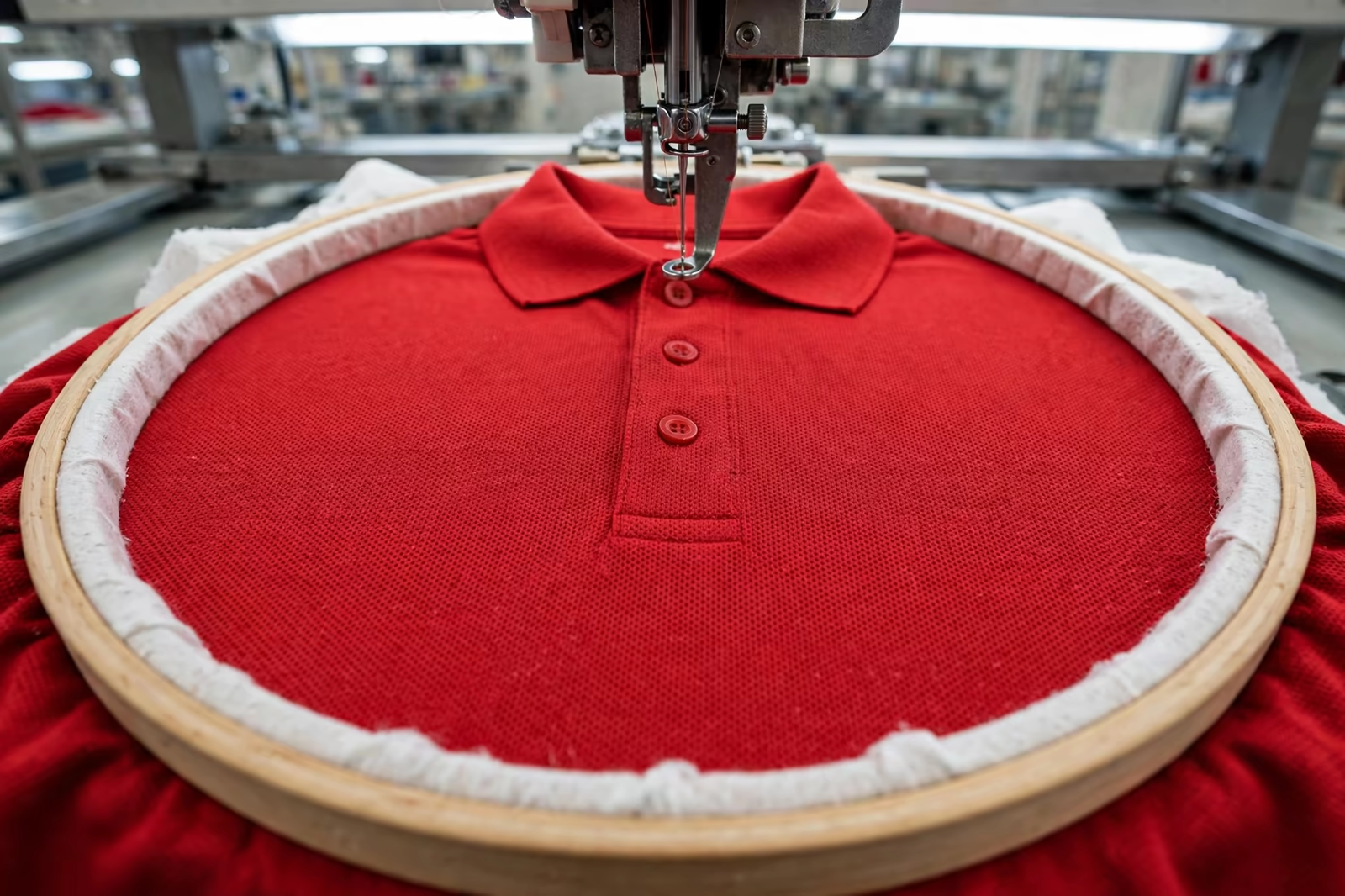
The classic hooping error on knits is kindness: stretching the garment smooth and tight in the hoop, so the embroidery forms on fabric already extended; released, the fabric contracts and the design puckers instantly, sewn-in distortion no inspection can remove. Correct hooping tensions the stabilizer firmly and lays the garment on it at rest, flat and undistorted, held by the frame’s grip and any adhesive rather than by being pulled. The garment should look bored in the hoop; excitement is a defect.
Hoop marks are the smaller cousin of the same care: textured and performance fabrics record pressure, so hoops are padded or the garment is hooped with protective layers where its surface is delicate, and finished pieces are steamed to lift any ring the frame left. A logo can be perfect and the garment still rejected for the frame’s signature around it, which is why hooping is a craft position in stretch programs and not the job given to whoever is free.
Needles and Thread for Elastic Grounds
The needle itself votes on stretch work. Ballpoint needles, standard for knits, slide between yarns instead of cutting them, so the fabric around the embroidery keeps its integrity instead of laddering out from a thousand tiny wounds; sharp needles belong to wovens and their use on elastane jersey shows within a season as runs radiating from the logo. Needle size follows thread and fabric weight, changed on schedule rather than on failure, because a dulling needle pushes stretch fabric ahead of it and writes puckers that no stabilizer can then remove.
Thread tension runs a touch gentler than on wovens for the same reason everything else does: the ground gives. The experienced operator’s settings for a performance knit are a small body of knowledge per fabric family, which is why stretch programs are kept on the machines and hands that know them, and why the first-off garment of every run is checked before the batch, not after it.
Garment Families: From Performance Polo to Leggings
Each stretch family presents the problem at a different strength. Performance polos combine moderate stretch with pique texture: cut-away, topping and reduced density solve them completely. Fleece and sweatshirt knits are heavier and more forgiving, their pile the main enemy, answered with topping and bolder elements. Leggings and high-elastane athletic wear sit at the extreme, maximum movement in every direction; there the honest answers are small, light designs in tested positions, or patches and transfers for large marks, chosen before the program discovers physics at bulk scale.
Placement bends to the same logic: positions over seams, ribs and high-flex zones distort most, while the stable islands of a garment, upper chest, yoke, thigh panel, carry embroidery with the least argument. The placement map of a stretch garment is drawn on the body in motion, not on the table at rest, and samples are checked flexed, because that is the state the customer will judge them in.
What Stretch Embroidery Costs and Why
Stretch work costs a little more and should: two-layer stabilizers, topping film, adhesive systems, slower hooping and density-limited designs that still take their sampling rounds. The premium is small beside the garment’s value and trivial beside the cost of a distorted fleet. Buyers should be suspicious of the opposite quote, stretch embroidery priced identically to woven work with no mention of stabilizer or adjustment, because the difference is being paid somewhere, and it is usually paid in the garment’s appearance by week three.
Ask the two diagnostic questions and the answers price themselves: what stabilizer system runs under this fabric, and may I see a washed sew-out on it. A program that answers both plainly has already spent the money the honest quote contains. A program that answers neither is quoting the sewing and leaving the engineering, the part that decides whether the logo survives, as an exercise for the buyer’s customers.
Testing: The Stretch-and-Wash Verdict
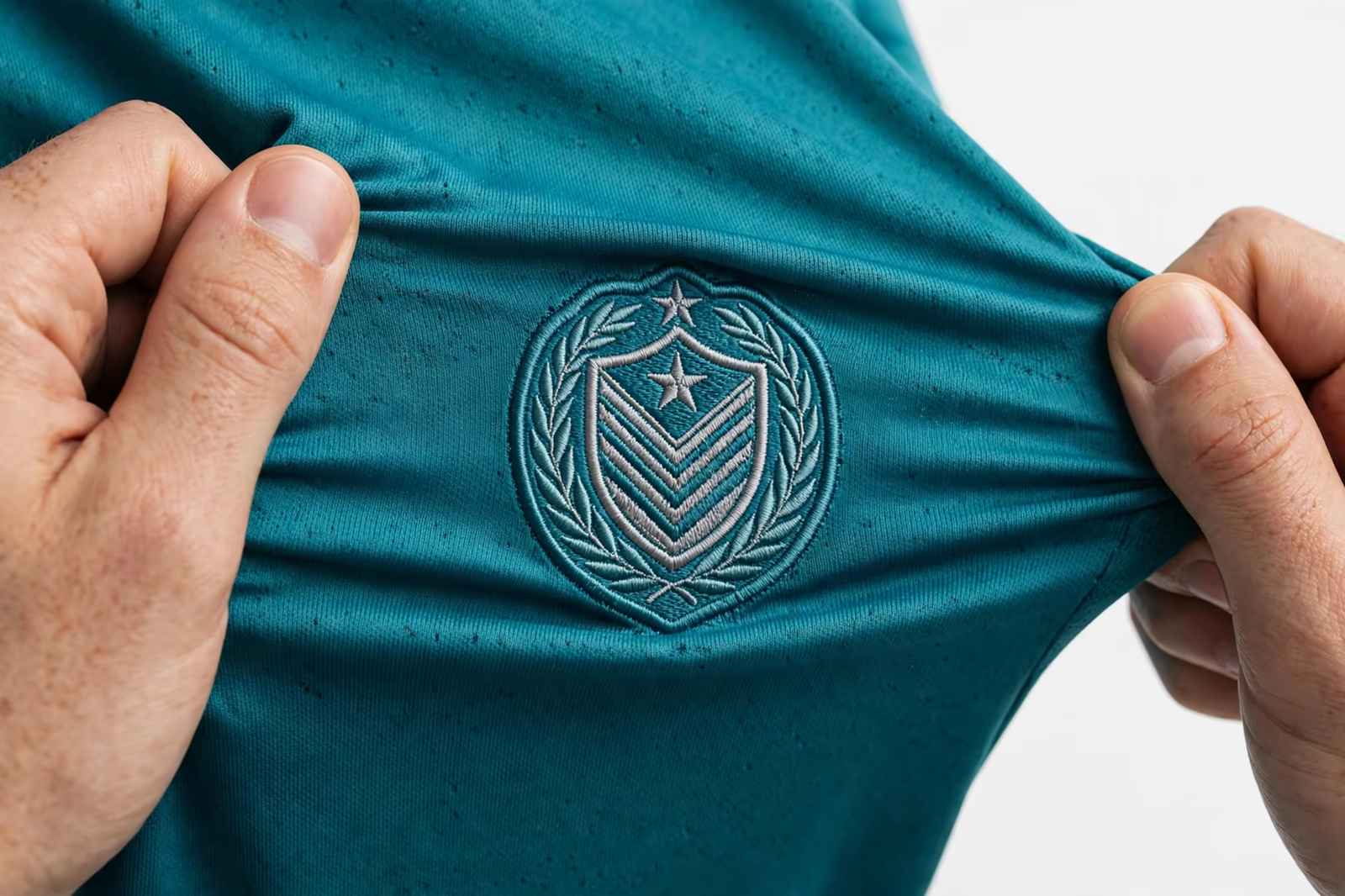
A stretch embroidery sample is judged three times: as sewn, after gentle stretching in both directions, and after washing. The first judgement catches placement and legibility; the second predicts wear, revealing whether the design rides the fabric’s movement or fights it; the third is the one that matters, because stabilizer choices and density decisions all declare themselves after water and heat. Approving stretch work unwashed is approving a hypothesis.
Our programs run at our standard minimum of 1,200 pieces per style in up to two colours, with stretch designs digitized for the production fabric and approved on a washed, flexed sew-out. Send the actual garment fabric or style with the artwork: in stretch embroidery the fabric is half the specification, and a factory that asks for it before quoting is telling you it intends to win the fight this guide describes.
Positions That Forgive and Positions That Do Not
Not all of a stretch garment moves equally, and the map of its stillness is a design tool. The upper chest between the shoulders rides on the body’s frame and barely flexes in wear; the yoke and upper back are nearly as calm; a thigh panel on leggings moves with every stride. Embroidery concentrated on the calm territories can afford density and size that the mobile territories forbid, and a program that places one design across both must build it for the harsher address or split it into two versions.
Samples placed and judged on the body in motion reveal this map faster than any diagram. Walk, reach and bend in the sample garment; the logo that stays composed through the movements its wearer will actually make has been placed with the fabric’s life in mind, and the one that wrinkles into a frown at the first reach has been placed for the table. The distinction is visible in seconds and decisive for seasons.
Frequently Asked Questions
Why does embroidery pucker on stretch fabric?
Because the fabric moves under the needle and relaxes afterwards: stitches formed on extended fabric pull the design into ripples when the garment comes off the hoop, and dense designs on light elastane knits show it worst. The cure is a system, cut-away stabilizer, topping, reduced density, rest-tension hooping and a design adjusted for movement.
Which stabilizer is right for stretch garments?
Cut-away, in a weight matched to the design’s density, because it stays in the garment and supports the embroidery for its whole life; heavy designs on very mobile fabric may take two layers, and slippery performance fabrics may need adhesive or fusible grades. Tear-away on elastane is a false economy that returns as distortion.
Can any logo be embroidered on leggings or high-stretch wear?
No, and a factory should say so early. High-elastane garments take small, light designs in stable positions; large or dense marks belong on patches or transfers instead. The routing decision made at artwork stage, with a washed and flexed sew-out as evidence, is what separates a program from a complaint.
How should a stretch embroidery sample be approved?
On the production fabric, three ways: as sewn for placement and legibility, after stretching in both directions to predict wear, and after washing, which is where stabilizer and density choices declare themselves. The washed, flexed sew-out is the only full evidence, and it should be kept as the program standard.