
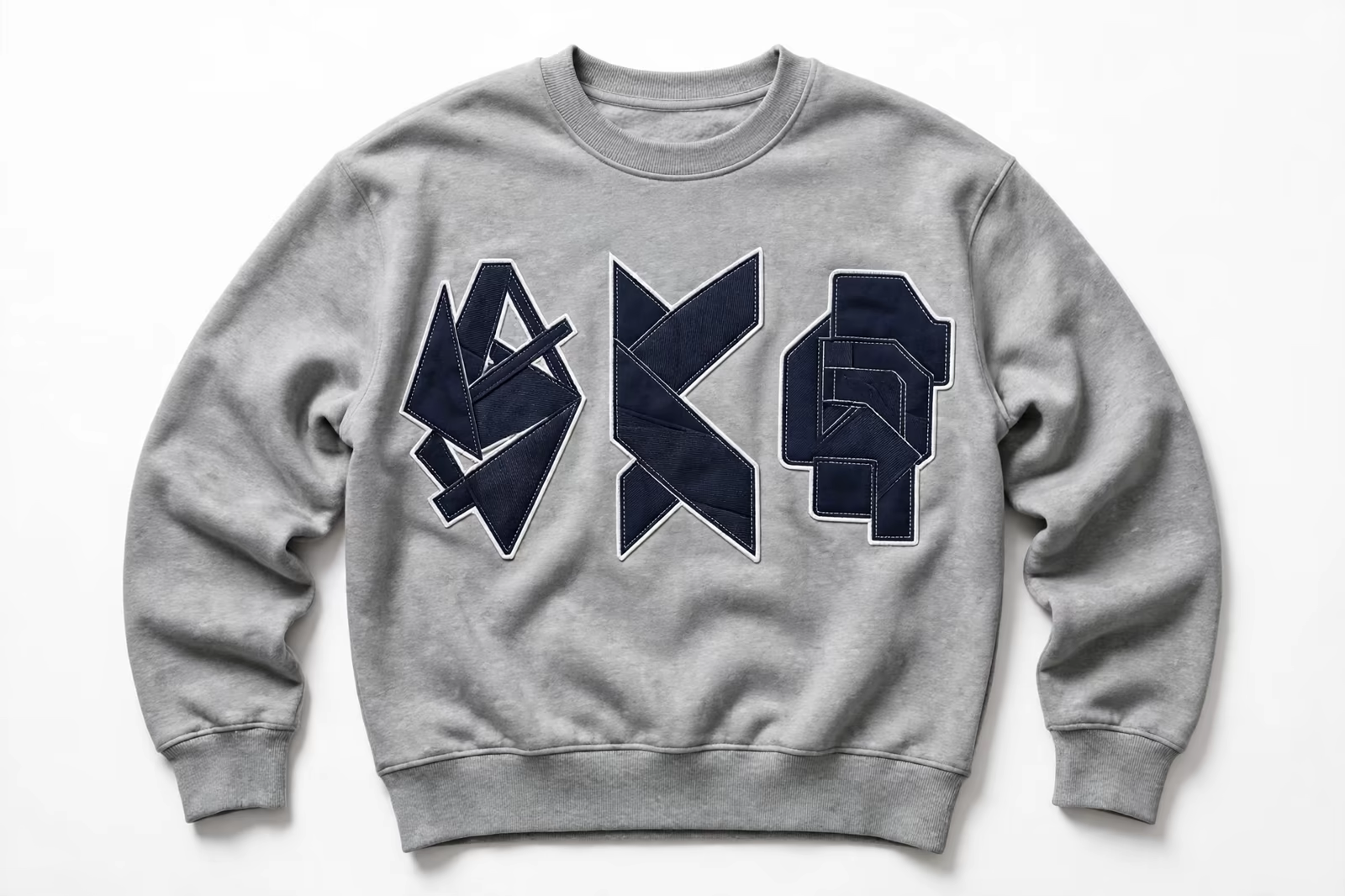
Flat embroidery is not the only language thread speaks. Appliqué sews a shaped piece of fabric inside a stitched border, patches build the whole design on its own ground and attach it ready-made, and chenille-style work piles thread into soft loops with a texture no flat stitch can imitate. For brands, these are not novelties: they are how a logo gains dimension, how a garment gets a collegiate or heritage character, and sometimes how a design too large for economical stitching becomes affordable. Texture is a design decision with production consequences, and it deserves the same planning as the artwork itself.
Applique and patch work is sampled in Bangladesh for brands in Australia, Germany and France, with edge stitching and backing proven on the sew out before bulk production starts.
This guide compares the texture options inside our embroidery programs, on garments such as the crewneck sweatshirt, for the labels we build through brands.
Appliqué: Fabric Doing the Heavy Lifting
Appliqué replaces stitched fill with real fabric: the shape is cut, placed on the garment and secured with a satin border that seals its edge. The interior that flat embroidery would fill with tens of thousands of stitches is cloth instead, which changes everything at once: stitch counts fall sharply on large shapes, the hand feel stays soft where a solid fill would board up, and the design gains a layered, constructed look that reads as craft. Twill appliqué on sweatshirts and hoodies is the classic collegiate language for exactly these reasons.
The technique has its own disciplines. The appliqué fabric must behave with the garment, similar weight and stretch character, or the pair will fight in the wash; its edges must be cut cleanly because the border covers a fixed width and no more; and layered appliqué, shape upon shape, multiplies both the effect and the alignment care. Done well, appliqué looks more expensive than the flat work it replaces while costing less in machine time, a rare honest bargain in decoration.
Patches: The Design That Arrives Finished
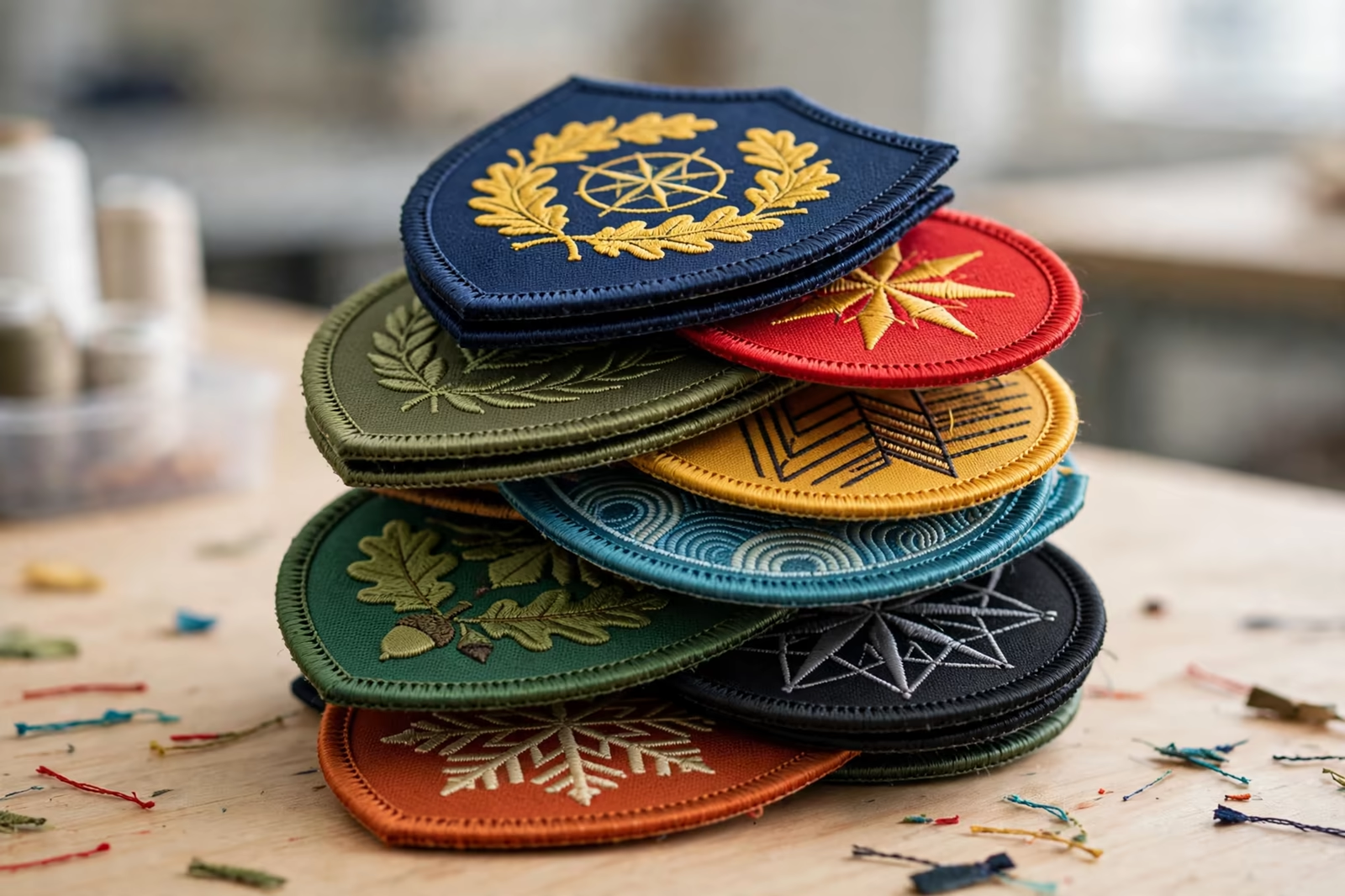
A patch is embroidery completed on its own backing, cut to shape with a finished border, then attached to the garment by sewing, heat seal or both. The separation changes the logistics of a program: patches can be produced in one run and applied across many garment styles and colours, held as decorated stock while garments stay plain until needed, and replaced in the field when a uniform’s patch outlives or outdates its garment. Clubs, services and event programs run on this flexibility.
Patch borders carry the construction: a merrowed edge wraps the patch’s rim in a thick stitched frame, the classic look; a laser-cut edge with satin border reads cleaner and more modern; heat-cut edges suit simple shapes. Attachment is part of the specification, not an afterthought: a sewn patch survives everything the garment does, an iron-on alone may not survive the garment’s own washing regime, and serious programs sew or combine both, deciding with the laundry in mind rather than the application table.
Chenille and Texture Stitches: The Soft Dimension
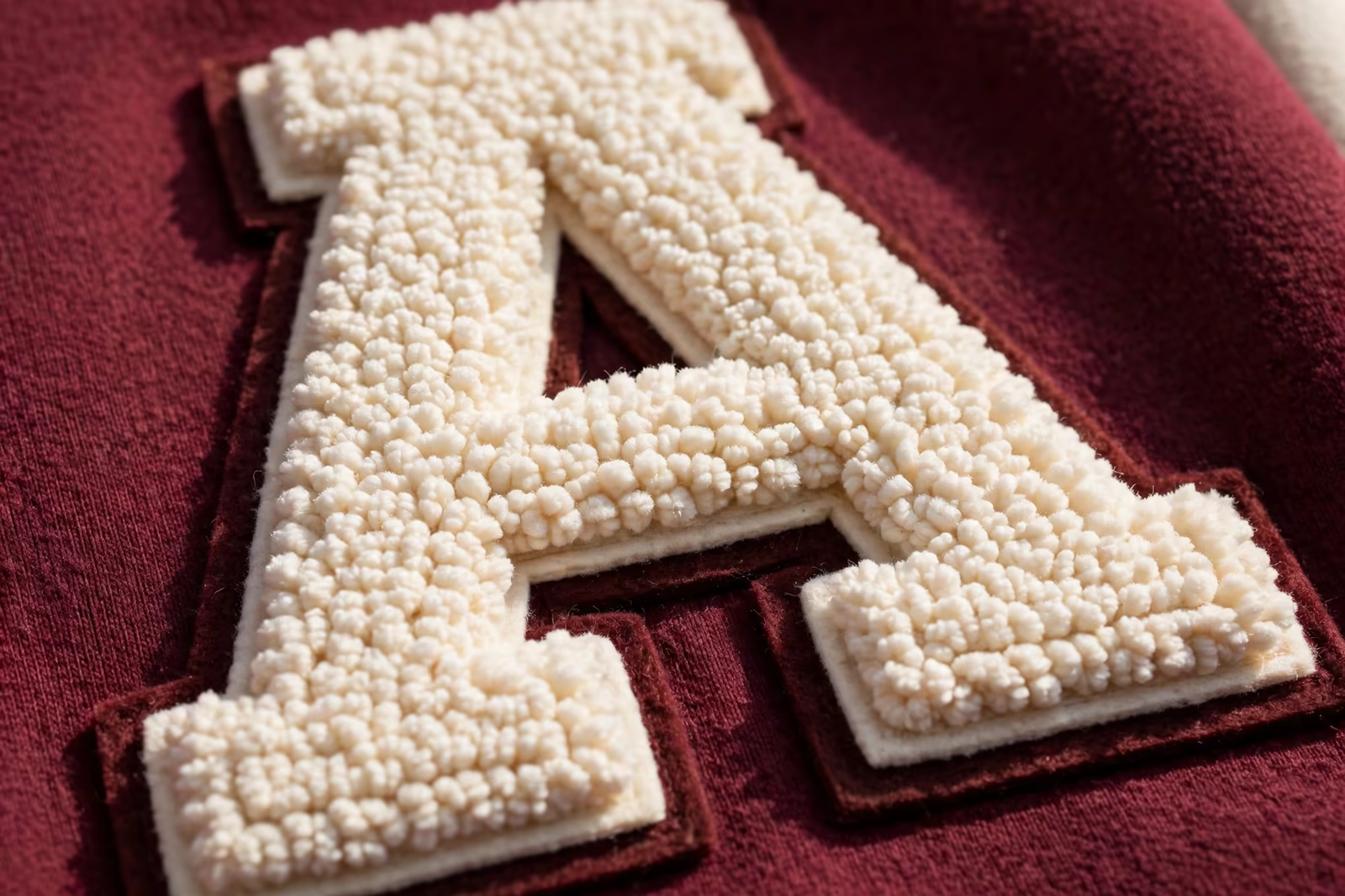
Chenille-style embroidery builds the design from looped, raised yarn with a velvet pile, the varsity letter’s unmistakable hand. It is produced with specialised attachments and yarns rather than standard thread, reads boldly at distance, and forgives simple shapes while punishing fine detail, which is why its natural vocabulary is big letters, numbers and strong symbols. A chenille letter on a sweatshirt does not decorate the garment; it announces it.
Other texture routes sit between flat and chenille: puff embroidery raises satin work over a foam layer for a rounded, almost moulded relief on caps and bold logos; heavy chain and moss stitches add their own grains. Each texture is a material commitment with digitizing of its own, and each is judged, like everything else, by a sample on the production garment, because texture is the quality photographs flatten most dishonestly.
Appliqué Versus Flat Fill: The Honest Comparison
On large filled shapes, appliqué wins on cost, softness and speed; flat fill wins on fine detail, photographic subtlety and small sizes where cutting and placing fabric loses its economy. On durability they tie when both are properly built, the appliqué border and the fill’s density each doing their structural work; on appearance they are simply different dialects, one constructed and layered, the other drawn in thread. The choice is therefore aesthetic first and economic second, and the economics usually agree with the aesthetics on big work.
Hybrid designs often take the best of both: appliqué grounds carrying flat-embroidered detail on top, a twill letter with a stitched mascot inside it, a patch whose border is appliqué and whose centre is fine work. Layering multiplies the sampling care, each element approved in its own construction, and rewards it with designs no single technique could have produced at any price.
Materials for Appliqué: Twills, Felts and Garment Fabric
The appliqué fabric is a material specification like any other. Cotton and polyester twills give the classic smooth ground and cut cleanly; felt gives a soft, matt, heritage surface and forgives raw construction beneath its border; using the garment’s own fabric family, fleece on fleece, jersey on jersey, keeps wash behaviour matched and can look deliberately tonal when the appliqué is cut from a contrasting colour of the same cloth. Metallic and specialty cloth exists for ceremony, with ceremony’s handling care attached.
Colour matching runs fabric-to-thread-to-garment here, three materials that must agree in the buyer’s light. The appliqué material should be sampled in the exact dye lot family intended for production, because cloth shifts between lots more visibly than thread does, and a patch program’s consistency lives or dies on the ground fabric even more than on the stitching.
Durability, Washing and Repair
Textured work fails at its interfaces. An appliqué border that misses the fabric edge by a hair leaves a lip that washing lifts, then peels; a patch attached by tired adhesive lets go at a corner and worries itself off across a season. The construction answers are mundane: borders wide enough to swallow the cut edge fully, appliqué fabric pre-shrunk or matched to the garment so the pair move together, attachment specified for the laundry the garment will meet. Judged at the sample through real wash cycles, these details are visible before they are expensive.
Repair is texture’s quiet advantage. A damaged patch can be removed and replaced where a damaged direct embroidery cannot be unpicked without scarring the garment, and appliqué letters can be re-bordered. Programs with long service lives, uniforms expected to outlast sponsors and seasons, weigh this maintainability deliberately: the decoration that can be serviced is worth a small premium over the decoration that can only be mourned.
Sizing Textured Work: Bigger Reads Better
Texture needs scale. Appliqué shapes below a certain size become fiddly cuttings whose borders crowd out their centres; patches shrink their own embroidery by the width of their frame; chenille turns to moss when its letters are small. Each technique has a floor below which flat embroidery does the same job better, and honest sampling shows the floor quickly, because textured samples at too-small sizes look wrong in the hand in a way no photograph explains away.
The working habit is to design texture at the largest size the placement carries gracefully, then test one step down, not up. Programs discover their optimum at the sample table in minutes. What they must not do is scale a textured design across a size range of garments blindly: the chest version and the cap version of a patch program are different constructions, each drawn for its ground, as placement discipline demands everywhere in embroidery.
Costs: Where Texture Saves and Where It Spends
Appliqué saves machine time on big fills and spends hand time on cutting and placement; patches spend production efficiency to buy program flexibility; chenille spends specialised setup to buy an effect nothing else gives. None of these is the cheap option in the abstract, each is the economical option for its own job, and quotes should show the construction being priced so the buyer compares techniques knowingly rather than discovering the construction from the delivered garment.
Our programs run at our standard minimum of 1,200 pieces per style in up to two colours, with textured work costed from the digitized and sampled construction. Bring the garment and the intended scale to the conversation: texture choices made at artwork size, on the real garment family, are the ones that survive sampling without a redesign, and sampling is where texture programs are truly decided.
Sampling Texture: Judge It in the Hand
Texture is the decoration least honestly served by photographs: pile flattens, relief shadow disappears, an appliqué’s layered edge reads as a printed line. Samples of textured work must be handled, flexed, stretched gently and washed, because their virtues and their failures both live in three dimensions. A buyer approving chenille from a screen has approved a rumour; the same buyer with the sample in hand knows in ten seconds whether the program has its effect.
Keep the approved construction sample as the governing standard, with its materials recorded: appliqué fabric and lot family, border type and width, attachment method, yarn for textured work. Texture programs drift at exactly these unrecorded joints, a felt swapped for a twill, a merrow border for a satin one, and the record is what makes the third season’s sweatshirts match the first season’s photographs of themselves.
When Flat Embroidery Is Still the Right Answer
Texture is a vocabulary, not an upgrade. Fine corporate marks, small chest logos, detailed crests and anything whose authority comes from precision all belong to flat work, where thread control is finest and the finish reads as tailored rather than constructed. A brand that textures everything shouts everywhere and is heard nowhere; the strong programs reserve dimension for the garments and moments that carry it, the sweatshirt’s big letter, the cap’s raised mark, the team’s patch, and keep the rest of the range in disciplined flat stitch.
The factory’s honest role is to argue the routing per design, with samples, before the program commits. Bring the artwork at size and the garment it will live on; the technique that suits it will identify itself in the hand, and a program decorated by fit rather than fashion wears its textures the way it wears its logos, deliberately, in the places they belong.
Frequently Asked Questions
What is the difference between appliqué and a patch?
Appliqué is built on the garment: fabric shapes placed and border-stitched directly onto it. A patch is embroidered complete on its own backing and then attached, by sewing, heat seal or both, which lets one patch production serve many garments and lets patches be replaced later. The two are often combined in layered designs.
Is appliqué cheaper than fully stitched embroidery?
On large filled shapes, usually yes: cloth replaces tens of thousands of fill stitches, cutting machine time while keeping the garment soft. On small or finely detailed designs the cutting and placement labour erases the saving and flat work is both better and cheaper. Scale and detail decide, which is why the construction is quoted from the actual design.
Do iron-on patches stay on through washing?
Heat seal alone is the weakest attachment and can fail under commercial laundering or repeated heat. Programs whose garments live hard washing lives should specify sewn attachment, or heat seal combined with a stitched border, and the choice belongs in the specification, tested on the sample through the garment’s real wash regime.
What designs suit chenille best?
Bold, simple ones: large letters, numbers and strong symbols where the raised velvet pile reads at distance. Chenille cannot hold fine detail, small text or subtle shading, and forcing it to produces mush. It is a specialist texture, sampled on the production garment, and unbeatable inside its own vocabulary.