
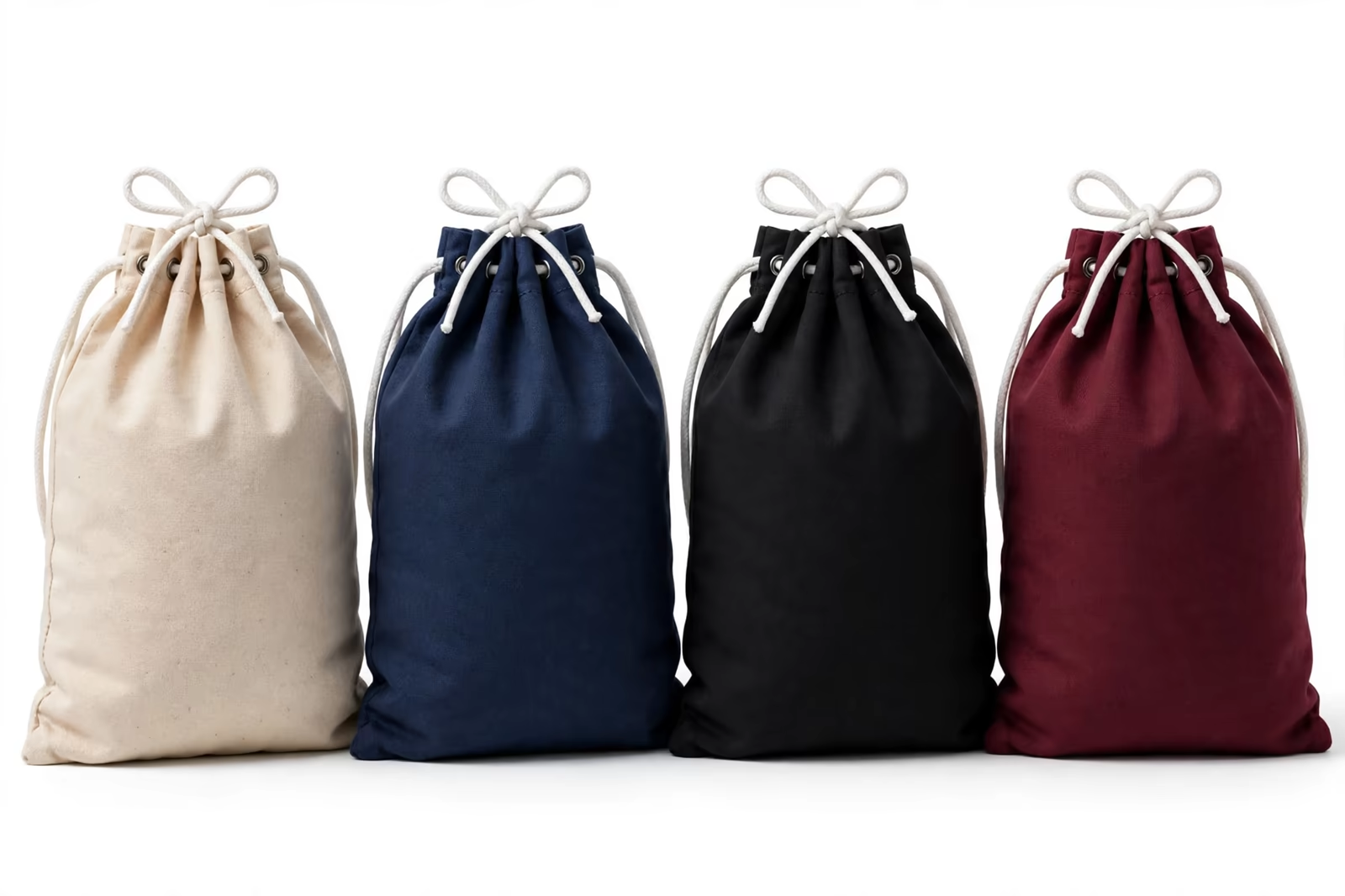
The drawstring bag is the event world’s default container: handed out by the thousand, slung over shoulders all day and kept afterwards for gym kits, shoes and swimming gear. It is also the bag buyers spec fastest and regret slowest, because its weaknesses, a torn eyelet, a cord that saws through its channel, seams that open under a pair of trainers, only appear after the event, when the brand is attached to them.
Drawstring bags are made in Bangladesh for event buyers in the USA, the UK and the Middle East, with cord and eyelet choices proven on samples first.
This guide is built around our drawstring bag range, the screen printing that decorates most event builds and the MOQ and production terms behind a program.
Why Drawstring Bag Construction Matters at Events
An event bag has a strange duty cycle: one intense day of being stuffed, carried and photographed, followed by months of ordinary service in gyms and school corridors. Programs buy it for the first day and are judged on all the others. A bag that survives becomes a small, mobile billboard with a working life far beyond the event budget that paid for it.
The construction decisions are few, which is why each one matters: fabric, cord, eyelets, the channel the cord runs through and the seams that hold the corners. This guide takes them in the order they fail, which is roughly the order a buyer should spec them.
Drawstring Bag Fabrics: Polyester, Cotton Canvas and Non-Woven
Polyester, usually quoted as 210D or 420D, is the event standard: light, water-resistant, cheap to print and strong for its weight, with the higher denier numbers carrying noticeably more abuse. It folds to almost nothing, which is why conference and race programs ship it by the pallet. Its honest limits are feel and heat: it reads synthetic in the hand and softens near high temperatures, so it is never the premium answer.
Cotton and cotton canvas builds serve school, retail and eco-positioned programs, heavier and kinder in the hand, washable, and printable with a softer result. Non-woven polypropylene sits at the pure giveaway end, priced for single-event life and specced honestly as such. Ripstop polyester splits the difference for sports clubs, light like standard polyester with a grid that stops tears running.
Cord Choices: Thickness, Material and Knot Finishing
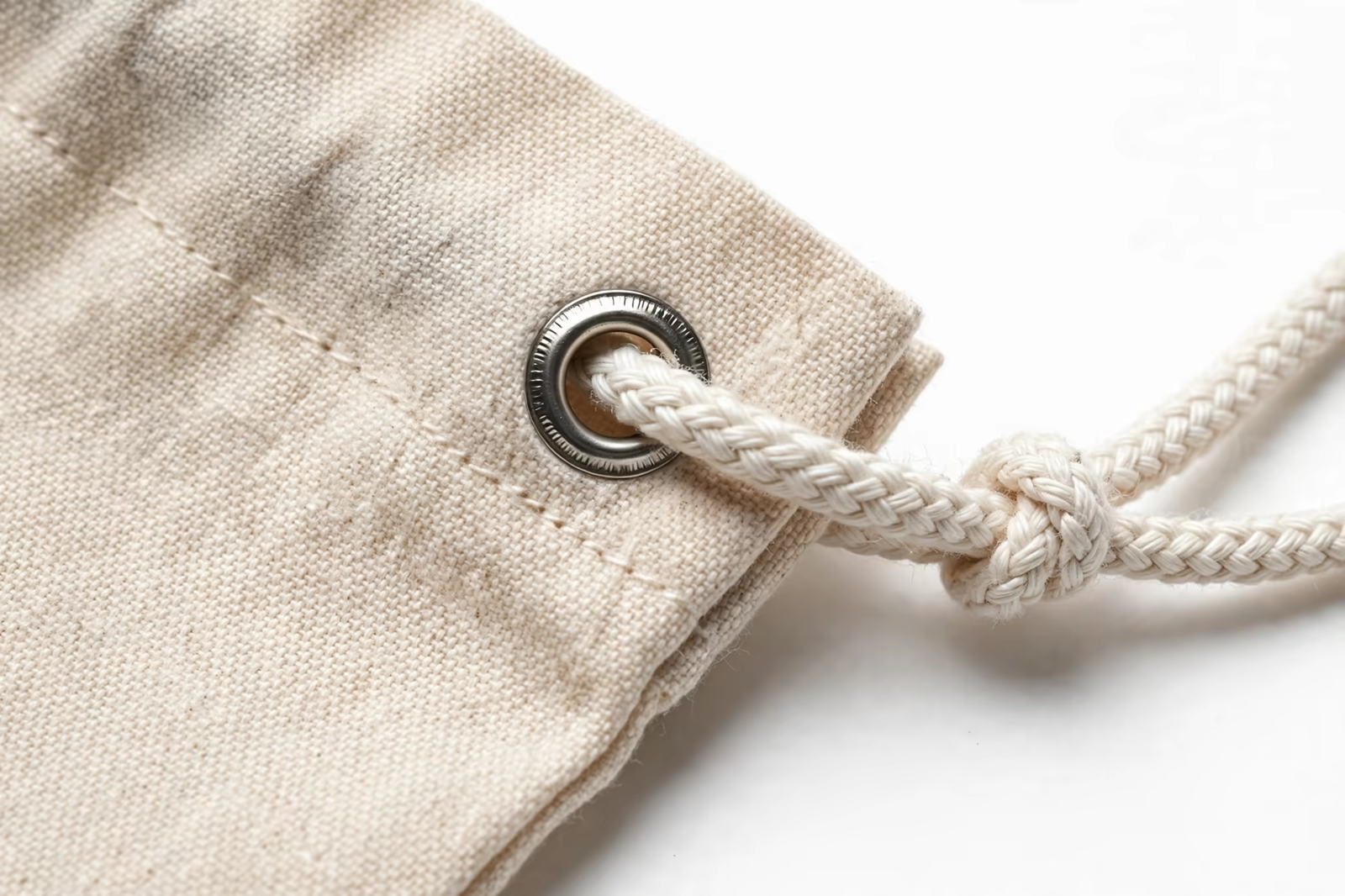
The cord is the bag’s moving part, and it is chosen on three axes. Thickness first: cords around four to five millimetres run smoothly and knot reliably, thinner cords cut into the channel fabric and into shoulders, thicker ones jam in the eyelets they were meant to glide through. Material second: braided polyester cord slides best and resists fraying, cotton cord grips and knots more securely at the cost of absorbing water and dirt.
Finishing third, and most often skipped: cord ends must be heat-sealed or knotted so they cannot retreat into the channel, because a cord lost inside its casing retires the bag on the spot. Double-cord builds, one cord per side so the bag doubles as a backpack, are the event standard; single-cord sling builds suit light promotional use. Shoulder comfort under load is a cord question too, which is why gym programs test with real kit inside, not with the bag empty.
Eyelets: Metal, Plastic and Stitched Reinforcement
Eyelets are the small rings the cord passes through at the bag’s bottom corners, and they carry the entire load’s stress at two points. Metal eyelets, properly set with the fabric gripped between ring and washer, are the durable standard for any bag expected to carry weight repeatedly. Plastic eyelets cost less and suit light builds, with an honest life measured in gentler use.
The third option is no eyelet at all: the cord anchors through a reinforced stitched tab or a bartacked loop of webbing, which removes the tear-out failure mode entirely and is increasingly the choice for sports programs. What fails is never the ring itself but the fabric around it, so reinforcement patches or doubled fabric at the corners matter more than the eyelet material printed on a quote.
The Channel: How the Drawstring Casing Is Built
The channel is the folded tunnel at the bag’s top that the cord runs through, and its construction decides how the bag closes for its whole life. A channel stitched from the bag’s own folded top is standard; a separate casing strip in contrast fabric is both a design detail and a stronger build. Width must match the cord with room to travel: a tight channel makes every opening a small wrestling match.
Channel seams take the strain each time the bag is yanked shut, which across a school year is thousands of pulls. Buyers should check the sample’s channel corners, where the stitching turns, because that junction is where casings split. A bag that closes smoothly with one pull when new will still be closing smoothly in year two if the channel was built generously and stitched flat.
Colour deserves one honest paragraph of its own. Dark polyester hides the scuffs of gym floors and school corridors and keeps sponsor artwork readable for years, while white and pale builds show every mark but carry full-colour print beautifully for a single season. Programs ordering both should expect the two to age differently and brief them as different products, because they are.
Sizes for Gym, School and Event Programs
Drawstring sizes cluster around three honest formats. The standard event bag near 34 by 42 centimetres swallows a kit bundle, a water bottle and event literature. Smaller builds near 28 by 36 serve shoes, swimming gear and children’s programs. Oversize gym builds near 40 by 50 take boots, balls and a change of clothes without the seams being asked to negotiate.
Size interacts with print and price more than buyers expect: the printable field scales with the panel, the fabric cost steps with the format, and freight on a folded-flat product is driven by weight and bale density rather than volume. Spec the size from the largest load the program honestly expects, because an event bag that cannot close over its contents fails its only job in public.
There is also a quiet sustainability conversation in this category that buyers handle best plainly: a durable bag reused five hundred times is the environmental choice whatever it is made from, and a flimsy bag landfilled after one event is not rescued by a natural fibre label. Build quality is the greenest specification a drawstring program can write.
Print Options for Drawstring Bags Your Program Will Carry
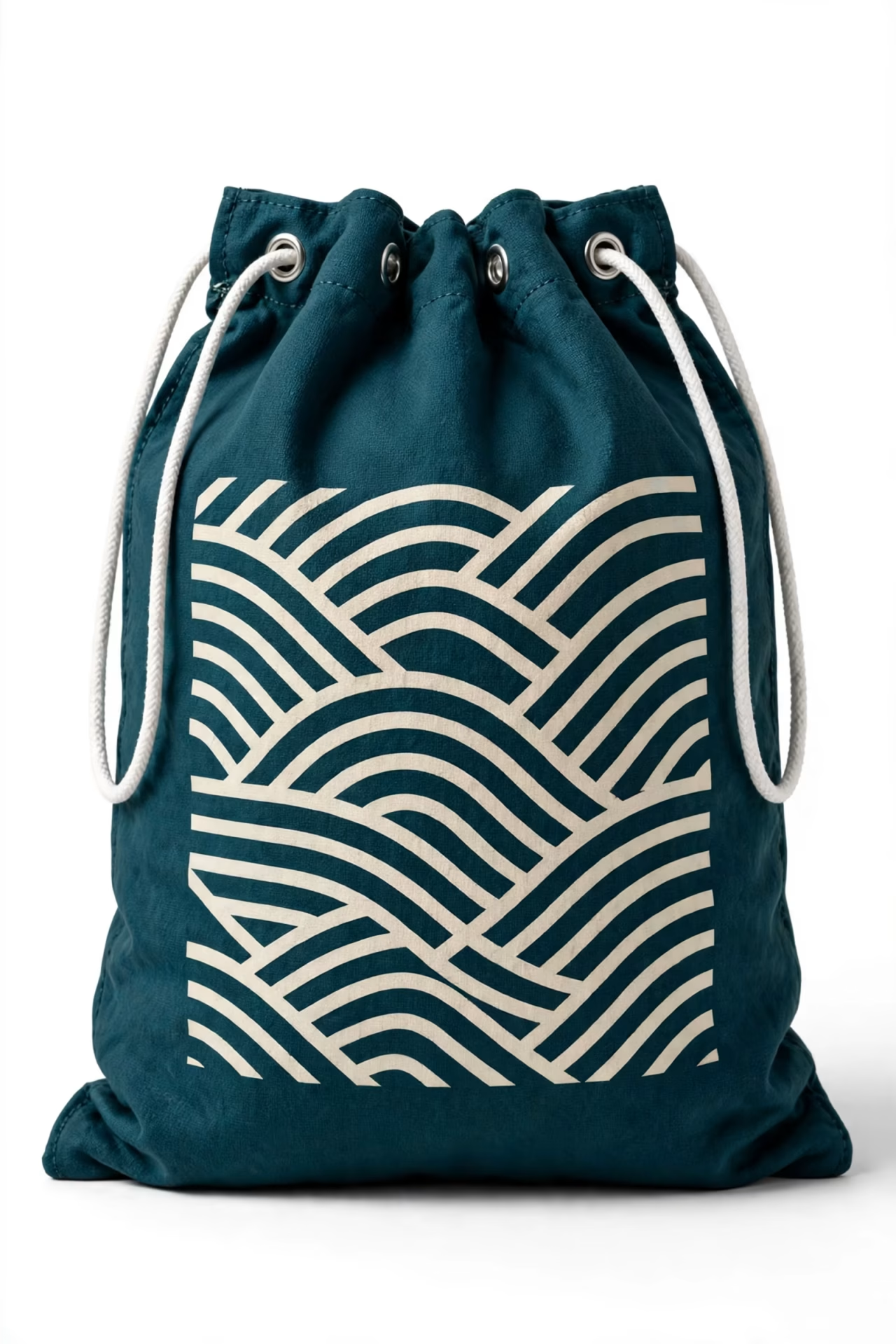
The drawstring bag offers one of promotional printing’s best canvases: a large, flat, uninterrupted panel on each face, worn at back height where every camera at an event can see it. Screen printing is the default method, sharp and economical in one to three colours, and it suits polyester and cotton alike with the right inks.
Full-colour designs move to transfer or digital print, priced per piece and sampled for hand feel, because a stiff transfer across a bag that scrunches into a ball will crack exactly where the bag flexes. Sublimation serves white and light polyester all-over builds. Print placement should respect the channel and the corner anchors: artwork kept clear of the top casing and the bottom stress points survives longest and reads cleanest.
Back Panels, Mesh and Pocket Additions
Beyond the basic build, three additions change a drawstring bag’s usefulness. A mesh panel or mesh side pocket ventilates gym kit and finds the water bottle without opening the bag, a sports club favourite. A zip pocket on the front panel gives valuables a home that the main compartment, open to every dip of a hand, cannot.
Reflective trims serve running and cycling programs whose bags are seen at dusk. Each addition costs, complicates the print layout and must earn its place in the brief; a race bag for five thousand runners and a school bag for a September intake are different products wearing the same silhouette, and the additions are where they part company.
Strength Testing: Seams, Corners and Cord Anchors
An honest sample test for a drawstring bag takes ten minutes and no equipment. Load the bag with five kilograms, books or bottles, and lift it by the cords alone fifty times. Then pull each cord anchor sideways, hard, the direction a bag gets yanked off a peg. Finally work the drawstring open and closed thirty times and inspect the channel corners.
Side seams should be double-stitched or overlocked with a proper allowance, bottom corners reinforced where the eyelets or tabs anchor, and the fabric at the anchor points doubled on any bag specced for real loads. Programs that run this test at sampling almost never meet the failures in the field, because weak builds announce themselves immediately and politely, in the office rather than at the event.
None of this requires laboratory equipment or outside testing houses, only a sample, a stack of books, a sink for the wash check and the discipline.
Specifying Drawstring Bags for Your Event or Club
Specify from the failure points backwards: anchors and corners for the load, channel and cord for the daily closing, fabric for the feel and the print, size for the contents. Quantities follow our standard minimum of 1,200 pieces per style in up to two colours, with print colours agreed separately so the quote compares like with like.
Approve the sample loaded, yanked and washed, not folded flat on a table. The drawstring bag is the cheapest branded product most programs buy and the one carried longest afterwards, which makes its ten-minute strength test the best-value quarter hour in the whole order.
Frequently Asked Questions
What fabric is best for drawstring gym bags?
Polyester in 420D is the gym standard: light, water-resistant, strong for its weight and easy to wipe down, with ripstop versions adding tear resistance for rougher use. Cotton canvas suits programs selling a natural, premium feel and home washing. The choice follows the kit: wet swimming gear and muddy boots argue for polyester, school and retail programs often prefer cotton.
Metal or plastic eyelets on drawstring bags?
Metal eyelets, properly set over reinforced fabric, last longest under repeated load and suit gym, school and club bags. Plastic eyelets are fine for light, short-life promotional builds. The strongest option removes the eyelet entirely: a bartacked webbing loop or reinforced tab anchor cannot tear out of the fabric, which is why many sports programs now spec it.
How much weight can a drawstring bag carry?
A well-built 420D polyester bag with reinforced anchors carries five kilograms comfortably and survives peaks above that. Light non-woven and thin polyester builds should be kept to two or three kilograms. The anchors and corner seams decide the real limit, not the fabric alone, which is why the loaded lift test on the sample matters more than any number on a quote.
Can drawstring bags be printed on both sides?
Yes, both faces carry a large flat print field, and many programs print the main design on one side and a sponsor list, schedule or secondary mark on the other. Each side is its own print pass in the price. Keep artwork clear of the top channel and the bottom anchor corners so the print is not stressed where the bag works hardest.