
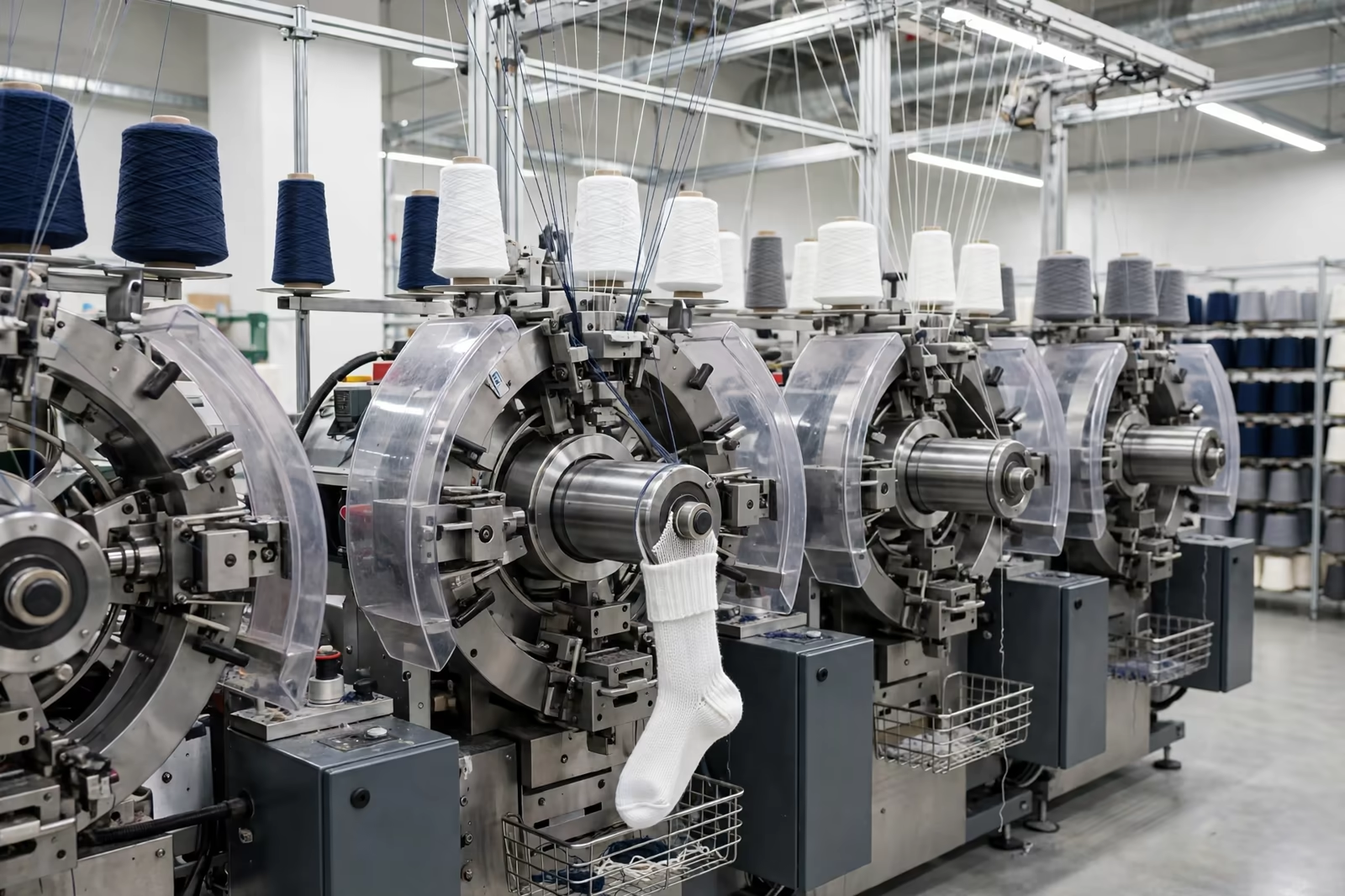
A custom sock is the smallest garment in a merch range and, stitch for stitch, the most engineered. It is knitted in the round on a cylinder of fine needles, cushioned where feet actually strike, and decorated with logos that are not printed on afterwards but knitted into the fabric itself. Brands that understand how socks are made get a product people genuinely keep; brands that treat them as printed tubes get returns and one-star reviews about holes.
Custom socks are knitted in Bangladesh to the size run and logo artwork the buyer approves, with cushioning and jacquard definition checked on the first pair off the machine.
This guide is built around our socks range, the brands programs they usually join and the quote details that shape a sock order.
How Custom Socks Are Knitted: Cylinders, Gauges and Needle Counts
Socks are knitted on circular machines, a cylinder of needles forming a seamless tube that becomes the leg, heel and foot. The needle count is the sock’s gauge and its personality: common counts run from 96 needles for chunky casual socks through 144 and 168 for standard dress and merch socks to 200 for fine, smooth, high-definition knitting.
Higher needle counts knit finer yarns into smoother fabric with crisper jacquard detail, at slower speeds and higher cost. Lower counts knit faster and bolder, with a hand-made character some brands choose deliberately. The machine count also limits the design: fine logos, small text and tight patterns belong on 168 and 200 needle builds, bold stripes and big marks are happy anywhere. A sock brief that names its needle count has already made half its quality decisions.
Jacquard Logos: Knitted In, Never Printed On
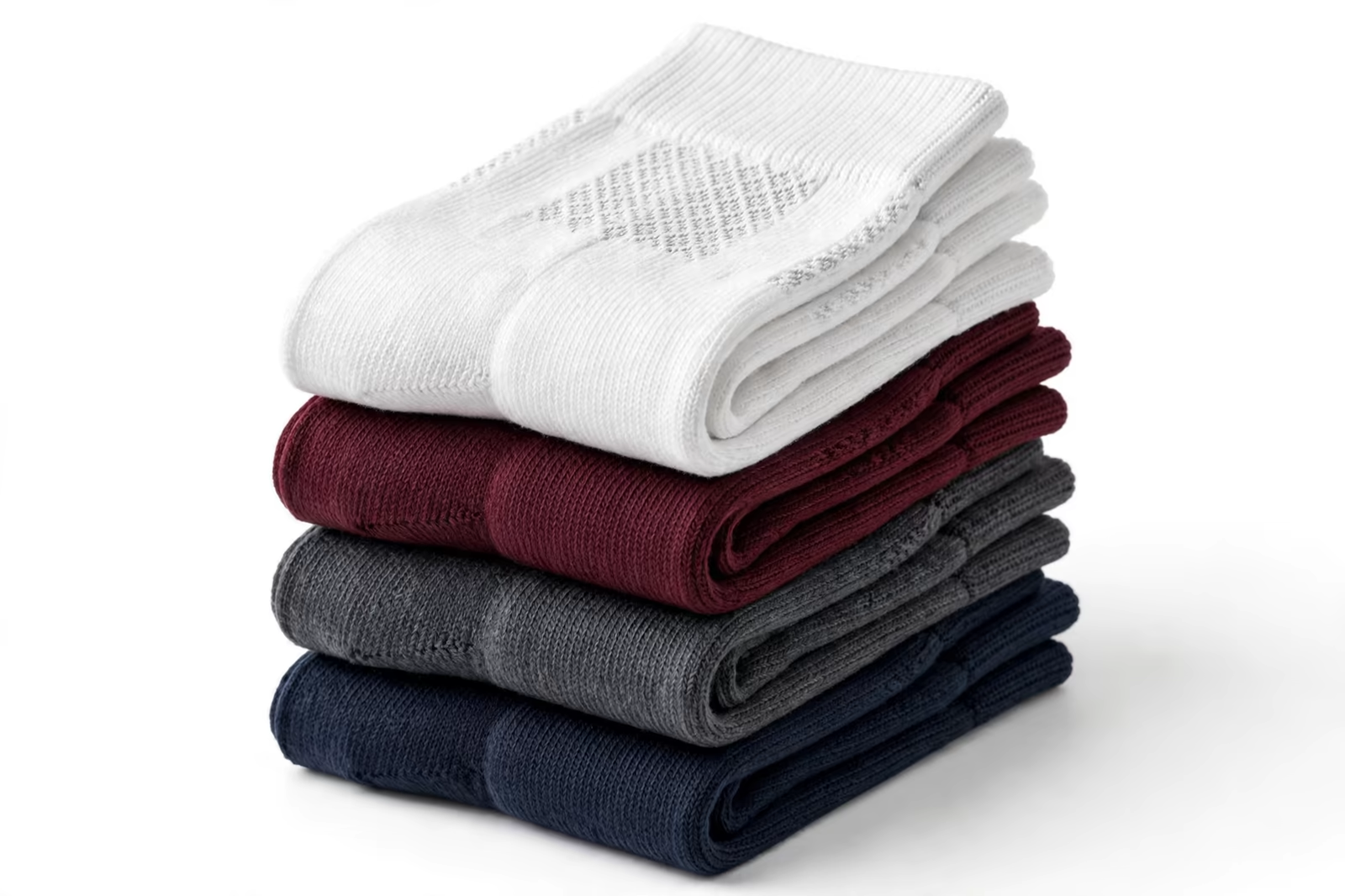
The jacquard logo is the custom sock’s signature: the design formed by the knitting itself, coloured yarns carried around the cylinder and worked into the fabric where the pattern calls for them. Because the logo is structure rather than surface, it cannot crack, peel or wash out, and it looks as good inside the sock’s second year as on the day it was made.
Jacquard has honest rules. A design uses a limited palette, typically up to four or five colours plus the ground, because every colour is a yarn feed the machine must carry. Fine lines and tiny text blur at sock scale; bold shapes, stripes, spots and strong wordmarks knit beautifully. The inside of a jacquard sock shows the design’s float yarns, the loose strands carried behind the pattern, which better builds keep short and tidy so toes do not catch. Approving a jacquard sample means turning it inside out as well as reading the outside.
Sock Fibres: Cotton, Combed Cotton, Wool and Performance Blends
Combed cotton is the merch standard: soft, breathable, printable-adjacent in feel and kind to skin across a long day, usually blended with nylon for strength and elastane for hold. Standard cotton costs less and feels it after twenty washes, which is why the combed upgrade is the one sock buyers name most often when they reorder.
Merino wool blends serve outdoor, hiking and premium winter programs, warm, odour-resistant and more delicate to wash. Performance sport builds use nylon and polyester-rich blends with moisture management, mesh ventilation and targeted compression. Bamboo and modal fibres appear in lifestyle ranges for softness. Every fibre choice is really a care and durability choice wearing a comfort costume, and the brief should say which matters most.
Cushioning Zones: Where Socks Earn Their Comfort
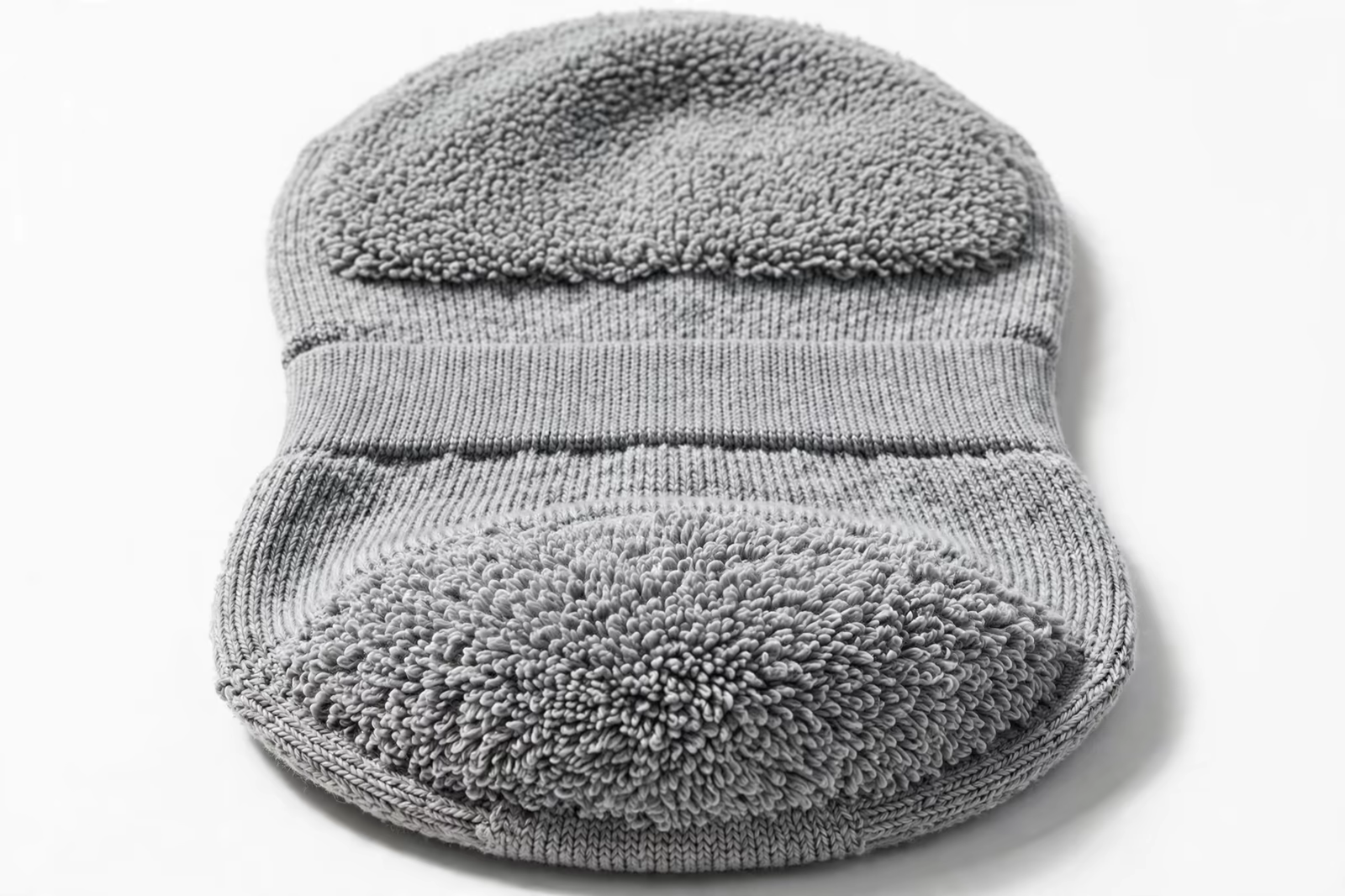
Cushioning is terry loop knitted into selected zones, and its map is the difference between a sock and a good sock. Full cushioning wraps the whole foot in terry, warm and plush, the hiking and winter choice. Half cushioning, the common sports and everyday build, terry-loops the sole, heel and toe while leaving the instep lighter and cooler.
Targeted builds add padding exactly at the ball and heel strike points and keep the rest fine, which suits running and court sports. Cushioning costs yarn and time, changes the sock’s fit inside a shoe, and must be specced with the footwear in mind: a fully cushioned sock in a tight dress shoe is a complaint wearing a disguise. Sample socks worn in the buyer’s own shoes settle arguments that swatches cannot.
Heels, Toes and the Fits That Prevent Holes
Holes are born at the heel and toe, and construction decides when. A properly knitted Y-heel or short-row heel shapes a pocket that holds the foot’s curve, so fabric is not stretched thin across the heel bone where it rubs. A flat, unshaped tube sock pulls tight at exactly that point and wears through first, which is why tube socks are priced as they are.
Toes close two ways: a linked, hand-finished seam that lies almost flat and disappears inside a shoe, or a machine seam that is faster and slightly more present. Reinforced heel and toe zones, knitted with extra nylon in the blend, extend life where friction lives. Buyers comparing quotes should ask about heel shape, toe closing and reinforcement by name, because none of the three appears in a product photograph.
Crew, Quarter, Ankle and Knee: Lengths and Their Programs
Length is program logic. Crew socks, the mid-calf standard, carry the largest jacquard canvas and anchor most merch and team ranges. Quarter lengths sit above the ankle bone for sport and summer programs. Ankle and trainer builds hide inside the shoe with a small heel tab, the logo reduced to a cuff hit or a footbed mark, and no-show builds go further still with silicone grips to stay in place.
Knee-high serves field sports, equestrian and traditional school programs, with more knitting time and more design room. Each length is a different product on the machine, with its own sizing behaviour, and programs that mix lengths should sample and approve each one rather than assuming the crew’s approval covers its shorter cousins.
Ribbing, Cuffs and Staying Up
A sock that slides down is returned, mocked or binned, and staying up is a cuff engineering question. True rib, knitted with alternating raised and recessed columns, grips by structure and recovers after washing. Elastane content through the leg, commonly two to five percent, does the quieter half of the work, and a double-layer cuff adds hold and a premium finish at the top edge.
Compression-style cuffs borrow from medical knitting, graduated pressure that athletes feel as security. The sampling test is unglamorous and decisive: wear the socks for a full day in real shoes, wash them, and wear them again. A cuff that survives day two at the same height it started day one is a cuff worth ordering by the thousand.
Sizing Socks: Ranges, Stretch and Market Differences
Sock sizes are ranges, not points, because knitted fabric stretches to cover several shoe sizes per size step. A typical adult program runs two or three sizes across the whole shoe range, each knitted to its own dimensions rather than stretched from one. Children’s programs size more tightly because small feet change fast.
Ranges differ by market more than buyers expect: the same nominal size covers different shoe spans in Europe, the UK and the USA, and unisex ranges need their stretch tested at both ends of the span. The spec should state shoe sizes in the destination market’s own system and let the factory translate, rather than the other way around.
Colour approval on socks follows yarn, not screens. Jacquard colours are the actual yarns the machine carries, chosen from a knitting range and approved as physical cones or knitted swatches beside the artwork. A screen can promise a shade that no stocked yarn honestly holds, and the programs that approve yarn early are never surprised by the gentle difference between a monitor at noon and a fibre under the shop light where the customer decides.
Sublimation and Printed Socks: The Other Route
Not every decorated sock is jacquard. Sublimation printing on white polyester socks carries photographic, full-colour, all-over artwork that knitting cannot attempt, and it serves fan merch, event socks and bold fashion statements. Its trade-offs are honest ones: the print stretches with the sock, so artwork lightens over the heel and ankle where the fabric extends most, and the inside stays white.
Printed socks and jacquard socks are not rivals so much as different products: one for image, one for endurance. Programs sometimes run both, a knitted staple in the brand’s core design and printed specials for campaigns, each bought for what it does best.
Packaging deserves a sentence in any sock brief, because socks are rarely sold loose. Header cards, band rolls and paired polybags each present the product differently and protect the knitting differently in transit, and retail programs should approve the packed article, not only the bare sock, since the packed article is what the customer actually meets first on the rail.
Specifying Custom Socks for Your Brand or Club
Specify in machine order: needle count for the design’s detail, fibre blend for the wear and care, cushioning map for the activity, heel and toe construction for the lifespan, then length, cuff and sizing ranges for the market. Quantities follow our standard minimum of 1,200 pairs per style in up to two colourways, with jacquard colours counted inside the design’s palette.
Approve the sample worn for a day and washed, inside out as well as right side out. A sock is judged at the heel in month three, long after the launch photographs, and the buyers who test for that day are the ones whose sock programs get reordered.
Washing behaviour belongs in the same approval round, because elastane and dark cotton shades both relax in the first cycles, and a sock that shrinks or sags after washing will do it in the customer’s drawer, not in the sampling room.
Frequently Asked Questions
What does needle count mean on custom socks?
It is the number of needles on the knitting machine’s cylinder, and it sets the sock’s fineness. Counts of 96 to 144 knit chunkier casual and sport socks; 168 to 200 knit finer, smoother socks that hold detailed jacquard logos crisply. Higher counts cost more and run slower, so the design’s detail should choose the count, with bold logos happy at standard counts.
Are jacquard logos better than printed socks?
For durability, yes: a jacquard logo is knitted into the fabric, so it cannot crack, peel or fade away, and it survives the sock’s whole life. Printed and sublimated socks win on artwork, carrying full-colour photographic designs jacquard cannot knit. Most brands use jacquard for their core staple socks and print for campaign pieces, rather than forcing one method to do both jobs.
How long should custom socks last?
A well-built cotton-blend sock with a shaped heel, reinforced heel and toe zones and a linked toe seam should survive regular weekly wear and washing for well over a year. Tube socks and unreinforced builds wear through at the heel far sooner. Lifespan is mostly construction, which is why heel shape and reinforcement belong in the written specification, not in hope.
Can one sock size really fit everyone?
Within a range, mostly yes, because knitted fabric stretches, but one size stretched across an entire adult shoe range fits nobody well at the extremes. Two or three sizes across the range is the honest standard for retail and team programs, each knitted to its own dimensions. Children’s programs need tighter size steps again, because small feet change quickly.