
Pick up two garments of identical quality and the one that feels like a brand, rather than a product, is usually decided by pieces of fabric and card smaller than a postage stamp. Woven labels, printed labels and hang tags are the trims that tell a customer who made the garment, how to care for it and whether anyone cared about the details. Private label programs live or die on these small decisions, and they are almost always the last items specified and the first ones a customer touches.
Woven labels and hang tags are produced in Bangladesh for brands in the USA, Germany and Canada, matched to the garment order so branding arrives ready to attach.
This primer connects to our brands work, the garments the trims ride on, such as the classic crew-neck t-shirt, and the wider services behind a finished program.
Why Labels and Tags Decide Whether a Garment Looks Finished
A label works three jobs in silence. It identifies the brand at the exact moment of inspection, in the hand at a rail or on the skin against a neck. It carries the legal information a garment cannot legally travel without. And it signals quality in the way all small, well-finished things do: nobody praises a beautiful woven label out loud, but everybody registers the cheap printed one that scratches.
Retail buyers read trims the way editors read footnotes. A damask woven label with a clean fold says the program had a budget and a standard; a fraying straight-cut label with blurry type says the opposite, whatever the garment itself cost. Because trims are bought in thousands and attached in seconds, they are also where consistency is easiest to win and most embarrassing to lose.
Woven Labels: Damask, Satin and Taffeta Weaves
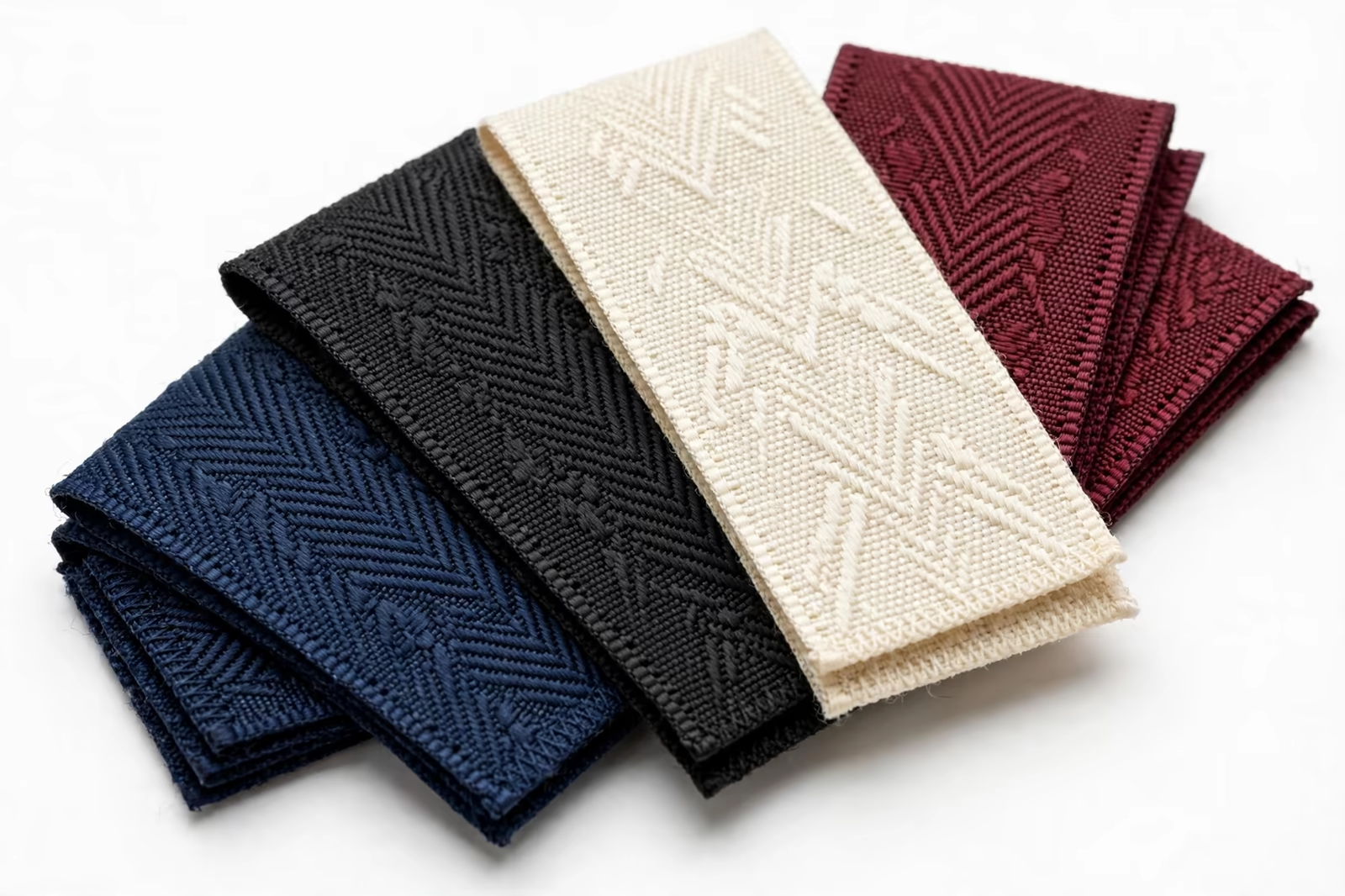
Woven labels are made on looms, the design formed by the weave itself, which is why they feel permanent and wash for the garment’s whole life. Damask is the premium standard: a fine, dense weave that holds small lettering and detailed logos with soft edges against the skin, the default for main brand labels in mid and premium apparel.
Satin weave brings a smooth, slightly lustrous surface that reads elegant and suits fashion and lingerie-adjacent programs, though its fine detail sits a step below damask. Taffeta is the economy weave, crisper and stiffer, entirely respectable for care labels, size tabs and workwear where softness matters less than survival. The weave choice is a hand-feel choice as much as a budget one, and samples should be rubbed against a wrist, not just read.
Printed Labels: Satin, Cotton and Tyvek Options
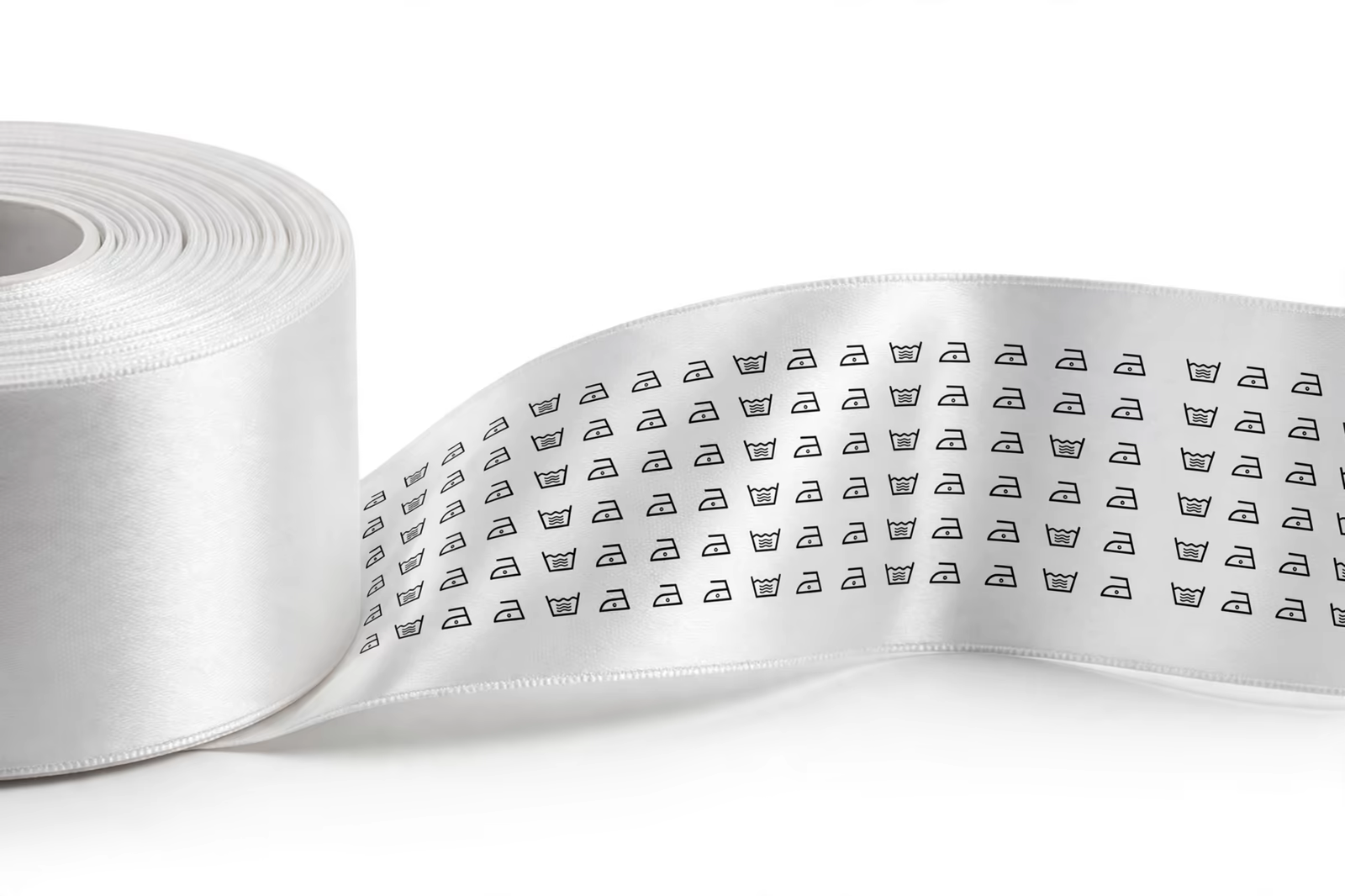
Printed labels trade the loom for a press, ink on a ribbon of fabric or film, and they win where woven cannot go: very fine legal text, many languages, variable information and small runs. Satin ribbons print smoothly with a soft sheen and fold comfortably into neck and side seams. Cotton ribbons print with a matte, natural read that suits organic and craft-positioned brands.
Tyvek and synthetic films print crisply and survive industrial washing and outdoor use, which is why they dominate care labels in workwear and outerwear. The honest limits of print are wash fade over years and a flatter feel than weave, which is why most considered programs print the information layer and weave the brand layer, each where it is strongest.
Heat Transfer Neck Labels: The Tagless Route
Heat transfer labels print the brand directly onto the garment’s inner neck, no sewn label at all. The comfort argument is real: nothing scratches, nothing flips out in photographs, and athletes and children, the two groups who complain loudest about labels, get silence. Sportswear and basics programs have largely standardised on transfers for exactly this reason.
The trade-offs are durability and feel at the extremes: a good transfer survives the garment’s life, a poor one cracks and peels in the wash, and transfers need a smooth, suitable fabric surface to bond honestly. Programs using transfers keep a small woven label somewhere else, a hem or side seam hit, so the brand still exists as an object and not only as ink.
Label Folds and Placements: Centre Fold, End Fold, Straight Cut
How a label folds decides where it can live. Centre fold labels loop over a seam, the classic neck label arrangement and the standard for side-seam care labels, with the brand on the front face and information folded behind. End fold labels fold under both short edges for a clean, soft perimeter, sewn flat at the neck or chest for premium programs and visible brand hits on pockets and hems.
Straight cut labels are heat-sealed at the edges and sewn on all four sides or into a seam, the economy option whose comfort depends entirely on placement and edge quality. Placement is a small design language of its own: centre back neck for the main label, side seam for care, hem or sleeve for a quiet exterior brand mark that photographs well without a logo print.
Choosing Hang Tags That Make Garments Look Retail-Ready
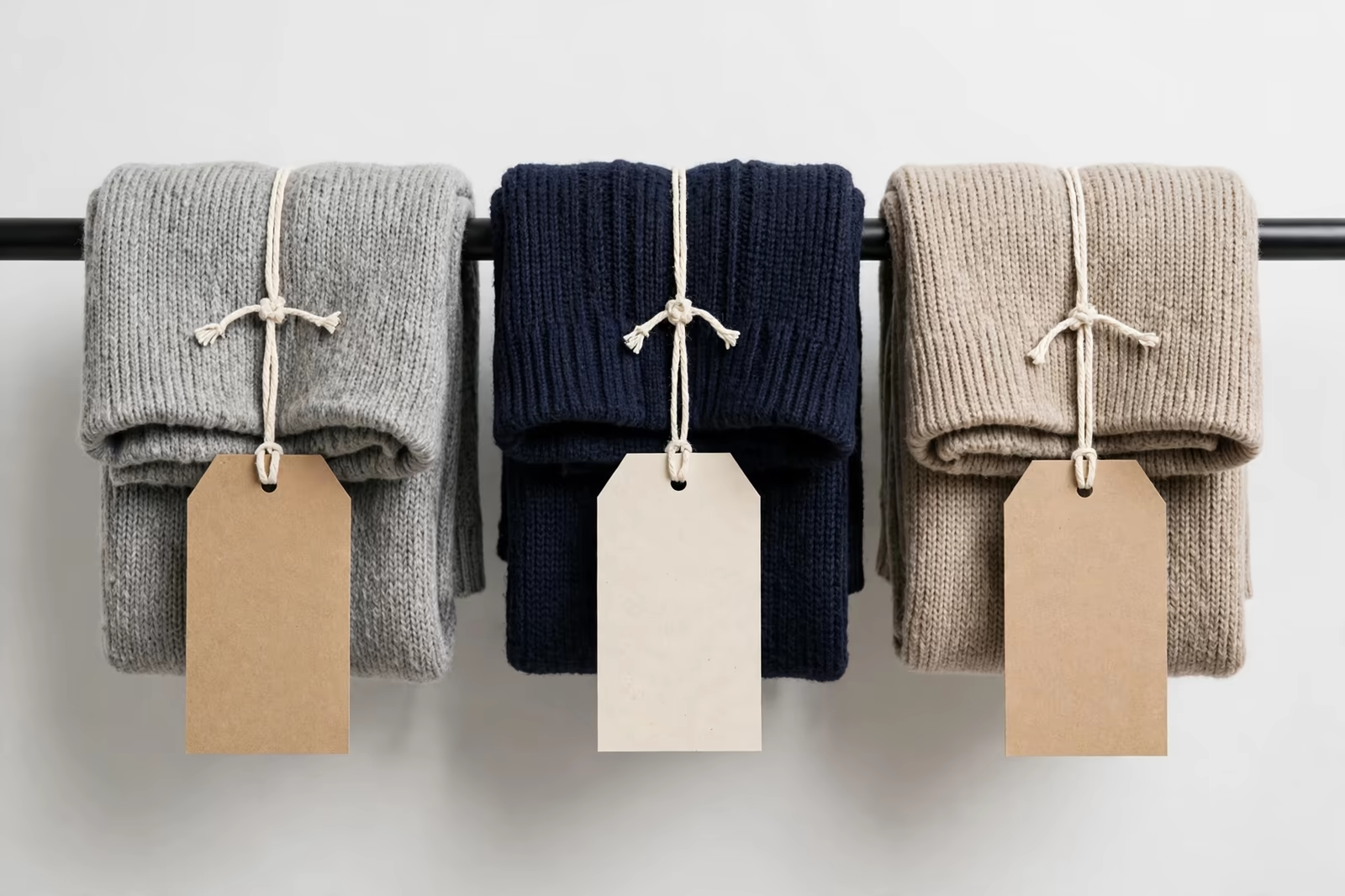
The hang tag is the garment’s first price of admission to a rail, a piece of card that carries the brand, the story and the barcode into the customer’s hand. Stock weight is the first decision: tags around 300 to 400 GSM feel substantial and resist dog-earing on a rail, while lighter stocks bend, curl and cheapen everything hanging beside them.
Finishes do the talking after weight: matte for quiet premium, gloss for colour pop, soft-touch lamination for fashion programs, uncoated kraft for honest workwear and eco stories, foil and embossing where the price point allows theatre. The attachment matters as much as the card: cotton string with a seal, jute for natural brands, plastic fasteners for volume basics. A tag that tears off in the stockroom or strangles the garment’s drape on display has failed before its design was ever read.
Size and care tabs deserve a mention as the smallest members of the family: tiny woven or printed tabs carrying only a size letter or a care mark, folded into side seams and hems. They cost almost nothing, they are what a wearer actually consults for the garment’s whole life, and their legibility at four millimetres wide is a small masterclass in why trim artwork is simplified so firmly.
Care and Content Labels: The Legal Layer
Beneath the branding sits the law. Most markets require a garment to state its fibre content, its country of origin and its care instructions in defined forms, and the care label is where those duties usually live together. Symbols follow international conventions, wording follows the destination market’s language and legal habits, and the brand owner, not the factory, carries the legal responsibility for accuracy.
This is why care labels are designed, not improvised: the fibre percentages come from the actual fabric specification, the care symbols from the most delicate component of the garment including its trims, and the origin statement from the rules of the market where the garment will be sold. Programs selling into several regions either carry a multi-panel label or market-specific label sets, decided at the brief stage, not at the shipping stage.
Sustainability claims gather around trims as well, and they should be made as carefully as anywhere else. Recycled yarns exist for woven labels, recycled and FSC-certified stocks for hang tags, and cotton strings that replace plastic fasteners gracefully, all of them real options a program can specify and verify rather than merely print beside a leaf symbol.
Designing Labels That Read at Real Size
Label artwork fails at scale more than anywhere else in branding. A logo that sings on a screen becomes soup at twelve millimetres unless letterforms are bold enough, spacing is generous and detail is edited with the courage trims demand. The professional habit is to print artwork at one hundred percent size and judge it across a room and against skin, in the lighting of a shop rather than a studio.
Colour behaves differently in yarn than in ink: woven colours are thread colours from a range, matched physically, while printed labels can chase a Pantone more closely and fade differently over time. Approving a woven label from a paper proof is the classic small mistake with a long life, because the label approved is the label sewn into ten thousand garments.
Barcodes and price tickets ride on the hang tag in most retail systems, and they bring discipline: a quiet zone around the code, a minimum print contrast, and a position that scanners can reach without unfolding the garment. Programs supplying chain retailers receive the retailer’s ticketing specification, and the tag design has to satisfy that document as it satisfies the brand book beside it on the designer’s desk.
Ordering Labels and Tags With a Garment Program
Trims are ordered on their own timeline inside the garment program: woven labels carry loom setup and sampling, printed labels are faster, hang tags ride with print production, and all three must arrive before the garment line reaches its finishing stage. The practical rule is to approve trims with the first garment sample, not the last, because a late label delays a finished garment exactly as surely as late fabric.
Quantities follow the garment order with a sensible overage for seconds, samples and the small losses of any sewing floor. On our programs, labels and tags are specified alongside the garment itself, with the same minimum order of 1,200 pieces per style framing the trim quantities, so the brand layer and the garment layer are planned as one product rather than reconciled at the end.
Frequently Asked Questions
Woven or printed labels: which is better?
They do different jobs best. Woven labels, especially damask, are the premium and permanent choice for the main brand label: soft, detailed and wash-proof for the garment’s life. Printed labels win for information: fine legal text, multiple languages and small or variable runs at low cost. Most considered programs weave the brand label and print the care label, rather than asking one method to do everything.
What information must a care label carry?
Typically the fibre content by percentage, the country of origin, and care instructions in symbols and, in many markets, words, following the rules of the market where the garment is sold. The brand owner carries legal responsibility for accuracy, so fibre content must match the real fabric specification and care symbols must suit the most delicate part of the garment, trims included.
Which label fold is best for neck labels?
Centre fold is the standard neck arrangement: the label loops over the back neck seam with the brand facing out and a soft fold against the skin. End fold labels, sewn flat with folded-under edges, read more premium and suit fashion programs. Straight cut is the economy route and belongs away from skin contact or with carefully sealed edges.
How thick should a hang tag be?
Around 300 to 400 GSM is the retail standard: stiff enough to feel substantial in the hand and hold its shape on a rail, light enough not to drag a garment out of line. Premium programs go heavier with layered or duplexed stocks and soft-touch finishes. Whatever the weight, the hole and string must be strong enough that the tag survives the stockroom, not just the photograph.