
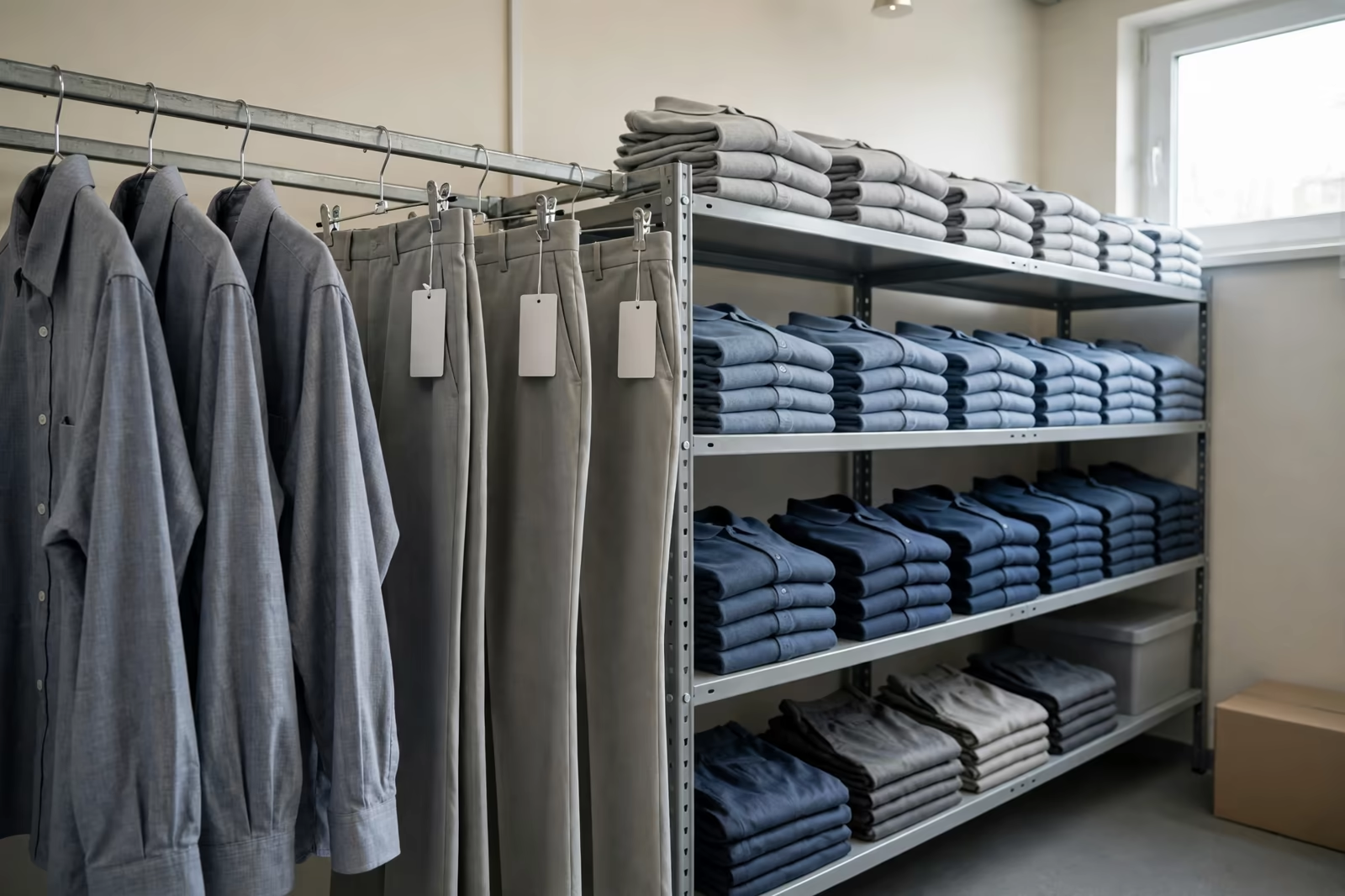
A uniform budget fails in one of two ways: everything replaced at once in a panic, or nothing replaced until the clothing embarrasses the brand. The middle path is a replacement cycle, garments retired by evidence, age, washes and condition, with the budget spread across the year instead of detonating in one month. This guide builds that cycle.
Uniform replacement programmes are produced to order in Bangladesh for employers in the USA, the UK, Germany, Canada and Australia.
Money mechanics sit at payment terms; programme terms at MOQ and production; the wider offer is on services.
Every Garment Has a Working Life
Replacement planning starts with honest working lives per garment family, set by wear and washing rather than hope:
- Base layers in daily wear (tees, polos): the shortest lives, driven by wash count and colour fade.
- Shirts and blouses: collars and cuffs set the limit, usually before the body fabric fails.
- Trousers and skirts: knees, seat and hems wear first; reinforcement extends the honest life.
- Knitwear: shape recovery decides, a jumper that bags at the cuff is finished socially before it fails physically.
- Hi-vis: reflective performance after washing is the limit, and it is a safety limit, not a cosmetic one.
- Outerwear: the longest lives, retired by waterproofing failure and appearance together.
These lives are recorded per programme from the buyer’s own return and condition data, so the second cycle is planned from evidence rather than from the first cycle’s guesses. Where no data exists yet, the first cycle runs on conservative lives and the review corrects them, an honest method that converges within a year.
Condition Grading: Wear, Repair, Retire
A cycle needs a grading language everyone shares. Programmes that work use three grades:
- Wear: garment passes appearance and function checks, stays in service.
- Repair: a defined fix (button, hem, small seam) returns it to full standard economically.
- Retire: fade, damage, fit or safety performance ends its service, whatever its age.
Grading happens at laundry return, at the spares rail, or at scheduled kit inspections, whichever the operation’s rhythm supports. The grade, not the calendar alone, releases replacement stock, which is how budgets stop replacing good garments and stop keeping bad ones. Graders are trained once and referenced forever; five minutes of standard-setting saves arguments in every laundry week that follows.

The Rolling Budget: Spread, Do Not Spike
The budget model follows the cycle: a monthly or quarterly replacement allowance per wearer, built from the garment lives and the workforce size, replaces the annual cliff-edge order. Starters draw from the same system through their starter packs, leavers return kit to the rail, and the allowance absorbs both.
- Cost per wearer per year is the headline number, tracked and compared across sites.
- Spares ratios are budgeted, not improvised, weighted to the sizes the data shows.
- Seasonal issues (winter layers, summer variants) sit in the calendar as planned lines.
- A small contingency line absorbs damage and loss spikes without raiding next quarter.
Finance teams prefer this shape for the same reason operations do: no surprises with zips on. The allowance also exposes true cost differences between roles and sites, which is the beginning of every sensible specification conversation.
Setting the first allowance is simpler than it looks: take the fleet’s replacement value, divide by the weighted average garment life in years, and the result is the annual provision, spread monthly. Workforce growth adds wearers at the same rate; shrinkage returns value through the rail. The arithmetic is deliberately boring, because boring budgets are the ones that survive contact with a finance review, year after year.
Data: Wash Counts, Returns and Wear Trials
Cycles improve when they feed on data. The useful sources are unglamorous:
- Laundry and wash counts where the model tracks them, the truest age a garment has.
- Return and retirement reasons, coded simply, so fade, damage and fit separate in the record.
- Exchange data from issue, which exposes grading and sizing drift early.
- Wear-trial results from before the bulk order, which set the first cycle’s expectations honestly.
Reviewed together once a cycle, these turn replacement from folklore into forecasting: which family is retiring early, which site is hard on kit, which specification change would pay for itself in life extension. None of it needs new systems; it needs the habit of writing the reason down.
The habit compounds quietly: within two cycles the buyer knows their fleet’s true lives better than any catalogue does, and specification arguments end with data instead of opinions. That knowledge also travels into negotiations, tenders and relaunches, anywhere a claim about garment life needs to be more than a hope.
Retirement Triggers in Practice
Triggers translate grading into action at the rail and the laundry. A garment retires when any trigger fires: colour drift beyond the fleet standard, print or embroidery no longer clean, fabric thinning at the known wear points, reflective performance below the requirement, fit altered by shrinkage or stretch, or repair cost exceeding the garment’s remaining value. Staff applying triggers need the standard visible, a reference garment or photograph at the grading point, because judgement without a reference drifts generous and then strict by turns.
Retired stock leaves the building by a planned route, which the sustainability section covers.
Triggers also protect people, not just budgets: a uniform that no longer fits after body changes, a hi-vis layer that no longer closes over winter kit, protective-adjacent pieces worn past their honest state. The grading conversation gives staff a respectable route to replacement that does not depend on complaining loudly, which quieter employees rarely do, and the cost of that silence lands on the workforce’s comfort and the employer’s appearance alike, every single working day of the year, without exception.
New issues are drawn against retirements, keeping the per-wearer count honest automatically. The trigger list is printed in the programme document verbatim, so a new laundry supervisor inherits the standard, not a rumour of it.

Sustainability and End-of-Life
A disciplined cycle is also the uniform’s sustainability story, since the greenest garment is the one worn for its full honest life. End-of-life routes are planned, not improvised:
- Reuse inside the operation for training, trials and dirty-task kit where appearance allows.
- Donation routes where branding and condition make them appropriate and secure.
- Textile recycling streams for retired stock, with branded items de-identified first.
- Secure destruction only where identity or security genuinely requires it.
Recording retirement destinations closes the loop for buyers reporting on their own commitments, and designing for disassembly at specification stage, mono-fibre choices where feasible, makes every route easier. Volume helps here too: a cycle produces predictable retirement quantities, which recyclers and donation partners can actually plan around.
The Annual Review: Resetting the Cycle
Once a year the cycle itself is reviewed: garment lives against the data, budget per wearer against actuals, workforce changes, site openings and closures, and any identity refresh on the horizon. The review is where specification improvements enter, a reinforced knee that earned its cost, a fabric change the fade data demands, because mid-cycle changes break fleet consistency.
Suppliers belong in the review with their production data on the table.
The output is next year’s allowance and order calendar, agreed while change is still cheap. Reviews that slip become surprises; the calendar protects the review the way the cycle protects the fleet.
Multi-Site Budget Fairness
Multi-site employers watch one number above all: whether sites are funded and dressed to the same standard. Central cycles deliver it, one allowance formula, one grading standard, site-level reporting that shows condition rather than just spend. Sites with harsher duty, outdoor, industrial, chilled, carry weighted allowances set openly by duty type, which ends the quiet arms race of local top-ups.
Central stock visibility lets one site’s surplus cover another’s spike before new production is triggered.
Fairness here is not bookkeeping; it is the workforce reading the employer’s standard in its own clothing. It also travels: customers visiting two sites in a week should meet one company, not two budgets.
When to Replace the Whole Look Instead
Sometimes the right answer is not a cycle but a relaunch: rebrands, mergers, a register change from casual to formal, or a fleet whose drift has gone too far to grade back. Relaunches are budgeted as projects, with the old fleet’s retirement planned as carefully as the new one’s arrival, and the cycle machinery installed from day one so the new look never decays into the old problem.
Phased relaunches by site or role spread cost where a single date is impossible.
The decision test is honest: if grading the current fleet produces more retirements than keeps, the cycle has already voted. Staff consultation belongs in relaunches too, since the workforce wears the decision and its pride is an asset.
How We Run Replacement Programmes
Our replacement programmes are built on the original order’s documents: specifications, colour standards, crest files and size data, so cycle orders match the fleet exactly. We plan batching with the buyer against their allowance rhythm, hold the size curve current from their starter and exchange data, and report retirements and issues in the format their review uses.
- Original specifications retained centrally, no reinterpretation between orders.
- Batching aligned to the buyer’s budget calendar.
- Size and spares data refreshed from every cycle’s movements.
The result is a fleet that looks deliberate in year three, which is where most uniform programmes quietly fail. Deliberate is the operative word: every garment in service is there because it passed, not because nobody looked.
Frequently Asked Questions
How often should uniforms be replaced?
By garment family and evidence rather than one date: base layers turn over fastest, outerwear slowest, hi-vis when its post-wash reflective performance falls. The programme’s own grading data sets the rhythm after the first cycle; until then, conservative planning lives per family, reviewed against actual returns, beat any universal rule.
What does a replacement cycle save?
It saves the two wastes: replacing garments with life left in them, and the emergency retail buying that fills gaps when worn kit fails unmanaged. It also protects appearance, since retirement by grade keeps the workforce’s standard even instead of drifting by individual garment age.
How are starters and leavers handled in the budget?
Starters draw a full kit from programme stock, costed into the per-wearer allowance; leavers return kit for grading, with serviceable pieces cleaned back to the rail and retired pieces exiting the count. The allowance model assumes churn at the operation’s real rate, so growth and turnover stop being budget emergencies.
Can replacement orders ride on the original programme?
Yes, and they should: replacement production uses the original specifications, colour standards and crest files, so new garments match the fleet. Orders are batched to the cycle’s rhythm, which also keeps quantities efficient under the programme’s minimums, rather than dribbling in as panic singles.