
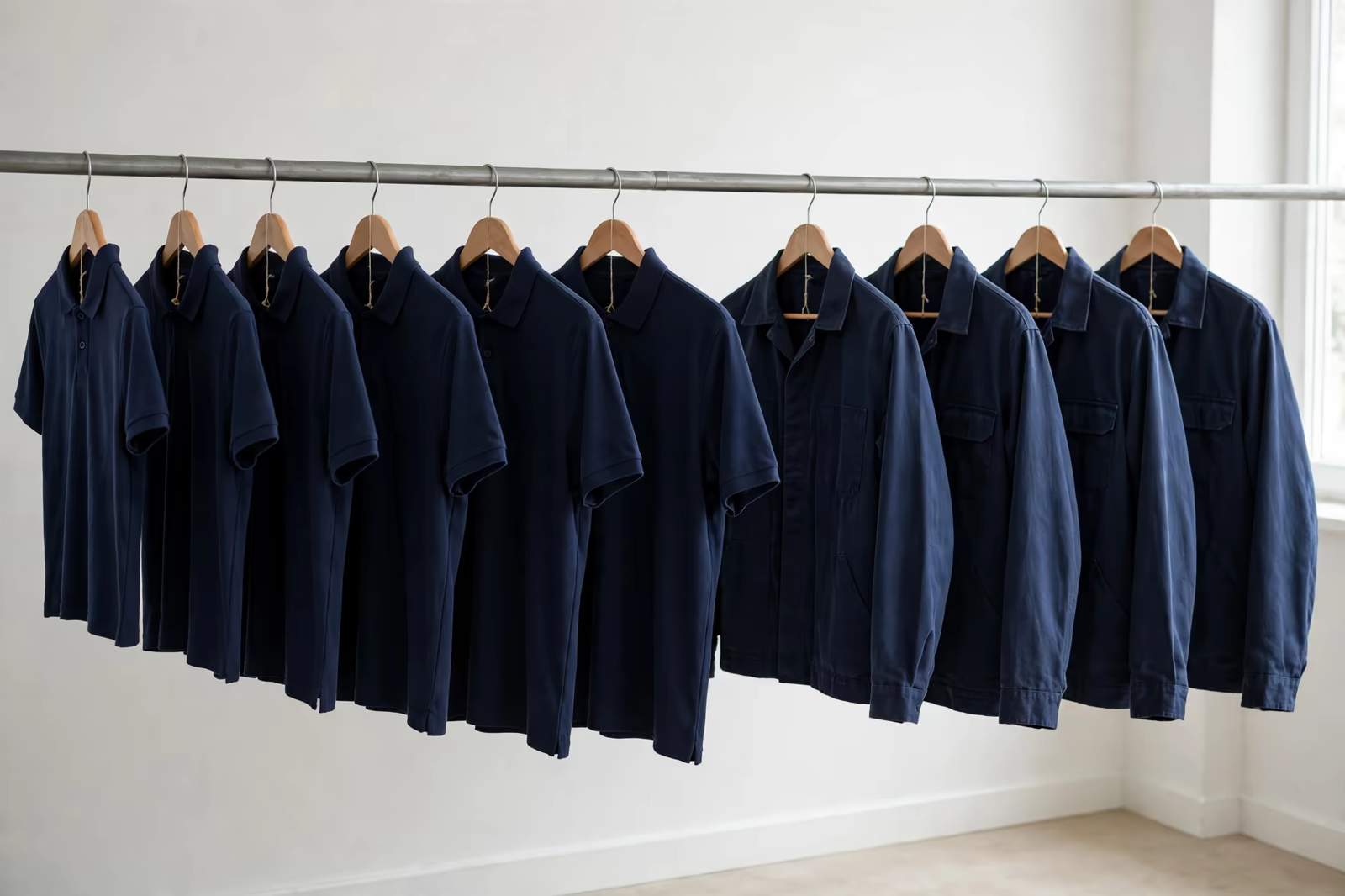
Every uniform programme meets the same dragon: collecting sizes from a whole workforce without tears, errors or a spreadsheet that collapses by Friday. Staff guess, managers chase, and the order arrives with too many mediums and not enough of everything else. This guide sets out the methods that work, from fit kits and self-measurement to the size curve that rescues imperfect data.
Uniform size collection systems support programmes produced to order in Bangladesh for employers in the USA, the UK, Germany, Canada and Australia.
Programme terms sit at MOQ and production; questions go to contact, and orders open at get a quote.
Why Guessed Sizes Fail
Asked cold, people report the size they wish they wore, the size of a favourite garment from another brand, or the size they wore when last measured, which for some was school. Vanity and optimism are not sizing systems. Guess-based orders show their error in the exchange rate: double-digit percentages swapping sizes in the first month, with the unpopular sizes exhausted and the popular ones stranded.
The failure is not the staff’s fault; the method asked memory to do a tape measure’s job. Different brands grade differently, fits differ by style, and a workforce’s memory holds all of it as one unreliable number.
Every method below replaces guessing with evidence at a cost proportionate to the workforce. The exchange bill for guessing is paid in postage, spares and goodwill, and it always exceeds the cost of measuring once.
The Fit Kit: Try Before the Order
The gold standard is physical: a fit kit, one garment in every size of the core styles, sent to each site for staff to try in private, recording the size that fits in the actual garment rather than a chart’s idea of them. Fit kits settle unisex-versus-fitted questions, length options and layer allowances in a single exercise, and their data is the cleanest an order ever gets.
Kits circulate by schedule, sites booking their week, with a named owner at each stop.
- One garment in every size of the core styles, per site.
- Trying in private, recorded against the actual garment.
- Kit contents checked between sites, gaps corrupt data.
- Kits built to the same specification as the bulk order.
Our programmes build fit kits from the same production specification as the bulk, so the size tried is the size delivered. Fitting sessions run better with a mirror, privacy and no audience, arrangements the site owner controls.

Self-Measurement That People Can Actually Do
Where fitting cannot reach, remote sites, home workers, multi-country rollouts, guided self-measurement is the fallback: a short illustrated guide, three measurements maximum, taken over light clothing with a soft tape or a printable one, entered into a form that sanity-checks entries against height and build. Simplicity is the whole art; ask for nine measurements and the data dies by measurement four.
Video guidance lifts completion further than diagrams alone.
Entries are collected against names and sites, never as anonymous piles, so gaps can be chased by name. A second person checking the tape’s reading, a partner or a colleague, quietly removes the commonest measurement errors.
Height is the quiet hero of self-measurement: given height and one honest circumference, grading logic can place most people correctly, and outliers reveal themselves for a personal follow-up. Programmes collecting remotely ask for height first for exactly this reason, it anchors every sanity check that follows and turns a doubtful entry into a solvable one.
The Form: What to Ask and What to Skip
A size form earns completion by being short: name, site, role, the garment sizes from fitting or measurement, one fit preference where the range offers a choice, and nothing else. Every extra field, inside-leg philosophy, collar opinions, costs responses.
- Name, site, role and the fitted or measured sizes only.
- Mobile-first, with dropdowns wherever the answer is a size.
- Silent sanity checks flagging implausible entries at once.
- A confirmation view before the deadline, while fixes are free.
Sanity rules run silently: entries outside plausible ranges are flagged back to the person while they still remember answering.
Paper twins of the form exist for sites where phones are banned on the floor, entered centrally the same week. A confirmation view, showing each person their recorded sizes before the deadline, catches transcription errors while they are still free.
Language deserves the same care as layout: forms in the workforce’s own languages, size terms pictured rather than translated loosely, and a named human at the end of a phone number for the questions no form anticipates. Collection stalls are rarely laziness; they are usually one confusing question, and the programmes that finish on time are the ones that hear about it early and answer it once, publicly, for everyone.
Managers, Deadlines and the Chase
Size collection succeeds socially or not at all: a named manager per site owns the list, a deadline with a reason (the order date) is published, reminders run through the channels staff actually read, and completion is visible, sites shown as done or outstanding so peer pressure does the chasing. Senior staff complete first and say so; nothing moves a workforce list like the boss’s name already on it.
The chase list is generated from the data itself, names without entries, so effort lands on the actual gaps.
Programmes that skip this machinery discover its absence at delivery, in the wrong sizes. The deadline deserves a cushion: collection closes before the order must be placed, leaving days for the chase and the curve.
Gendered Fits, Unisex Lines and Dignity
Fit architecture is a dignity decision: ranges offered in men’s and women’s fits, unisex lines chosen deliberately, and try-on arrangements that respect privacy, individual fitting rather than public measurement wherever bodies are involved. Forms ask for garment sizes, not body statistics beyond the measurements the method needs, and data handling states who sees the list and why.
Religious and cultural dress requirements surface at this stage too, lengths, fits and layering, recorded as specification, not exception.
Handled well, size collection becomes the programme’s first trust-building exercise with the workforce. Pregnancy, disability and return-to-work adjustments are handled inside the same private process, never as public exceptions.
Choice within the system helps more than any single fit decision: where the range allows, letting staff choose between fits, lengths and rises converts a compliance exercise into a small act of respect, and chosen garments are worn better and complained about less.
The data records the choice as happily as the size, and reorders inherit both, season after season, without asking twice, because the system carries the knowledge forward and nobody has to chase a colleague around the building with a clipboard, a deadline and a spreadsheet.
From Raw List to Order Curve
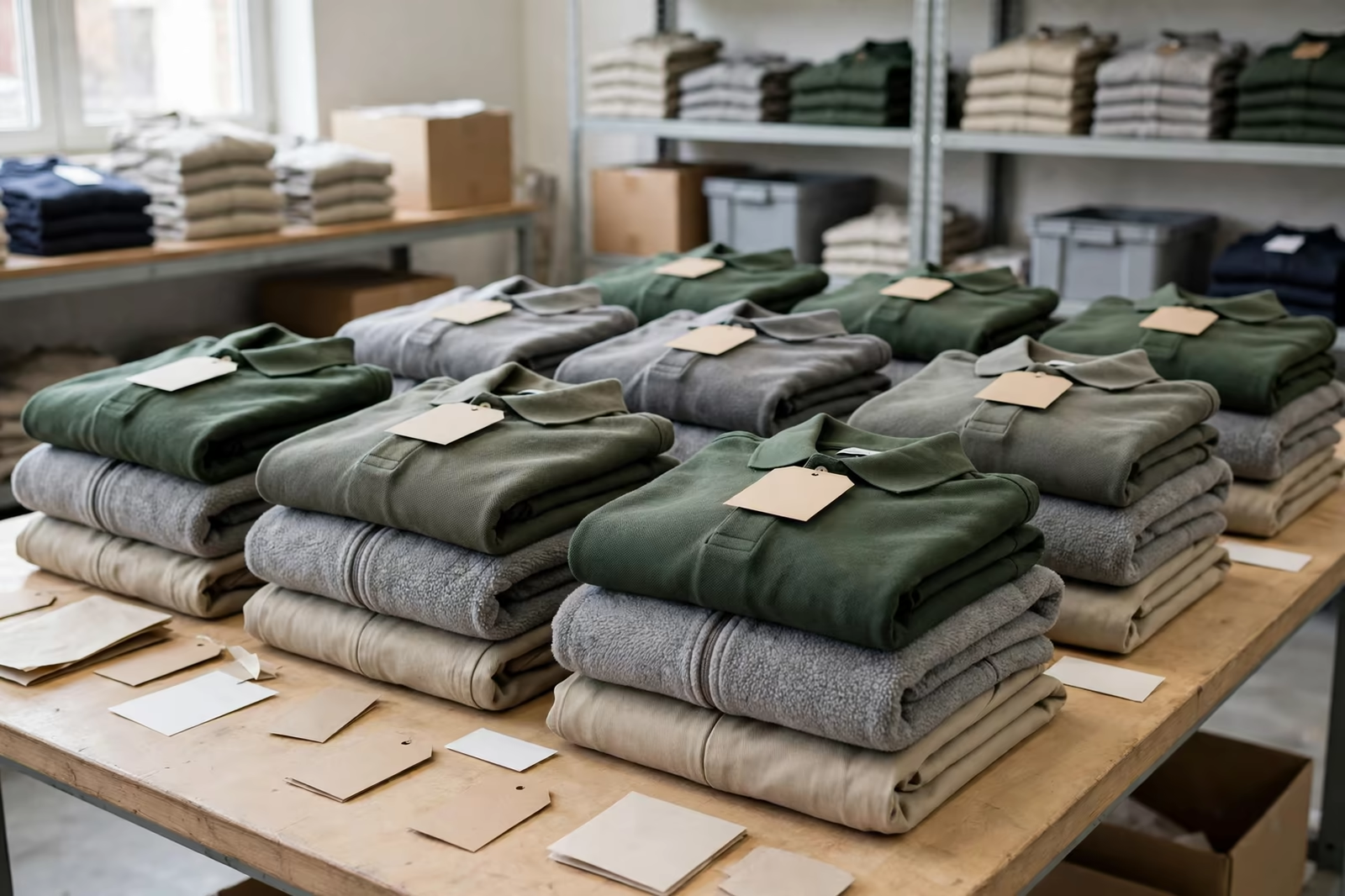
Raw lists become orders through the curve: the collected distribution is read for bias, compared against prior programmes and supplier grading, then converted into production quantities with spares weighted to the middle sizes and the known exchange-prone fits. Names stay attached to a per-person allocation inside that curve, so delivery can be packed by person or by site as the rollout requires.
The curve is a programme document, reviewed before production, because after production it is archaeology.
- Distributions read for bias before quantities are set.
- Spares weighted to the middle and exchange-prone fits.
- Per-person allocation kept inside the curve for packing.
- Curve extremes checked twice, they cannot exchange from stock.
Our size-set planning follows this method on every multi-site order, with the curve signed off by the buyer. Extremes of the curve get a second look, since a handful of very large or small sizes ordered wrongly cannot be exchanged from stock.
Multi-Site and Multi-Country Rollouts
Scale changes the exercise, not the principles: fit kits multiply or travel by region, forms run in the workforce’s languages, size labelling converts between the markets’ conventions inside the data rather than in anyone’s head, and site-level curves roll up into one production order without flattening real regional differences in build and preference.
Phased rollouts pilot one site end to end, fitting to delivery, and harvest its lessons before the wave.
Global employers get a single data standard out of it, which is the foundation of every later reorder. Time zones and working weeks differ by site; the collection calendar is built around them rather than against them.
Keeping the Data Alive: Starters and Reorders
Size data is an asset with a half-life: workforces change, bodies change, and last year’s list decays. Living programmes capture size at every starter onboarding, refresh through exchanges (each swap corrects the record), and re-verify the curve at each reorder rather than photocopying it. The data’s home is named, a system or a disciplined file, with an owner.
Exchange data is gold: it shows where the grading or the guidance misleads, and programmes read it before reordering.
A reorder placed from live data is the cheapest quality improvement a uniform programme can buy. It is also the moment the original collection effort pays its dividend, which is why the method is worth doing properly once.
How We Run Size Collection
Our programmes supply the kit and the method together: fit kits built to production specification, a short mobile form with sanity checks, chase lists generated from the data, and a signed-off size curve before cutting. Buyers keep the dataset, structured for their next order with us or anyone, because the data is theirs.
- Fit kits and the method supplied together as one system.
- Chase lists generated from the data itself.
- The size curve signed off before any cutting begins.
Multi-country rollouts run the conversions and languages inside the same system.
The result is an order whose sizes are evidence, and a first delivery measured by its low exchange rate.
Buyers repeating the exercise tell us the second collection takes half the effort of the first, because the workforce has learned the system works. That learning is the real deliverable: a workforce that trusts the process answers it quickly, honestly and completely, every single time it is asked.
Frequently Asked Questions
What is the most reliable way to collect uniform sizes?
A fit kit of the actual garments, tried on site, produces the cleanest data; guided self-measurement with a simple form is the practical method where sites are remote or numerous. Both beat asking staff to name a size from memory, which is where most exchange problems are born.
What if some staff never respond?
Chase by name with a deadline, then cover non-responders from the spares curve rather than blocking the order: their sizes are estimated from the responding population’s distribution and exchanged from stock on arrival. The programme plans for a non-response margin instead of being ambushed by it.
How do size curves rescue imperfect data?
Aggregated orders are bought against a curve, a distribution across sizes derived from the collected data, prior programmes or the workforce’s demographics, then adjusted for the known biases, vanity sizing down, for example. Even imperfect individual data produces a sound curve, and exchanges inside the delivered stock absorb the residual errors.
Should sizes be collected by name or anonymously?
By name, with privacy handled properly: named data lets managers chase gaps, deliver the right parcel to the right person and learn the site’s true curve for reorders. Anonymous collection feels kinder and produces undeliverable boxes. Access to the list is limited to the programme team, which is the proportionate safeguard.