
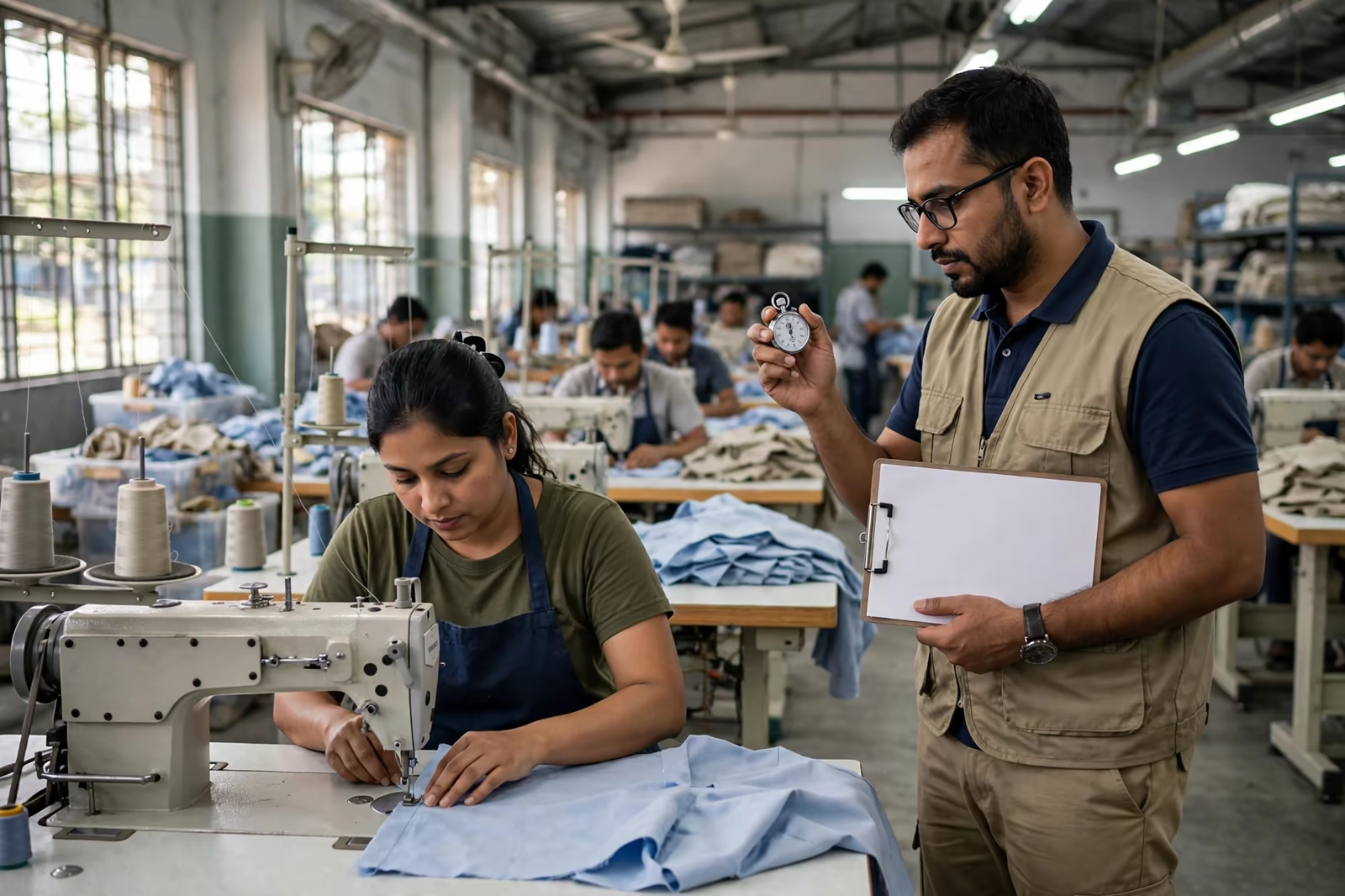
Two garments can use the same fabric, the same quantity and the same trims, and one can still cost noticeably more to make than the other. The difference is not materials; it is minutes. Every style carries a hidden price tag written in the time it takes to sew, and the sewing floor’s craft of arranging that time, called line balancing, decides how much of the theoretical cost a buyer actually pays.
The sewing floors behind this guide work in Bangladesh, producing export orders for buyers in the USA, the UK, Germany and the wider European market. Their costing language is the same one used in garment factories worldwide, and a buyer who learns it can read a quotation the way a merchandiser does: not as a number to haggle down, but as a structure to understand.
Line balancing sits inside the production system on our services page, with the commercial frame on our payment terms page. For a costing built on your own style rather than a general example, get a quote and send the tech pack.
The Minute Inside Every Garment
Garment costing measures sewing work in standard minutes. Each operation in a style’s construction, joining a shoulder, setting a sleeve, hemming a bottom, attaching a pocket, is timed by industrial engineers using standard data for machine work and handling. The total is the style’s standard minute value, its SMV, sometimes called SAM: the honest clock time a trained operator, working at a standard pace, needs to produce one complete garment.
SMV turns a style from a picture into a quantity. A basic tee might carry a modest count of minutes; a lined jacket with welt pockets, topstitching and a dozen closure operations carries many times more. Neither factory opinion nor buyer hope enters the number; it is measured from the construction itself.
The factory’s cost per minute, built from wages, overheads and machine costs, multiplied by the style’s SMV and adjusted for the line’s efficiency, gives the sewing cost inside the garment price. Change any of the three and the price moves, which is why the sections that follow matter to anyone comparing quotes.
Line Balancing: Matching Hands to Work
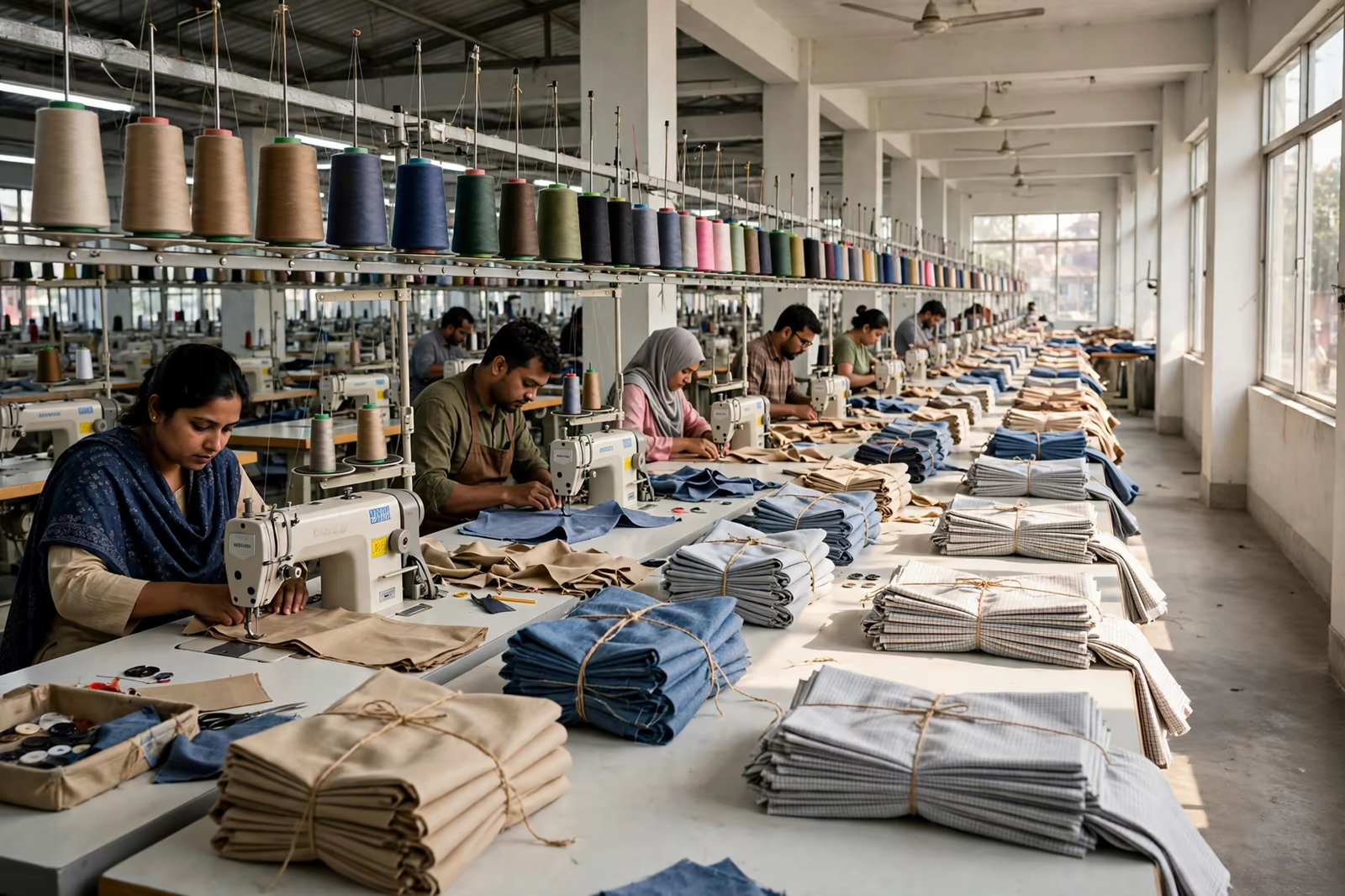
A sewing line is a chain of operations, and garments flow along it from station to station. Line balancing is the arrangement of operators along that chain so that each station’s workload matches its neighbours’: enough hands on the slow operations, few on the fast ones, so garments neither pile up waiting nor starve the next station of work.
An unbalanced line pays for minutes it never uses. Operators at fast stations sit idle part of each hour while a bottleneck operation drowns in bundles, and the line’s daily output is set by its slowest point regardless of how many people stand elsewhere. The buyer pays for the whole line’s wages either way; balance decides how much finished clothing those wages produce.
Balancing is redone for every style, because every style’s operation times differ. It is also adjusted during the run, as real output data replaces the plan’s assumptions, which is why a line’s second week on a style is almost always cheaper per garment than its first.
Why Complexity Costs More Than Fabric Sometimes
Buyers feel material costs directly and sewing costs vaguely, so complexity creeps into styles unpriced. Each added operation, however, is minutes forever: a chest pocket, a decorative topstitch line, a placket with five buttons instead of a plain front. On a single sample the addition looks free. Across ten thousand garments it is a line of extra operators.
Some operations cost more than their minutes suggest because they need scarcer skills or special machines. Buttonholing, bartacking stress points, setting zips evenly, attaching collars that must sit perfectly: these stations are staffed by the line’s most experienced operators, and a style heavy in them draws on a limited pool.
Complexity also multiplies quality risk. Every operation is a chance for a fault, an inspection point and a possible rework. The honest comparison between two designs is rarely the fabric difference the buyer negotiated; it is the construction difference nobody counted.
The Operations That Eat Minutes
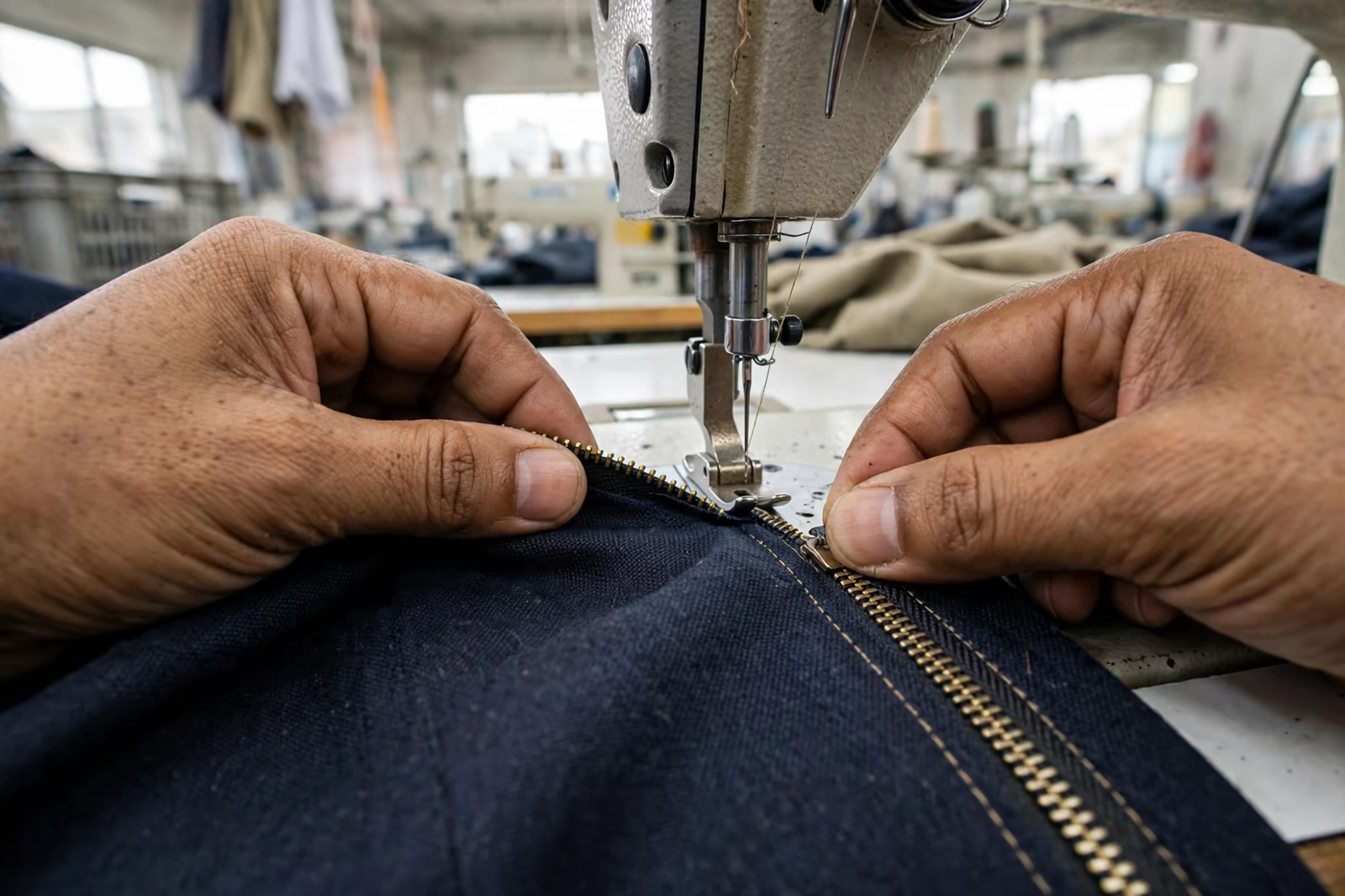
Closures are the first appetite. Zips must be prepared, inserted, aligned and topstitched; button stands need marking, buttonholing and button sewing as separate stations. A style closed with a long zip and a storm flap can carry the closure minutes of three plain styles.
Pockets follow. A simple patch pocket is one operation family; a welt pocket is a small construction project of cutting, folding, stitching and pressing, and an in-seam pocket hides its minutes inside two other operations. Linings multiply everything: the lining is effectively a second garment, cut and sewn in parallel and then joined to the first.
Finishing details finish the list: topstitching that must run perfectly straight because it is decoration, bartacks at every stress point, drawcord insertion and knotting, eyelets, snaps, and embroidery or print placements that interrupt the line’s flow by sending garments off-line and back. None is unreasonable; all are priced in minutes.
Learning Curves and the First Days of a Style
A line does not reach its planned efficiency on day one. Operators learn the new style’s handling, supervisors rebalance stations against real times, and small jams reveal themselves and get fixed. Output climbs over the first days along a learning curve every factory knows and honest costings allow for.
Short orders live permanently on the steep part of that curve. A style produced for only a few days never reaches the efficiency its SMV assumes at full pace, which is one of the structural reasons small runs cost more per piece: the learning is paid for by fewer garments.
Repeat orders invert the arithmetic. The style is known, the balance is proven, the line starts near its best pace, and the buyer’s price can reflect it. This is a real economy of loyalty that no amount of supplier-hopping reproduces, because the learning walks out of the door with every change of factory.
Efficiency: The Gap Between Theory and the Line
SMV assumes a standard pace sustained without interruption. Real lines lose minutes to machine breakdowns, bundle waiting, thread changes, operator absence and the hundred small frictions of a working floor. The ratio of minutes actually earned to minutes attended is the line’s efficiency, and it varies by factory, by style and by week.
This is the number that separates factories most honestly. Two factories with identical wage bills quote different sewing costs on the same style because one runs its lines at a markedly higher efficiency: better balancing, better maintenance, better supervision, fewer work-in-progress jams. The buyer is not paying for the same minutes at a different price; they are paying for different quantities of wasted minutes.
Efficiency is also why the cheapest quote deserves a second look. A factory can win an order by assuming an efficiency it does not achieve, then recover the difference in quality shortcuts, late delivery or mid-order renegotiation. The arithmetic always collects its debt somewhere.
How This Reaches Your Price
Sewing cost is typically calculated per garment as the style’s SMV, divided by the line’s expected efficiency, multiplied by the factory’s cost per minute. Around that core sit cutting, finishing, overheads and margin, but the sewing core is where style complexity converts into money.
It follows that a buyer’s most powerful cost lever is not pressure but design. Removing one operation, simplifying a pocket, choosing a closure the line already masters: each takes minutes out of every garment forever. A merchandiser who quotes both versions of a style, as drawn and as simplified, gives the buyer a choice with numbers attached.
It also follows that prices are not comparable across factories until the assumptions are. The same style quoted on different efficiency expectations and different minute costs produces different totals from identical fabric, which is why serious buyers ask what sits underneath a quote.
What Buyers Can Do to Lower Sewing Cost Honestly
Simplify with knowledge rather than by accident. Ask which operations drive your style’s SMV and what each contributes; factories that measure can answer, and the answer usually contains one or two surprises worth redesigning. Keep the features customers see and value; question the ones nobody notices.
Stabilise what you order. Repeats, consistent size ratios and fewer mid-order changes keep lines on the flat part of the learning curve, where garments are cheapest to make. Every change of mind at production stage is paid for in minutes at the worst exchange rate.
And give the line time to be efficient. Realistic schedules let supervisors balance properly and hold experienced operators on your styles. Rushed orders are sewn by whoever is free, at whatever efficiency panic produces, and the invoice rarely shows that separately.
Reading a Quote With SMV Eyes
A quote becomes legible once you know its moving parts. Ask for the style’s SMV, the efficiency assumed and the cost per minute applied, and most mysteries dissolve: you can see whether a higher price is fabric, complexity, caution or inefficiency wearing a disguise.
Compare like with like across factories by fixing the style and asking each for its three numbers. A factory unwilling to discuss them is asking you to buy its arithmetic blind, which reputable manufacturers do not need to ask.
Finally, remember what the numbers cannot show: whether the line that sews your order will hold its quality at the promised pace. Minutes measure cost; inspections measure truth. A complete buyer reads both.
A Note on Work in Progress
Balanced lines also keep work in progress low: bundles move station to station without accumulating in piles that hide faults, confuse counts and age on the floor. A floor drowning in bundles is usually an unbalanced line announcing itself, and its garments are being paid for twice, once in wages and once in waiting.
Frequently Asked Questions
What is SMV in garment costing?
SMV, standard minute value, is the measured time a trained operator working at a standard pace needs to complete a garment’s sewing operations. Engineers build it operation by operation from standard timing data. Multiplied by the factory’s cost per minute and adjusted for line efficiency, it produces the sewing cost inside the garment’s price, which is why two styles in identical fabric can carry different making costs.
Why does the same style cost more at one factory than another?
Usually because of efficiency and minute cost, not fabric. A factory running well-balanced lines at high efficiency wastes fewer paid minutes per garment, so the same SMV converts into a lower sewing cost. Wage levels and overheads set the cost per minute. Asking each factory for the style’s SMV, its assumed efficiency and its minute cost shows you exactly where any price difference lives.
Does a higher SMV mean a better quality garment?
No. SMV measures construction time, not quality. A high SMV means more operations, more detail or more difficult work, which a factory may execute beautifully or badly. Quality is decided by workmanship standards and inspection, not by minutes. Some of the best-made garments in the world are simple styles with low SMVs sewn to a very high standard.
Can I ask a factory to simplify my style’s construction?
Yes, and it is one of the most productive conversations in garment buying. Ask which operations contribute most to the SMV and what a simplified version would save per garment and at your quantity. A good merchandiser will protect the features your customers see and value, and offer alternatives on the hidden construction, so the redesign lowers minutes without lowering the product.