
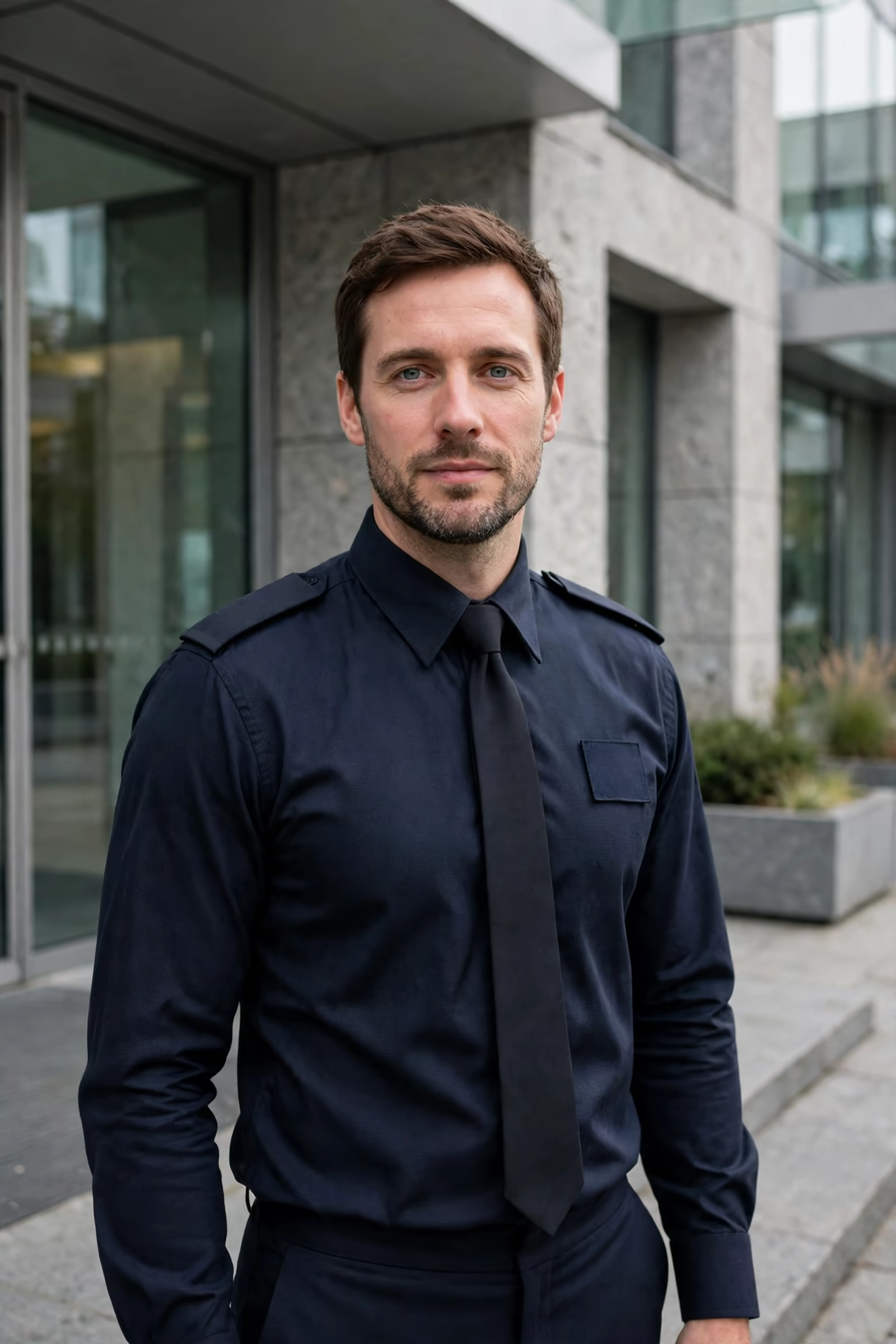
A security officer’s uniform does two jobs before a word is spoken: it must read as authority to the public, and it must let the officer work a twelve-hour shift in comfort. Facility staff around them, cleaners, porters, maintenance crews, carry the same site identity in more practical dress. This guide builds both sides of the programme: presence where the role demands it, practicality where the work does.
Security and facility programmes are produced to order in Bangladesh for buyers in the USA, the UK, Germany, Canada and Australia.
The working pieces linked here are our work shirt and high-visibility vest; programmes start at get a quote.
The Authority Register: Shirts, Layers, Presence
Security dress borrows its grammar from formal uniform: structured shirts in dark, disciplined colours, epaulettes or rank markings where the client’s system uses them, clip ties or standard ties by site policy, tailored trousers, and outer layers, blazers, softshells, waterproofs, that keep the register in bad weather. The effect is deliberate: a guard who looks appointed is treated as appointed.
- Structured dark shirts with epaulettes or rank marks where used.
- Clip or standard ties set by site policy, never by the wearer.
- Tailored trousers with creases that hold a whole shift.
- Outer layers that keep the register in bad weather.
Branding follows the same discipline: company marks embroidered or woven as badges, SECURITY wording where the client’s market requires identification, placed by rule and sized by regulation where local rules set them. Shoulder titles and sleeve badges carry site or contract identity where the system uses them, produced as woven pieces that outlast the shirt beneath.
Every element should be specified as a system, because an officer assembling the look from personal substitutes dissolves the authority the uniform was bought to create. Trousers deserve the same attention as shirts: a disciplined break, creases that hold, belts and boots anticipated in the length, since authority is read from the whole figure.
Comfort Across Long Shifts
Authority that hurts is authority that gets left in the locker. Security work is standing, patrolling, stairs, weather, and the uniform must be patterned for it: breathable shirt fabrics with stretch where movement demands, trousers with working pockets and reinforced seats, layers that regulate temperature across a night shift’s cold hours and a lobby’s warm ones.
Footwear stays the officer’s domain, but trouser lengths, break and hem weight are specified with boots in mind, and belt loops are sized for the duty belts many postings actually wear.
Sets per officer follow the laundry reality of shift patterns; a guard working five nights needs a rotation that never forces a re-worn shirt. Posture and presence are comfort outcomes too: an officer whose uniform fits and breathes stands differently, and the public reads the difference before any interaction begins.
Hi-Vis and Site-Safety Variants
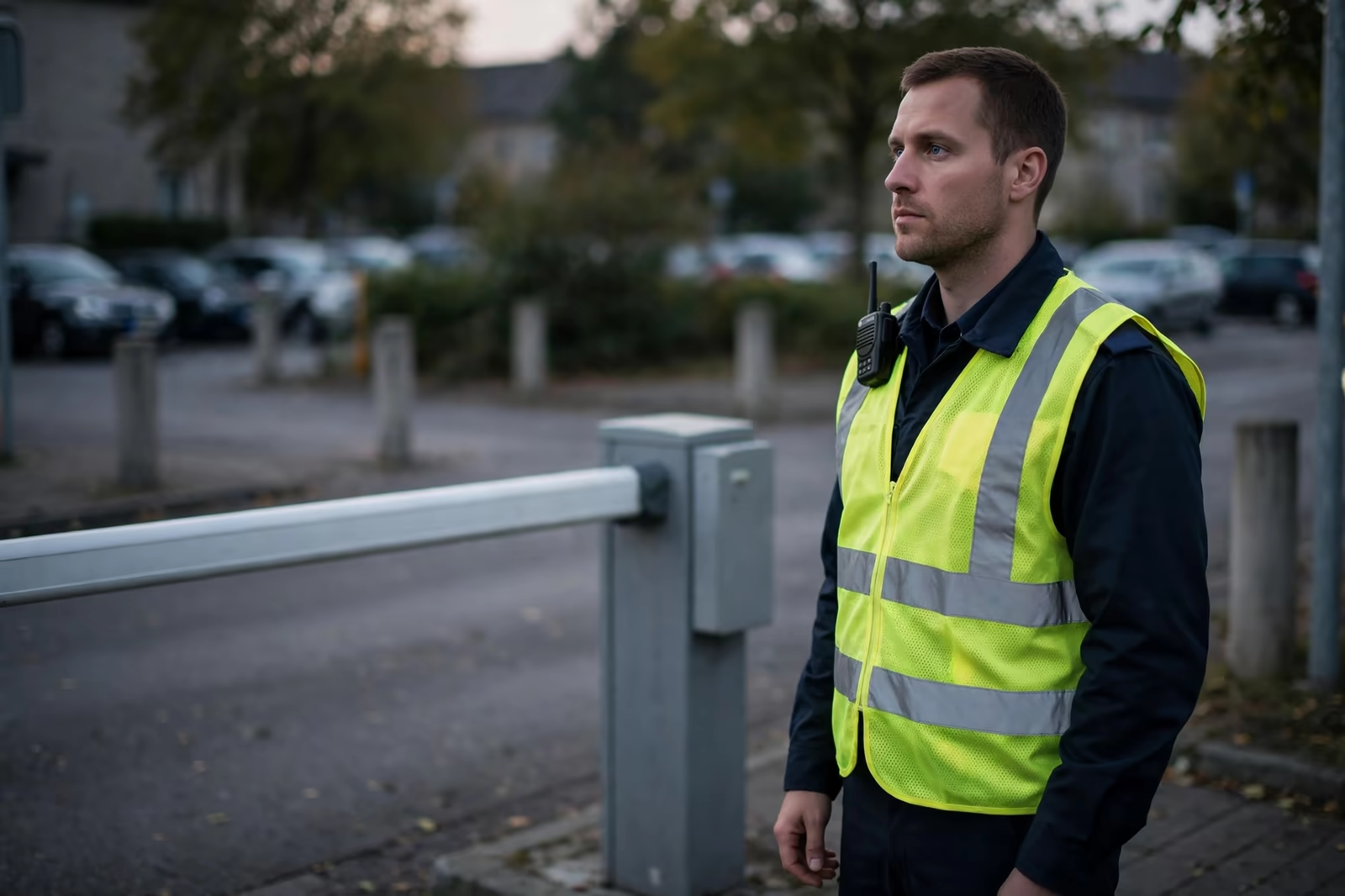
Many security and facility roles cross into vehicle and yard environments where visibility rules apply: gates, car parks, loading areas, events. Hi-vis vests and jackets in the certified colourways, worn over the base uniform, answer those environments; the programme specifies them as part of the system, reflective tape patterns and all, rather than as an afterthought bought locally.
Replacement follows condition, since tape and background fabric lose performance with washing and weather long before the garment looks worn.
Where the buyer’s market sets visibility standards, garments are specified to those standards and described by them, never by vague promise.
- Certified colourways worn over the base uniform as one system.
- Reflective tape patterns specified, not left to local purchase.
- Replacement by condition, since performance fades before looks do.
- Outers sized to fit over winter layers without binding.
The base uniform beneath stays in the site’s colours, so the officer reads as the same authority with the vest on or off. Vest fit over layers is a specification detail worth stating: outers sized to sit over the winter stack without binding, since a vest worn open for comfort protects nobody.
Facility Teams: Cleaning, Porters, Maintenance
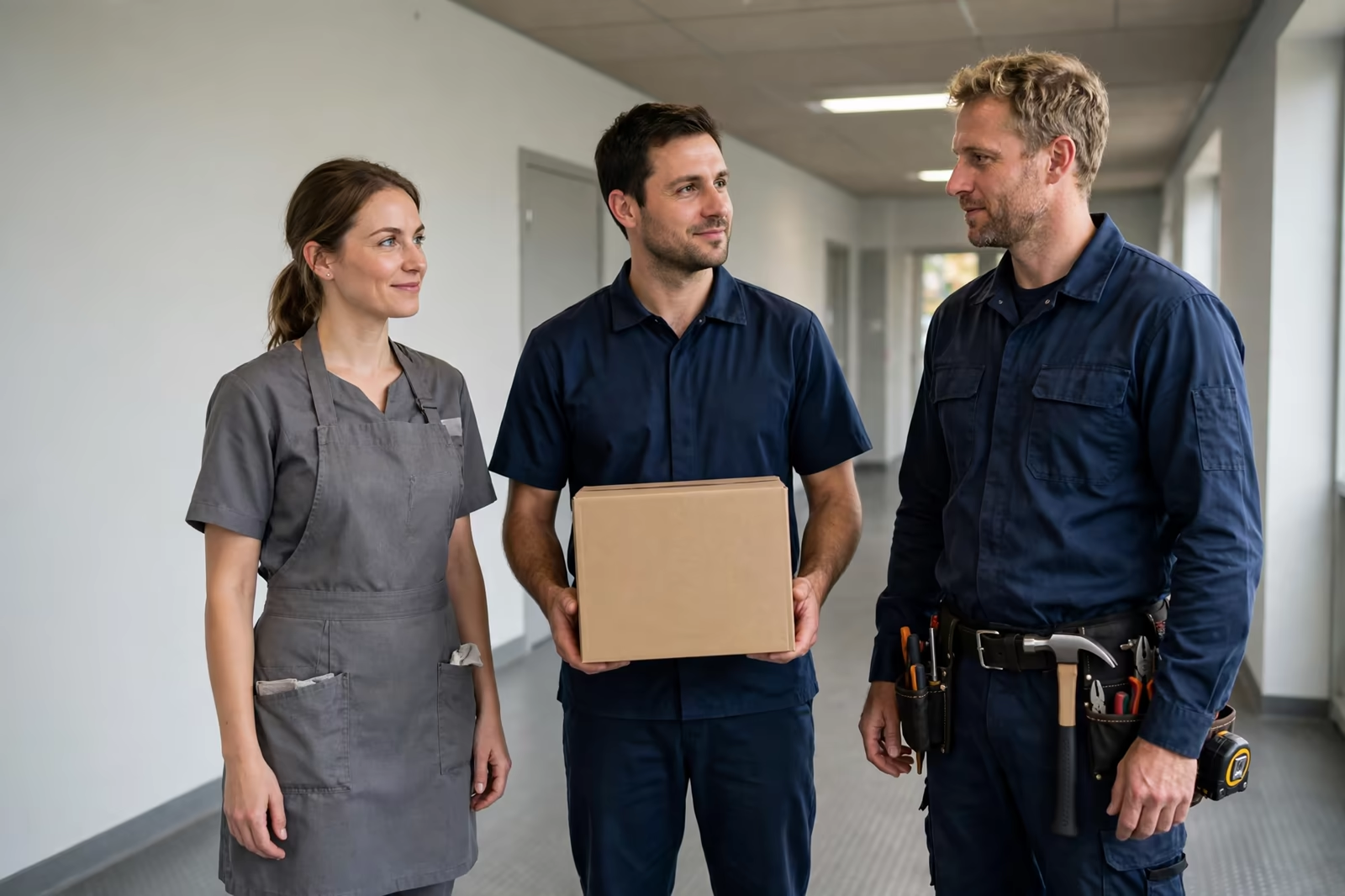
Around the officers stands the facility team whose uniforms promise a different virtue: competence. Cleaners in practical tunics or polos with aprons and pockets for tools of the trade; porters in shirts and waistcoats that survive luggage work; maintenance crews in durable work shirts and cargo trousers with reinforced knees and tool loops. Each family is specified for its work, then pulled into the site system by colour and badge.
These families launder hardest after housekeeping, and their fabrics are chosen with the same industrial discipline, colourfast, stable and quick to turn around between shifts.
Contractors managing many sites gain most from the system approach: one document dresses every site, and staff moving between sites carry the identity with them. Cleaning teams’ colour choice carries a quiet signal of its own, fresh mid-tones that show the work is being done rather than hiding that it exists.
Weather Layers and Night Work
Security is outdoor work in most postings: gates, patrols, car parks, perimeters. The layer system, base shirt, knit or fleece mid layer, waterproof outer with the same badge rules, decides whether the authority register survives February. Hi-vis outers answer the vehicle environments; dark waterproofs answer the formal ones; the programme specifies which posts wear which, by rule rather than by the officer’s wardrobe.
Waterproof construction is specified honestly, taped seams and real membranes where the posting is truly exposed, lighter showerproof shells where it is not.
Night work adds reflective detailing decisions and warmth that day-only programmes forget.
Summer reverses the problem: breathable shirts, lighter trousers, caps where policy allows, specified before the heat arrives rather than improvised during it. Gloves, hats and thermal layers follow the same badge-and-colour logic when the client’s standard includes them, so winter never invents its own uniform.
Identification, Badges and Access Dress
Identification is part of the garment system: woven or embroidered company badges, role titles, ID-card loops and lanyard rules, radio loops and body-camera mounts where the client’s equipment demands them. Each attachment point is a construction decision made at the pattern stage, not a pin through a finished shirt.
- Company badges woven or embroidered, placed by one chart.
- ID loops, lanyard rules and radio loops built into the pattern.
- Breakaway safety rules stated by the client’s own policy.
- Personal issue recorded per officer for accountability.
Access-control environments add dress rules of their own, no loose items here, reinforced pockets there, which the enquiry should state plainly.
The badge chart, one approved artwork set with placements per family, keeps every site’s officers identically identified. Numbering and naming follow the client’s accountability system, personal issue recorded per officer, which the programme’s spares and replacement rules are built to support, contract after contract, without the identity drifting between them or fading.
Sizing a Mixed Security Workforce
Security recruits across every build, and the programme’s size curve must cover the real workforce including tall and broad ranges as policy. Fitting samples at programme launch, recorded sizes per officer, and a spares pool for the constant churn of starters and leavers keep posts dressed without emergency orders. Uniform issue is often part of an officer’s first day, which makes the spares pool a retention tool as much as a stock line.
Women officers are patterned in women’s fits, not issued men’s shirts in smaller sizes, a point of both dignity and presence.
Replacement sizes follow the recorded data, so the reorder curve improves with every cycle instead of resetting. Height ranges deserve explicit policy in this category: patrol and gate work reads badly in trousers that pool or ride, whatever the shirt above them does.
Laundering and the Pressed Standard
A security uniform’s authority lives partly in its press: creases where trousers should have them, shirts that hold a front through a shift. Fabrics and finishes are chosen with this in mind, easy-care weaves that release wrinkles, collars and cuffs constructed to survive pressing, colours that hold through the industrial cycles most contracts use.
Where officers launder at home, the specification forgives: home-stable fabrics and simple care instructions printed into the programme document, with spare capacity for the weeks when life interrupts the washing.
Trial-washing samples through the actual process remains the cheapest insurance in this category, as in every uniform family on this site. Dark colours carry one more discipline: fade shows first at collars, cuffs and creases, so colourfastness testing weighs those zones hardest.
Events, Retail and Corporate Sites Compared
The security register tunes by environment. Corporate headquarters want the formal end: blazers, ties, crisp shirts. Retail wants approachable authority: softer colours, polos under a structured layer, branding that reassures rather than warns. Events want visibility and numbers: hi-vis, bold identification, garments that survive a muddy field and a sixteen-hour day. Each register is a specification choice made in advance, not a mood adopted on the day or the site.
One contractor often serves all three, which argues for a modular system: shared trousers and base layers, environment-specific tops and outers, one badge language across all of it.
The programme document maps postings to kits, so a transferred officer already owns most of the new look. Contract wins and losses move officers between registers constantly in this industry, which makes the modular system a commercial asset, not only a tidy idea.
How We Build Security Programmes
Our security work starts from the postings: sites, environments, shift patterns, identification rules and the client’s authority register, then builds the families, officers, facility teams, weather and hi-vis layers, against one colour and badge discipline. Samples are fitted on real officers, laundry trials run, sizes recorded, and the whole system written into the programme document the client reorders from.
- Every posting mapped to its kit inside one document.
- Officers and facility teams under one badge discipline.
- Weather and hi-vis layers specified by rule, not improvised.
Presence and comfort are specified together, because in this category each fails without the other.
A post dressed by system looks appointed on the first night and the five-hundredth alike, in all weathers. The enquiry that starts it needs only the postings list and the standard the client wants a stranger to feel at the gate, every single shift.
Frequently Asked Questions
What colours work best for security uniforms?
Dark, disciplined colours dominate for good reasons: navy, black and dark grey read as authority, hide the day’s wear, and coordinate across sites. The client’s brand enters through badges, ties, epaulettes and accents rather than through the base colour, which keeps multi-site programmes consistent and reorders simple.
How many uniform sets does each officer need?
Enough for the shift pattern plus laundry turnaround: full-time officers typically hold several sets of shirts and trousers so a clean, pressed uniform exists for every shift, with outer layers and hi-vis held per officer or per post depending on the work. The programme document fixes the number per role so replacements and starters draw from the same rule.
Can rank and role markings be included?
Yes: epaulettes, woven badges, embroidered titles and SECURITY identification are produced to the client’s artwork and placement rules. Where local regulations govern security identification, wording, size or placement, the buyer’s compliance requirements lead the specification and are confirmed before production.
How are facility and cleaning staff fitted into the same programme?
As their own families inside the same system: practical polos, tunics or work shirts and trousers in the site’s colours, specified for movement and laundering, sharing badges and colour discipline with the security side. One programme document covers every family, which keeps a whole site’s staff visibly one organisation.