

Clinics, dental practices, veterinary surgeries, care homes and therapy centres all dress their people in scrubs-style clothing, and all discover the same truth: the garments look simple and are not. They must survive aggressive laundering, move through physical work, identify roles at a glance and keep patients calm. This guide covers sourcing scrubs-style sets and clinic uniforms as workwear, honestly framed: these are uniforms, not certified medical devices or barrier PPE.
Clinic uniform programmes are produced to order in Bangladesh for healthcare-adjacent buyers in the USA, the UK, Germany, Canada and Australia.
The tailored pieces linked here are our work shirt and work pants; programme terms sit at MOQ and production.
Who Wears Scrubs-Style Uniforms
The scrubs silhouette, a V-neck or tunic top with drawstring or elastic trousers, has spread far beyond the operating theatre: dentists and hygienists, veterinary teams, physiotherapists, care-home staff, pharmacy and laboratory staff, beauty and wellness clinics. Each setting borrows the silhouette for its own reasons: hygiene theatre, role clarity, comfort through long shifts, a clean slate at every change.
Colour does the identification work: departments and seniority are colour-coded by local convention, so the programme’s colour chart becomes an organisational chart.
- Dental and veterinary teams in scrubs-style sets.
- Care-home staff in tunics or polos in calm colours.
- Laboratory and pharmacy staff in coats or tunic styles.
- Reception teams in the clinic’s corporate dress language.
Buyers should name their setting honestly at enquiry, since a care home’s laundering and a dental clinic’s differ enough to change the fabric specification. Student and training cohorts add a seasonal rhythm in teaching settings, where bulk sets in standard sizes are ordered against course intakes rather than named staff.
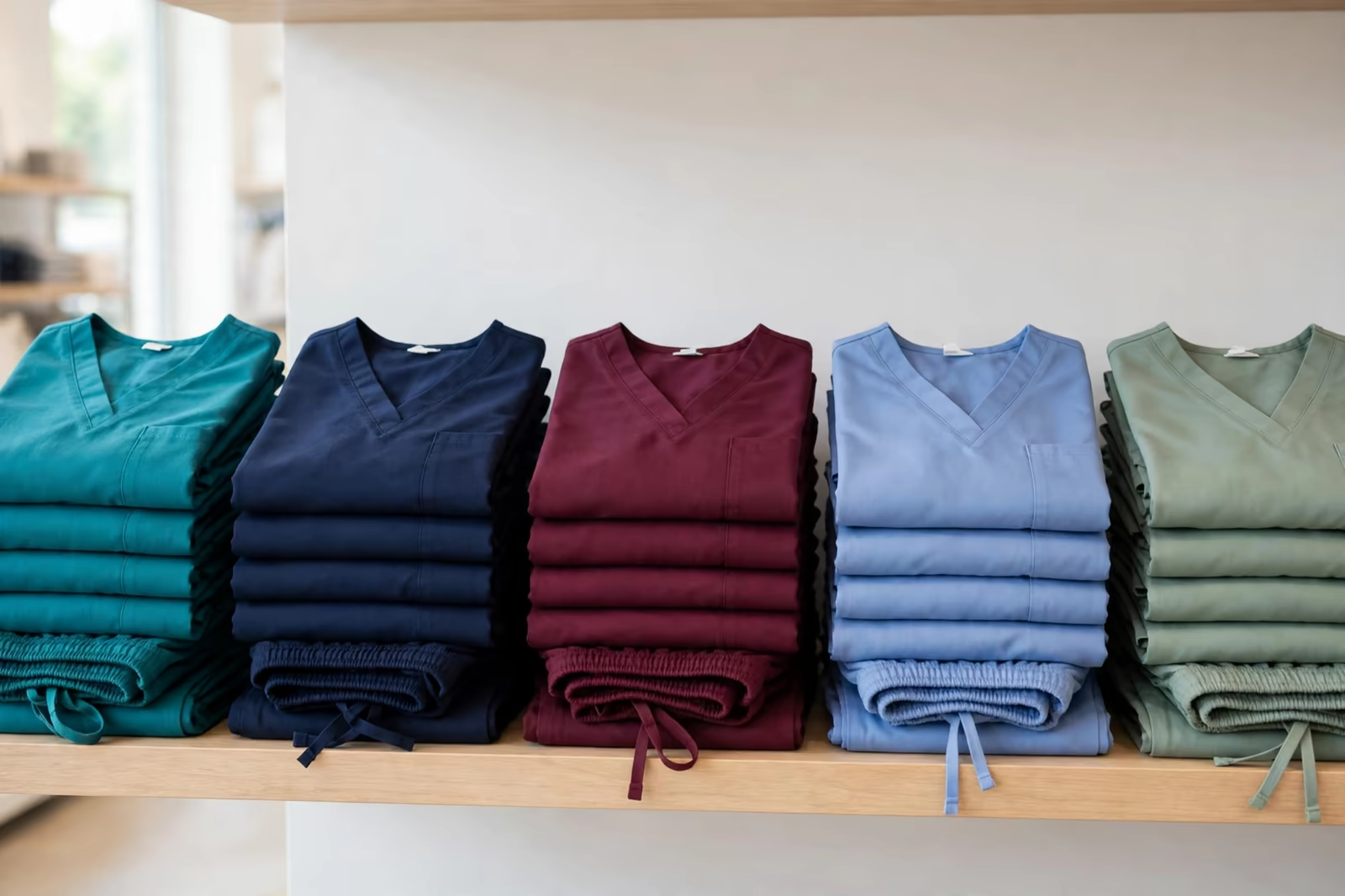
Fabrics That Survive Clinical Laundering
The defining demand is the wash: frequent, hot, chemically assisted cycles that destroy ordinary clothing in a season. Polyester-cotton blends dominate the category for good reasons, colour retention, dimensional stability, quick drying, easy care, with cotton-rich options where skin comfort in long shifts argues for them. Antimicrobial and fluid-repellent finishes exist as buyer-specified options, described by their test standards rather than by promise.
Colourfastness is specified hard in this category, because a set whose top fades faster than its trousers fails in public, and matched sets are bought precisely so that no patient ever watches it happen. Dark colours show lint and hair; light colours show stains; the colour chart conversation weighs the setting’s reality rather than fashion.
Weight is a shift-length decision: lighter cloth for warm wards and active roles, midweight where durability and opacity matter more.
- Polyester-cotton blends for colour retention through hot cycles.
- Colourfastness specified hard, so matched sets age together.
- Shrinkage control written into the specification, not hoped for.
- Finishes such as fluid repellency only as buyer-specified options.
Fit, Pockets and the Working Details
Scrubs are tools. Tops carry patch pockets sized for the setting’s actual kit, pens, scissors, phones, dosimeters, with pen divisions and badge loops placed by role; trousers carry cargo or slash pockets and waist systems, drawstring, elastic, or both, that survive a shift without adjustment. Side vents, action backs and raglan or set-in sleeve choices decide whether the set works through a day of lifting, bending and reaching.
- Pockets sized for the setting’s real kit, with pen divisions.
- Waist systems, drawstring, elastic or both, that hold a shift.
- Women’s and men’s fits patterned separately, maternity designed in.
- Opacity, neckline and rise specified for dignity at work.
Women’s and men’s fits are patterned separately, with maternity options designed in for settings that need them, rather than answered with a larger size and an apology in the corridor.
Modesty details, opacity at working weights, neckline depth, trouser rise, are specified, not assumed, because staff comfort in front of patients depends on them. Sleeve length is a hygiene-practice choice in many settings, short sleeves keeping cuffs clear of the work, and the pattern should offer the choice deliberately rather than by default.
Tunics, Lab-Coat Styles and Reception Dress
Not every healthcare-adjacent role wears the scrubs silhouette. Tunics serve dental, pharmacy, therapy and care settings that want a smarter register with the same practicality; lab-coat styles serve clinicians and laboratory staff who need coverage, pockets and a professional signal over their own clothes; reception and administrative staff in clinics usually wear the corporate uniform language of shirts and blouses with the clinic’s colour accents, separating the welcome from the treatment rooms.
All three families should share the colour chart and branding rules of the scrubs programme, or the organisation reads as several businesses under one roof, which patients notice even when they cannot name it.
The enquiry stage is where these families are listed; discovering the coat requirement after the scrubs ship is a common and avoidable failure. Coat styles carry their own specification points: closure type, pocket count for instruments and notes, lengths by role, and fabrics that release stains rather than keeping them.
Laundry Systems: In-House, Rental and Personal
How the garments are washed decides their specification. In-house laundries run controlled industrial cycles the buyer can describe exactly. Rental and laundry-service models hand the garments to a contractor whose process the specification must match, and whose loss rates the spares pool must absorb. Personal laundering, common in smaller practices and domiciliary care, argues for the most forgiving fabrics, home-wash stable, quick to dry, kind to iron.
Infection-control policies in some settings set wash temperatures as rules; the uniform specification follows the policy, not the other way round.
Our programme intake asks the laundry question explicitly, because it changes fibre, colour and construction choices throughout. Rental models add one more consideration: garments must tolerate being washed with strangers’ uniforms at the contractor’s standard cycle, which argues for the most robust end of every specification range.
Sizing a Clinical Workforce
Clinical teams are mixed in every dimension, and scrubs sizing runs unisex in some families and gendered in others, a distinction that must be settled before size curves are ordered. Fitting samples settle it in practice: staff try the actual sets, the programme records who wears what, and the order follows the recorded curve plus spares for starters, agency cover and size changes.
Drawstring waists forgive; elastic-and-drawstring combinations forgive more, which is why they dominate high-turnover settings where a perfect fit for a rotating cast matters less than a workable fit for everyone.
Length options matter in trousers more than any other measurement, since hems near clinical floors are a hygiene and safety detail, not a style one. Tall and petite ranges should be policy, not favours, in organisations that employ the whole population, which is to say all of them.

Care Homes and Domiciliary Care
Care settings dress for trust: residents and families read the uniform as the organisation’s character. Tunics and polo-based uniforms in calm colours, with names embroidered, soften the clinical signal while keeping identification clear. Domiciliary carers, working alone in homes, need weather layers and identification that read at a doorstep, plus garments that launder easily at home between shifts.
Durability demands stay high: personal care is physical work with frequent washing, and fabrics are specified accordingly.
Dignity cuts both ways in this setting: staff dressed with care are received with trust, which is a clinical outcome in its own right. Night staff, often forgotten in uniform programmes, need the same specification thought as day teams, including visibility on outdoor routes between buildings and entrances.
Veterinary and Dental Specifics
Veterinary teams add their own variables: hair that clings, animals that scratch, surgeries that run long. Fabrics with smoother surfaces shed hair better; darker or patterned colours forgive what the day leaves; reinforced construction survives handling large animals, and spare sets per shift are a practical necessity rather than a luxury.
Dental settings argue the opposite register: crisp, light, precise, with short sleeves for hygiene practice and fitted silhouettes that stay clear of the patient and the equipment.
Both settings share the category’s constant: colour coding by role, recorded centrally, reproduced exactly. Reception teams in both settings bridge to the corporate families, shirts and tunics in the practice colours, so the welcome and the treatment rooms read as one practice.
Replacement Cycles in High-Wash Settings
High-wash uniforms wear out faster than any other workwear, and honest programmes budget the cycle from the start: sets per person calculated against wash frequency, garment life tracked by family, reorders triggered by condition audits rather than complaints. Colour continuity across batches is the standing risk, managed by dye standards and retained reference samples, since a team’s sets bought across two years must still match on the ward.
Our replacement-cycle guidance covers the budgeting method in full; clinic programmes apply it with the shortest cycles on the site.
Planning the cycle at purchase turns replacement from a recurring emergency into a diary entry. The spares conversation belongs in the same breath: agency and bank staff drawn from the pool need generic sets in common sizes held by the setting itself, labelled and ready by the door.
How We Build Clinic Programmes
Our clinic work begins with the setting and its laundry system, then builds the families, scrubs sets, tunics, coat styles and reception dress, against one colour chart and one branding chart: fabrics specified for the actual wash process, samples trial-washed before bulk, sizes collected from real staff, spares and replacement cycles agreed in the programme document. The result is a system the organisation reorders from without re-deciding it.
- Fabrics specified against the laundry process actually used.
- Samples trial-washed before any bulk production.
- Spares and replacement cycles agreed in the programme document.
Honest framing is part of the service: workwear specified as workwear, and regulated requirements named as their own conversation, in writing, before money moves or cloth is cut.
Settings that know their laundry, their roles and their colours get uniforms that simply work, shift after shift. The first order is a conversation about those three things; everything else follows from the answers, in that order.
Frequently Asked Questions
Are these uniforms medical-grade or certified PPE?
No, and the distinction matters. Scrubs-style sets and clinic tunics are workwear: they serve hygiene practice, identification and comfort. Certified barrier garments and regulated PPE are separate product classes with their own standards and testing, and any buyer needing them should specify that requirement explicitly so it can be addressed on its own terms rather than assumed from a scrubs order.
How do clinics colour-code departments?
By local convention recorded in the programme document: a colour per department or role, tops and trousers matched or mixed by rule, with the chart held centrally so reorders reproduce it exactly. Because conventions differ between organisations and countries, the chart is the buyer’s to define; the maker’s job is fidelity to it across every batch.
What fabrics handle hot industrial washing?
Polyester-cotton blends are the category’s workhorse because polyester holds colour and shape through hot, frequent cycles while cotton keeps the hand comfortable. The specification should name the laundry’s actual temperatures and chemistry, and samples should be trial-washed through that process before bulk production, the same discipline our hospitality guidance recommends.
Can logos and names be added to scrubs?
Yes: embroidery carries clinic logos and staff names or roles on chest positions and survives clinical laundering better than print. Name embroidery doubles as identification, which many settings require. Artwork and placement follow one approved chart for the whole organisation so every site and batch matches.