
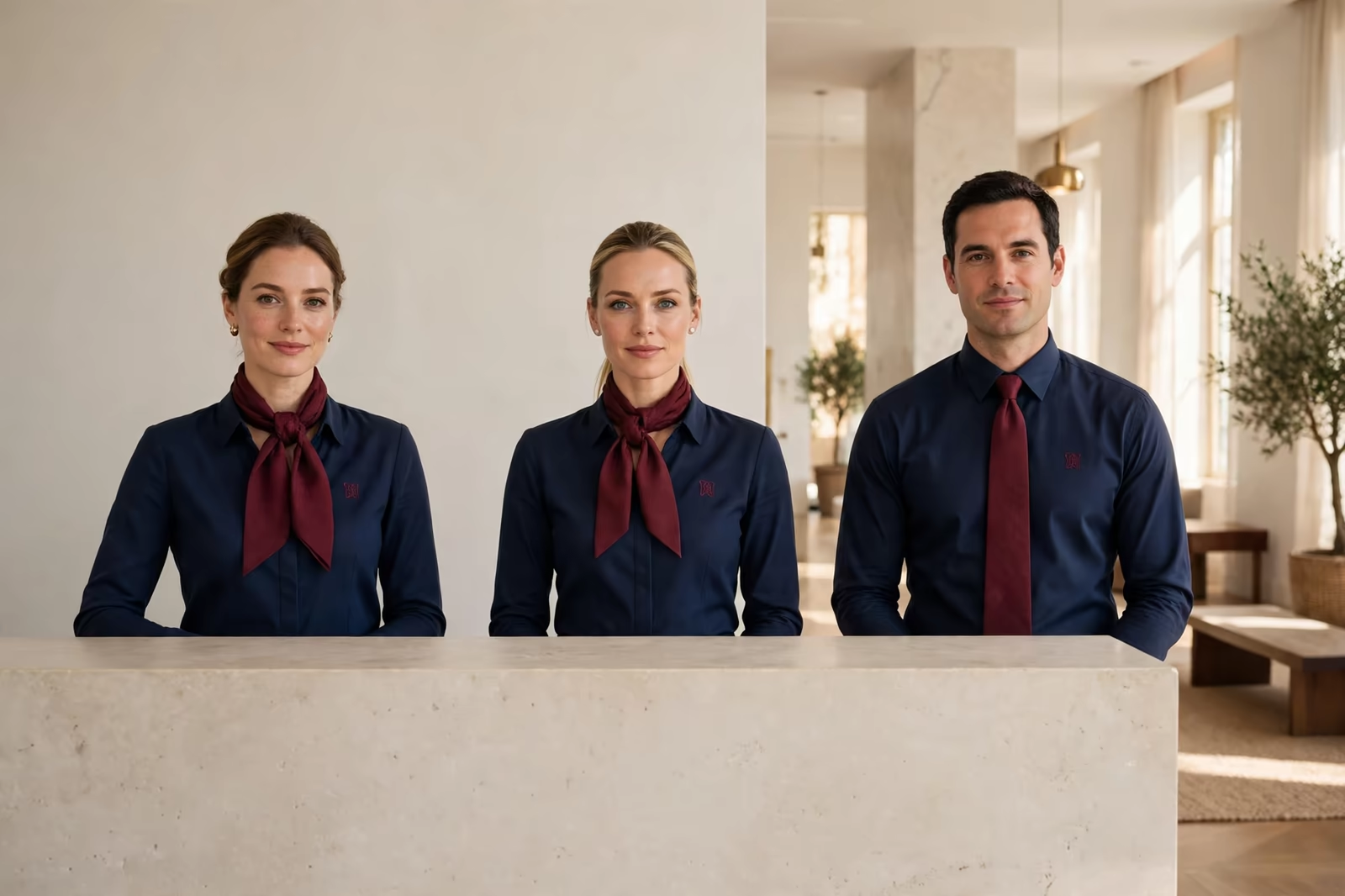
A hotel speaks through its uniforms before a word is said: the front desk’s polish promises order, housekeeping’s practical dress promises care, the kitchen’s whites promise discipline. Each department needs different clothing that still belongs to one property, one brand, one standard of welcome. This guide outfits the three departments hospitality buyers ask about most, and the support roles around them.
Hospitality programmes are produced to order in Bangladesh for hotels and restaurants in the USA, the UK, Germany, Canada and Australia.
The working pieces linked here are our apron and casual woven shirt; branding runs through embroidery.
Front Desk and Guest-Facing Roles
The front desk uniform is a photograph that guests take home in memory: structured shirts or blouses, tailored layers, a scarf or tie accent in the property’s colour, name badges placed by rule. Fabrics must survive daily wear without shining at the elbows or wilting by evening, which argues for quality woven cloth with easy-care finishes and fits patterned for standing work. Desk staff also handle luggage, doors and weather at the entrance, which the layering must quietly anticipate.
- Structured shirt or blouse with a tailored layer in the property colour.
- Name badge placed by rule, the same side on every wearer.
- Scarf, tie or neck accent that carries the brand, not the wearer.
- Weather layer matched to the desk palette for entrance duty.
Concierge, doorman and valet roles extend the same language outdoors: weather layers that match the desk’s palette, gloves and caps designed in rather than added by the wearer.
Consistency across shifts matters as much as design; the night desk in the same standard as the morning desk is what five-star actually looks like. Grooming rules travel with the uniform, badge on the same side, scarf tied the same way, because the system is worn by people whose small variations are the only version guests ever see.
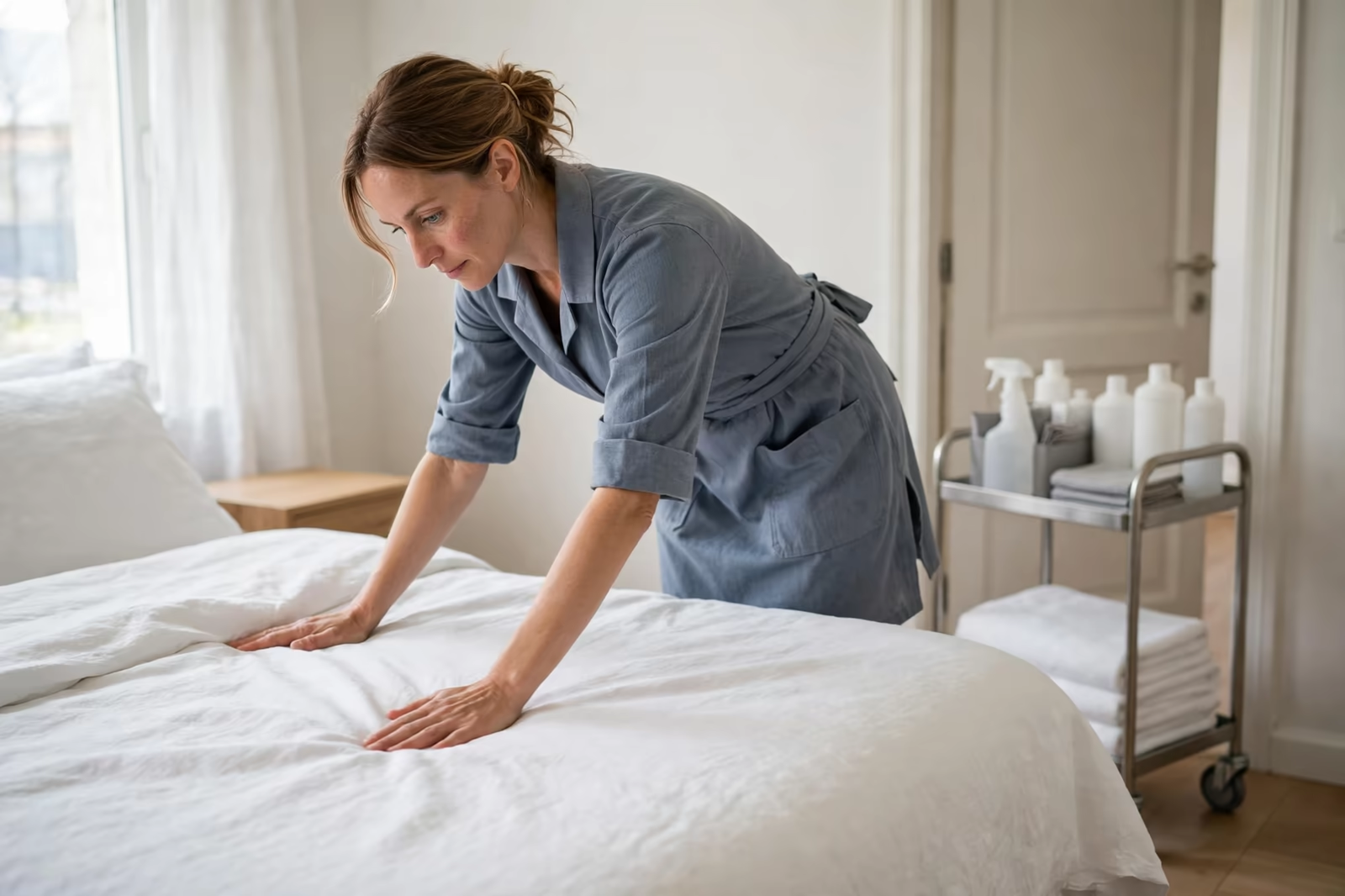
Housekeeping: Built for Movement
Housekeeping is physical labour performed invisibly, and its uniform must bend, reach, kneel and carry without binding, riding up or soaking through. Tunics and dresses in breathable, quick-drying fabrics with action backs and generous pockets are the trade’s settled answer; trousers where the work argues for them; aprons or tabards that protect the uniform beneath and carry tools. Footwear stays the wearer’s safety domain, but trouser lengths and hems are specified with shoes and trolleys in mind.
- Action backs and stretch where the work bends and reaches.
- Aprons or tabards that protect the uniform and carry tools.
- Colourfast construction specified for daily industrial laundering.
- Real size ranges graded carefully, because fit here is safety.
Colour choice is strategy: housekeeping palettes often sit a step softer than front-of-house, signalling care rather than ceremony, while staying inside the property’s colour family.
Laundering is daily and industrial, so construction, colourfastness and seam strength are specified harder here than anywhere else in the building. Fit is a safety matter in this department: loose sleeves near machinery and over-long hems on stairs are hazards, which is why housekeeping patterns are graded carefully and supplied in real size ranges.
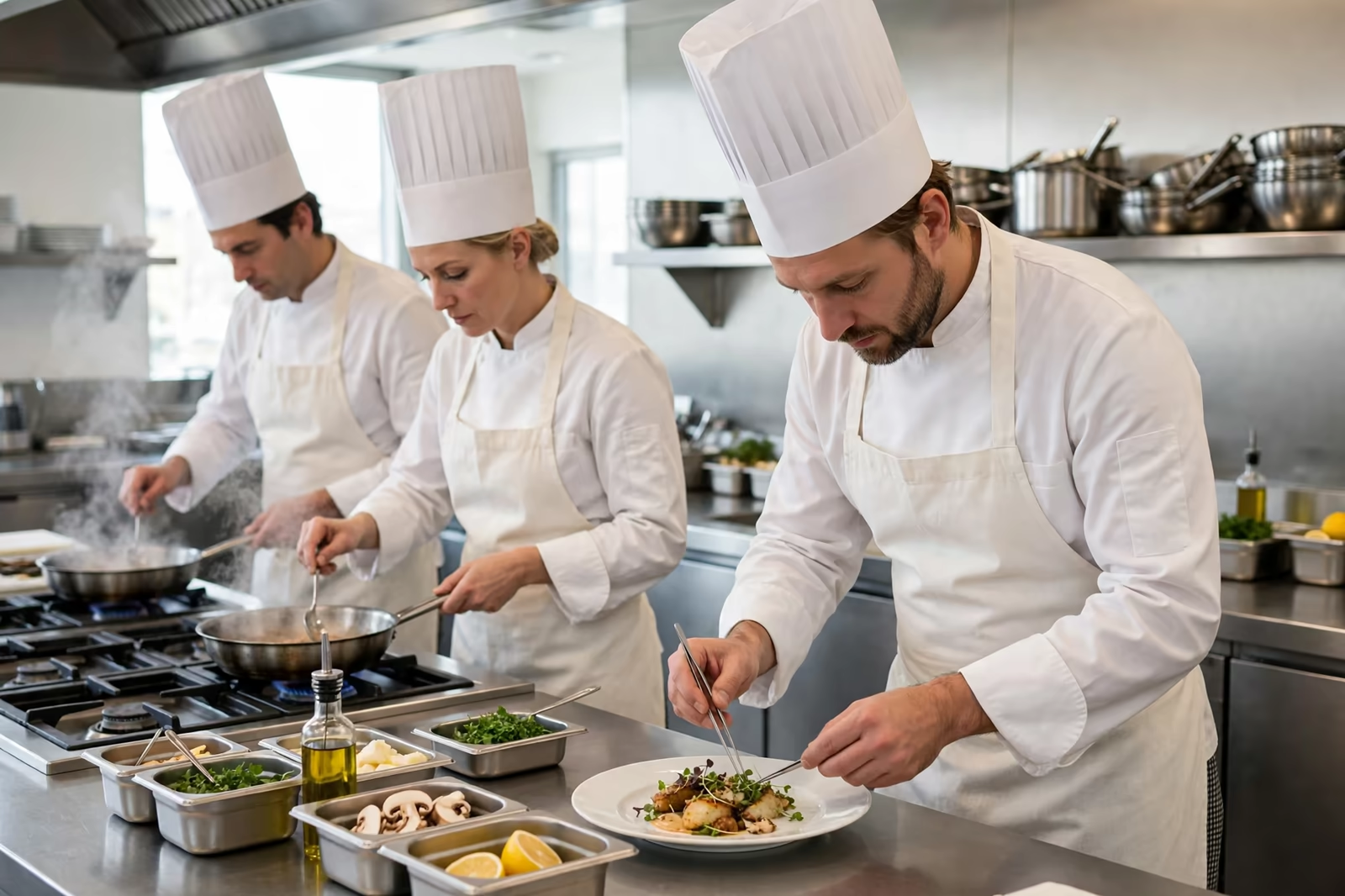
Kitchens: Whites, Aprons and Safety
The kitchen’s uniform is protective equipment wearing a tradition: chef jackets in breathable cotton-rich cloth with knotted or stud closures that release quickly, aprons that shield against heat and splash, trousers that move and hide the day’s evidence, headwear that contains hair completely. Each piece answers a hazard or a hygiene rule before it answers a style question. Sleeve lengths, button styles and apron ties all sit under local food-safety rules, which the specification should be checked against.
- Chef jackets with closures that release quickly in an emergency.
- Aprons shielding against heat and splash, by station.
- Headwear containing hair completely, without exception.
- Trousers that move, hide the day’s evidence and clear the floor.
Heat argues for mesh backs and lighter weaves in the hot line’s jackets; the pass and open kitchens, where guests watch, argue for the crisp, logo-bearing version of the same system.
Apron programmes deserve their own specification: bib and waist styles by station, split pockets, cross-back straps for long shifts, fabrics that survive boil washes. Trousers carry their own rules, checked and dark patterns that forgive splashes, hems kept clear of the floor, and pockets placed for the tools each station actually carries.
Restaurants, Bars and Banqueting
Restaurant uniforms run on theatre and stamina: servers need shirts and aprons that survive a double shift and a red-wine incident, bartenders need sleeves that work wet, banqueting teams need a formal register that assembles fast for events of two hundred covers. Bib aprons in brand colour over black or white shirts are the industry’s durable grammar, varied by venue concept.
Sommelier, host and manager layers add structure, a waistcoat, a tailored shirt, a tie, so guests can read seniority at a glance across a busy room. Collar and cuff construction take a beating in service work, so these garments are specified with reinforceable, replaceable details where the concept allows.
Banqueting’s casual workforce argues for a simplified, size-flexible version of the same look that a new hire can wear correctly within minutes. Stain strategy shapes colour choice in dining spaces: mid-tones and patterns at the apron and waistcoat hide the evening’s evidence better than either black or white alone.
Spa, Wellness and Leisure Staff
Spa and wellness uniforms speak softly: tunics in calm colours with clean lines, fabrics quiet against skin and quiet in sound, fits that allow treatment work without clinical coldness. Pool and leisure staff need the performance version, quick-drying polos and shorts in the same palette, with sun and chlorine resistance specified where the work is outdoors.
The wellness palette usually steps furthest from the corporate colour, and the system’s discipline is what keeps that step looking intentional rather than lost.
Kids’ club and activity staff add the cheerful register, brighter accents on the same base garments. Therapists’ tunics deserve a construction note of their own: wrap and side-vent designs that allow a full day of physical treatments without pulling at the shoulder, in fabrics that release massage oils in the wash rather than holding them.
Engineering, Security and Back-of-House
The departments guests rarely see still wear the property: engineers in durable work shirts and cargo trousers with tool pockets, security in a formal dark register that reads as authority, stewarding and back-of-house teams in practical, hygienic dress. Their uniforms are specified hardest for function, but the colour family and badge rules still apply, because corridors connect every department in a guest’s single impression.
Hi-vis and protective variants for loading and plant work follow safety standards first, branded second, never the reverse, and their replacement follows wear rules rather than the calendar.
A complete property programme lists these roles on day one; adding them later, in whatever a local supplier had, is how the system quietly breaks. Back-of-house sizing runs widest of any department, since the roles recruit across every demographic, and the spares pool should reflect that spread honestly.
Laundry Partnership: Designing With the Wash
Hospitality uniforms live in the laundry, and the laundry should be consulted like a design partner: its wash temperatures, chemistry and cycle counts set the real specification for colourfastness, shrinkage and construction. A fabric that tests well at domestic temperatures can fade or twist under industrial cycles within a month of service.
Properties running in-house laundries control this specification directly; those outsourcing it inherit the contractor’s process, which the uniform order must be told about.
Our hospitality specifications are set against the laundry process the property actually runs, garments and tests matched to it, rather than to a laboratory fiction. One operational rule follows: trial-wash the samples through the property’s real laundry before the bulk order, because the cheapest time to discover a fading tunic is while it is still a sample.
Fitting a Rotating Workforce
Hospitality hires constantly, across every body type, and the uniform programme must absorb new starters weekly without bespoke drama: size curves ordered against real staff data, a spares pool per department, simple size-exchange discipline, and garments whose fit forgives, wrap aprons, adjustable waists, stretch panels where movement demands them.
Agency and banqueting staff need the flexible subset: garments that fit acceptably across sizes, issued and returned by the shift.
Fitting sessions at programme launch, with samples in every size, prevent the first-month exchange flood that properties quietly expect and should not accept. The data from those sessions, real staff sizes by department, becomes the reorder curve, replacing guesswork with the property’s own evidence year after year.
Seasonal and Event Staffing Peaks
Resorts and venues breathe with the calendar: high season doubles some departments, events spike others for a weekend. The programme plans both rhythms, core uniforms owned per staff member, peak garments held as a property pool in common sizes, event-specific pieces like branded polos for festivals or holiday accents that attach to the base uniform rather than replacing it.
Ordering for the peak in the low season, when production and freight are calm, is the budget discipline experienced properties share.
Post-season, pool garments are laundered, repaired and stored against the size curve the season actually used, data that makes the next peak cheaper. Properties with sister sites can go further, sharing one programme across locations so peak pools and spares move where the season moves.
How We Outfit a Property
Our hospitality programmes start department by department from the property’s own structure: role lists, laundry process, brand standards and staffing rhythm, then build each family’s specification, fabrics, branding by our embroidery studio, size curves and spares, before sampling the guest-facing roles on real staff. The output is a programme document the property reorders from for years.
- Every department specified inside one colour and badge system.
- Size curves and spares pools set from real staff data.
- Guest-facing roles sampled on real staff before bulk production.
Single-department orders are welcome; the system thinking comes with them free, along with honest advice about what the neighbouring departments will eventually need.
A property looks like its uniforms on the best day and the busiest day alike when the programme was designed for both. That, in the end, is the standard worth ordering to: not the launch photograph, but the five-hundredth service, and every one between.
Frequently Asked Questions
How many sets per employee does a hotel need?
Enough for the laundry cycle plus a margin: daily-change roles typically run several sets per person so a clean uniform exists on every shift including laundry delays, with the exact count set by the property’s wash turnaround. Front desk roles worn less punishingly run fewer sets; kitchens and housekeeping run the most.
Should housekeeping and front desk share colours?
They should share the property’s colour family while differing in register: the desk at full saturation and structure, housekeeping softer and more practical, kitchens in their whites with the brand carried in aprons and neckerchiefs. Guests read the relationship instantly when the palette is disciplined; they read chaos when each department shops alone.
What fabrics survive hotel laundering best?
Fibres and constructions chosen for industrial cycles: polyester-cotton blends for shirts and tunics where colour retention and easy care dominate, cotton-rich cloth where skin comfort and heat rule, all colourfast to the wash temperatures the laundry actually runs. The specification conversation with the laundry matters as much as the fabric choice itself.
How is branding applied on hospitality uniforms?
Embroidery carries the property’s mark on desk shirts, tunics and chef jackets because it survives the laundry and reads as quality; name badges, woven or printed, sit by a fixed placement rule. Aprons take embroidery or print depending on design. One approved artwork file and placement chart for the whole property keeps every department’s branding identical.