

A school uniform programme is bigger than its polo shirts. Beyond the classroom staples sit layers for cold corridors, PE kits that survive twice-weekly washing, summer and winter variants, and a sizing system that must fit children who grow between order and delivery. Schools, trusts and uniform retailers who plan the whole kit, not just the famous piece, spend less and argue less. This guide builds the full programme.
School uniform programmes are produced to order in Bangladesh for schools and retailers in the USA, the UK, Germany, Canada and Australia.
The staples linked here are our kids’ polo shirt and crewneck sweatshirt; terms sit at MOQ and production.
The Core Kit: Polos, Shirts and Bottoms
The core kit carries the school’s identity daily: polo shirts or formal shirts by the school’s register, trousers, shorts, skirts and skorts in disciplined colours, knitwear for the classroom’s temperature swings. Each piece is specified for playground physics: reinforced knees and seats, easy-care fabrics that forgive home washing at every temperature a parent owns, colourfastness that keeps a year group matching from September to July.
Buttons, zips and fastenings are chosen for small hands and short breaks, a detail adults forget and children grade daily.
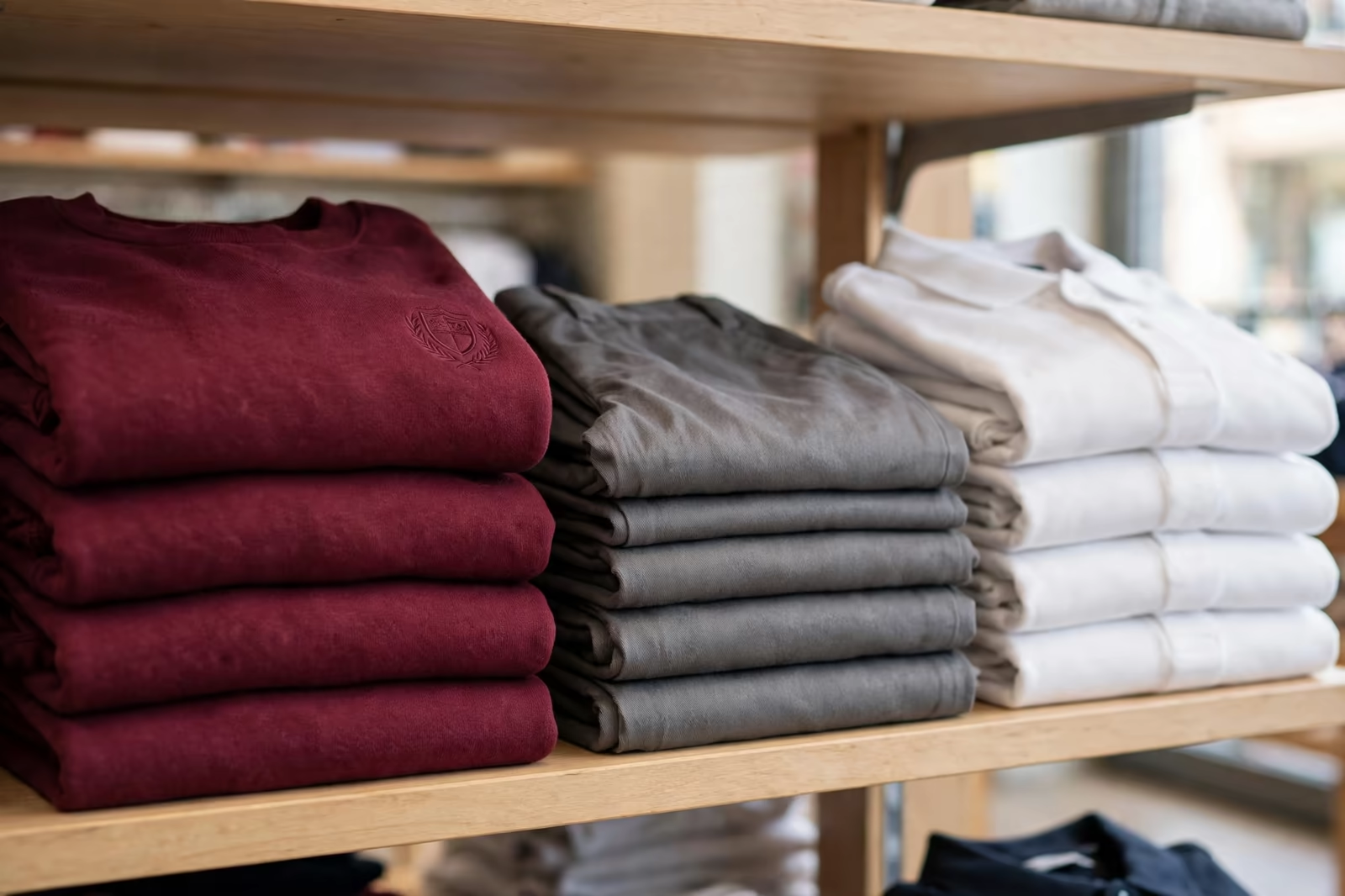
Embroidered crests carry the identity on knitwear and polos; printed marks serve PE and events.
- Reinforced knees, seats and hems where school clothes wear first.
- Easy-care fabrics that forgive home washing at any temperature.
- Fastenings small hands can work inside a short break.
- Kit lists written per year group as children grow.
The kit list is written per year group where schools differentiate, infants’ elastic waists giving way to formal closures as children grow. Bottoms carry the hardest specification in the kit: knees, seats and hems are where school clothes go to die, and reinforcement there is money visibly well spent by October.
Layers: Sweatshirts, Knitwear, Blazer-Adjacent Pieces
British-style programmes especially live in their layers: crewneck and V-neck sweatshirts, cardigans and jumpers in school colours, and at the formal end blazer-adjacent jackets, structured, crested, designed to give young wearers the blazer’s register with a school garment’s practicality and price. Acrylic and cotton-blend yarns dominate for washability, with rib structures at collar, cuff and hem knitted to recover after every wash.
Layer colours are the school’s public face in winter photographs, so dye discipline across reorders is a programme promise, not a hope, and families notice a drift before schools do.
Fleece jackets and showerproof outers complete the journey-to-school layer in colder markets. Knitwear construction deserves its yarn-and-gauge conversation, stitch density decides whether a jumper keeps its shape through a year of bags, pegs and washing, and it is specified, not sampled by luck.

PE Kits: Built for the Wash Cycle
PE kit is the hardest-working clothing in the building: tee or polo, shorts, and in colder programmes tracksuit layers, washed after every use, often twice a week, in machines of every temperament. Fabrics are chosen for that violence: colourfast, quick-drying, dimensionally stable, with house colours carrying team identity where the school runs them. Names and initials are printed or embroidered by many programmes, since a PE kit’s other destiny is the lost property box.
- Colourfast, quick-drying fabrics stable through twice-weekly washes.
- House colours carrying team identity across the kit.
- Generous sizing, because kit that binds stays in the bag.
- Drawcords and waistbands that survive a whole match.
Sizing PE generously is policy: children play in it, and kit that binds is kit left in the bag, or trailing home with a note in the bag.
Spare ratios follow the wash reality of family life, which schools understand better than any supplier. Drawcord and waistband quality decide whether shorts stay up through a match, a small specification with a very public failure mode that no programme should learn twice.
Summer, Winter and the Shoulder Seasons
School programmes dress a calendar, not a day: summer terms argue for short sleeves, shorts and dresses in lighter weights; winter for the full layer stack, knitwear under blazer-adjacent jackets, trousers over shorts, showerproof and insulated outers for the journey. Shoulder seasons, where most of the year actually lives, are served by the layering logic itself, pieces designed to combine rather than seasonal uniforms that replace each other.
Markets invert the calendar: southern-hemisphere programmes order against January starts, Gulf programmes weight the summer specification hardest.
The programme document carries the term calendar explicitly, so reorders land in the right season by design. Dress and skirt variants follow the same seasonal logic, lengths and weights by term, with modesty and movement tested on real playgrounds rather than in catalogues.
Uniform Retailers and School Shops
Many schools reach families through retailers or on-site shops, and the programme serves both: retailers need dependable size curves, crest accuracy across dozens of schools, and reorder reliability in the August surge; school shops need simplified ranges, parent-proof size charts and stock that survives the returns season. Production planning respects the surge honestly: school volume is the most seasonal in the uniform world, and capacity booked early is the difference between a stocked shop and an apologetic one.
Private-label programmes for retailers follow the same discipline, the shop’s brand on the label, the school’s standard on the garment.
- Dependable size curves and crest accuracy across schools.
- Capacity booked early against the August surge.
- Parent-proof size charts that buy down size exchanges.
Online sizing tools and pre-order windows, now standard practice, all depend on the size data the programme documents. Returns in this trade are mostly size exchanges, and every point of chart clarity buys them down before they happen.
Second-Hand, Spares and the Growth Problem
Children outgrow uniforms before they wear them out, and healthy programmes plan for it: durable construction that survives a second owner through school swap shops, spares held in the middle sizes where growth is fastest, and pricing that respects family budgets across several children. Growth room is designed, hems that can be let down, waists that adjust, knitwear with recovery that forgives a size stretch.
Retailers see the growth curve in their returns data and should share it with production, since next year’s curve is this year’s, aged one year.
A programme that fits September’s child and still fits March’s has done its quiet job. Name labels and woven identification, offered by many programmes, raise the odds that outgrown and lost pieces find their way back into circulation.
Crest, Colours and Identity Discipline
A school’s crest is heraldry to its families, and its reproduction is a discipline: embroidery digitised once from approved artwork, thread colours fixed by named references, placement measured per garment family and size, because a crest that wanders across the chest by year group looks like carelessness in every photograph. School colours follow the same law, dyed to retained standards, checked across fabric families, since the polo, knit and PE kit must read as one school under one sky.
New crests and rebrands are programme events, piloted on samples and approved by the school before bulk.
Our embroidery studio holds crest files centrally for every school programme, so reorders never re-interpret the artwork. Small crest details, stars, mottos, house marks, are digitised at sizes that stay legible on the smallest garment in the range, not only the largest.
Ordering Calendar: The School Year Rules
School uniform production runs on immovable deadlines: garments must exist before term starts, in the right sizes, wherever the school’s families are. The calendar works backwards from that date through shipping, production and approval, with crest and colour approvals front-loaded because they gate everything. Late orders compress the wrong stages, sampling and approval, which is why experienced schools and retailers place core orders a full season ahead and treat August as a delivery month, not an ordering one.
Mid-year top-ups for new joiners and lost kit follow the spares logic rather than fresh production runs.
The programme document carries the buyer’s own calendar, terms, intakes and surges, so the second year starts from a plan. Freight choice follows the same calendar honesty: sea freight booked against a plan costs a fraction of the air freight a late order forces.
Inclusivity: Fit, Sensory and Budget
Modern school programmes dress every child: extended size ranges as policy, adaptive details for children who need them, closures and fabrics chosen with sensory sensitivities in mind, seamless or flat-seam options where the need is stated, and gender-inclusive kit lists that let families choose pieces rather than be assigned them. Budget inclusivity is designed too: durable core pieces that survive siblings, honest pricing on the items every family must buy in multiples.
These are specification conversations at programme stage, inexpensive to design in and expensive to retrofit.
A uniform every child can wear comfortably is the programme’s definition of success, ahead of any photograph. Schools reviewing a programme should ask how it serves the child who fits nothing standard, because that answer predicts how it serves everyone.
How We Build School Programmes
Our school work starts from the kit list and the calendar: core pieces, layers, PE, seasonal variants, each specified for home laundering and playground physics, crests digitised and colour standards retained, sizes charted for parents, production planned against the term dates the garments must meet. Retailer programmes add private label and multi-school crest management inside the same document discipline.
Samples are washed the way families wash, because that is the test the garments will actually sit.
- Whole kit planned against the term calendar, not piecemeal.
- Crests digitised once and held centrally for every reorder.
- Growth room, spares and second-owner durability designed in.
The result is a programme a school can hand to next year’s coordinator complete, which is when uniform systems prove their worth. It is also a programme that survives its second August, the deadline that exposes every shortcut taken in the first, in front of every parent in the queue at the shop on the busiest Saturday of the whole year.
Frequently Asked Questions
What belongs in a complete school uniform kit?
Typically: classroom tops (polos or shirts), bottoms (trousers, shorts, skirts or skorts), a knitwear layer, a PE kit, and seasonal variants or outer layers where the climate demands them. Each school’s list differs by register and market, but the planning unit is the whole kit, since pieces ordered separately across years rarely match in colour or quality.
How are sizes handled for growing children?
By age-and-height sizing with growth room designed into the fit, size charts written for parents rather than factories, and order windows timed so garments arrive close to the school year. Retailers serving many schools hold the curve as stock logic; schools ordering directly collect sizes from parents against the chart and add spares in the fastest-growing sizes.
Can crests and house colours be reproduced exactly?
Yes: crests are embroidered from the school’s artwork with thread colours fixed by reference, and house or year colours are dyed to retained standards so this year’s intake matches last year’s. The discipline is documentation: one approved crest file, one colour standard, held centrally for every reorder.
What fabrics survive a school year of home washing?
Polyester-cotton blends for polos and PE pieces, where colour retention and easy care dominate, and acrylic-cotton blends for knitwear, chosen for recovery and washability. The honest test is domestic, not industrial: samples washed at home temperatures through repeated cycles before the bulk order, as our testing guides recommend for every uniform family.