
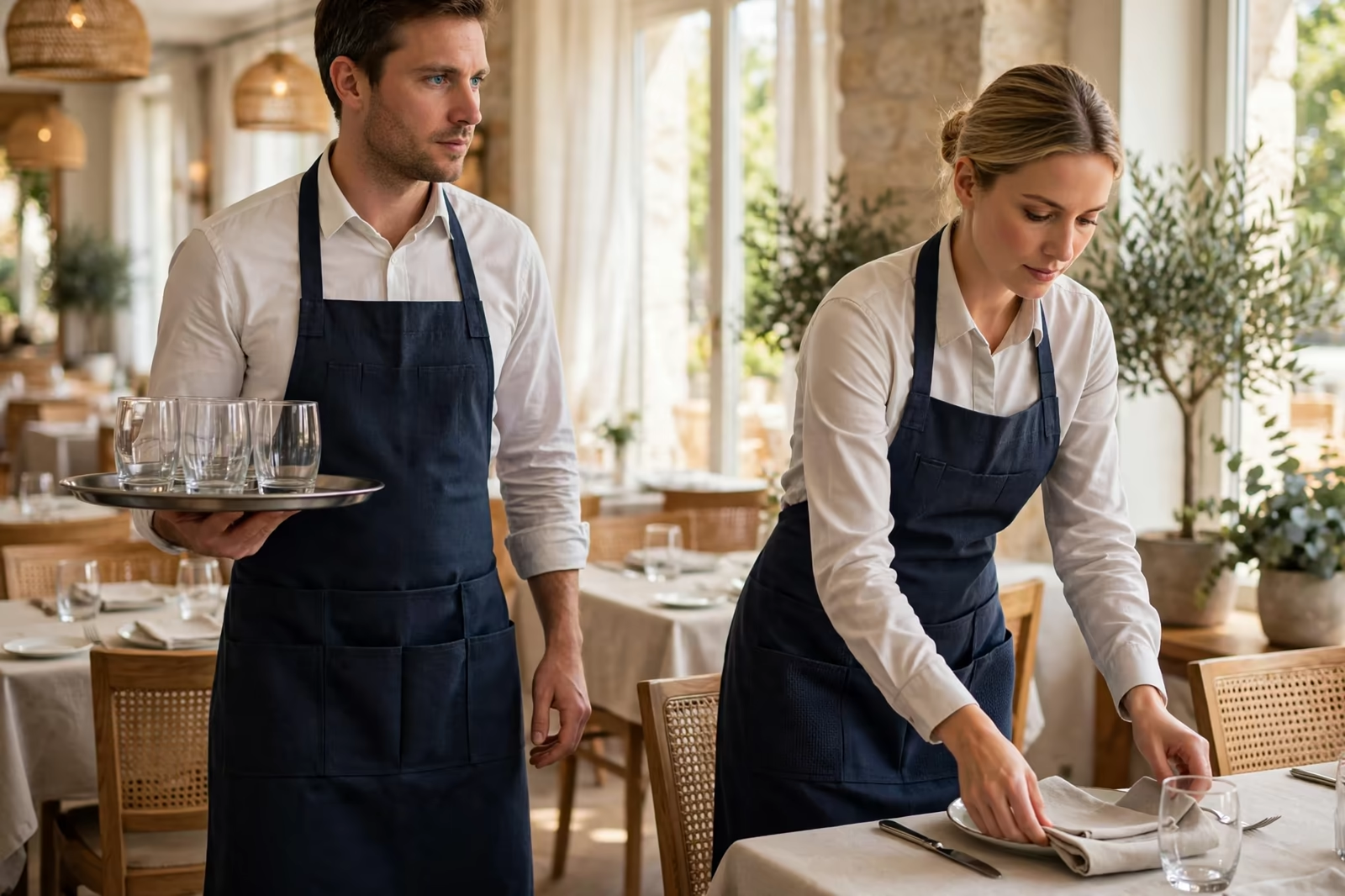
Most restaurant uniform conversations stop at the apron, and most restaurant uniform problems start everywhere else: the server whose shirt wilts by the second seating, the bartender whose sleeves live in the wash, the host whose look belongs to a different restaurant entirely. A full staff look is a system, front of house to kitchen door, and this guide builds it piece by piece.
Restaurant programmes are produced to order in Bangladesh for restaurants in the USA, the UK, Germany, Canada and Australia.
The anchor pieces linked here are our apron and oxford button-down shirt; branding runs through embroidery.
Servers: The Working Uniform
The server’s uniform is athletic equipment in formal dress: shirts or blouses that survive a double shift’s movement, aprons with pockets engineered for order pads, pens, corkscrews and card readers, trousers and skirts that bend, reach and carry without complaint. Fabric choice is stain strategy as much as comfort: mid-tones and subtle patterns forgive the evening, easy-care weaves forgive the laundry, and a spare shirt per shift forgives the inevitable.
- Apron pockets engineered for pads, pens and card readers.
- Cross-back straps that spare the neck across long services.
- Shoulder and back fit that survives the twentieth table.
- Size range and spares treated as a design feature.
Fit through the shoulder and back decides whether the twentieth table feels like the first.
Waist aprons dominate casual concepts, bib aprons formal ones, with strap systems, cross-back above all, that spare the neck across long services.
Consistency of the server look across the whole floor is what guests photograph, which makes size range and spares a design feature, not an afterthought. Sleeve and collar construction take disproportionate wear in service, reaching, carrying, leaning, so these zones are specified reinforced where the concept’s look allows.
The Bar Team
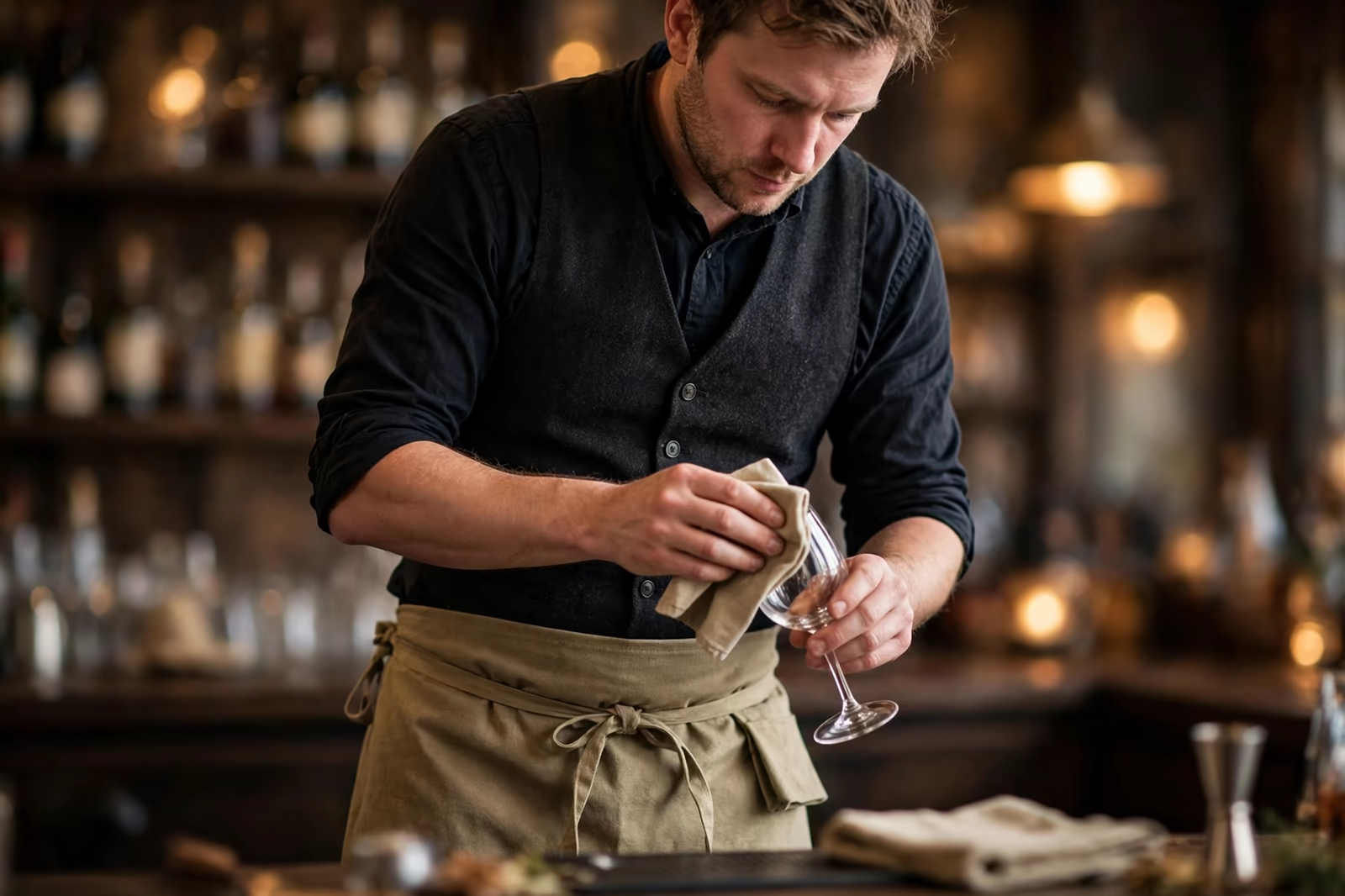
Bartenders work wet, fast and visible, and their dress tunes accordingly: rolled or short sleeves that stay out of the wash, waistcoats or aprons in leather-look or heavy canvas where the concept calls for craft, shirts dark enough to hide the splash pattern of a busy bar. The bar look usually carries the concept’s strongest styling, since the bar is where guests watch the longest, and where the team’s hands, sleeves and aprons are quite literally on display.
Pockets shrink here, speed matters more, and every piece must survive nightly washing without losing its edge.
Bar backs, the engine room of the bar, wear the practical version of the same palette: darker, tougher, apron-forward. Glassware and ice argue for forearms that can get wet without consequence, which is why bar aprons run longer and bar shirts specify sleeves that roll and stay rolled.
Hosts, Managers and the Formal Register
Guests read hierarchy from dress: the host’s tailored shirt or dress, the manager’s waistcoat, blazer or tie marks the person who can solve a problem. This register should share the floor’s colours while stepping one level more formal, so the room reads as one restaurant with a chain of welcome rather than two staffs who met at the door. The difference should be visible across a full dining room, which argues for silhouette, not jewellery.
Name badges and embroidered marks sit by one rule across every register.
Seasonal formality, a summer host in shirtsleeves, works when the programme defines it rather than letting the weather decide nightly. The host desk is also where the brand’s printed pieces live, menus and cards, and the uniform’s colour discipline should be chosen with those materials already on the table.
The Kitchen Door: Pass, Runners, Dish Pit
Between kitchen and floor stands a small cast with its own dress logic: expediters and runners who cross the line all night, dressed to satisfy both worlds, aprons and shirts that read front-of-house with kitchen-grade practicality; dish pit staff in the toughest, quickest-drying dress in the building, where waterproof aprons and spare sets are survival rather than comfort. Heat at the pass argues for breathable backs on every garment that works within a metre of it.
These roles are forgotten in most uniform orders and improvised nightly in most restaurants, which is why they belong on the programme’s first list.
Their colours sit deliberately between the kitchen’s whites and the floor’s register, the visual hinge of the room. Runners in particular cover distance at speed with hot plates, which makes footwear-friendly trouser lengths and non-slip-conscious hems a safety specification, not a style note.

Cafes, Bakeries and Counter Service
Counter concepts run a lighter register: branded tees or polos under aprons, caps or bandanas where hair rules and concept meet, colours that survive flour dust and coffee splash. The apron is the uniform here, carrying brand, pockets and protection, while the base garment rotates with the season, tees in summer, sweatshirts and layered shirts when the door opens onto winter.
- Branded tees or polos under the working apron.
- Caps or bandanas where hair rules and concept meet.
- Mid-tone aprons that forgive flour dust between services.
- Pieces that scale from one site to ten without redesign.
Bakery production staff add heat and early hours to the equation: breathable whites or brand colours with the same apron logic.
Counter programmes are often a young brand’s first uniform, which argues for pieces that scale from one site to ten without redesign. Apron colours in flour-dusted environments are a practical art: mid-tones that forgive dust between services keep a bakery counter looking fresh at four in the afternoon.
Delivery and Takeaway Staff
The rider and driver are the restaurant outside its walls: weatherproof branded layers, hi-vis elements where roads demand them, garments that work on a bike, in a car and at a stranger’s door. Insulated jackets and rain layers carry the logo furthest of any piece the restaurant owns, which makes their branding quality a marketing decision as much as a uniform one.
Comfort across a shift of short journeys, in and out of heat and weather, argues for layers that open and close fast, and for gloves and hats that carry the same branding discipline in miniature, at speed, in the rain, after dark, in traffic.
Where the team is platform-based rather than employed, the programme often stops at a branded layer and cap, designed to sit over anything the rider already owns. Employed riders deserve the full thought: base layers for winter, ventilation for summer, and pockets that keep a phone and float dry through weather.
Stain, Laundry and the Nightly Turnaround
Restaurant dress lives one shift from the laundry, and the programme is designed backwards from the wash: fabrics that release wine, oil and turmeric; colours that keep their nerve through nightly industrial cycles; aprons as sacrificial armour replaced more often than the garments beneath. Restaurants running laundry services inherit the contractor’s cycle, which the specification must be told; in-house machines give control at the price of discipline.
Trial-washing through the real process settles arguments that fabric descriptions cannot.
- Fabrics chosen to release wine, oil and spice stains.
- Aprons as sacrificial armour on a faster replacement cycle.
- Spare ratios set by the laundry turnaround arithmetic.
- Colourfastness proven through the actual wash process.
Spare ratios are set by the turnaround: a two-day laundry cycle with a full house nightly is an arithmetic problem with one right answer. Aprons earn a separate, faster replacement cycle in the budget, since they absorb the damage the rest of the uniform is spared.
Fitting Casual and Part-Time Teams
Restaurants employ the most fluid workforce in hospitality: students, part-timers, seasonal surges. The programme answers with forgiving garments, aprons that fit everyone, shirts across a wide recorded size range, a house pool for trial shifts and agency cover, and issue discipline simple enough for a busy manager: sizes recorded, returns laundered, spares counted.
Dignity still applies: a part-timer in a badly fitting shirt serves like one.
Programmes that fit the core team beautifully and the casual team approximately will be judged, nightly, on the approximate half. One manager-level habit protects the whole system: a thirty-second uniform check at the pre-shift briefing, aprons tied, badges on, spare shirt issued where the evening has already claimed one.
Concepts: From Food Truck to Fine Dining
The uniform is the concept worn. Food trucks dress loud and practical, print-forward tees and aprons built for a two-person line. Bistros dress in the classic grammar of shirt, apron and towel. Fine dining dresses quietest of all, tailored, minimal, branding reduced to a whisper of embroidery, because at that level restraint is the loudest signal. Each register is a legitimate system; the failure mode is mixing them by accident.
New concepts should dress the opening team from the programme, not from a marketplace basket, because the first photographs outlive the first menu.
Our programme work starts from the concept document and the menu, since covers, courses and kitchen heat all vote on the dress. Chain rollouts add one more discipline: the concept’s look must survive translation across climates and cultures without losing the thread that makes it recognisable.
How We Dress a Restaurant
Our restaurant programmes map the house role by role, floor, bar, host, pass, kitchen door and delivery, then specify each family’s garments against the laundry the restaurant actually runs: aprons engineered by station, shirts that survive the service, branding from our embroidery studio on one placement chart, sizes recorded from real staff, spares set by the wash cycle. The programme document becomes the house standard, reordered by reference.
- Every role mapped, floor to delivery, in one programme.
- Aprons engineered by station, not bought as an afterthought.
- One embroidery placement chart for the whole house.
Single pieces are welcome; the system thinking arrives with them.
A restaurant dressed by programme looks intentional at the first seating and the last, which is the whole review guests write in their heads. It also photographs that way, which in the age of the guest’s camera is the same review made public, shared and permanent, long after the plates are cleared and the lights are up for the cleaning crew.
Frequently Asked Questions
What apron style suits which restaurant concept?
Waist aprons serve casual and high-volume concepts where speed and coolness matter; bib aprons serve formal and craft concepts where coverage and presence matter; cross-back straps serve any concept whose staff wear aprons all shift, since they move the load from neck to shoulders. The apron programme is specified by station, since bar, floor and kitchen wear their aprons differently.
How many shirts does each server need?
Enough for the rota plus laundry turnaround plus the mid-shift disaster: most programmes issue several shirts per server with aprons in similar rotation, because the apron protects the outfit but the shirt still meets the evening. Exact counts follow the restaurant’s wash system, in-house or laundry service, and are fixed in the programme document.
How is a restaurant’s brand carried on staff dress?
Embroidery on shirts, aprons and waistcoats carries logos and names with the durability restaurant laundering demands; printed pieces serve events and promotions. One artwork and placement chart for the whole house keeps the host, floor and bar telling the same brand story at the same quality.
Can one programme dress both a flagship and a casual sister site?
Yes, and groups do it deliberately: shared base colours and apron families, with the formal register reserved for the flagship and the relaxed register for the casual site, all inside one programme document. Staff moving between sites carry most of their kit with them, and purchasing keeps one relationship instead of two.