
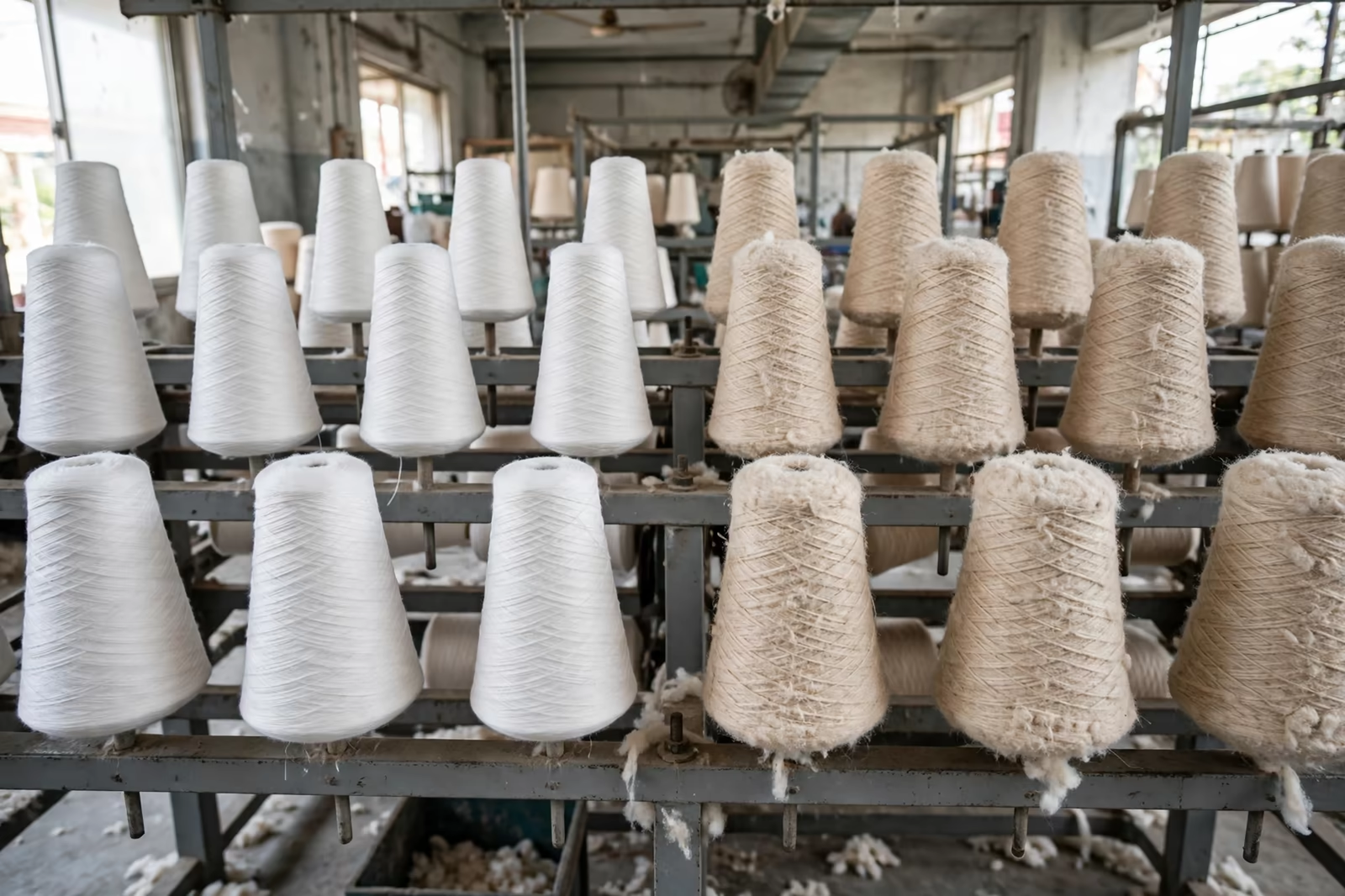
A fabric specification sheet looks like a part number for cloth: a line of counts, gauges, weights and abbreviations that either unlocks an intelligent conversation with a mill or quietly signs the buyer up for whatever arrives. Most disputes about hand feel, weight and price were encoded in that line long before production. This guide teaches buyers to read it: yarn count, knit structure, gauge, stitch length and weight, and what each number does to the garment.
The specifications behind this guide are the working documents of garment production in Bangladesh for the USA, the UK, Germany, Canada and Australia.
Bring any specification to our services desk for a reading; the minimum structure behind fabric commitments sits on our MOQ and production page, and quotes begin at get a quote.
Yarn Count: The Fineness Number
Yarn count states how fine a yarn is. In the cotton system used across this trade, the count, written Ne, rises as the yarn gets finer: a Ne 30 yarn is finer than a Ne 20, and a fabric knitted from it will be smoother, lighter for the same structure, and usually dearer, because finer yarn demands better cotton and slower, cleaner spinning.
The count therefore predicts a family of properties at once: surface smoothness, drape, pilling behaviour and price, before any other line is read. Two fabrics at identical weight can feel like different species because one was knitted from fine yarn at tight structure and the other from coarse yarn loosely.
Reading a specification starts here, because almost every other line is the count’s consequence. Other count systems exist, metric and denier among them, and conversion mistakes between systems have built real garments in the wrong yarn; a specification should name its system as plainly as its number.
Carded, Combed and Ring-Spun: The Words Beside the Count
Beside the count sit the preparation words, covered fully in our cotton qualities guide: carded yarn keeps shorter fibres and a hairier surface; combing removes the short fibres for smoothness and strength; ring spinning gives a softer, stronger yarn than open-end spinning at the same count. The words matter as much as the number: Ne 30 carded and Ne 30 combed are different materials wearing one numeral.
Melange, slub and other effect yarns add their own lines, each with appearance consequences the buyer should see in a swatch rather than imagine from a name.
A specification that gives the count without the preparation is half a sentence. Ply belongs in the same reading: two finer yarns twisted together behave differently from one yarn of the combined count, in strength, texture and price, and knitwear in particular exploits the difference deliberately.
Gauge: Needles Per Inch, Character Per Fabric
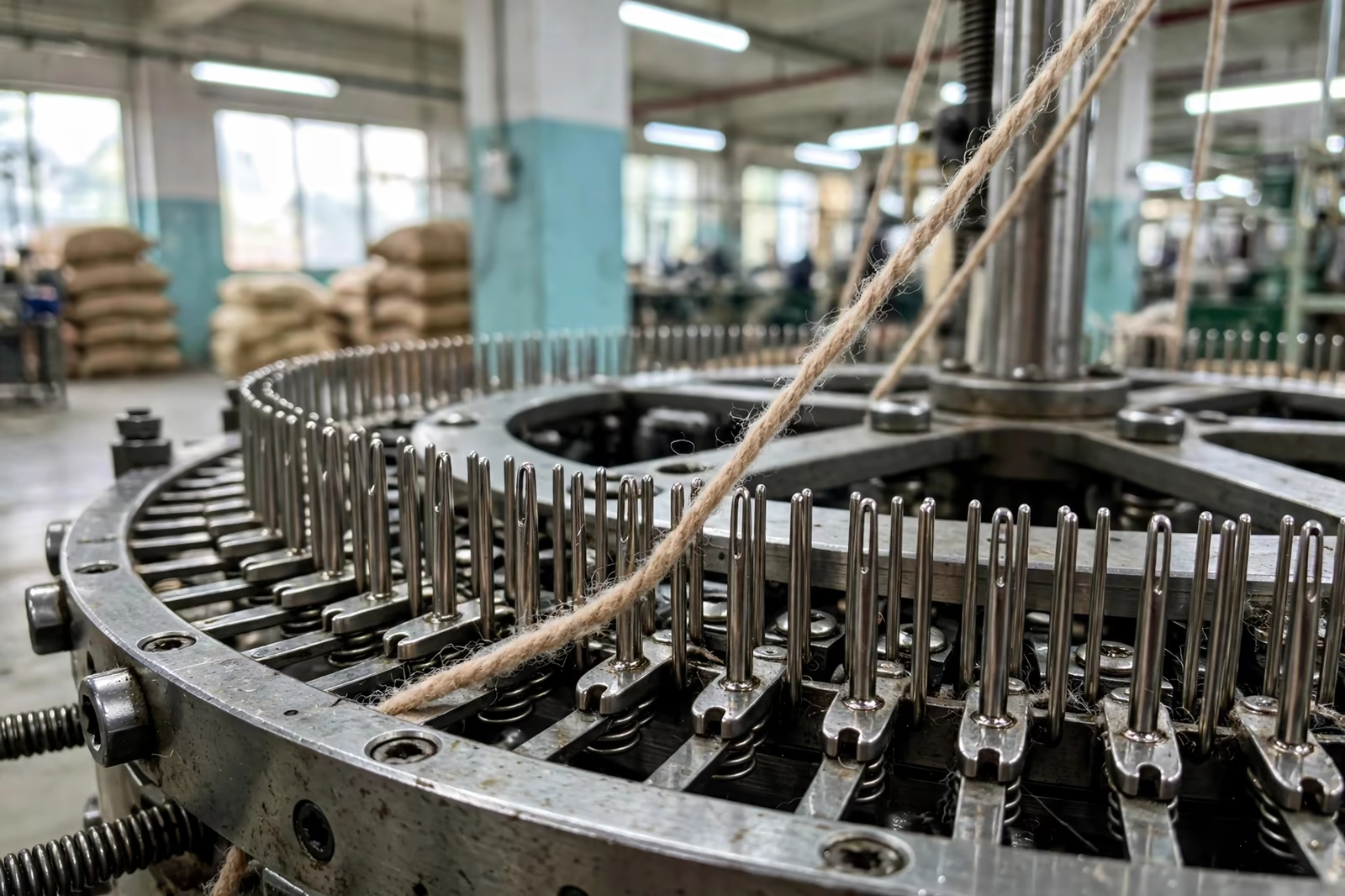
On knitting machines, gauge counts the needles per inch: higher gauge, finer needles, finer fabric. Gauge and yarn count travel together, fine yarns on high-gauge machines making the smooth, dense jerseys of premium tees; coarser yarns on lower gauges making the chunkier structures of sweatshirts and knitwear.
A mismatch announces itself: yarn too coarse for the gauge strains and breaks, yarn too fine swims loosely and the fabric loses body. When a specification names one without the other, the buyer is entitled to ask what the mill actually intends to run.
For knitwear the gauge also sets the garment’s whole visual register, the difference between a fine-gauge layering piece and a rustic sweater is written here first. Knitwear specifications in our own packs name the yarn’s fibre and count, the machine gauge and the stitch structures at body, collar, cuffs and hem, because a sweater is several knitted fabrics wearing one name.
Stitch Length: The Quiet Cost Lever
Stitch length, the yarn consumed in one knitted loop, is the specification’s quiet lever. Shorten it and each course packs more yarn: the fabric gains weight, stability, opacity and cost together. Lengthen it and the same count of yarn covers more area more cheaply, producing the loose, sleazy hand and the spirality that plague budget knitwear.
Because stitch length is invisible in a fabric’s name and hard to judge from a photograph, it is where silent economies live: a fabric can keep its count, gauge and even its nominal weight class while its loops lengthen underneath.
Serious specifications pin it, and serious mills report the loop length they ran, because both sides know exactly what the number protects. It also explains a common sample-room mystery: the bulk fabric that feels thinner than the approved sample although every named line matches, until somebody finally measures the loops.
GSM: Weight, and What It Does Not Say
Grams per square metre, the famous GSM, measures finished fabric weight and nothing else: not fineness, not density of structure, not quality. It remains essential, garments are bought by it and wearers judge heft by it, but the number is a sum that many different fabrics can reach by different roads.
Weight also moves through production: dyeing, washing, compacting and finishing all shift the finished GSM away from the greige figure, which is why specifications state finished weight with a tolerance and the point in production at which it is judged.
The professional reading treats GSM as the last line to check against the order, not the first, and never as a synonym for quality. The same caution applies to marketing weights: a heavyweight label on a loose, long-stitched fabric describes a scale reading, not the dense, durable cloth the word promises in the customer’s mind.
Knit Structures Decoded: Jersey, Interlock, Rib, Pique
The structure words name how loops are arranged, and each carries a behaviour set. Single jersey: light, stretchy across, prone to curling edges and spirality if poorly made. Interlock: two intermeshed jerseys giving a firm, reversible fabric that lies flat. Rib: alternating wales giving strong width-wise stretch for cuffs, collars and fitted bodies. Pique: a textured structure with air in its geometry, the polo shirt’s classic.
Fleece adds a raised backing yarn brushed for warmth; French terry keeps its loops unbrushed. Each structure eats yarn differently, which is why structure, count and weight must be read as one sentence.
Our knitwear descriptions state yarn, gauge and stitch structure together, since a polo in pique and one in jersey are different products that happen to share a pattern.
Woven Specifications: Ends, Picks and Constructions
Woven cloth speaks a parallel language: ends and picks per inch count the warp and weft threads, the construction names the interlacing, plain weave, twill, satin, and thread counts summarise density. A shirting’s fineness lives in its counts and thread density exactly as a knit’s lives in gauge and yarn count.
The same reading discipline applies: a named construction without its densities is half-specified, and the hand of a twill at one density becomes board or gauze at another.
Buyers moving between knitted and woven programmes will find the logic identical, only the vocabulary changes costume.
Width, Shrinkage and the Finished Lines
The last lines of a specification are commercial dynamite in plain dress. Usable width decides how many garments a metre yields and therefore the true price of the cloth; a cheap fabric two centimetres narrower can cost more per garment than a dearer wide one. Shrinkage allowances state how much length and width the fabric may still move in washing, the numbers the pattern’s oversize is built from.
Composition closes the sheet, fibre by fibre with percentages, the line every other claim in this cluster leans on.
Read together, the finished lines tell the buyer what the garment will cost, how it will behave in the customer’s wash, and what it is actually made of: the whole order in five short lines.
Reading a Real Specification Line by Line
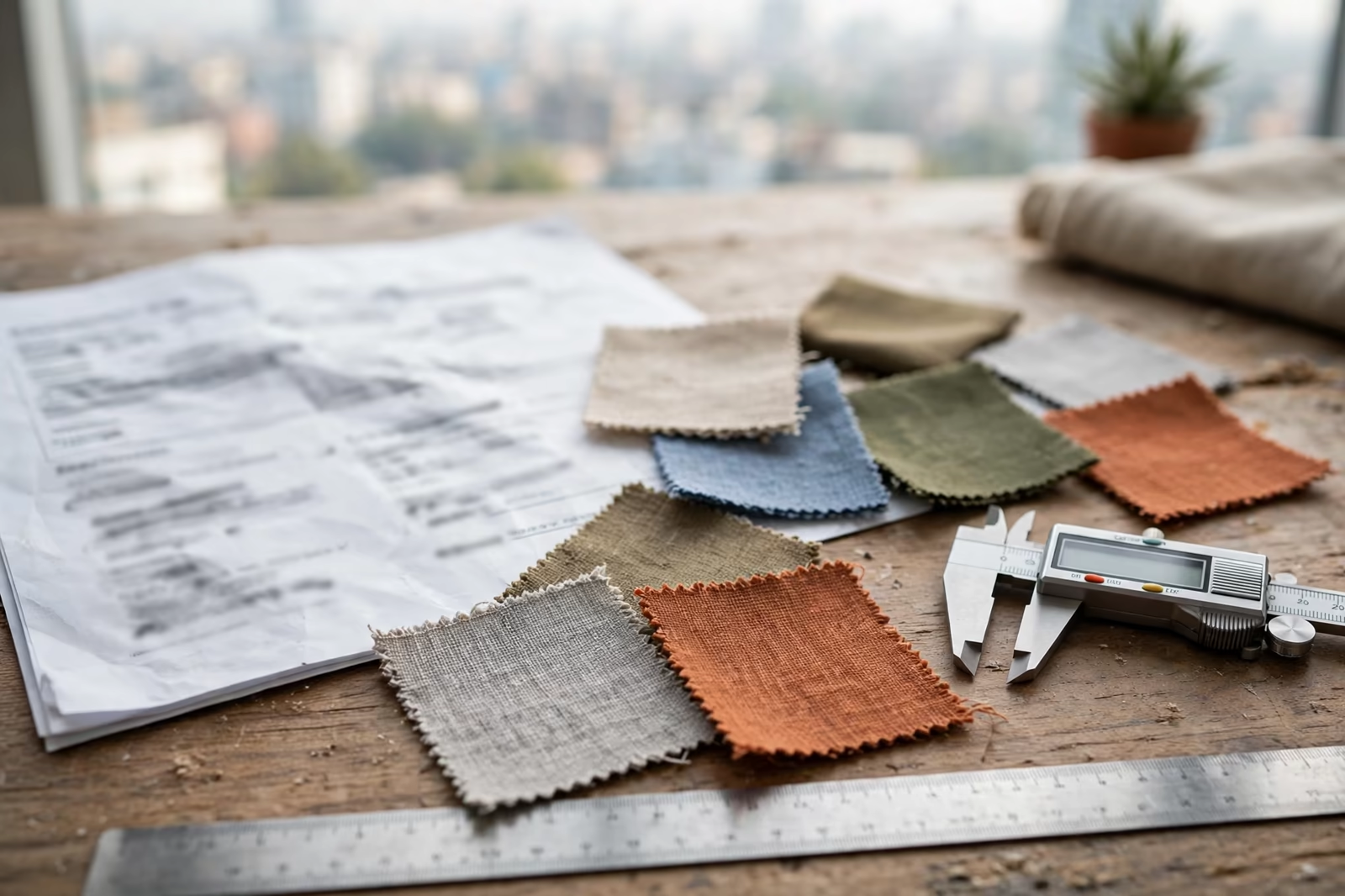
Take a typical jersey line: a count in the fine-carded range, a stated gauge, a stitch length, a finished weight with tolerance, a usable width, a shrinkage allowance, a composition. Each element cross-examines the others. The count and gauge should suit each other; the stitch length should be able to deliver the weight at that count; the width should suit the marker plan; the shrinkage should match the fibre story.
When one line contradicts the rest, the specification is describing a fabric that does not exist, and the mill’s answer will be an improvisation.
This cross-reading is a learnable habit, and it is the cheapest quality control a buying office can install. Keep the approved fabric’s retained sample beside the sheet as well: numbers verify the bulk, and the swatch catches the one property, hand, that no line on the sheet has ever fully described.
Our Specification Discipline
Our fabric specifications are written complete before costing: count and preparation, gauge, stitch length, structure, finished weight and width, shrinkage and composition, with tolerances stated as numbers. Substitutions inside any line during production require approval, because each line is a property of the garment, as the interlining guide in this series argues for hidden components.
Buyers receive the specification with the quotation rather than after it, so the price can be challenged line by line, which is, in our experience, how durable programmes start.
A specification that cannot survive being read was never a specification at all; it was a hope with units attached, priced accordingly sooner or later.
Frequently Asked Questions
What does Ne mean in a yarn count?
Ne is the English cotton count system: the number states how many standard hanks of yarn weigh one pound, so a higher number means a finer, lighter yarn. Ne 30 is finer than Ne 20. Finer yarns cost more, knit smoother fabrics, and are one of the first places to look when two fabrics at the same weight feel completely different.
Can two fabrics share a GSM and still be different?
Completely: weight is one number, while yarn count, gauge, stitch length and finishing all move independently. A fine-count, tight-stitched fabric and a coarse, loose one can weigh the same per square metre and differ in drape, opacity, pilling and life. That is why a serious specification fixes the construction lines, not the weight alone.
What is stitch length and why does it matter?
Stitch length is the amount of yarn in each loop of a knitted fabric. Shorter stitches pack more yarn into the fabric, giving weight, stability and opacity; longer stitches save yarn and produce looser, cheaper-feeling cloth prone to distortion. Because it directly trades yarn cost against quality, it is one of the most quietly adjusted numbers in production.
How should a buyer challenge a fabric quote?
Line by line against the specification: count and preparation, gauge, stitch length, finished weight and width, composition. Ask the mill to state what it will run for each line at the quoted price. Quotes usually separate themselves at this point, because the cheap version of a fabric is almost always a specific line quietly changed.