
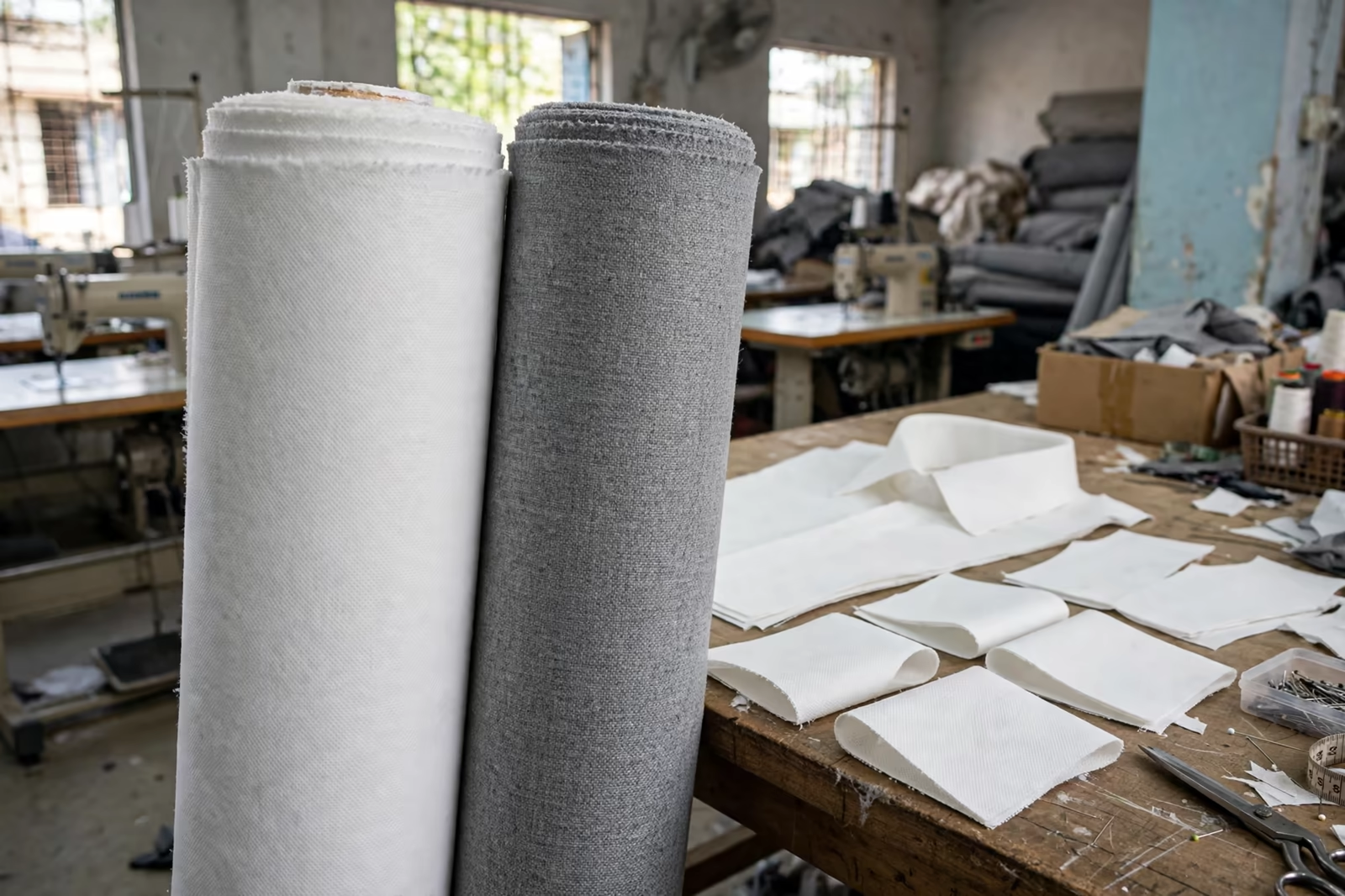
Turn a good shirt inside out and the quality argument changes completely. The cloth everyone photographs is only the garment’s skin; underneath it sit the components nobody markets: interlinings fused inside collars and plackets, shoulder tape holding a t-shirt’s shape, seam tapes, pocketing, stay tapes and the quiet skeleton that decides whether a garment still looks tailored after fifty washes or collapses at the first one. This guide tours the invisible parts.
The inside view in this guide comes from garment production in Bangladesh for the USA, the UK, Germany, Canada and Australia, where the hidden specification is priced as carefully as the cloth itself.
Our poplin dress shirt and classic crew neck t-shirt both live or die by these components; the construction standards behind them sit inside our services.
Interlining: The Garment’s Hidden Skeleton
Interlining is the layer bonded or sewn between a garment’s outer cloth and its lining or facing, giving selected parts their body: collars, cuffs, plackets, button stands, waistbands and the fronts of structured garments. Without it a collar is a handkerchief; with the right one it is architecture.
Interlinings come as fusible, bonded to the cloth by heat and pressure, or sew-in, and in woven, knitted and non-woven constructions, at weights matched to the shell fabric. The specification questions are weight, construction, resin behaviour and compatibility: the interlining must give the part its intended hand, crisp, soft, fluid, without overpowering a light shell cloth or vanishing inside a heavy one.
Buyers rarely see this line on a specification sheet, which is exactly the problem this guide exists to correct. The inside components also carry a surprising share of the garment’s comfort: a waistband’s give, a collar’s edge against the neck, a shoulder’s stability are all felt on the body long after the cloth’s colour has stopped being noticed.
Fusing: Where Interlining Quality Is Won or Lost
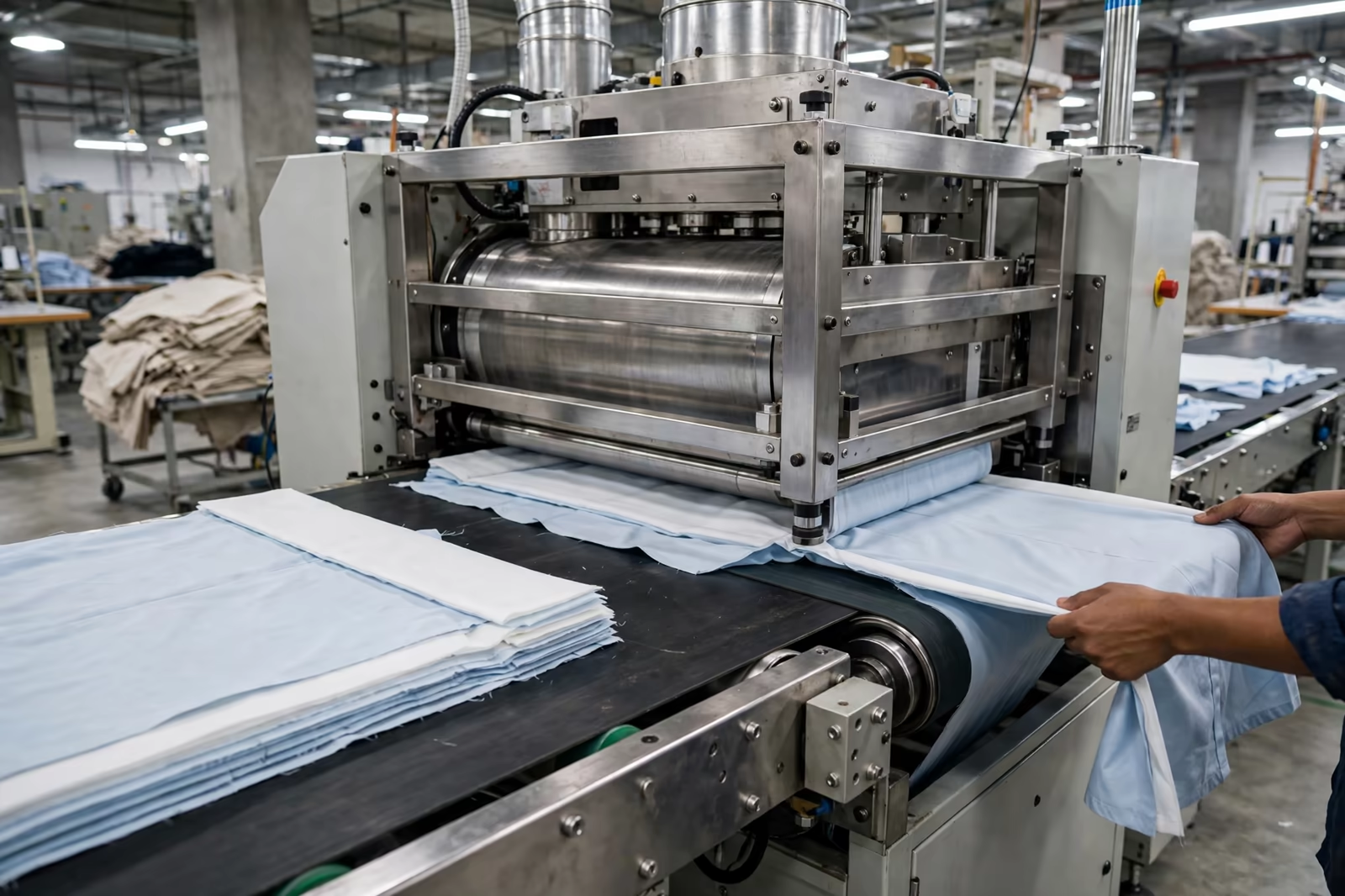
A fusible interlining is only as good as its bond. Fusing runs on three variables, temperature, pressure and time, set for the specific pairing of shell and interlining, and tested by peeling: a proper bond resists separation evenly, while a poor one bubbles, delaminates after washing, or strikes through, glue ghosting onto the garment’s face as shiny patches.
The failure catalogue is instructive: bubbling after the first wash points at under-fusing or incompatible resin; a collar that goes board-stiff points at an interlining too heavy for its cloth; shrinkage mismatch waves the placket as the two layers dry at different rates.
Serious production tests fusing on the actual shell fabric before bulk, peels samples after wash cycles, and records the machine settings per style, because interlining quality is a process outcome wearing a material’s name. That settings log doubles as dispute evidence: when a collar bubbles in a customer’s wash, the record shows whether the bond was ever properly made.
Shoulder Tape: The Small Strip That Holds a Tee Together
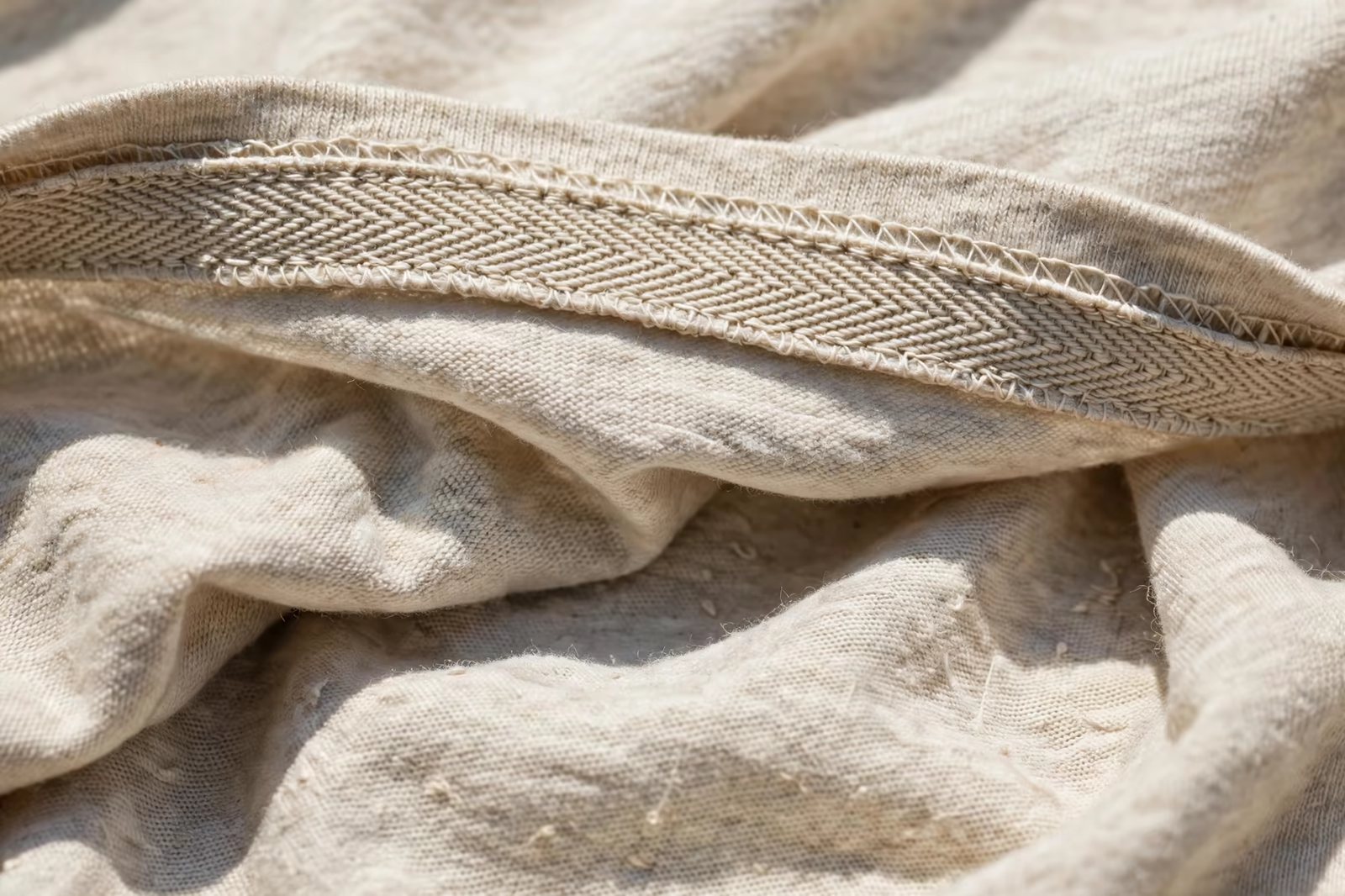
A t-shirt’s shoulder seam carries the garment’s whole hanging weight, and knit fabric stretches under load. Shoulder tape, a narrow woven or twill strip sewn into the shoulder seam from neck to sleeve, stops that stretch, keeping the neckline where it was cut and the shoulders level season after season.
Its absence is the invisible economy that shows a year later: shoulders that slope, a neck that wanders, a garment that looks tired while its fabric is still perfectly sound. Alternatives exist, clear elastic in sportswear, self-fabric strips in some constructions, each with its own stretch and recovery behaviour to specify.
The buyer’s check is tactile and instant: feel along the shoulder seam for the tape’s firm edge, then stretch the seam gently and watch it return. On polos and heavier knits the same strip also steadies the placket side of the shoulder, one more reason its specification belongs in writing rather than in the sample room’s memory.
Seam Tapes, Stay Tapes and Pocketing
The supporting cast continues inside. Seam and stay tapes stabilise armholes, necklines and curved seams against stretching on the bias; pocketing fabric must hold keys and phones without sagging or shining through a light trouser; waistband internals combine interlining, gripper elements and curtain construction to keep a shirt tucked and a trouser sitting.
Each is a specification line with a cheap version and a right version, and each fails in costume: the pocket that bags, the armhole that ripples, the waistband that rolls.
Together these parts explain why two garments in identical cloth can age five years apart: the skeleton, not the skin, is the difference, and it is specified or it is gambled.
Collar and Cuff Construction in Shirts
The shirt is where interlining earns its reputation, because the collar is the garment’s public face. A dress collar typically pairs a stiffer interlining in the collar band with a softer one in the fall, so the band stands and the leaf folds; cuffs match the collar’s hand so the set reads as one design. Casual shirts soften both, sometimes to a completely unfused, washed construction whose rumple is the point.
Collar failure modes are all interlining stories: points that curl upward from a too-light or shrinking interlining, edges that bubble, bands that crack their fold line after repeated pressing.
The specification conversation is therefore about the collar’s intended character first, boardroom-crisp or weekend-soft, and the interlining weights follow that decision, never the supplier’s default bin.
Waistbands, Canvas and Structured Garments
Trousers and tailored pieces carry the heaviest hidden engineering. A waistband stacks interlining, a firm band canvas and often a gripper strip into a structure that must flex with the wearer yet never roll or collapse; jacket fronts in structured tailoring carry canvas and chest pieces that mould the garment’s whole silhouette, the reason tailored jackets cost what they do.
Promotional and uniform ranges meet lighter versions of the same principles: a workwear trouser’s waistband construction decides whether it survives industrial laundering sitting square, and a blazer’s front interlining decides whether it drapes or boards.
The buyer-visible symptom of skimped structure is always the same photograph a season later: the garment that has lost its posture while its fabric remains perfectly good.
Specifying the Invisible: What Belongs on the Sheet
A complete garment specification names the hidden components with the same precision as the shell: interlining type, weight and supplier class for each fused part; fusing conditions and peel-test requirements; shoulder tape material and width; pocketing weight and composition; waistband construction. Lines that read simply “interlining: standard” delegate the garment’s ageing to the supplier’s cheapest bin.
The specification should also fix substitution discipline: interlining changes alter hand, fusing behaviour and wash performance, so they are approval items, not purchasing freedoms.
Our specification packs carry these lines as standard, because the arguments they prevent are always more expensive than the ink.
How Hidden Components Drive Cost Differences
Two quotes on identical cloth diverge most often inside the garment. Branded interlinings with consistent resin, woven rather than non-woven constructions at the heavy-stress parts, real shoulder tape instead of none, pocketing matched to the trouser’s weight: each is a small line, and together they are the honest anatomy of a price gap.
This is why quote comparisons should demand the inside specification alongside the price; a cheaper quote with silent skeletons is not the same garment offered cheaper, it is a different garment ageing on a different clock.
Buyers who specify the inside find their returns and complaints falling in the categories that never photograph well at order stage. They also gain a steadier reorder: a programme whose skeleton is written down can be rebuilt identically next season, while one held together by a departed sample drifts a little further with every repetition.
Sampling Tests for the Inside of the Garment
The inside can be audited at sample stage with simple violence. Peel a fused seam allowance and feel whether the bond resists evenly. Wash the sample at the garment’s care temperature and inspect every fused edge for bubbles. Stretch the shoulder seam and measure its return. Flex the waistband hard and look for roll. Turn the garment inside out and read the pocketing, tapes and bindings as a bill of materials.
None of this needs a laboratory; it needs ten minutes and the habit of judging the half of the garment customers only meet after buying it. Photograph the insides of the approved sample as well: bulk garments can then be compared against a picture of the skeleton they were promised, which settles arguments that memory cannot.
Our sample reviews run these checks before a style is costed for bulk, because rebuilding a skeleton after production is not a remedy that exists.
Our Own Inside Standards
Our construction standard fixes the hidden specification per garment family: interlining classes matched to shell weights in shirts, shoulder tape as a non-optional line in knits, pocketing and waistband builds set by end use, and fusing records kept per style. Substitutions in any of these lines require the same approval as a fabric change, because their effect on the garment is of the same order.
Buyers are invited to audit the inside on any sample we send: cut a seam allowance, peel the fusing, measure the tape.
A manufacturer confident in its skeleton has no reason to keep it a secret, and several reasons, covered in this guide, to make it the specification’s centre rather than its footnote.
Frequently Asked Questions
What is fusible interlining?
An interlining carrying a heat-activated resin on one face, bonded to the garment’s cloth under controlled temperature, pressure and time. It stiffens and shapes collars, cuffs, plackets and waistbands. Its quality shows in the bond: properly fused parts survive washing without bubbling or peeling, under-fused or mismatched ones fail exactly there.
How can a buyer check interlining quality?
Flex and crease the collar and placket, then wash the sample and look for bubbling, delamination or shrinkage waves between the layers. Ask which interlining weight and construction the factory specifies for the shell fabric, and whether fusing settings and peel tests are recorded per style. Vague answers predict vague bonding.
Why do cheap t-shirts lose their shoulder shape?
Because the shoulder seam in an unstaped knit garment carries the hanging weight on a stretchy seam, which grows a little with every wear until the neckline and shoulders drift. Shoulder tape, a firm woven strip sewn into the seam, carries that load instead and is one of the smallest costs with the largest effect in knitwear.
Do interlinings affect garment care and washing?
Yes: interlining and shell must shrink compatibly and the resin must tolerate the garment’s wash temperature and any pressing regime, or the bonded parts pucker and bubble in the customer’s first laundry cycle. Compatibility testing on the actual fabric pairing, before bulk, is how production keeps the inside invisible for the garment’s whole life.