

Of all the labels a buyer meets in apparel, OEKO-TEX Standard 100 is the one most often requested and most often misunderstood. It appears in retailer requirement lists and on consumer hangtags, and it certifies something specific and valuable: that the article has been tested for substances harmful to human health. This guide explains exactly what the label covers, how its classes work, and where its limits sit.
The compliance desk behind this guide works with buyer-specified certification requirements on programmes made in Bangladesh for the USA, the UK, Germany, Canada and Australia, where Standard 100 is the most frequent chemical-safety specification on the list.
The production services the label touches are in our services, its strictest class meets our kids’ t-shirt range, and certification questions for an order start on our contact page.
What Standard 100 Actually Tests
Standard 100 is a product certification, not a factory audit. A finished article, or the materials for one, is submitted to an accredited institute and tested in a laboratory against a catalogue of harmful substances: legally regulated chemicals, known harmful substances not yet regulated, and parameters included as health precautions, all under limit values the scheme reviews and updates regularly.
The testing covers every component of the article, not just the shell fabric: sewing threads, prints, coatings, buttons, zips, interlinings, labels and trims each fall inside the certificate’s scope. A garment is only as certified as its least-examined button, which is why the scheme insists on the full bill of materials.
Certificates run for a defined period and can be checked: each carries a certificate number and the issuing institute, and buyers can verify validity and the exact articles covered rather than trusting a logo on a quotation.
The Substance Catalogue in Plain Terms
Buyers do not need chemistry degrees to read the catalogue’s shape. It groups the familiar hazards of textile production: certain azo dyes that can release prohibited amines, formaldehyde from easy-care finishes, heavy metals extracted from prints and accessories, pesticide residues on natural fibres, plasticisers in plastisol prints and coated trims, and skin-compatibility measures such as pH value and colourfastness.
Each group carries limit values per product class, tightened as skin contact and user vulnerability rise. The catalogue also reaches beyond the legally regulated list, testing substances that are known to be harmful but not yet covered by law in every market, which is much of the scheme’s practical value to a buyer selling across several jurisdictions at once.
For the factory, the catalogue quietly dictates purchasing: dyes, print pastes and trims are sourced from ranges formulated to pass it, which is why certification starts at the chemical shopping list, not at the laboratory door.
The Four Product Classes
The scheme grades its strictness by skin contact and user vulnerability. Product Class I is the strictest, covering articles for babies and small children, where limits are tightest because the users are the most sensitive and everything is likely to be mouthed. Most children’s wear buyers specify Class I without negotiation.
Product Class II covers articles in direct, large-area skin contact: underwear, shirts, t-shirts, bedding. Class III covers articles without direct skin contact, jackets and outer layers, and Class IV covers furnishing and decoration materials, where the exposure logic differs again.
The practical consequence for buyers is specification precision: asking for “OEKO-TEX” without a class invites ambiguity, because a Class II certificate does not qualify a garment for a Class I claim. Write the class into the order specification, and check the certificate presented matches it.
What the Label Does Not Certify
Standard 100 says nothing about how the article was made environmentally: it does not certify organic fibre, recycled content, factory emissions, water treatment or a production site’s environmental management. A conventionally grown cotton shirt can be fully Standard 100 compliant, because the tests examine the product in hand, not the field or the dyehouse’s footprint.
It also says nothing about social conditions, wages or working hours, which belong to the audit world described in our factory audit guide. Buyers building a full compliance stack therefore combine instruments: Standard 100 for product chemical safety, social audits for the workplace, and fibre-level schemes where organic or recycled claims are made.
Understanding the boundary protects buyers twice over: it stops a chemical-safety label being stretched into marketing claims it cannot support, and it stops genuinely certified product being undervalued for failing tests it never took.
How Certification Works on a Real Order
In practice, certification sits at two levels. Component level: mills and trim suppliers hold certificates for their fabrics, threads and components, and the garment maker builds from certified inputs, keeping the chain documented article by article. Finished-article level: the garment itself is tested and certified as a complete product, which is the strongest form for a buyer making a consumer-facing claim.
Buyers should know which level their claim rests on. Retail programmes increasingly ask for the finished article certificate in the brand’s or the maker’s name covering the exact styles shipped, because component certificates alone leave the assembly, the print paste mixed in-house, the wash applied at the end, outside anyone’s test report.
Either way, the paperwork discipline is the same: certificates collected before production, checked for class, validity and article scope, and refreshed when a fabric or trim source changes mid-programme.
Costs and Timing Buyers Should Plan For
Testing is laboratory work with laboratory calendars, so certification belongs in the development schedule, not the shipping week. Articles are sampled, submitted and tested before bulk production claims are made, and a failed parameter, one trim from an uncertified source, sends the programme back to substitution and retest while the production clock watches.
The costs sit where value sits: on the certificate holder, scaled to the articles and components in scope, and they repeat at renewal. Buyers comparing quotations should ask how certification is carried in the price, because a programme priced with finished-article certification and one priced on component papers are not the same product wearing the same label.
None of this is heavy relative to a recall or a retail rejection, which is the honest comparison. Certification is cheap insurance bought at the calm end of the calendar.

Verifying a Certificate Instead of Admiring It
A certificate number, an issuing institute and a validity window make verification a five-minute job rather than an act of faith: the scheme’s own channels confirm whether the number is genuine, current and scoped to the article being bought. Do this at onboarding and at each renewal cycle, because certificates lapse quietly while logos linger on websites.
Check the scope lines in particular. A certificate covering a mill’s greige fabric does not automatically cover its dyed and finished range, and a maker’s certificate for one buyer’s programme does not certify another’s. The article list and class printed on the certificate are the claim; everything else is decoration.
On our side, buyer-specified certificates are treated the same way: numbers shared, scope shown, and claims on any document limited strictly to what the current certificate covers.
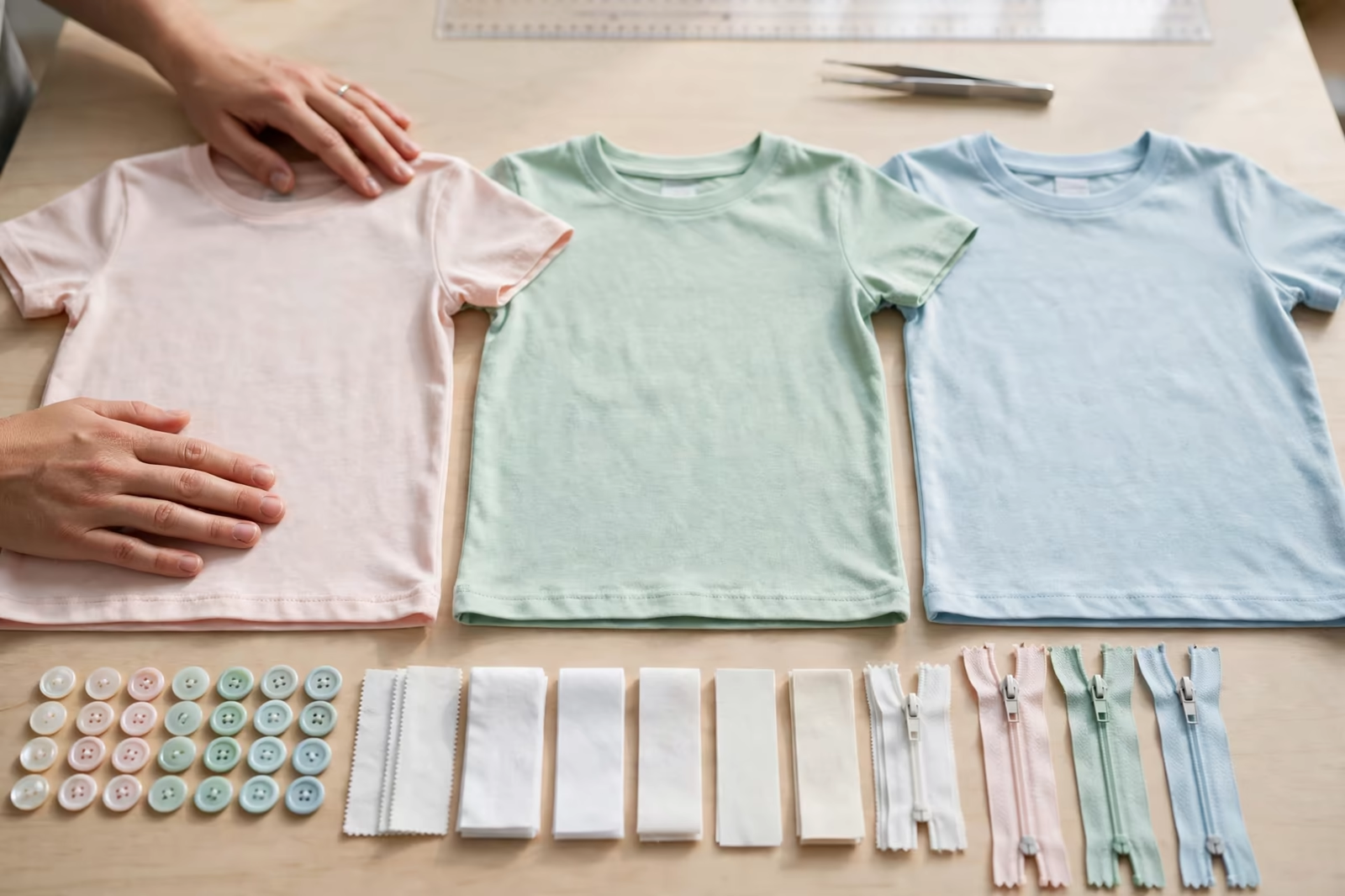
Children’s Wear: Where Class I Bites
Children’s apparel is where Standard 100 stops being a preference and becomes the operating system. Class I limits are set for skin that is thinner, more permeable and attached to a person who will chew the product, so the testing net is drawn tighter across colourfastness to saliva and perspiration, extractable substances and the residues of finishing chemistry.
For buyers, this interacts with the legal layer rather than replacing it: children’s products also carry mandatory safety law in every major market, flammability, drawstring rules, small-parts and chemical restrictions, and the certificate complements that law by testing a broader substance catalogue than most statutes name.
Programmes for children’s wear should therefore be specified as a bundle: the market’s legal requirements, the factory’s needle and metal controls, and Standard 100 Class I across the full article, prints and trims included.
Label Use and Marketing Discipline
The famous hangtag is governed as strictly as the testing. The label may be used only for articles inside a valid certificate’s scope, by the certificate holder or with the scheme’s permission flowing through the supply chain, and the claim wording is prescribed: the label certifies tested product safety, not virtue in general.
Buyers should audit their own marketing with the same rigour as the factory’s paperwork. A web page that stretches a Standard 100 certificate into “eco-friendly production” language has created a claim no laboratory signed, and regulators and retail compliance teams increasingly read those pages.
Kept inside its lines, the label is powerful precisely because it is narrow: a specific, verified, checkable promise on the exact article in the customer’s hand.
The Wider Label Shelf
Standard 100 usually sits in a stack. Fibre-content schemes certify what the garment is made from, organic or recycled inputs with chain-of-custody paperwork, the subjects of the next guides in this series. Production-focused instruments examine the factory’s own environmental and chemical management, and social audits cover the people.
Buyers do not need every label; they need the right ones for the claims they intend to print. Mapping claim to instrument first, then specifying certificates by name, class and scope, turns the label shelf from decoration into compliance architecture.
Our compliance conversation with a new buyer starts exactly there: which claims will this programme make, and which certificates must therefore exist before the first order is cut.
Frequently Asked Questions
What does OEKO-TEX Standard 100 certify?
That the tested article, every component of it from fabric and threads to buttons, prints and labels, has been laboratory-tested for harmful substances against the scheme’s limit values and passed. It is a product chemical-safety certification issued by accredited institutes for a defined validity period, with a certificate number buyers can verify. It does not certify organic content, environmental production or social conditions.
What is the difference between Product Class I and II?
Class I is the strictest tier, for babies’ and small children’s articles, where limits are tightest because the users are most vulnerable. Class II covers articles worn in direct, large-area skin contact such as t-shirts, shirts and underwear. A Class II certificate does not support a Class I claim, so buyers should specify the class in the order and check the certificate matches it.
How can I verify an OEKO-TEX certificate?
Ask for the certificate number, the issuing institute and the validity dates, then confirm through the scheme’s verification channels that the number is genuine and current. Read the scope lines: the articles, product class and materials listed are exactly what is certified. Repeat the check at renewal, since certificates lapse while logos tend to stay on websites.
Does every component of a garment need to be certified?
For a finished-article claim, yes in effect: the scheme tests the complete article including threads, prints, buttons, zips, interlinings and labels, because the certificate is only as strong as its least-examined component. Garments assembled from certified components with a documented chain are the usual route, and full finished-article testing gives the strongest basis for a consumer-facing claim.