
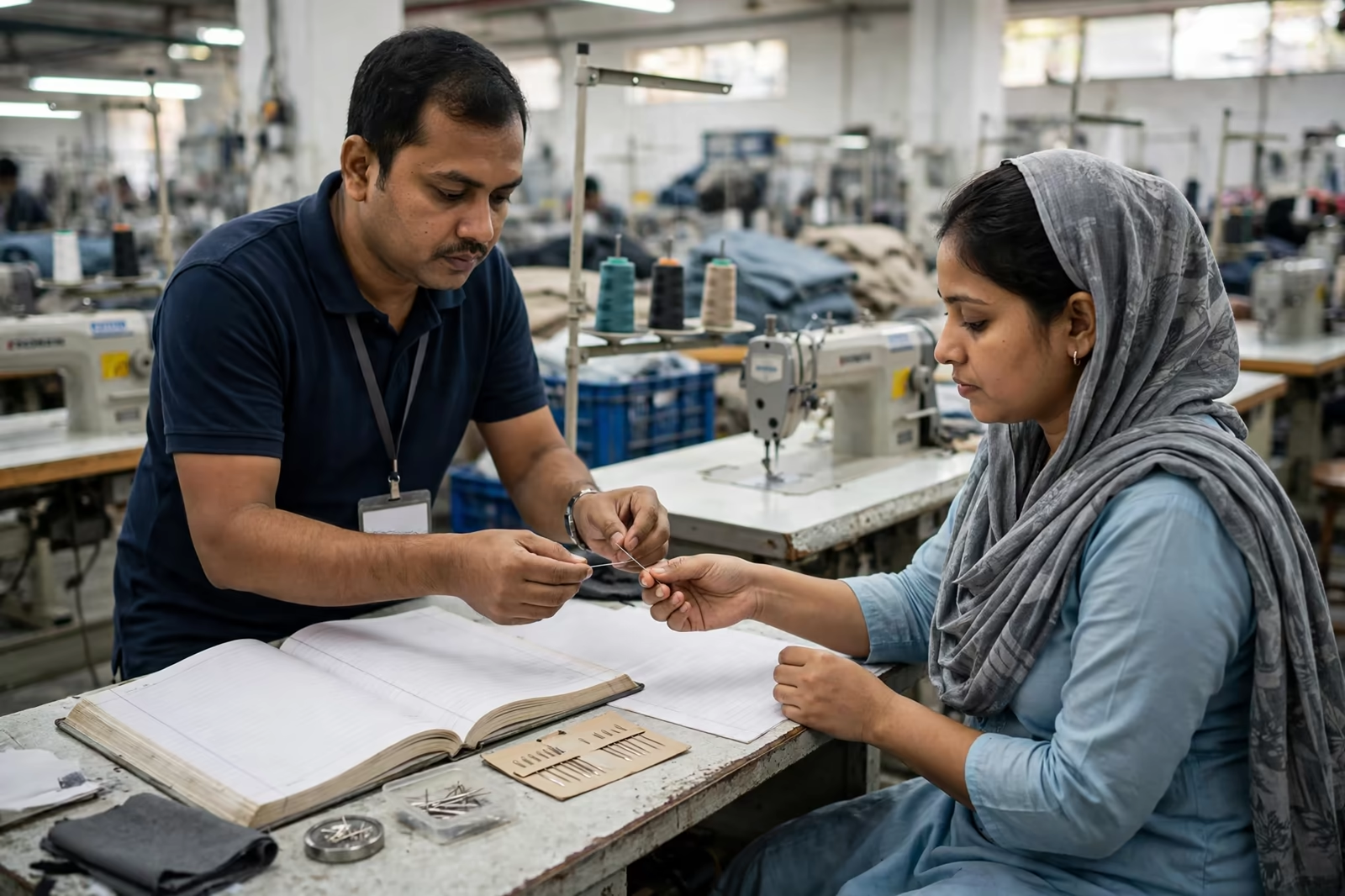
A sewing needle costs almost nothing and breaks more often than buyers imagine. Snapped against a thick seam, a pin or its own needle plate, it can leave a fragment inside a garment, invisible, sharp, and waiting for the person who wears it. The rules that stop that fragment from ever reaching a customer are among the least glamorous and most serious systems in a clothing factory: the needle policy and the metal detection gate behind it.
The factories behind this guide work in Bangladesh, sewing export orders for buyers in the USA, the UK, Germany, Canada and Australia. Their needle control follows the expectations those markets set, and the strictest version of it, the one written for children’s clothing, is the version worth understanding first, because it shows what the system is really for.
Needle control sits inside the production system on our services page and applies to every product we make, including the kids t-shirt range where the rules bite hardest. Questions about a specific order’s safety controls are welcome through our contact page.
Why Needles Are a Safety System, Not a Tool
On most factory floors a needle is treated as a consumable, changed when blunt and forgotten. Under a needle policy it is treated as a controlled item, closer to a medicine than a spare part: counted, issued one at a time, recorded against an operator, and accounted for at the end of every shift and every breakage.
The reasoning is simple. A whole needle can be returned and counted. A broken needle must be reconstructed, piece by piece, until every fragment is found, because any fragment not found has to be assumed to be inside a garment. The policy exists to make sure that assumption never has to be acted on.
Metal detection then stands behind the paperwork as the physical guarantee. Paper systems can be cheated by haste or habit; a calibrated detector cannot be argued with. The two together, control first and detection second, are the safety net this article explains.
The Needle Policy: One Out, One In
The core rule is exchange. An operator receives a new needle only by surrendering the old one, whole, to the supervisor or store keeper who issues needles. No drawer of spares sits at the machine, no pocket holds a private supply, and no needle enters the sewing floor except through the issue register.
Each issue is logged: date, machine, operator, needle type. The log looks like bureaucracy until the day a fragment cannot be found, when it becomes the map that narrows the search to one machine, one operator and one bundle of garments.
The same discipline covers the other sharp metal on the floor. Hand needles for finishing, pins, seam rippers and small scissors are counted items under most serious policies, issued and returned in the same way, because the detector at the end cannot tell which tool a fragment came from and does not need to.
Broken Needle Procedure, Step by Step
When a needle breaks, production at that machine stops. The operator gathers every fragment they can find, and the garments at the machine, the piece being sewn and its bundle neighbours, are set aside and marked. Nothing from that station moves forward until the procedure closes.
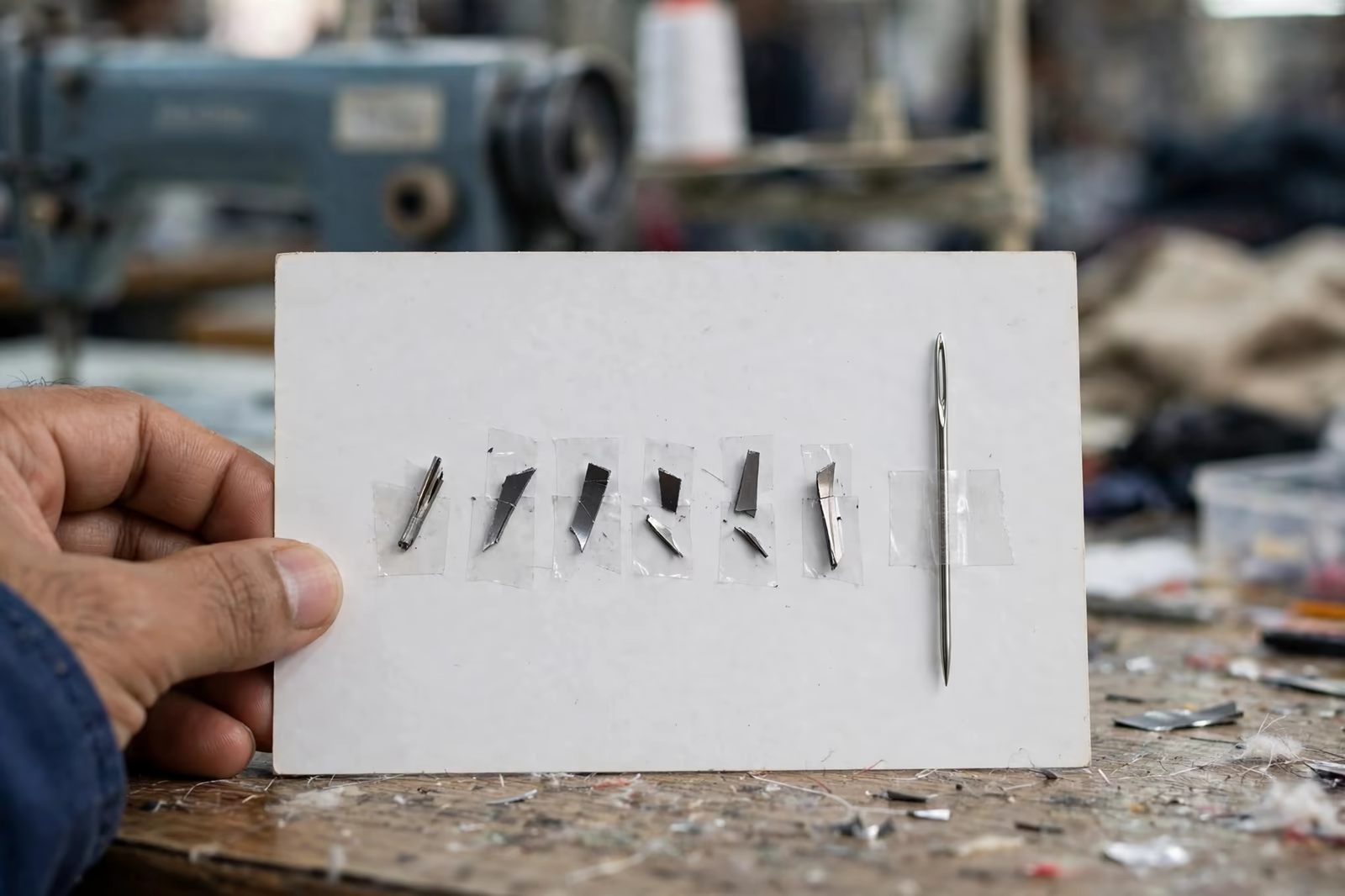
The fragments are matched against a complete needle, usually taped to a broken needle record card beside the outline of a whole one. If the pieces reconstruct the needle completely, the held garments are released through the detector with extra attention, the breakage is logged, and sewing restarts with a freshly issued needle.
If any fragment is missing, the search escalates: the held garments pass through the detector one by one, the area around the machine is checked, and the garments stay quarantined until the piece is found or the garments are rejected. A missing fragment is never signed off as probably fine. That refusal, repeated on tired evenings and busy days, is the entire value of the system.
Who the Rules Protect
Every wearer benefits, but the policy’s strictest form exists for children. A needle fragment in an adult’s shirt is an injury and a claim; in a baby garment it is a catastrophe and, in most export markets, a regulatory failure that ends supplier relationships permanently. Retailers in Europe and North America write needle control and metal detection into their supplier manuals for childrenswear without exception.
The same logic reaches further than children. Hospital garments, workwear worn against skin for long shifts, and any product a brand sells on safety all carry the expectation. Even ordinary adult fashion is usually produced under the same factory-wide policy, because running two standards on one floor protects neither.
There is also a quieter beneficiary: the factory itself. A documented needle policy, a working detector and complete records are what a manufacturer produces when a retailer asks how safety is controlled. The answer either exists as a system or it does not exist at all.
Metal Detection: The Conveyor Gate
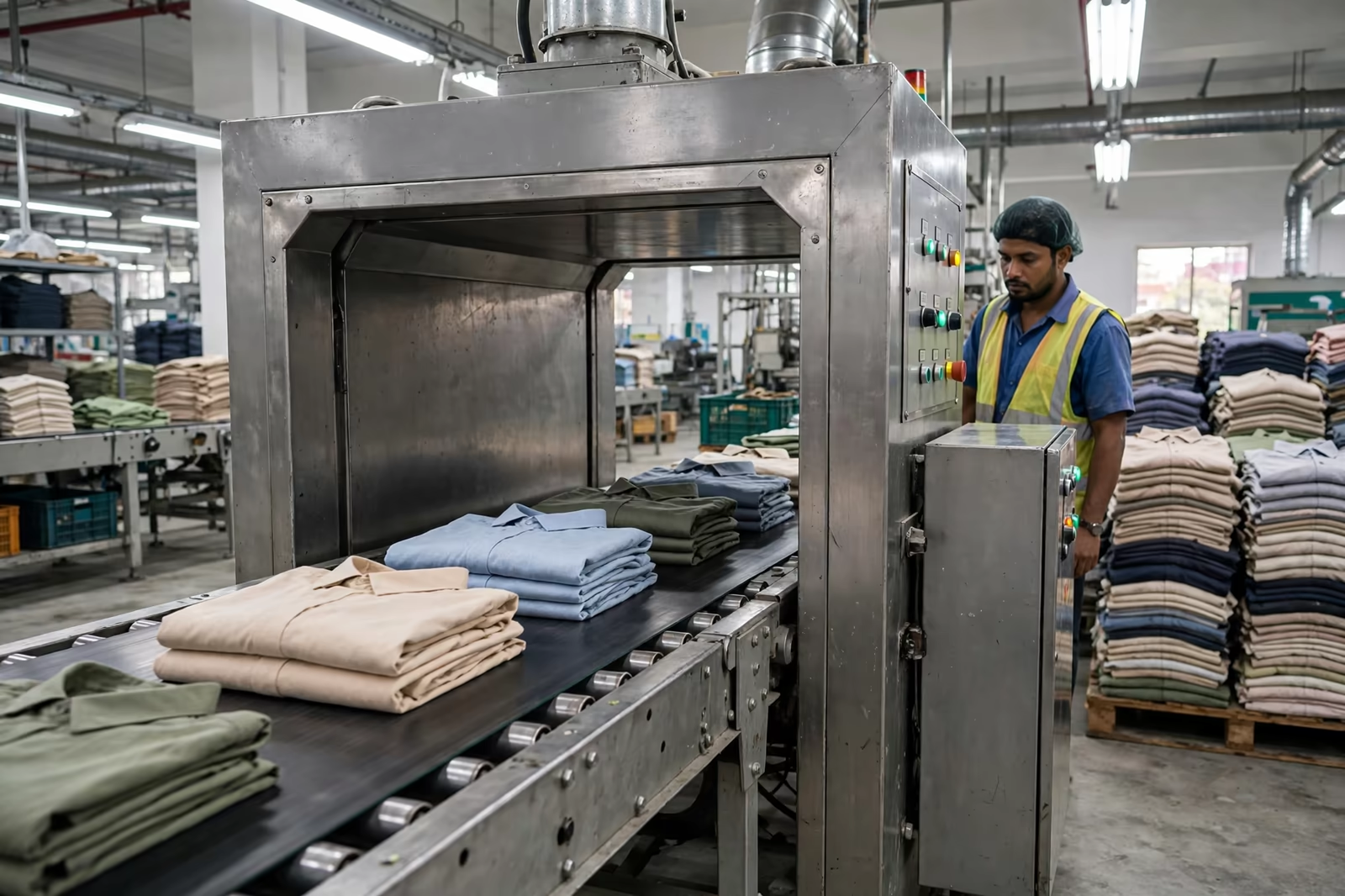
Finished garments pass, before or after packing depending on the buyer’s specification, through a conveyor metal detector: a tunnel the garment travels through on a belt, which alarms and stops when it senses ferrous metal above its calibrated sensitivity. Detected garments are removed, investigated and never simply passed through again until they clear.
Placement matters. Detection after final inspection catches everything the process added, from the first needle to the last hand-sewing; detection after packing protects against anything introduced at the packing table and checks the garment in its final form, carton-ready. Some buyers specify both.
The gate only works as a system: a trained operator, a log of passes and alarms, and a rule that an alarmed garment is investigated rather than waved through on a second pass. A detector used as a formality is furniture; a detector used as a gate is a safety system.
Calibration and Challenge Tests
A detector’s sensitivity is set against certified test pieces, small ferrous samples of graded sizes, which are passed through the tunnel to prove the machine alarms at the level the buyer’s standard requires. The checks run at start-up, at regular intervals through the day, and whenever the machine is moved or adjusted.
A failed challenge stops the gate. Garments passed since the last successful test are re-checked once the machine is proven again, because a detector that missed its test piece may have missed real metal too. The log of challenges, times and results is the evidence buyers’ auditors ask for first.
Sensitivity is a balance rather than a maximum. Set too fine, the machine alarms on harmless traces, belt metal and even mineral content in dyes or soil on workwear, and operators learn to ignore it. Set to the buyer’s specified standard and verified by test pieces, it alarms exactly when it should.
Beyond Needles: Every Metal Source
Needles are the headline risk, but the policy watches the whole floor’s metal. Staples are banned near production in strict factories, replaced by tape or stickers, because a stray staple defeats a needle register completely. Broken machine parts, hook and bar fragments, snapped hand needles from the finishing section, and metal from repairs all fall under the same find-every-piece rule.
Approved metal is controlled differently from foreign metal. Snaps, rivets, zips and buttons are meant to be in the garment, and detector settings and procedures account for them, often by testing the approved trims separately so the gate is tuned to catch what should not be there rather than what should.
This is also why maintenance follows a discipline of its own: work done on machines over garment bundles is covered work, tools are counted in and out, and any part replaced at a sewing station is accounted for like a needle.
Records, Rejection and the Failed Garment
When the detector alarms and investigation finds metal that cannot be explained and removed, the garment is rejected. Not downgraded, not sold as a second, not quietly returned to the bundle: rejected, recorded and destroyed or retained as evidence according to the buyer’s instruction. The cost of one garment is nothing against the cost of one injury.
The paperwork trail, needle issue log, broken needle cards, detector challenge log, rejection records, is retained per order. Months later, if a customer complaint ever raises the question, the factory can show the controls that were running on the day that garment was made.
Auditors weight these records heavily, and so should buyers. Any factory can buy a detector; the records show whether it is run as a gate or as a decoration.
What Buyers Should Ask
Ask to see the needle policy as a document, and the last broken needle card as evidence it lives. Ask where detection sits in the process, what test pieces calibrate it, how often challenges run, and what happens to a garment that fails. The answers separate factories with systems from factories with equipment.
State your own standard in the order documents rather than assuming it. Sensitivity level, detection stage, and whether childrenswear rules apply to your whole range are decisions a factory can only follow when they are written down.
Finally, ask how the policy covers the small things: pins, hand needles, staples, repairs. A factory that has thought about staples has usually thought about everything.
The Human Side of the System
None of this works without operators who stop the line willingly. Factories where reporting a breakage earns blame teach concealment instead, and concealment is the one failure the records cannot catch. The policy therefore protects the operator who reports as carefully as the wearer it ultimately protects; a stopped machine is treated as the system working, not as a fault.
Frequently Asked Questions
What happens when a needle breaks during sewing?
The machine stops, the garments at that station are held, and the operator and supervisor reconstruct the broken needle from its fragments against a record card. Only when every fragment is accounted for are the held garments released, through the detector. If a fragment is missing, the garments stay quarantined and are checked piece by piece until the fragment is found or the garments are rejected.
Are all garments passed through a metal detector?
For childrenswear and most safety-conscious buyers, yes, every single garment passes the gate individually, usually after final inspection and sometimes again after packing. For other ranges it depends on the buyer’s specification, which is why the requirement belongs in the order documents. A factory with a needle policy will detect on request without new equipment, because the system already exists.
Why are the rules stricter for children’s clothing?
Because the wearer cannot protect themselves. A baby cannot find, report or avoid a sharp fragment, and the consequences of a failure are at their most severe, medically, legally and commercially. Retailers and regulators in the USA, the UK and Europe therefore treat needle control and full metal detection as non-negotiable conditions for childrenswear suppliers, and factories apply the standard garment by garment.
What happens to a garment that fails metal detection?
It is taken out of the flow and investigated to find the metal source. If the cause is found and removed, and the garment then passes cleanly under the procedure, it may be released according to the buyer’s rules. If the metal cannot be found and explained, the garment is rejected and recorded, never downgraded or quietly reintroduced. The rejection log forms part of the order’s safety records.