
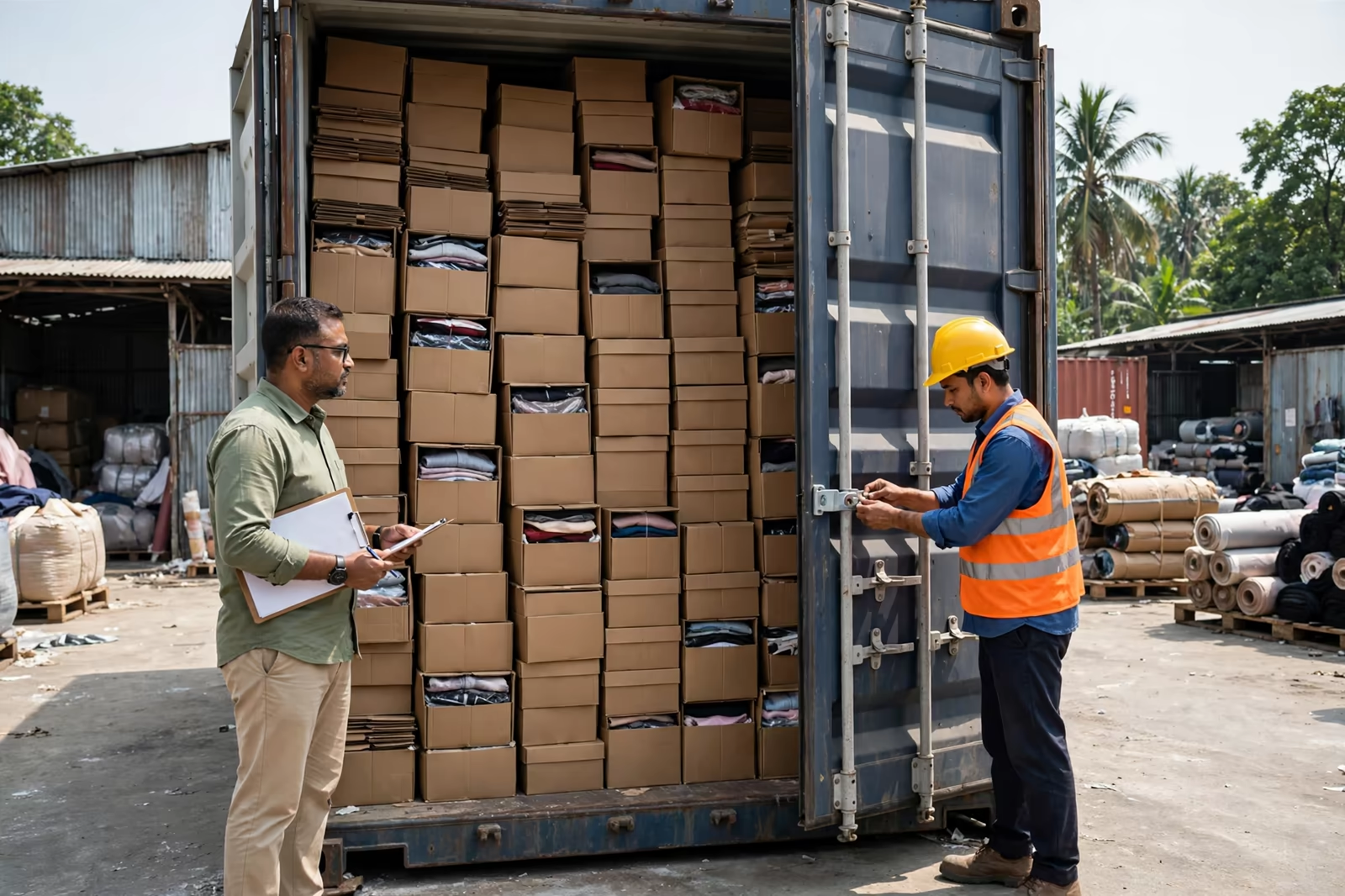
Not every apparel order fills a container, and pretending otherwise is expensive. The choice between LCL, sharing a container with other shippers, and FCL, taking the whole box for yourself, quietly decides your per-garment freight, your handling risk and part of your timeline. This guide explains both properly, so part-container orders ship smartly rather than hopefully.
The sourcing teams behind this guide ship apparel from Bangladesh in both arrangements for buyers in the USA, the UK, Germany, Canada and Australia. The abbreviations stand for Less than Container Load and Full Container Load, and the difference sounds clerical until the first invoice or the first damaged carton makes it real.
The choice touches the regions on our market area page, the order scale on our MOQ and production page, and help through our contact page.
FCL: The Whole Box Is Yours
Under FCL, you book an entire container, whether 20-foot, 40-foot or a high-cube variant, and it carries only your goods. The container is loaded at the factory or a depot, sealed, and in the normal course opened again at your destination. Your cargo travels untouched between those two points, documented under one bill of lading.
The economics reward volume: the box costs what the box costs, so every carton added lowers the freight per garment, and a well-filled container produces the cheapest per-piece shipping in the trade. Consolidating several styles, or several orders, into one FCL shipment is the standard way growing buyers reach that fill.
Control is the second reward. Loading order, packing configuration, seal integrity and a clean chain of custody all sit with you and your factory, which matters for high-value, white or delicate garments.
Container Sizes in Plain Terms
The standard boxes come in three working sizes. A 20-foot container offers roughly thirty cubic metres of packing space, the natural unit for a modest multi-style order. A 40-foot roughly doubles that, and a 40-foot high-cube adds height that bulky garments, fleece, padded styles, genuinely use.
Choosing between them is a packing-list exercise: carton dimensions times carton count, with a realistic fill factor, since garments in cartons never tessellate perfectly. Your factory produces the packing list early enough for this arithmetic to happen before booking, not at the loading dock.
Ordering cartons with the container in mind, dimensions that stack cleanly in the chosen box, quietly raises the fill and lowers the per-piece cost of every FCL shipment that follows.

LCL: Paying Only for Your Slice
Under LCL, your cartons travel as a part load. A consolidator collects cargo from many shippers, packs it together into a container at a freight station, and at destination the container is unpacked and each consignment separated for its owner. You pay for the space your cargo occupies, measured by volume against weight, plus handling at both ends.
For small orders it is the rational tool: a trial order, a capsule range, or a sample-season production run cannot justify a whole container, and LCL keeps those programmes shippable by sea rather than pushed into air freight economics.
The compromises are handling and time. Your cartons are loaded, consolidated, deconsolidated and handled again, each touch a small risk, and the schedule depends partly on the consolidator’s other cargo. LCL is slower door to door than the same route FCL, by handling days at both ends.

The Cost Crossover Nobody Quotes
LCL is priced per cubic metre with handling charges layered on top, and its rate looks friendly at small volumes. But as volume grows, the per-unit LCL charges keep climbing linearly while FCL’s flat box price spreads thinner, until somewhere before the box is full the whole container becomes the cheaper way to ship less than a container.
That crossover surprises buyers who compare headline rates: LCL quotes often exclude destination handling and deconsolidation charges that appear later, while the FCL comparison sits complete. Always compare total landed freight, both ends, before deciding.
Your forwarder can run the crossover for your actual carton count in minutes, and should be asked on every mid-size order. The answer shifts with rates and season, so last year’s decision is data, not doctrine.
Risk: Handling, Neighbours and Moisture
Cargo risk differs by arrangement. In FCL, the chain is short: loaded once, sealed, opened once. In LCL, your garments share space with strangers’ freight, are handled repeatedly, and sit in consolidation warehouses. Most LCL cargo arrives perfectly; the incident rate is simply higher, and it concentrates on crush, moisture and misdirection.
Packing is the buyer’s countermeasure. Strong cartons, polybag protection per garment, and moisture defence inside the carton, the packing discipline covered in our carton standards guide, matter twice as much when the container’s other tenants are unknown. Textiles packed for FCL gentleness can arrive from an LCL journey looking travelled.
Insurance follows the same logic. Part loads deserve the same deliberate cover as full ones, arguably more, and the value declared should reflect replacement cost at destination, not factory sentiment.
It is also worth knowing that shared containers occasionally suffer general average or another shipper’s customs problem, delays nobody’s packing could have prevented. Buyers shipping date-critical LCL cargo carry a small schedule reserve for exactly these shared-fate events.
Timing and Consolidation Strategy
LCL sailings depend on the consolidator filling space, and deconsolidation at destination adds days before your cartons are released. Tight-date programmes should price that slack honestly rather than discovering it, while flexible replenishment orders absorb it comfortably.
Buyers running several styles can play consolidator themselves: hold two or three orders to sail together as one FCL, fill a box across suppliers in the same region, or align order completion dates so the factory loads one container with the season’s range. Each variant trades a little waiting for a lot of freight saving.
Factories cooperate with all of it when the plan is stated at order stage: packing sequence, carton marking by style, and documents split or combined as the shipping plan demands.
One timing trap deserves naming: LCL cargo that misses its consolidation cut-off does not simply sail a day later; it waits for the next consolidation cycle, which can be a full sailing pattern away. Date-critical part loads should be delivered to the freight station with days in hand, and the cut-off confirmed in writing rather than assumed from the vessel’s date.
Documentation: The Extra Layer in LCL
FCL paperwork is one clean chain: one shipper, one container, one bill of lading. LCL adds the consolidator’s layer, a house bill of lading for your consignment sitting under the master bill for the container, and your release at destination depends on that chain being complete and consistent.
Practically, this means LCL buyers chase documents through one more pair of hands, and discrepancies surface later in the journey. Copies checked at origin, against the packing list and invoice, prevent the classic destination scene of cargo present but not releasable.
It also means your cartons must be marked to survive separation: clear consignment marks on every carton, so deconsolidation staff can split five shippers’ similar brown boxes without guesswork. A morning spent on carton marks is the cheapest insurance in LCL.
Which Orders Belong in Which Mode
Trial orders, first orders with a new factory, capsule collections and sample production belong naturally in LCL: the volumes are honest part loads, and the learning matters more than the last freight percentage. Core replenishment, seasonal volume and multi-style ranges belong in FCL, consolidated until the box earns its flat rate.
Promotional and uniform programmes sit by size: a single-site uniform order is an LCL shipment; a national rollout is several FCL decisions. Let carton count, counted from the packing list, make the call rather than the order’s headline piece count.
On our own minimums, 1,200 pieces per style in up to two colours, a multi-style order often approaches container logic quickly, which is why our shipping desk raises the consolidation conversation at order stage rather than at the loading dock.
The Warehouse End
Delivery behaves differently too. An FCL container arrives at your warehouse or your forwarder’s dock as one unit on one appointment. LCL cargo is collected from the deconsolidation warehouse, sometimes in partial releases if cartons separate slowly, and someone must check every carton against the list at that point, not weeks later.
Claims windows are short, and damage discovered after goods enter your stock system is far harder to evidence. Build the receiving check into the plan for LCL: count, photograph, note exceptions on the delivery paperwork before signing.
None of this makes LCL a bad tool; it makes it a tool with a receiving protocol, which professional buyers write down once and reuse every season.
Questions to Ask Your Forwarder
Five questions settle most LCL against FCL decisions. What is my total cost both ends under each option, in writing? Where does consolidation and deconsolidation happen, and how many days does each usually add? What is the cut-off for this week’s sailing, and what happens to cargo that misses it?
Then: how are cartons marked and separated, and what exactly triggers storage charges at destination? A forwarder who answers these cleanly is worth more than a marginal rate difference, because the answers describe your actual journey rather than the brochure’s.
Ask the same five each season. Rates, routes and consolidation partners change quietly, and the right answer for last year’s volume is not automatically this year’s.
Frequently Asked Questions
What is the difference between LCL and FCL?
FCL books a whole container for your goods alone, loaded and sealed once and opened at destination. LCL ships your cartons as a part load inside a container shared with other shippers’ cargo, consolidated and separated at freight stations at both ends. FCL is priced per box, LCL per cubic metre of space used, plus handling.
At what volume does FCL become cheaper than LCL?
Sooner than most buyers expect. LCL charges grow with every cubic metre while the FCL box price is flat, so the crossover typically arrives well before the container is full, especially once LCL destination handling charges are included. The exact point moves with rates and routes, so have your forwarder cost both options against your real carton count.
Is LCL risky for clothing?
Mostly safe, but handled far more than FCL: consolidation, shared space with unknown cargo, warehouse storage and deconsolidation all add touches and time. Strong cartons, polybagged garments and proper insurance manage the risk well. For white, delicate or high-value garments, many buyers prefer FCL’s sealed single-owner chain once volumes allow.
Can several small orders be combined into one FCL shipment?
Yes, and it is the standard consolidation play: multiple styles, and even orders from nearby suppliers, loaded into one container so the flat box rate spreads across everything. It needs completion dates aligned and packing and documents planned per style. Factories and forwarders do this routinely when the plan is agreed at order stage.