

Colour is the first thing a customer sees and the first thing a buyer can get wrong at scale. A shade approved carelessly in a swatch becomes ten thousand garments in the wrong red. Factories therefore approve colour in stages, with two tools most buyers have heard of and few have had explained plainly: the lab dip, which fixes the target, and the shade band, which fixes the acceptable range around it.
The dye houses and factories behind this guide work in Bangladesh, colouring export orders for buyers in the USA, the UK, Germany and the wider European market. Their colour discipline is the quiet system behind the promise that the garment in the carton matches the swatch in the buyer’s hand.
Colour approval sits inside the production framework on our MOQ and production page and the range on our services page, and it pairs with print colour control on our screen printing page where a design carries both dye and print.
Why Colour Is Approved in Stages
A colour standard lives in one world and the garment in another. The standard might be a Pantone reference, a piece of a competitor’s garment, or a swatch from last season, while the garment is a specific fabric, from a specific mill, taking dye in a specific machine. The translation between those worlds is never exact, so it is tested, adjusted and approved before bulk money is committed.
The stages run small to large: a lab dip on a few metres of the real fabric, approval of that dip as the order’s target, a shade band defining the tolerance around the target, and bulk dyeing checked against both. Skipping stages does not remove the uncertainty; it moves it to a place where it costs more.
Each stage also has a different judge. The lab dip is judged by the buyer’s eye against their standard. The bulk is judged by the factory against the approved dip and band. Keeping those judgements in order is most of colour management.
The Lab Dip: Your Colour, On Your Fabric
A lab dip is a small dyeing of the actual production fabric, made in the dye house laboratory to a recipe calculated to hit the buyer’s standard. It answers the only question that matters at this stage: what will this colour look like on this cloth? The same recipe behaves differently on cotton, polyester, blends and brushed fleece, which is why dips on substitute fabric are worthless.
Dye houses usually submit the dip in variants, a small set of swatches bracketing the target: the closest match plus near neighbours slightly lighter, deeper, redder or bluer. The buyer picks the closest and comments on the rest, steering the next round with a direction rather than a guess.
Rounds continue until approval. Two or three rounds are a normal negotiation between chemistry and the eye, not a sign of failure; a dip approved on the first round for a difficult colour on a difficult fabric deserves more suspicion than one refined twice.

Reading a Lab Dip Properly
A dip judged in the wrong light is a coin toss. Colour is read in a light cabinet under standardised illumination, first under daylight-equivalent light, then under the lighting of the environment where the garment will be sold, typically store lighting. A match that holds in the cabinet under both sources is a match; one that holds only in daylight may fail on the shop floor.
The dip is also judged against the right things: the standard, not a screen photograph of the standard; dry, not wet from the lab, because wet fabric reads deeper; and on the correct face of the fabric, since brushed, raised or textured surfaces shift the perceived colour.
Buyers help most by judging promptly and commenting precisely. “Slightly too red, depth is right” moves the recipe in one instruction. “Not quite right” sends the dye house back to guess, and the round count climbs for both sides.
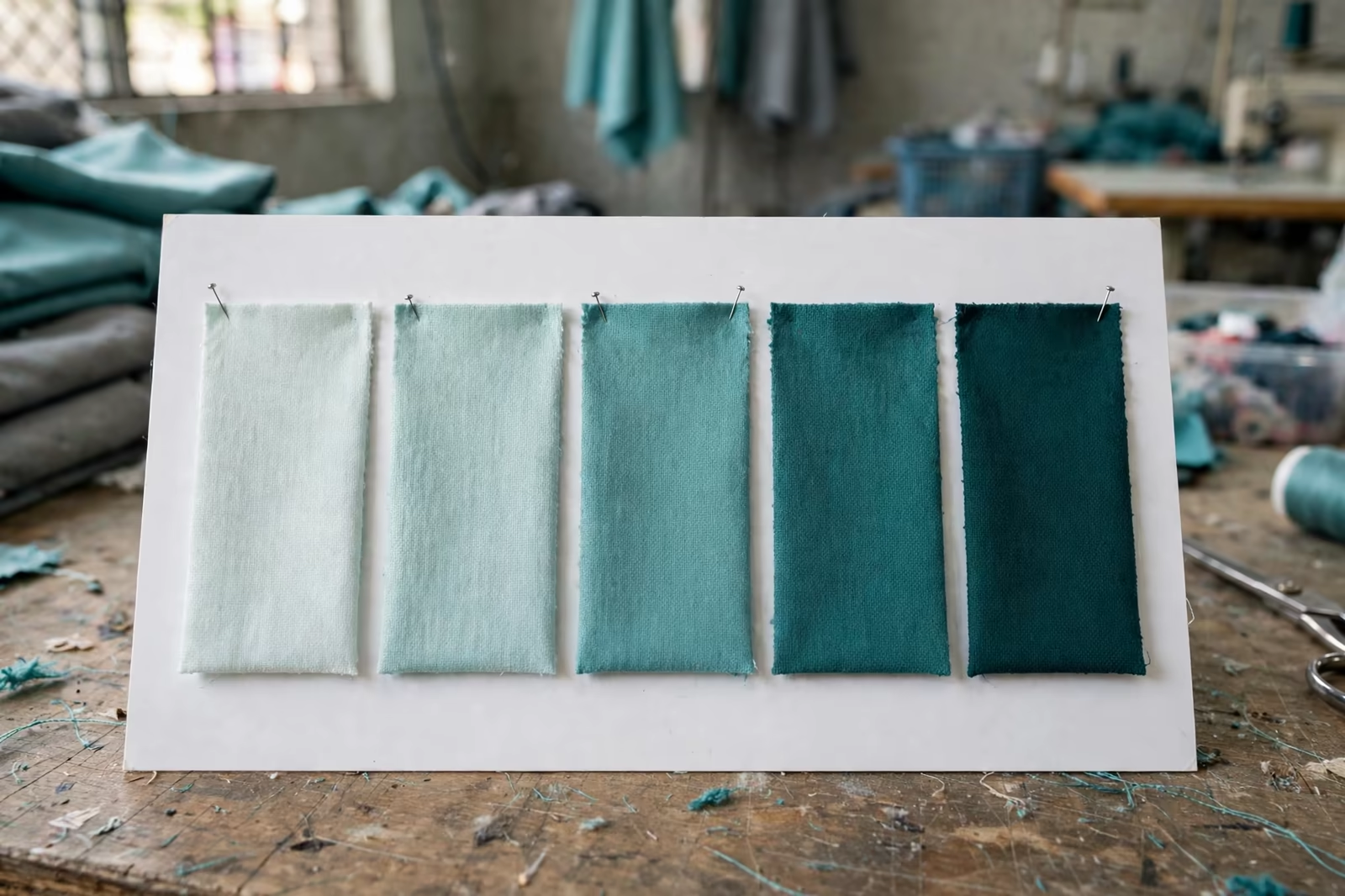
Shade Bands: The Acceptable Range Around Approved
Bulk dyeing is a physical process, and no two lots of fabric take dye in absolutely identical depth. The shade band is the honest answer to that fact: a set of swatches, approved by the buyer, showing the lightest and darkest, reddest and bluest extremes that will still be accepted as the colour.
The approved lab dip sits in the middle of the band as the target. Bulk lots landing inside the band pass; lots outside it are corrected, re-dyed or rejected. The band converts an argument about whether a lot “looks right” into a comparison against physical limits both sides agreed before dyeing began.
Band width is a commercial decision disguised as a technical one. A narrow band means tighter control, more rejected or corrected lots and a price that reflects both. A wide band is cheaper and shows itself in the shop, where garments from different lots hang side by side. The buyer chooses the band; the factory prices it.
Bulk Dyeing: Where Shade Is Won or Lost
Bulk follows the approved recipe, scaled from laboratory beakers to production machines, and the scaling itself is a skill: liquor ratios, temperature curves and timing all shift as volume grows. First bulk lots are checked against the dip and band before the full quantity runs, a checkpoint known as the bulk approval or first-bath check.
Within the run, every lot is assessed as it comes off, swatches cut and read against the band under the cabinet lights. Lots drifting toward a band edge trigger recipe correction before the next lot crosses it; lots outside are held for decision rather than blended optimistically into the order.
Fabric variation fights the dyer throughout. Greige fabric from different weaving lots absorbs dye differently, which is why disciplined factories test absorbency, group compatible greige lots together, and tell the buyer early when a fabric source is producing shade risk.
Shade Continuity Inside One Garment
Passing the band is not the whole promise. A garment whose body and sleeves come from different dye lots may pass inspection lot by lot and still look two-tone on the rail. Cutting discipline closes that gap: pieces for one garment are cut from the same lot and kept together through sewing, the roll discipline described in our cutting guidance.
Where an order genuinely needs multiple lots, they are segregated into separate garment batches, never mixed inside garments, and packed so a store receives coherent stock. Shade continuity is logistics as much as chemistry.
Trims join the same system. Ribs, drawcords, tapes and pocketing dyed to match are approved against the same standard and band, often in their own lab dips, because a body inside the band beside a rib outside it reads as a mismatch to every customer.
Metamerism: The Colour That Changes Rooms
Two dyeings can match exactly under daylight and separate under shop lighting, because they were built from different dye combinations that reflect light differently. This is metamerism, and it is the gremlin behind the shipment that was perfect in the factory and wrong in the store.
The defences are procedural: judge dips and bulk under both light sources, always; prefer dye recipes built from the same dye classes as the standard where possible; and treat a match that only works in one light as a failed match, however beautiful it looks in the cabinet’s daylight mode.
Buyers specifying for retail environments with strong coloured lighting, gyms, evening wear sold under warm spots, should say so at the dip stage. The dye house can only defend against the lights it knows about.
What Buyers Should Send and Specify
Send a physical standard wherever possible: a swatch of the actual fabric and colour wanted, or a recognised colour reference with the fabric and finish named. Screens lie about colour with complete confidence; physical standards at least lie consistently.
Specify the judgement conditions: the light sources for approval, who approves, and the band width your market will accept. State whether lots may mix within cartons and whether trims need their own dips. Every one of these answers costs a sentence at order stage and saves a claim later.
And build the rounds into the schedule. Lab dips, couriers and approvals consume calendar before bulk dyeing can start; a timeline that pretends otherwise pressures exactly the stage where pressure produces wrong colours.
When a Shade Goes Wrong
It still happens: a lot lands outside the band, or a band-edge garment reaches a store beside a target garment and the difference shows. The professional sequence is containment first, garments segregated and quantified, then options with honest costs: re-dye where the fabric allows, re-allocate lots to separate markets, remake where nothing else serves.
What the buyer should never accept is the quiet blend, out-of-band garments folded into good cartons to average the problem away. Shade problems hidden are shade problems shipped, and they return as returns.
The records decide the argument: approved dip, band, lot swatches and cabinet readings show whether the factory drifted or the band was wider than the buyer remembered approving. Colour disputes settled by documents end; those settled by memory do not.
Keeping the Approved Colour Alive
Approval is not the end of colour work. The approved dip and one band set travel with the order: copies held by the buyer, the dye house and the sewing factory, so every later judgement, bulk lots, trims, reorders months later, is made against the same physical references rather than memory. Reorders matched to a retained dip arrive as the same colour, season after season.
Frequently Asked Questions
How many lab dip rounds are normal before approval?
Two to three rounds is a normal path for a new colour on a new fabric: the first dip brackets the target, the buyer’s comments steer the recipe, and the refined dip is approved. Difficult colours, deep shades on synthetic fabrics, and matches to physical standards from other fibre types can take longer. A very fast approval is not always good news; it can mean the dip was judged casually or in the wrong light.
What is a shade band, in simple terms?
It is the agreed tolerance around your approved colour: a set of swatches showing the lightest, darkest and most shifted versions of the shade that you will still accept. The approved lab dip is the target in the middle. Bulk dye lots that land inside the band pass, and lots outside it are corrected or rejected, so both sides judge production against the same physical limits.
Why does a colour match in the factory but look different in the shop?
Usually because of metamerism: the garment and the standard were dyed with different dye combinations that agree under daylight but reflect differently under store lighting. The defence is to approve lab dips and check bulk under both daylight-equivalent and store lighting in a light cabinet. A match that only works in one light source is not yet a match.
Can two dye lots in one order ever match perfectly?
Not perfectly, and any factory promising absolute identity between lots is promising something chemistry cannot deliver. What good control delivers is difference below the level the eye catches at shopping distance, inside an agreed shade band, with lots kept separate inside garments. Judge a factory by how it manages the small difference honestly, not by claims that the difference does not exist.