

A garment comes off the sewing line looking finished, and it is not. It carries loose threads, chalk marks, needle holes that need relaxing, creases from handling, and a hand feel that owes more to the sewing floor than to the fabric the buyer approved. Between the last stitch and the sealed carton sits a whole department the customer never sees: washing and finishing, where the garment becomes the product.
The finishing floors behind this guide work in Bangladesh, completing export orders bound for buyers in the USA, the UK, Germany and across Europe. Buyers tend to think of this stage as tidying. In truth it is where hand feel, appearance, measurements and packing accuracy are finally fixed, and where a well-sewn garment can still be ruined or rescued.
Finishing forms part of the full range on our services page, within the production framework described on our MOQ and production page; the house behind it is introduced on our about us page.
First Stop: Thread Trimming and First Look
Every garment passes through hands that clip loose threads inside and out, because a thread tail left at a seam reads to a customer as carelessness and can unravel a lockstitch’s confidence. Trimmers work seam by seam with small clippers, turning garments inside out for the seams nobody sees but everybody feels.
The same pass is a first inspection in disguise. Trimmers spot skipped stitches, open seams, oil spots and holes while the garment is still cheap to repair, and route faults back to sewing before the garment travels further into the building. Faults caught here cost minutes; the same faults at final inspection cost the finished piece.
Chalk and marking lines from production are removed at this stage too, gently, since aggressive spot cleaning on a finished garment can leave a ring worse than the mark.
Spotting: The Delicate Art of Local Cleaning
Between trimming and washing sits spotting, the targeted removal of individual marks: oil from a machine, a smear of chalk that survived brushing, a spot of dye transferred in handling. The spotter works with a spotting gun, steam and a small armoury of cleaning agents chosen by stain type and fabric, testing at an inside seam before touching the visible face.
Spotting is judgement under pressure, literally: too much solvent or steam on the wrong fibre leaves a pale ring, a roughened patch or a shade change that no later stage can hide. Good spotters save garments other floors would reject, and their rule is restraint, small treatments repeated rather than one heroic attempt.
Marks that do not yield are recorded against the piece and judged at final checking, where honesty about one garment protects the buyer’s whole order from a defect reaching the shelf.
Washing: Why Finished Garments Go Back Into Water
Many garments are washed after sewing, and the reasons divide into three families. Some washes are functional: removing spinning oils, dust and handling soil so the garment reaches the customer clean. Some are dimensional: a garment wash relaxes the fabric and takes out residual shrinkage before the customer measures it, so the size the buyer approved is the size on the shelf. And some are aesthetic: softening a stiff hand, fading a denim, or giving knitwear its final drape.
The wash is a recipe, not a rinse. Water temperature, detergent type, mechanical action, time and load size all shape the result, and the recipe is proven on samples against the buyer’s approved standard before bulk washing begins. A wash that drifts changes shade and measurements across thousands of pieces at once, which is why bulk follows approval and never precedes it.
Not every garment is washed; some styles are specified dry-finished, cleaned by spotting and steam only. The order documents decide, and the finishing plan follows the buyer’s garment, not the factory’s habit.
Drying and Relaxing
What leaves the wash must be dried without setting new problems in. Tumble drying restores loft and softness to fleece and towelling; line or flat drying protects shapes that heat and tumbling would distort. The method belongs to the fabric and the style, and getting it wrong shows up as twisted seams and shrunken lengths.
After drying, garments rest. Fabric that has been washed, dried and moved needs time to relax to its true dimensions before pressing and measuring, and a finishing floor that measures hot, damp garments will pass pieces that shrink on the shelf. Patience at this stage is a measurement tool.
Special Washes: Denim, Enzyme and Garment Dye
Some garments owe their entire character to the wash. Denim is faded by enzyme and stone treatments that abrade the indigo surface to the approved degree; the difference between a vintage wash buyers love and a destroyed pair of jeans is recipe control and a signed standard hanging beside the machine.
Enzyme washes soften cotton and clear surface fuzz, giving knitwear a clean, smooth face. Garment dyeing colours the finished piece rather than the fabric, producing deep seam tones and a softness piece-dyed cloth rarely matches, at the price of shade discipline across every component, since threads, labels and buttons must take or resist the dye as planned.
Each effect is proven on sample garments and approved before bulk, because a wash acts on thousands of pieces identically, including its mistakes.
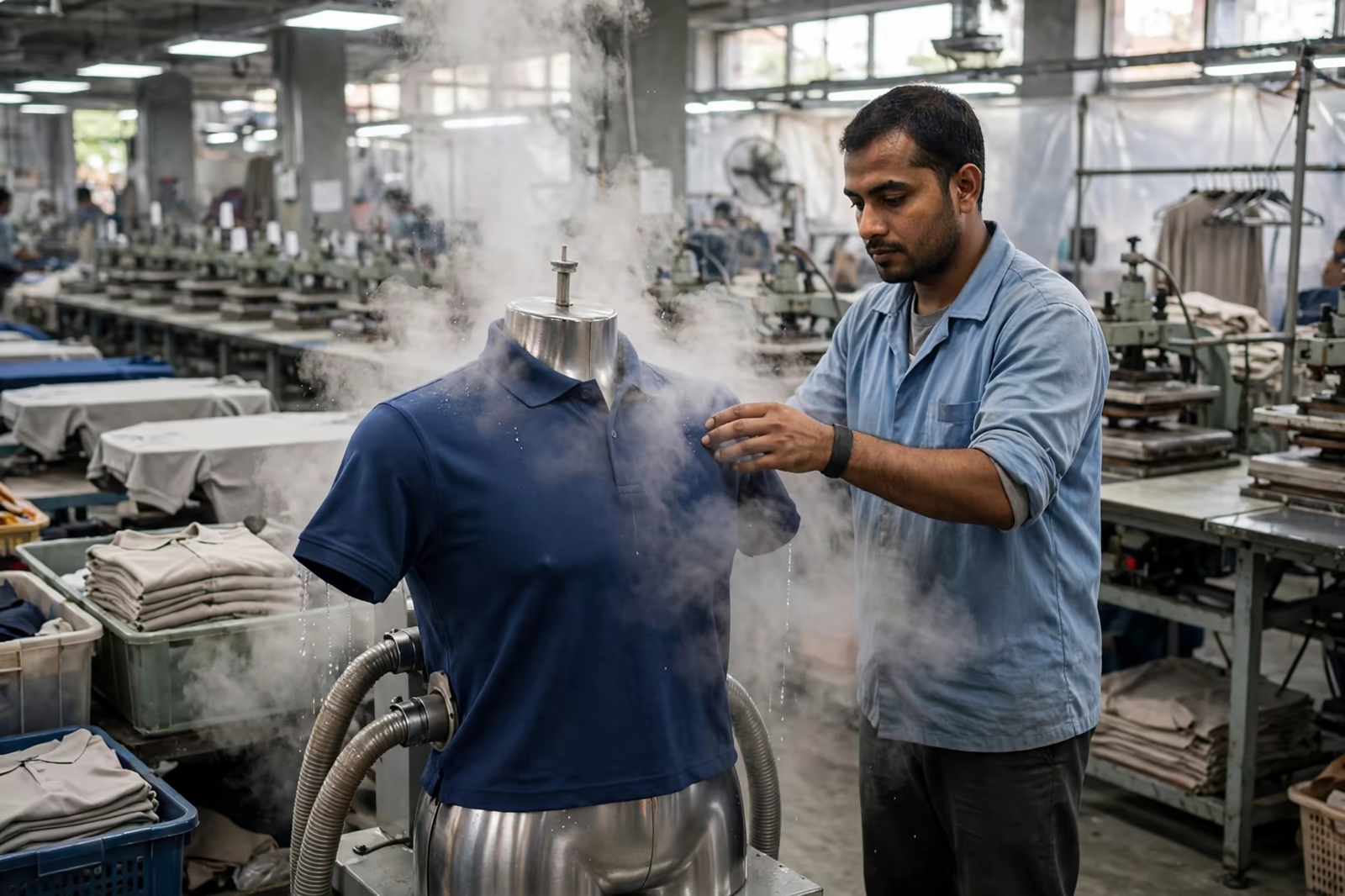
Pressing: Where the Garment Gets Its Face
Pressing is skilled work disguised as simple work. Steam irons, form finishers that blow the garment into shape on an air frame, and presses for collars, cuffs and trouser creases each have their place, and the operator’s judgement about heat, steam and pressure decides whether a garment looks crisp or cooked.
Shine is the enemy: too much heat or pressure on the wrong fabric glazes the surface, flattens texture and can scorch delicate fibres. Pressers test on a spare piece, adjust for each fabric, and follow the garment’s construction so seams lie flat, pleats sit where the pattern put them, and no iron mark prints through to the face.
Trousers get their crease, shirts their collar shape, knitwear a gentle form finish rather than a hard press. The goal is a garment that looks the way the store photograph promised, folded or hung exactly as the buyer’s packing instructions say.
Final Checking, Mend and Touch-Up
Finishing runs its own inspection under good light: every garment examined front and back, inside at the seams, measured against the size chart at the points the buyer specifies. Small faults are mended where mending is invisible and honest: a loose button re-sewn, a missed stitch repaired, a small mark cleaned. Faults that cannot be made perfect are rejected out of the order rather than folded into it.
Measurements matter most here, because this is the last honest reading before packing. A size set sampled from finished garments confirms the wash and press held the approved dimensions; a drift discovered now triggers a wider check, not a wider hope.
Metal detection and needle control close this stage for the orders that carry them: the finished garment passes the detector before it is allowed anywhere near a polybag.
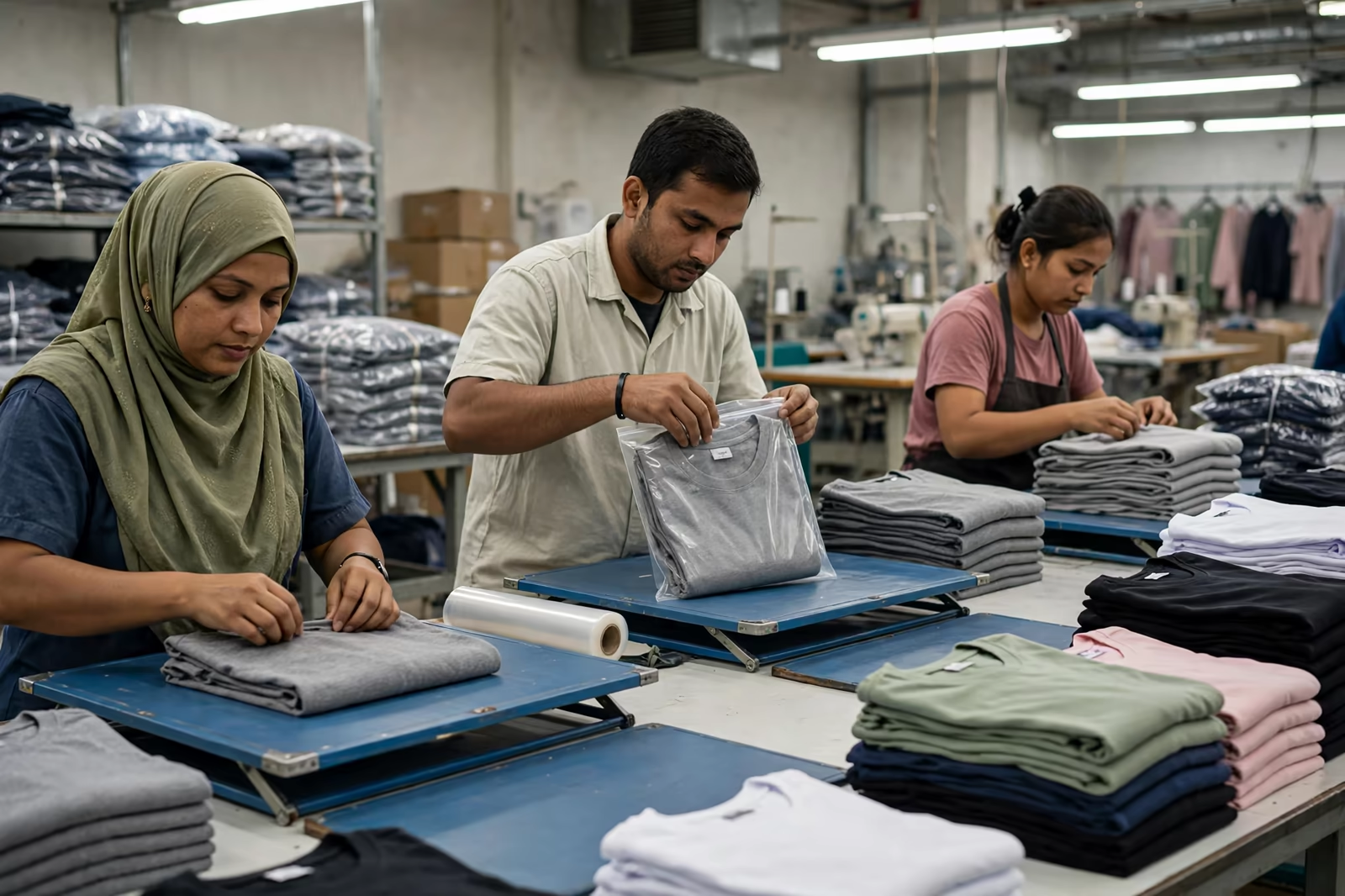
Folding, Tagging and Bagging
Packing follows the buyer’s instruction sheet to the letter, because retail presentation is part of the product. Garments are folded to the specified dimensions, on boards where the spec demands it, with tissue, clips or bands where listed. Hangtags are attached at the named position with the right fastener; barcode and price stickers sit where the retailer’s system expects them.
Each garment then enters its polybag of the specified size and grade, carrying the suffocation warning text the destination market requires, and is sealed or self-sealed as instructed. Assortment packing, ratios of sizes and colours per carton, is built at this table and verified against the packing list piece by piece.
Errors here are uniquely expensive: the garment is perfect and the order still fails, because a retailer received medium shirts in bags marked small. Finishing checks read labels against contents as a separate deliberate act, not a glance.
Cartons, Marks and the Packing List
Cartons are packed to the buyer’s specification: solid or assorted contents, maximum weights respected, garments protected from crushing and damp. Carton marks carry the order identity, style, contents summary and destination codes the buyer’s warehouse scans on arrival.
The packing list is generated from the actual packing, carton by carton, and reconciled against the order quantity before sealing finishes. Shortfalls and overages are found at this table or at the buyer’s warehouse, and only one of those places is cheap.
Sealed cartons are strapped, weighed and staged by order, ready for the final audit and the container. The garment that entered finishing as a sewn object leaves it as documented, countable, sellable stock.
What Buyers Should Specify
State the finish you expect: wash or no wash, and if wash, the approved effect proven by a wash standard you have signed. Name the pressing standard, the fold dimensions, tag position, bag specification and carton rules in the packing instruction, because finishing follows paper more faithfully than memory.
Approve a finished, packed reference piece before bulk finishing begins: one garment washed, pressed, tagged and bagged exactly as the bulk will be. That single piece settles arguments that emails cannot, and it travels back to you with the shipment samples as the standard the bulk was judged against.
Frequently Asked Questions
Why are garments washed after sewing if the fabric was already clean?
Production itself soils and stresses a garment: spinning oils, dust, chalk marks and handling all accumulate, and fabrics relax and shrink to their true size only after their first proper wash. A post-sewing wash cleans the garment, sets its final dimensions and hand feel, and delivers the size and softness the buyer approved, rather than leaving the first wash to surprise the customer.
Can washing change a garment’s measurements?
Yes, which is exactly why bulk washing follows an approved wash standard. Temperature, agitation and drying all affect shrinkage and shade, so the recipe is proven on samples first, and finished garments are re-measured at final checking. Styles the buyer specifies as dry-finished skip the wash entirely and are cleaned by spotting and steam, with measurements taken from the sewn garment as made.
What is the difference between pressing and ironing at home?
Control and equipment. A finishing floor uses form finishers that shape knitwear with steam and air instead of pressure, presses shaped for collars and trouser creases, and operators who adjust heat and steam to each fabric to avoid shine and scorching. The garment is pressed as a constructed object, seams and pleats set where the pattern placed them, at a consistency home ironing never attempts.
How are packing mistakes prevented?
By treating packing as inspection rather than wrapping. Labels and barcodes are read against the garment’s actual size and colour as a separate check, assortment cartons are built and counted against the packing list, and the list itself is reconciled with the order before cartons are sealed. A packed reference piece approved by the buyer anchors every choice of fold, tag and bag.