
Ask a factory why an order shipped late and the answer is rarely the sewing line. Far more often it is a box of buttons that arrived in the wrong shade, a woven label still waiting on a buyer’s proof approval, or a zip order placed with a supplier whose own queue nobody checked. Fabric gets the attention because it is the big cost. Trims decide the date.
The sourcing teams behind this guide work in Bangladesh, assembling trims for export orders bound for buyers in the USA, the UK, Germany, Canada and Australia. Their standing lesson, learned order after order, is that an order has two lead times: the one for the garment, and the hidden one for everything that goes on it and around it.
Trims planning sits inside the framework on our MOQ and production page, supports the labels and branding work described on our brands page, and is costed into every quotation from our get a quote page.
The Order Nobody Sees: What Counts as Trims
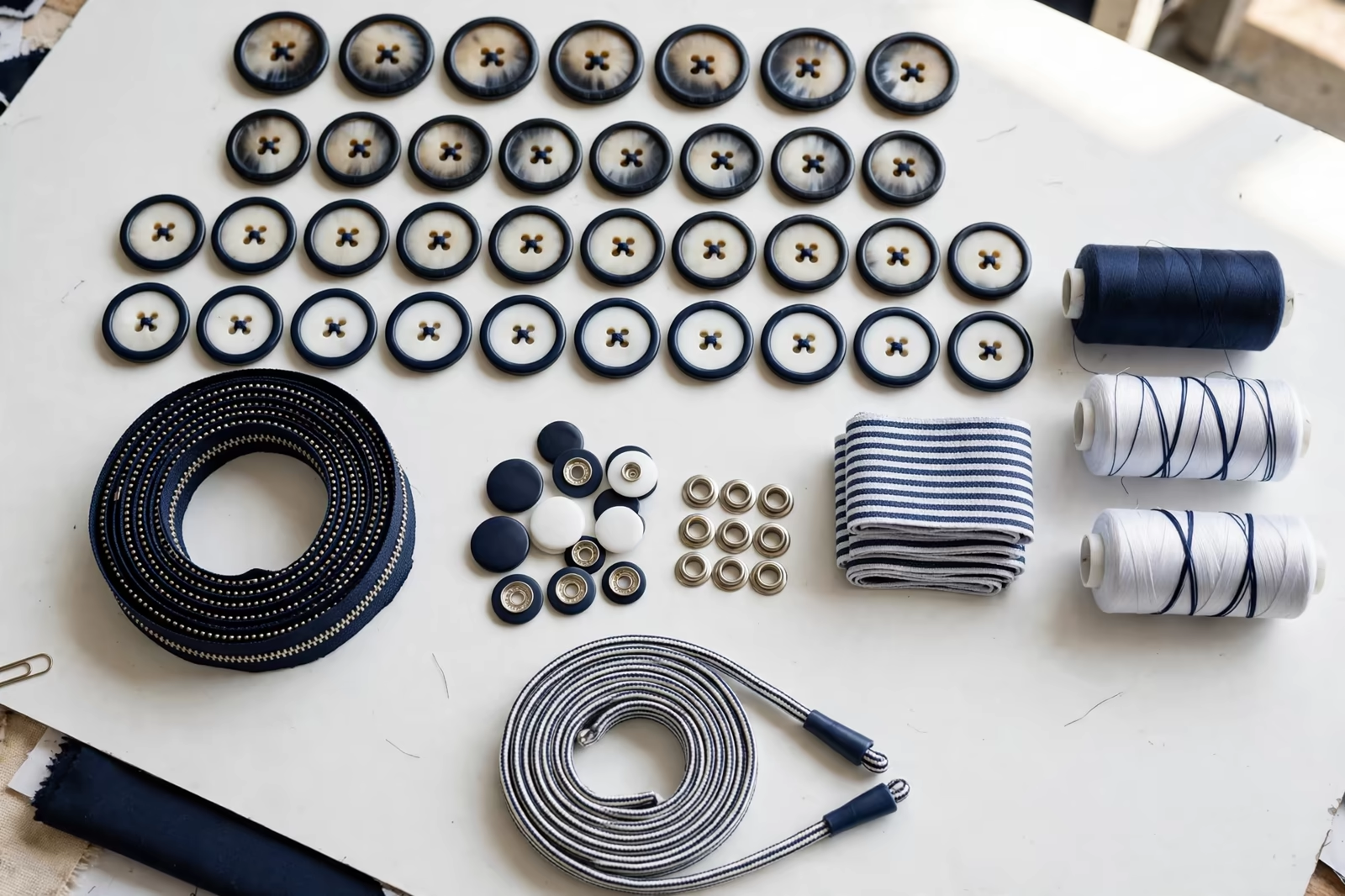
Trims and accessories are everything in and on the garment that is not the main fabric: buttons, zips, snaps, rivets, eyelets, drawcords and their tips, elastic, hook and loop tape, interlinings, shoulder pads, sewing threads. Then the branding layer: woven main labels, printed care labels, size tabs, hangtags, stickers and brand tapes. Then the packing layer: polybags, tissue, carton boxes, carton marks and tape.
Each item is small, cheap and individually unremarkable, which is exactly the danger. A garment missing any one of them is unfinished: a jacket without its zip is not late, it is impossible. The production plan treats fabric as one delivery; trims are twenty deliveries wearing a trench coat.
Every trim also carries a specification: material, size, colour, finish, logo, wording. A button is never just a button; it is this button, dyed to this shade, with this brand name engraved at this size. Specificity is what turns a commodity into a lead time.
Why Trims Run on Their Own Clock
Trim suppliers are factories too, with their own queues, minimums and production steps. Custom items are made to order: woven labels are loomed, buttons are moulded or turned and then dyed, zips are assembled to length and colour, printed items wait on artwork and plates. None of it comes from a shelf, because the buyer’s branding is the product.
The clock starts later than buyers assume. A trim cannot be ordered until its specification is final and, for branded items, its artwork is approved. Fabric is usually ordered on the purchase order’s momentum; trims wait for the slower machinery of proofs and sign-offs, and lose days they never recover.
Shipping adds a third clock when trims are nominated from another country, as branded items often are. The garment factory’s critical path then runs through a supplier it does not control, in a timezone it does not share, with a courier between them.
The Usual Suspects
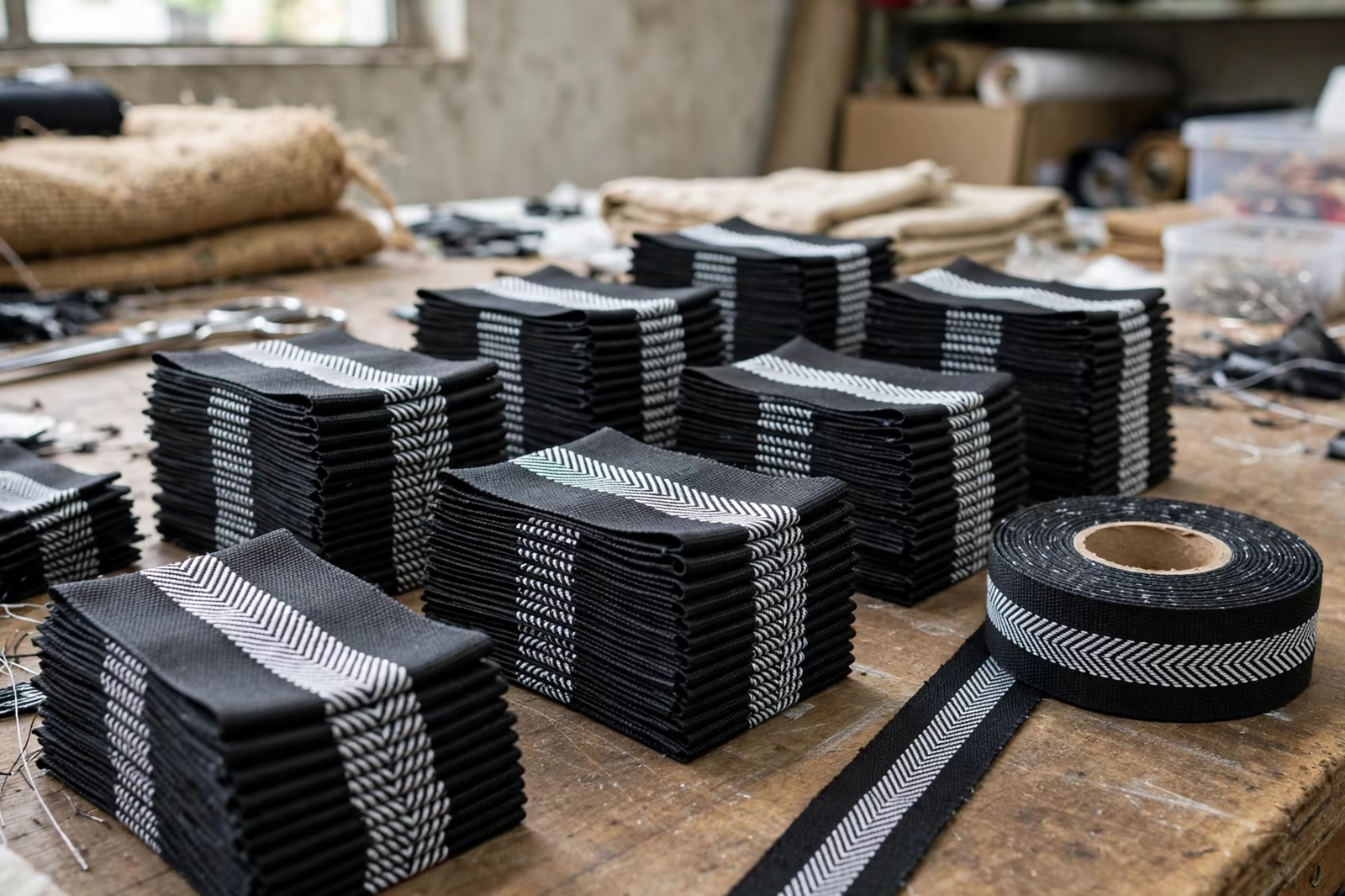
Woven labels lead the list, because they combine everything slow: custom artwork, loom setup, a proof woven and couriered for approval, and a buyer who quite reasonably wants the brand name perfect before thousands are made. Zips follow, specified by length, tape colour, slider type and finish, and unforgiving of substitution.
Custom buttons and snaps carry dyeing risk: they must match the fabric shade, which means their colour approval often waits for the fabric’s own lab dip, chaining the trim clock to the fabric clock. Printed care labels carry a different risk, legal accuracy: fibre content, care instructions and origin wording must be right for the destination market, and a wording change restarts the print queue.
Packing materials close the list quietly. Cartons with the retailer’s printed marks, polybags with the required warning text in the required languages: generic versions exist, but the specified versions are printed to order, and an order cannot ship in packaging that has not arrived.
Threads: The Trim Nobody Counts
Sewing thread deserves its own warning because it is consumed invisibly and specified loosely. Thread must match the fabric shade after dyeing, not before, survive the garment’s wash life, and suit the fabric’s weight; a thread too strong for a fine cloth cuts it like wire under stress, and one too weak opens seams in wear.
Thread is also ordered per colour per order, and a shade approved on fabric starts a matching exercise at the thread supplier. Factories that hold shade ranges ready and confirm against the bulk fabric save a loop that catches the unprepared on every new colour.
Approval Chains Inside the Lead Time
Most trim delay is approval delay wearing a disguise. The sequence artwork, proof, courier, buyer review, correction, re-proof can loop several times, and each loop costs days at both ends. The supplier cannot start bulk until the proof is signed; the factory cannot finish garments until the bulk arrives.
The loops multiply when approvals sit with different people: the brand team owns the label, the technical team owns the care wording, the retailer owns the carton marks. A factory chasing three approvers through one buyer contact learns patience or learns air freight.
The countermeasure is boring and effective: proofs prepared before the order lands where possible, approval deadlines named in the order calendar, and digital approval for first checks with physical proofs reserved for the final sign-off on colour-critical items.
Nominated Versus Factory-Sourced Trims
Buyers often nominate trim suppliers: a specific label maker, zip brand or button source named in the order. Nomination protects brand consistency across factories and countries, and it transfers the trim clock to a supplier the buyer chose. The factory orders, chases and receives, but cannot discipline a nominated supplier the way it can its own.
Factory-sourced trims run on the factory’s relationships: local and regional suppliers it buys from weekly, whose real lead times it knows from experience rather than from a brochure. For unbranded or lightly branded items, this route is usually faster and entirely adequate in quality.
The honest conversation at order stage is which items truly need nomination, brand-critical pieces like main labels and logo hardware, and which can be factory-sourced to a matched specification. Every unnecessary nomination is lead time volunteered.
The Real Cost of a Cheap Trim
Buyers sometimes press trim prices because each line is small. The arithmetic misleads: the saving on a cheaper snap is measured in fractions of a cent per garment, while the cost of that snap failing, popping off in wear or rusting in the wash, is measured in claims, rework and reputation. Trims touch the customer constantly; buttons, zips and labels are the parts of the garment handled every single day.
Specify quality where the hand meets the garment, and save money where nobody can detect the saving. A merchandiser who shows both versions of the trim sheet, and what each choice risks, is doing the buyer’s real work.
How a Good Factory Runs the Trim Clock
The trim order goes out with the fabric order, not after it. At purchase order stage the merchandiser builds the trim sheet from the tech pack, every item specified and quantified with sewing wastage allowed, and places orders in parallel: fabric, trims and packaging on the same day wherever specifications allow.
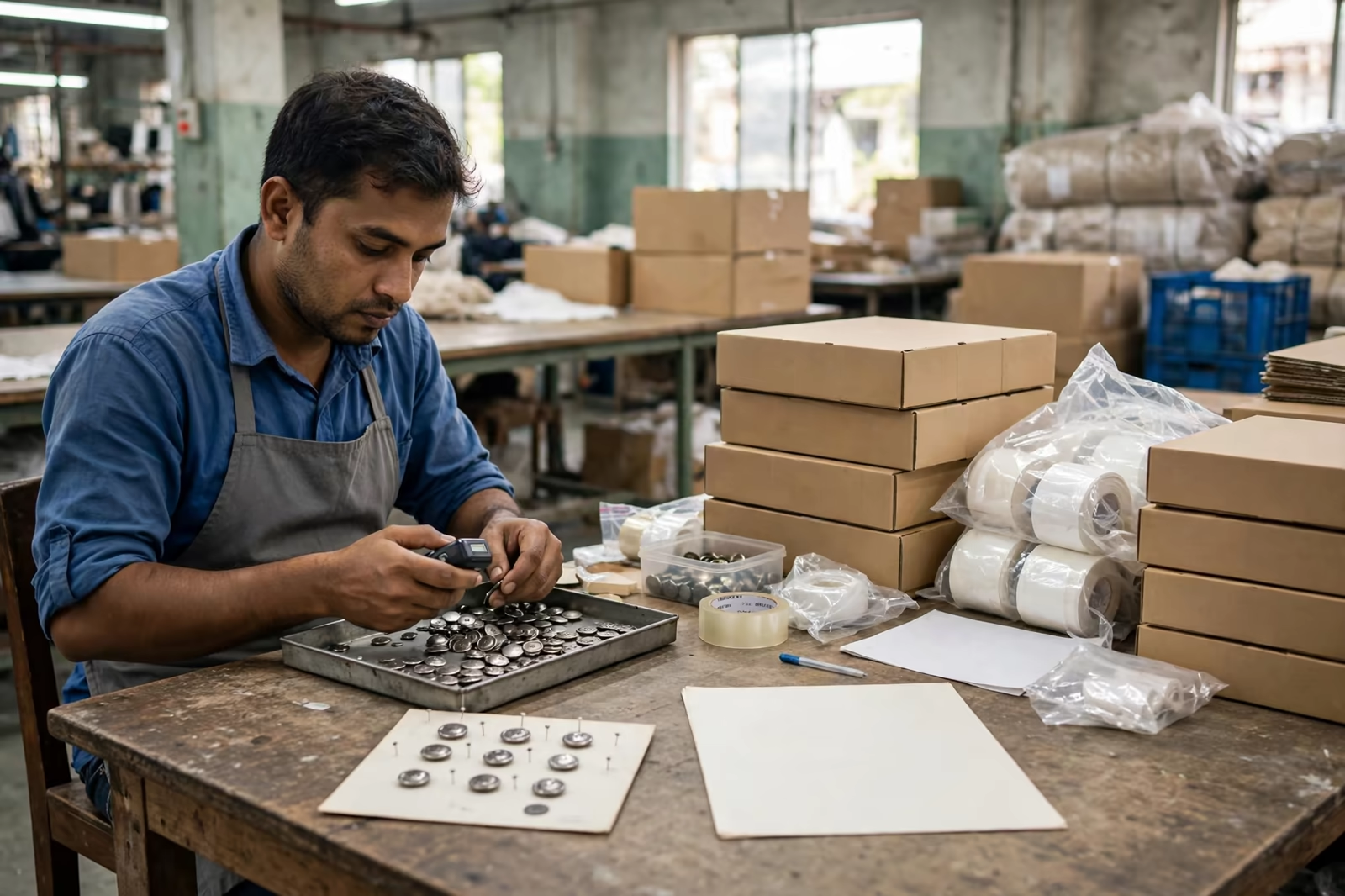
Receipt is inspected like fabric. Trims are counted, checked against samples and specifications, shade-checked under the light cabinet where colour matters, and stored against the order, because a wrong button discovered at the sewing line has already consumed the schedule that finding it early would have saved.
Generics are buffered. Plain threads, standard interlinings, common elastics and unprinted packaging are held as running stock in the factory’s own store, so the order’s critical path depends only on the custom items. The discipline is invisible when it works, which is the point.
What Buyers Can Do to Protect the Date
Freeze trim specifications with the order, not during it. Send final artwork for labels and prints with the tech pack, name approvers, and answer proofs at the speed you expect production to run. A proof that waits a week on a desk has consumed the float the schedule was counting on.
Accept matched alternatives where the brand allows: a factory-sourced button dyed to the approved shade, a stock zip in the specified colour family with the branded slider reserved for the hero product. Save nomination for the items a customer actually sees and touches.
Ask, at quotation stage, for the trim lead times by name. A factory that can list which items drive your order’s date, and what it is doing about each, has a plan. A factory that quotes one confident date for everything has a hope.
When Trims Arrive Wrong
Wrong shade, wrong size, wrong wording: the failure modes are small and total. The correct response is containment: the wrong stock is quarantined, never sewn in while a decision is pending, because unpicking a wrong label from finished garments costs more than the wait for the right one.
Replacement runs on the supplier’s clock again, which is why the factory’s options narrow to judgement calls made with the buyer: re-dye, expedite, substitute an approved equal, or resequence production so sewing does everything possible and the missing trim closes the garment last.
The lesson each incident teaches is recorded in the trim sheet for the next order: this supplier’s quoted time is not its real time, this proof needs two loops, this item orders first. Hidden lead times become visible one order at a time.
Frequently Asked Questions
Why do trims delay orders more often than fabric?
Because there are so many of them, each with its own supplier, specification and approval chain. Fabric is usually one or two deliveries from sources ordered immediately at purchase order stage. Trims are a dozen or more small custom orders, several waiting on artwork proofs and buyer sign-offs, any one of which can hold finished garments hostage. Sewing cannot complete a garment that is missing its zip, labels or buttons.
What are nominated trims?
Trims the buyer requires from a specific named supplier, often for brand consistency: a particular label weaver, zip manufacturer or button source used across all the brand’s factories. Nomination keeps branding identical worldwide, but it puts that part of the schedule in a supplier the garment factory does not control, which is why brand-critical items are worth nominating and commodity items usually are not.
Can sewing start before every trim has arrived?
Partly, and good factories plan exactly that. Garments can be cut and sewn through every operation that does not need the missing item, leaving label insertion, buttoning or final closure until the trim lands. What cannot happen is finishing, inspection and packing, which all need the garment complete. Resequencing buys days; it does not repeal the dependency.
Who pays when late trims force air freight?
It follows the cause. If the factory ordered late or chose a supplier that failed, the factory carries the recovery cost. If the delay came from a buyer-nominated supplier or from approvals that waited on the buyer’s side, the cost normally sits with the buyer. Clear order-stage agreement on nominations and approval deadlines prevents the argument, which is why the trim sheet and calendar matter.