
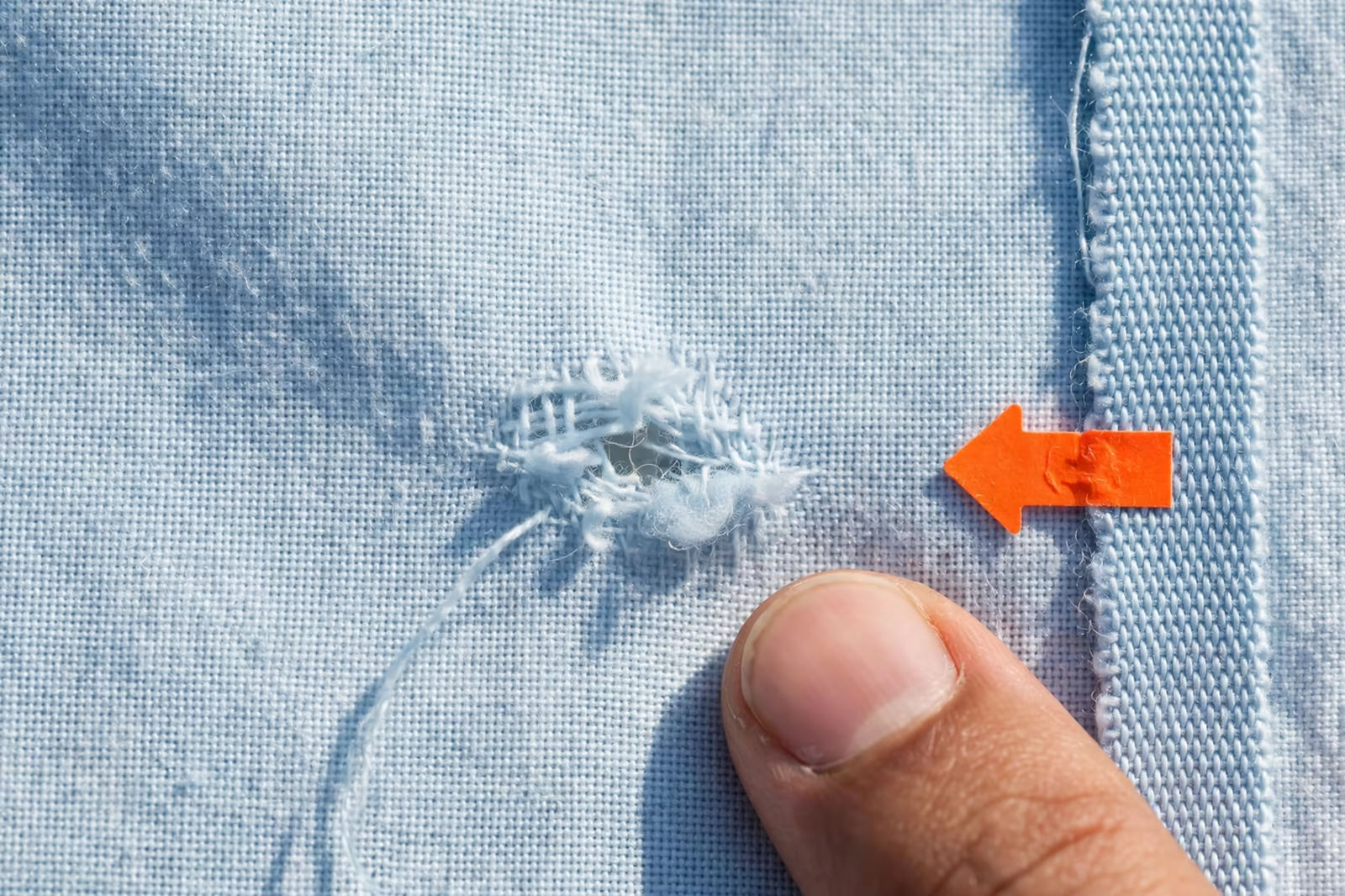
Every garment fault that cannot be sewn away starts as a fault in the fabric: a hole, a slub, a streak of wrong shade, a line of oil from the loom. Once cloth is cut, those faults become garments, rework and claims. Fabric inspection exists to catch them while they are still just metres on a roll, and the method most of the world’s clothing industry agrees on is the 4-point system.
The inspection rooms behind this guide work in Bangladesh, checking fabric for export orders bound for buyers in the USA, the UK, Germany and the wider European market. Their system is not homegrown; it is the international standard method, which means a buyer who understands it can read any honest factory’s inspection report anywhere.
Fabric inspection opens the production framework on our MOQ and production page and sits inside the range on our services page. For the inspection terms attached to a specific order, ask through our contact page.
Why Fabric Is Inspected Before Anything Else Happens
Fabric is the largest cost in the order and the one input the sewing factory usually does not make itself. It arrives from mills and knitters with its own history: loom faults, dyeing faults, finishing faults, damage from handling and transport. Accepting it unseen means underwriting that history with the buyer’s money.
Inspection converts trust into evidence. Each roll is examined, scored and recorded, so the decision to cut is made roll by roll, with knowledge of where the faults sit and how severe they are. Faulty areas can be planned around in cutting; faulty rolls can be rejected and replaced while replacement is still possible.
The timing matters as much as the method. Inspection happens at receipt, before the fabric enters the production clock, because a rejected roll discovered at the cutting table costs days, while the same roll discovered at the store door costs a phone call.
The 4-Point System in Plain Terms
The system scores defects by size. An inspector examining the fabric marks every fault and assigns points: a defect up to 3 inches long scores 1 point; over 3 and up to 6 inches scores 2; over 6 and up to 9 scores 3; anything longer scores 4. Serious holes and openings score the maximum 4 points regardless of size. No single defect, however long, scores more than 4, which is where the system gets its name.
The roll’s total points are then normalised by its area, expressed as points per 100 square yards, so rolls of different lengths and widths can be compared fairly. That single number, judged against the acceptance limit agreed for the order, decides whether the roll passes.
The elegance of the method is its portability. A buyer in London, a mill in another country and a factory in Bangladesh can argue about many things, but a 4-point report is written in a shared language: defect, size, points, total.
How the Inspection Actually Runs
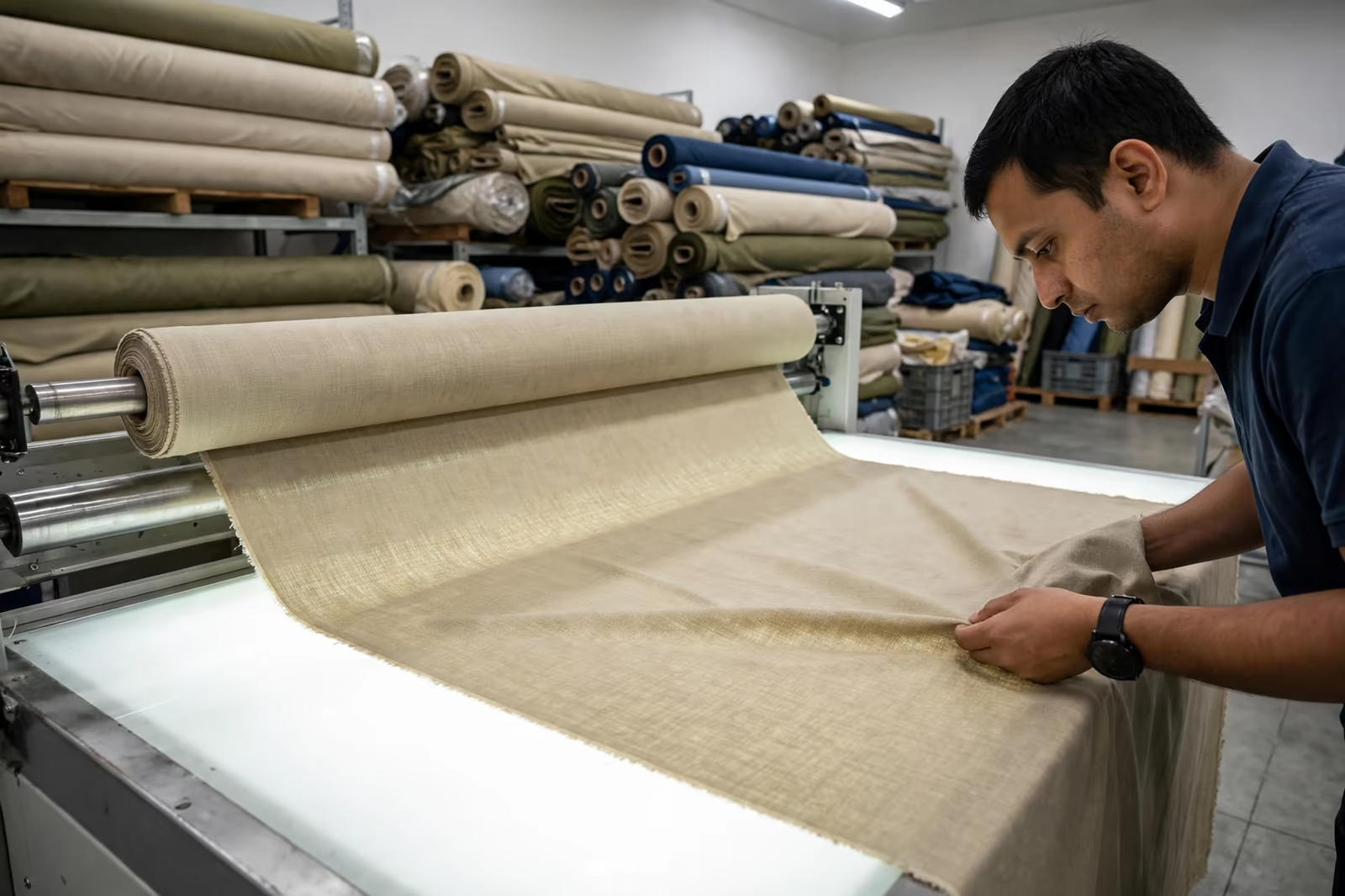
Rolls are mounted on an inspection frame and drawn slowly across a lit viewing board, face side up, at a speed the inspector can genuinely read. The inspector watches for the full catalogue of faults: holes, slubs and knots, thick and thin places, missing yarns, oil and dirt marks, dye streaks, barre patterns in knits, and edges that wave or narrow.
Defects are marked at the selvedge with stickers or chalk as they pass, and recorded on the roll’s report with their position. That map travels with the roll to the cutting room, where layers are planned so marked faults fall in waste areas rather than garment panels, or faulty sections are cut out before spreading.
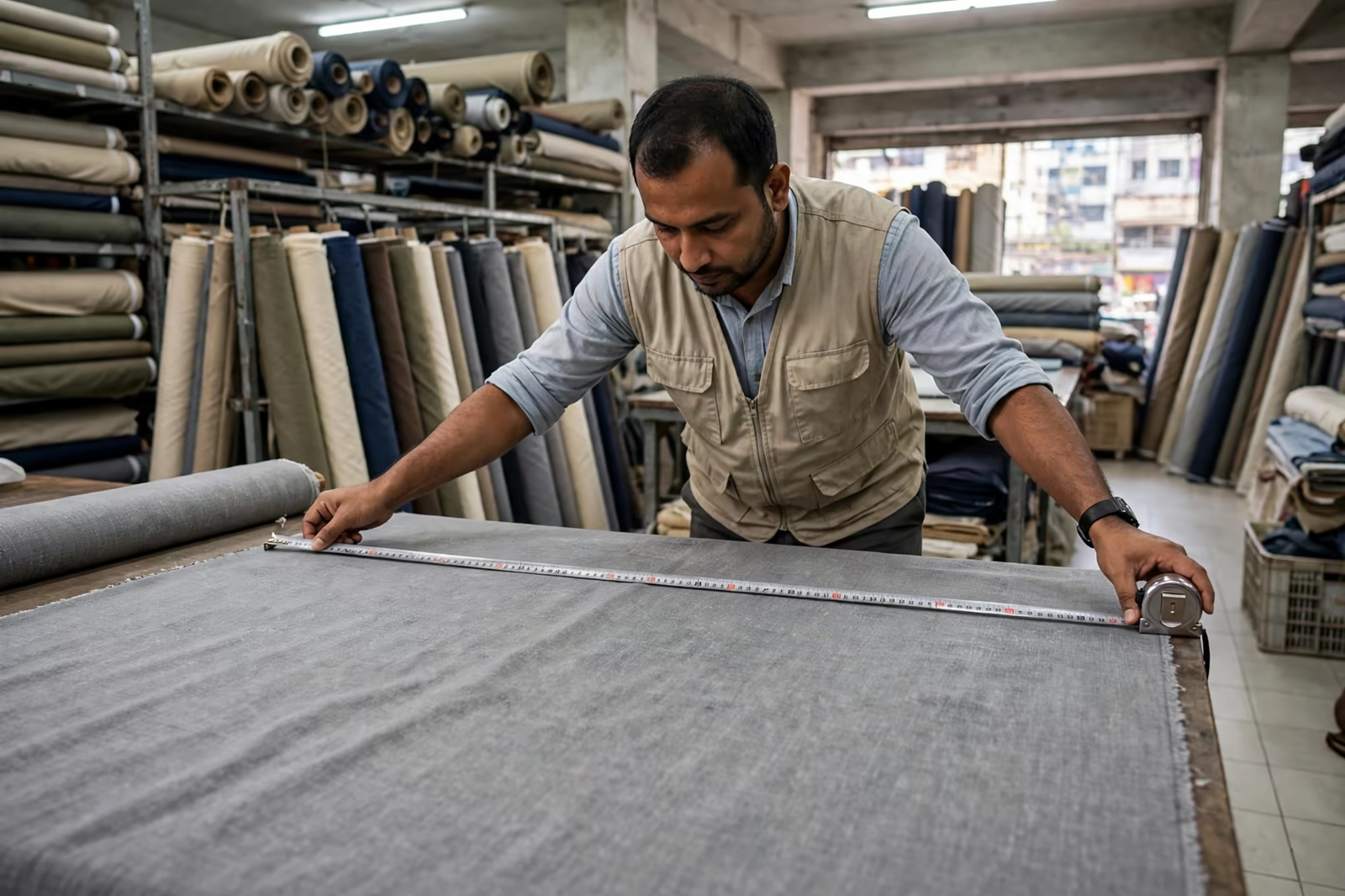
Inspection checks more than faults. Usable width is measured, because a roll narrower than booked breaks markers and consumption. Length is verified against the mill’s ticket. Shade is compared roll to roll and against the approved standard, since the 4-point score alone says nothing about colour.
The Score: Points per Hundred Square Yards
The formula divides the roll’s total defect points by its area in square yards and multiplies by 100, producing the comparable figure. Acceptance limits vary by fabric and by buyer: fine shirting and premium fabrics are held to tighter limits than heavy workwear cloth, and each buyer’s manual sets the line their orders are judged against.
Rather than a universal pass mark, treat the number as a grade with a context. The factory reports the score per roll and for the consignment as a whole; a single weak roll inside a strong delivery is handled differently from a delivery whose average hides widespread faults.
Serious faults break the arithmetic in a useful way. Holes, which score maximum points and usually mean rejection of the affected section whatever the average says, remind everyone that the system guides judgement rather than replacing it. A roll can pass on points and still be refused for one ugly defect in the wrong repeat position.
Reading a Fabric Inspection Report
A good report tells the roll’s whole story on one page: roll number, mill ticket length and measured length, booked and actual width, total points, the normalised score, and the defect list with types and positions. Read across several reports and patterns emerge, such as one fault repeating at regular intervals, which points to a specific loom problem the mill can fix.
Ask for the reports, not a summary. Summaries average away exactly the roll-level detail the system exists to capture, and the buyer who reads reports learns their fabric supply faster than any other document teaches it.
Accept, Correct or Reject
A passing roll goes to the store rack with its report attached. A marginal roll may be accepted with a cutting plan that works around its marked faults, accepted after the mill agrees a price allowance, or downgraded to a less critical use with the buyer’s knowledge. Each path is a recorded decision, not a shrug.
A failing roll is rejected back to the supplier for replacement or credit. This is the moment the whole system is built for, and the moment it must happen early: the replacement clock starts while the production schedule can still absorb it.
What never happens in a disciplined factory is silent acceptance, faulty fabric waved through because the timeline is tight. The faults do not disappear under pressure; they reappear as defective garments at final inspection, where each one costs a finished piece instead of a metre of cloth.
What the System Cannot See
The 4-point method judges visible surface quality. It says nothing about whether the fabric will shrink beyond tolerance, bleed colour in the wash, pill after a month of wear or fail a strength test. Those are laboratory questions, answered by the separate battery of fabric tests an order may carry: dimensional stability, colour fastness, tensile and tear strength, pilling.
Hand feel escapes it too. A roll can score beautifully and still feel harsher than the approved swatch, which is why inspection includes a hand and appearance comparison against the standard, recorded as a judgement rather than a number.
Knowing the system’s limits is part of using it well. Buyers who treat a good 4-point score as a complete fabric approval leave the invisible half of fabric quality unexamined.
How Much Fabric Gets Inspected
Full inspection of every roll is the gold standard and is what critical orders, light colours and fine fabrics deserve. For large consignments of proven fabric from a consistent mill, many buyers specify inspection of a defined share of rolls, chosen across the delivery, with the right to expand to full inspection if early rolls score badly.
The choice is a risk calculation the buyer owns. Sampling saves inspection time on fabric that history says is reliable; it spends that saving the first time a bad roll hides in the uninspected share. Factories will advise from the mill’s record, but the specification belongs in the order.
Either way, width, length and shade checks ride along on every inspected roll, because those failures do not announce themselves in garments until the damage is cut and sewn.
The Inspector’s Craft
Inspection looks passive and is anything but. The inspector holds a moving river of cloth in attention for hours, catching a two-inch slub at speed without slowing the frame to a crawl, and judging borderline faults consistently from the first roll of the morning to the last. Fatigue is the system’s quiet enemy, managed with pace, lighting and rotation rather than exhortation.
Consistency is trained and checked: the same roll re-inspected should earn the same score. Buyers auditing a factory can ask for exactly that demonstration; a confident inspection room welcomes it.
What Buyers Should Specify
Name the system and the limit: the 4-point method, your acceptance score per fabric type, and the share of rolls to be inspected. Ask that reports, one per roll with its defect map, be retained and shared, and that rejected rolls be reported the week they are found, not the week cutting starts.
Agree the shade procedure separately, since points do not cover colour: roll-to-roll comparison against the approved dip or standard, judged in the light cabinet. And agree what happens to marginal fabric before it arrives, because a fabric dispute negotiated calmly at order stage becomes an emergency when it is negotiated at the cutting table.
Finally, ask who inspects. A named fabric inspector with a frame, a standard and a report book is a system; “we check the fabric” is a sentence.
Frequently Asked Questions
What counts as a defect under the 4-point system?
Any visible fault in the fabric surface: holes, slubs, knots, thick or thin yarns, missing threads, oil or dirt stains, dye streaks, uneven knitting patterns and damaged edges. Each defect is scored by its length, 1 point up to 3 inches, 2 up to 6, 3 up to 9 and 4 for anything longer, with holes scoring the maximum 4 points whatever their size.
What score counts as acceptable fabric?
There is no single universal number: the result is expressed as points per 100 square yards, and the acceptance limit is set by the fabric type and the buyer’s standard. Fine, premium fabrics are held to tighter limits than heavy utility cloth. What matters commercially is that the limit is agreed in the order documents, so the factory’s pass and fail decisions follow your line rather than an assumption.
Is every roll of fabric inspected?
It depends on the order’s specification. Full roll-by-roll inspection is the standard for critical fabrics and colours, while consistent fabric from a proven mill is often inspected on a sample of rolls agreed in advance, with inspection expanded if early rolls score poorly. Either way, the inspected rolls are individually scored and reported, and width, length and shade are checked alongside the fault score.
Who pays when fabric fails inspection?
When the factory buys the fabric, failed rolls are the factory’s claim against its mill, and replacement is the factory’s problem to solve inside your schedule. When a buyer nominates or supplies the fabric, the same inspection protects them: the failure is found at receipt, evidenced by the roll reports, and raised with the nominated mill while replacement is still possible, instead of after cutting.