
No two garments ever measure exactly alike. Cut a thousand shirts from the same pattern, sew them on the same line and wash them in the same load, and their chest measures will still spread across a small range, because fabric breathes, stretches, relaxes and shrinks in ways no factory can fully freeze. Measurement tolerance is the industry’s honest answer to that spread: every specification carries a plus or minus, a band within which the garment is correct.
The measurement teams behind this guide work in Bangladesh, checking export orders bound for buyers in the USA, the UK, Germany and across Europe and the Middle East. None of their buyers expects perfection to the millimetre. All of them expect the band to be agreed, measured correctly and respected.
Tolerances are agreed inside the framework on our MOQ and production page, applied across the range on our services page, and reflected in every quotation from our get a quote page.
Why Fabric Refuses to Be Exact
A garment’s dimensions are set by materials that move. Knit fabric stretches under its own weight on the cutting table; woven fabric shifts fractionally with humidity; every fabric relaxes after cutting and shrinks or grows slightly in washing and pressing. The pattern may be digital and perfect, but it is executed in a material with a mind of its own.
Human and machine variation adds its own layer: a seam allowance taken a thread wider at one station, a press applied a breath longer at another. Each effect is tiny. A garment is the sum of dozens of them, and sums of tiny variations produce a distribution, never a single repeated number.
Tolerance is how the industry prices this reality into the contract. Demanding zero variation does not produce zero variation; it produces arguments, rejected lots that customers would have loved, and factories quietly building the risk into higher prices.
How a Tolerance Is Written
A size specification lists points of measure: chest, body length, sleeve length, shoulder, waist, hip, inseam and the rest, each with a target value per size and a tolerance, written as plus or minus a figure in centimetres or inches. A chest of 56 centimetres with a tolerance of plus or minus 1 means garments measuring from 55 to 57 pass; outside that band, the garment is a measurement defect.
Tolerances differ by point, because points differ in difficulty and importance. Body length on a stable woven is held tighter than the width of a stretchy knit, where the fabric’s own elasticity argues for a wider band. Fit-critical points, neck openings, waist on tailored trousers, carry tighter tolerances than forgiving ones like a relaxed hood’s depth.
Plus and minus are not always symmetric in effect even when symmetric on paper: a shirt 1 centimetre long is a shrug, while 1 centimetre short can look cropped. Good specifications note which direction matters most for sensitive styles, so production centres its aim accordingly.
Where Variation Is Born
Cutting contributes first: layer tension, knife drift on thick lays and marker accuracy all move panel sizes slightly before a stitch exists. Relaxation after spreading, letting fabric rest before cutting, is the classic control, and skipping it to save time writes variation into every layer below the top one.
Sewing contributes seam by seam: feed tension stretches knits as they pass under the needle, and operators ease panels together by hand where patterns meet. Washing and pressing contribute last and largest for many styles, which is why measurement for approval is taken from finished garments in their final state, never from the sewing line.
Understanding the sources matters because each has a cure: rest the fabric, balance the line, prove the wash. A tolerance breach with a known birthplace is a maintenance task; a breach treated as bad luck recurs order after order.
Measuring the Same Way Every Time
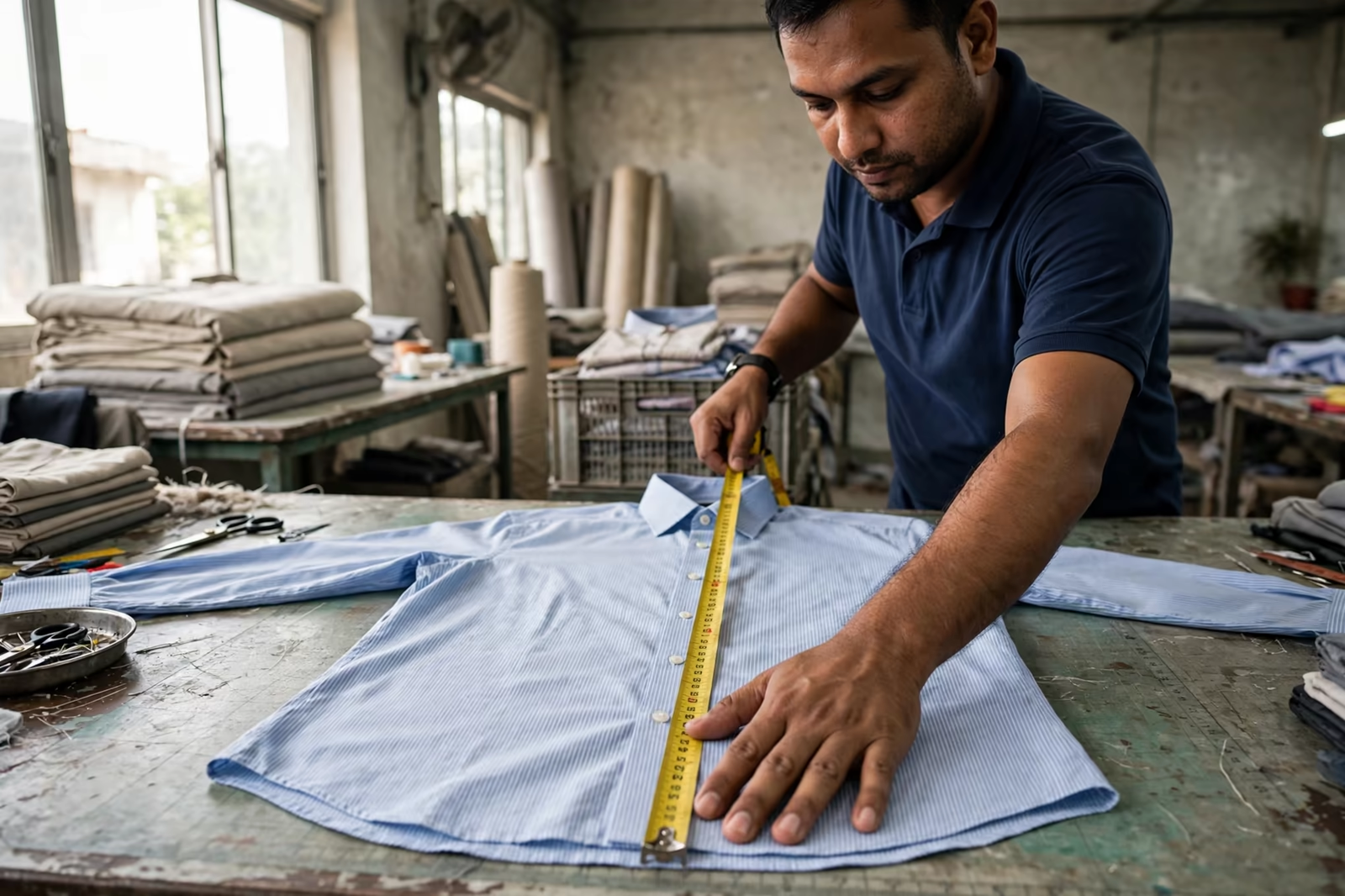
A measurement is only meaningful under a method: the garment laid flat and smoothed without stretching, measured at defined points, buttoned or zipped as specified, with the tape following stated paths. Two measurers using different methods can disagree by more than the tolerance itself, which makes the method part of the specification.
Professional buyers publish measuring guides with diagrams for exactly this reason. Factories measure to the buyer’s method even when their house method differs, because the number that matters is the one the buyer’s inspector will reproduce at final audit.
Condition matters too: garments are measured after finishing and relaxing, at room conditions, not warm from the press. The discipline sounds fussy until the first dispute is settled by both sides re-measuring the buyer’s way and watching the argument evaporate.
Tolerance Stacking: When Small Becomes Big
Individual points can each sit inside tolerance while the garment still looks wrong, because fit is a relationship between points. A chest at the top of its band with a waist at the bottom of its band changes the garment’s silhouette; sleeves at opposite ends of theirs look uneven even though each passes alone.
Inspectors therefore read measurements as a set, not only line by line. A garment whose every point hugs one side of the band tells a story of drift, in cutting or sewing, that the pattern of numbers reveals before the eye confirms it.
Production aims at the centre of the band, never at its edges. A line that aims at the limit produces half its output outside it after normal variation; a line centred on target keeps the whole spread inside, which is the quiet arithmetic behind consistent sizing.
Size Sets and the Reference Garment
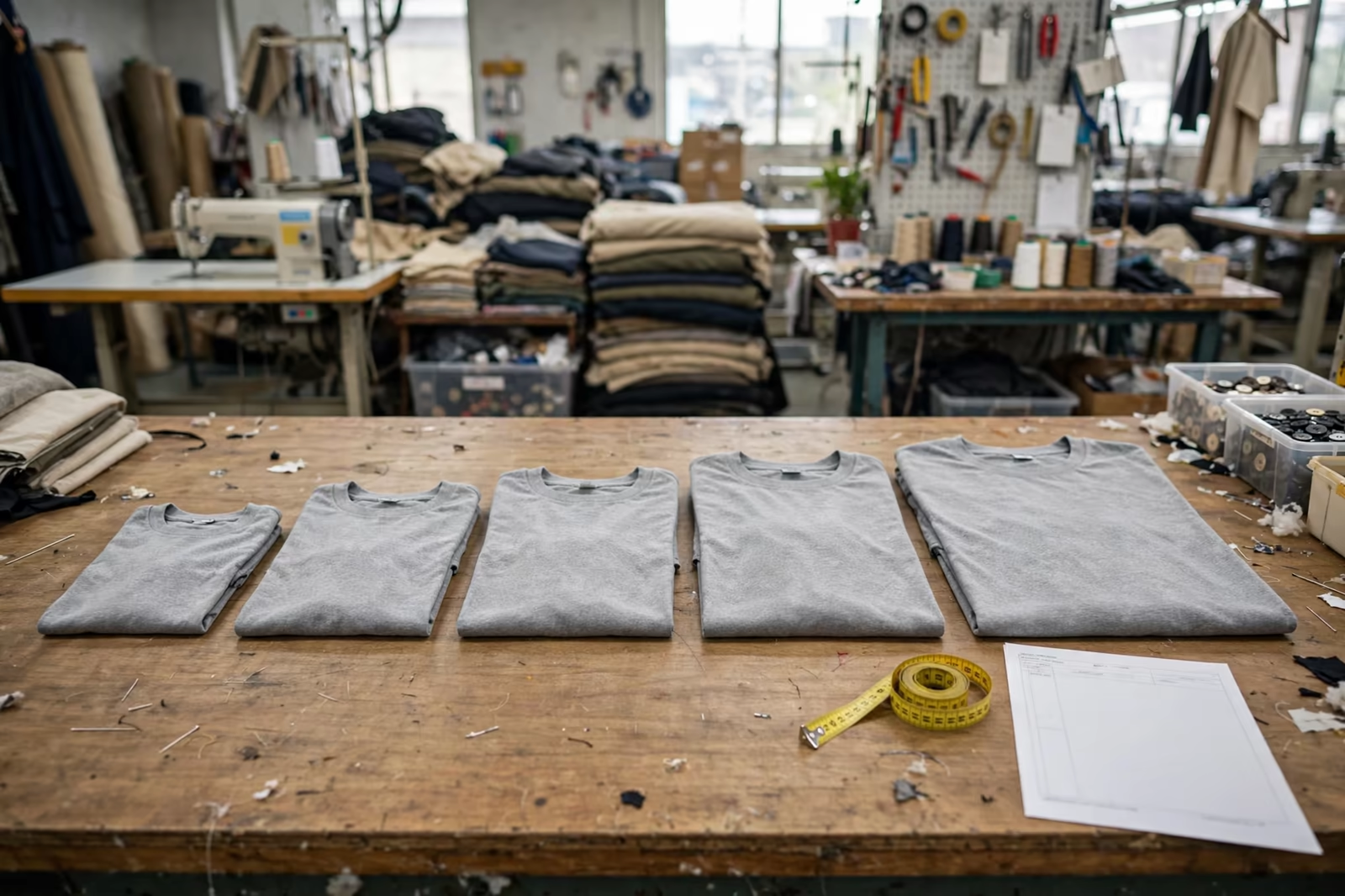
Before bulk production, a size set proves the pattern across the range: one garment in every size, measured point by point, because a pattern can grade wrongly even when the base size is perfect. The set’s measurements, checked against the spec before cutting bulk, are the cheapest sizing insurance in the entire order.
The approved pre-production sample then serves as the physical reference for fit and measurement intent, kept beside the spec sheet. Where a number and the reference garment seem to disagree, the pair is raised with the buyer before production rather than resolved silently on the floor, because the buyer’s inspector will arrive carrying both.
Grading errors deserve their reputation: a mistake repeated identically across a size produces garments all wrong the same way, which sampling reads instantly once someone measures more than the base size.
Knit Versus Woven: Different Fabrics, Different Bands
Knitwear argues for wider tolerances and gets them: the fabric stretches, recovers imperfectly, and measures differently under its own weight than laid under slight tension. Woven garments, structurally stable, carry tighter bands, and tailored pieces tightest of all where the silhouette is the product.
Denim sits interestingly between: woven and stable before washing, then moved decisively by the wash itself, so its measurements are judged after the full wash process, and the wash recipe becomes a sizing tool as much as an aesthetic one.
The buyer setting tolerances names the fabric behaviour they are buying. Copying a woven shirting tolerance onto a loose knit hoodie manufactures failures out of a healthy process, and any factory that accepts such a spec without discussion is not paying attention.
How Inspectors Sample Measurements
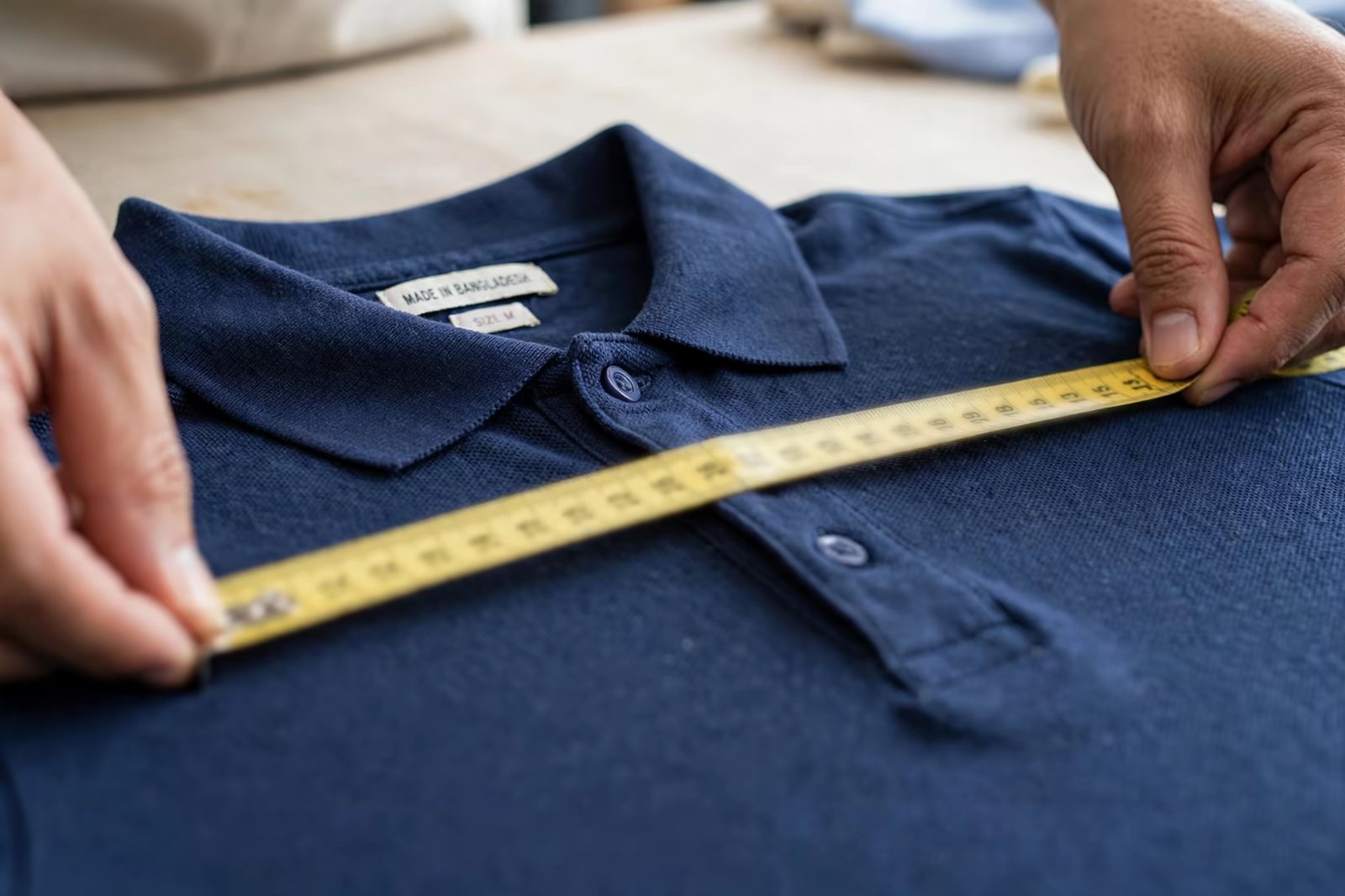
Inspectors do not measure every garment; they measure a sample across sizes and colours, following the size set the order carries. Each measured point is recorded against its band, and the pattern of results decides: isolated points outside suggest individual escapes, systematic drift across the sample suggests a process cause that a re-check of the wider lot must size.
Results near the band edges across many garments earn attention equal to outright failures, because they announce a process wandering toward the cliff. The corrective conversation with production, adjust the pattern, check the cutting, happens while the order can still be steered.
Shipment samples and the buyer’s own audits remeasure independently, which is why the factory’s honesty in its own numbers is structural: a factory that records kindly will be corrected publicly by the next tape that touches the garment.
Shrinkage: The Tolerance Eater
Most measurement battles are shrinkage battles. A garment cut exactly to spec can wash its way out of tolerance if the fabric’s shrinkage was underestimated, which is why shrinkage is tested before bulk cutting and the pattern carries a shrinkage allowance: the garment is made deliberately oversize by the expected amount, so the wash delivers it onto target.
When shrinkage varies between fabric lots or colours, the allowance that centred one lot can leave another at the band’s edge. Measurement reports broken down by colour catch this early, and the factory that reads them lot by lot adjusts cutting instead of explaining shipments.
Buyers see the system working when finished-garment measurements cluster near target across colours. They see it failing when one colour consistently measures small: the cloth, not the sewing, is talking.
What Buyers Should Specify
Publish the points of measure, targets and tolerances with the order, with a measuring method guide or a reference to yours. Set tolerances that respect the fabric: ask the factory, before confirming, whether the bands are achievable on this cloth in this construction, and listen to the answer, because a tolerance agreed in ignorance will be renegotiated in conflict later.
Name the sizes to be measured at approval stages, and ask for measurement reports from finished garments, not from patterns. And when a report shows drift, ask for the cause and the correction, not only the re-measurement: the numbers are the factory’s steering wheel, and buyers should see it being used.
Frequently Asked Questions
Why can a factory not simply make every garment exactly to spec?
Because garments are assembled from materials that stretch, relax and shrink, by processes with small natural variations at every step. Even excellent production produces a narrow spread of measurements around the target. Tolerance defines the spread the buyer accepts as correct, so garments inside the band are right, not approximately right, and the argument shifts from impossible perfection to honest measurement.
Who sets the tolerance values?
The buyer sets them in the size specification, usually following their own standards for each garment type and fabric. Sensible buyers confirm achievability with the factory before production, since a knit’s behaviour demands a wider band than a stable woven. The factory may propose adjustments from experience; once agreed, the published tolerances are the standard the inspection enforces for both sides.
How are garments measured during inspection?
By the buyer’s published method: garment flat, smoothed without stretching, fastened as specified, tape applied at defined points, after finishing and relaxing. Inspectors measure a sample across sizes and colours, record every point against its tolerance band, and judge the pattern of results. A single garment outside a band is an escape; many garments drifting the same way signal a cutting, sewing or wash cause.
What happens when measurements fall outside tolerance?
The affected garments are measurement defects. Isolated failures are rejected or reworked where rework is honest, and the lot’s fate follows the inspection’s sampling result. Systematic failures trigger a cause hunt, pattern, cutting, line or wash, and a wider measurement of the lot before any shipment decision. Either way the findings are reported in numbers, which is the advantage of the system: nobody argues about a tape.