

Every inspection ends with the same argument unless the words are agreed first: is this fault bad enough to matter? A small mark in an invisible place, a stitch slightly off line, a needle hole in a seam allowance: factories call them nothing, buyers call them defects, and both are arguing from instinct. Defect classification replaces instinct with a shared scale of three words: critical, major and minor.
The inspectors behind this guide work in Bangladesh, classifying faults on export orders bound for buyers in the USA, the UK, Germany, Australia and across Europe. The scale they use is the industry’s common one, and a buyer who learns it can read any inspection report in the world and know exactly what the inspector meant.
Classification underpins the inspection work inside the range on our services page, connects to the outcomes described on our return policy page, and can be agreed for a specific order through our contact page.
Critical Defects: The Zero-Tolerance Class
A critical defect is one that can harm the user, break the law, or destroy the product’s basic function: a needle or metal fragment in a garment, a sharp edge, a broken needle piece unaccounted for, flammability failures on children’s sleepwear, banned chemical findings, a mould or contamination problem. Safety and legality live in this class, and its acceptance number is always zero.
One critical defect found in a sample can stop a shipment outright, whatever the rest of the sample looks like. The reasoning is simple arithmetic of consequences: the factory’s problem is one inspection; the buyer’s problem is a recall, a regulator or an injured child.
Critical also covers faults that make the garment unsellable at any price in the buyer’s market, such as wrong fibre content on the label against legal declarations. The class is small by design; everything in it earns its place by consequence, not by appearance.
Major Defects: Faults a Customer Would Reject
A major defect is anything that would make a reasonable customer return the garment or refuse to buy it: a hole in a visible panel, an open seam, a stain that catches the eye, a broken button, a zip that fails, print misregistered across the chest, one sleeve measurably shorter than the other, shade variation between panels of the same garment.
The test is the shop floor, not the microscope: would this fault be noticed in normal use, in normal light, by a normal customer? If yes, it is major. Majors are counted strictly in sampling plans, and a handful too many fails the lot.
Workmanship faults dominate this class: skipped stitches, puckering that distorts a seam line, crooked collars, mismatched stripes at a seam where the pattern promised a match. Each is survivable alone; together they describe a garment made without care, which is what the customer is really rejecting.
Minor Defects: Faults Only Inspectors Find
A minor defect is a small imperfection that neither harms function nor would normally be noticed or rejected by a customer: a tiny thread tail missed in trimming, a faint mark inside the garment, a stitch count marginally off in an invisible seam, a slight press shine in a hidden area. Minors are real deviations from perfection that fall short of mattering.
Their existence in the scale is its honesty. If every deviation were major, inspectors would either fail everything or quietly stop recording small faults, and the report would lie either way. Minors give small faults a truthful home, counted with a more generous limit, so they stay visible without stopping shipments they should not stop.
Accumulation is the watch point: a garment carrying many minors is telling a story about care even when each fault alone is forgivable. Good inspectors note when minors cluster, because the next order’s majors are usually this order’s ignored clusters.
Zones: Where on the Garment Decides the Class
The same fault changes class with its address. A small stain on the chest is major; the identical stain inside the hem may be minor. Factories and buyers divide the garment into zones, the highly visible front and upper areas judged most strictly, hidden areas like inner seams and undersides judged more leniently.
Zone thinking matches how customers actually see clothing: the eye lands on the chest, the collar, the front of the thigh. It also makes classification teachable, because an inspector can learn “a mark this size, in this zone, is this class” far more reliably than “use your judgement”.
Children’s garments shrink the lenient zones, because parents inspect closely and safety expectations rise; workwear enlarges them in appearance while tightening them in function. The zone map belongs in the buyer’s quality manual, agreed before the first inspection, not debated over a failed sample.
Borderline Cases: Where Arguments Are Born
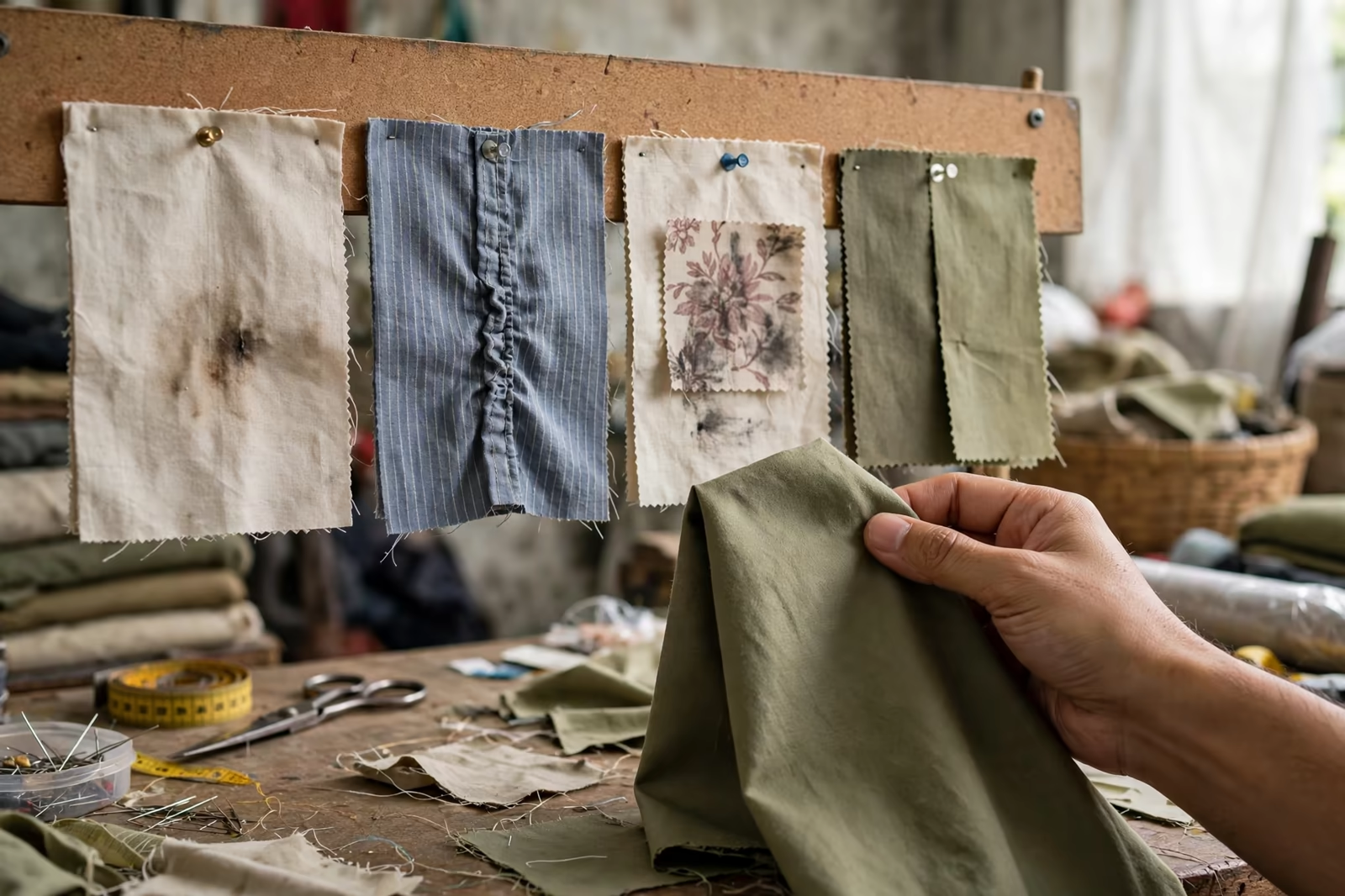
Every inspector’s hardest calls sit on the borders: the stain that might vanish in the first wash, the print slightly soft at one edge, the pucker visible only at one angle of light. Borderline faults are where unwritten standards go to die, because two honest people can see the same garment differently.
The professional tools for borders are physical: a limit sample, the worst acceptable example of the fault, approved and kept at the inspection table. Faults worse than the limit sample fail; faults better pass; the sample absorbs the argument. Photographs help for reporting, but light lies about stains and shade, so the sample that decides is cloth, not a screen.
Buyers who supply limit samples for their sensitive faults, print softness, pucker, shade depth, give their inspections a spine. Factories that build limit samples from the buyer’s comments order by order are doing the same work from the other side.
Workmanship, Material and Measurement Defects
Classification also runs by family. Workmanship defects are made by the sewing process: stitching, assembly, pressing faults. Material defects arrive with the fabric and trims: holes, slubs, shade faults, weak zips. Measurement defects are garments outside their size tolerance at specified points.
The families matter because they point at different cures. Workmanship clusters send training and line balancing back to sewing; material clusters send claims back to mills and trim suppliers; measurement drift sends everyone back to patterns, wash recipes and cutting. A report that classifies by severity and family turns one inspection into a maintenance plan.
Appearance defects, print and embroidery faults, and packing defects complete the usual families, each with its own examples list in the buyer’s manual.
How Classification Drives the Pass or Fail
Sampling plans give each class its own acceptance limit: zero for critical, a tight count for major, a looser count for minor. The inspector’s tally by class is compared with those limits, and the lot passes or fails on the comparison, not on a general feeling about the sample.
This separation protects both sides. A factory cannot be failed for an accumulation of invisible trifles beyond the agreed minor limit, and a buyer cannot be talked into accepting majors because the garments “mostly look fine”. The numbers argue; the people read.
Defects found are also recorded per garment, because one garment carrying several majors is a different signal from the same majors spread thinly: the first suggests a problem station or operator, the second a general standard. Classification starts the diagnosis either way.
The Buyer’s Defect List: Agree It Before Production
The system only works when the examples are written down. A buyer’s quality manual or order quality sheet should carry a defect list: named faults placed in classes, with sizes, zones and photographs or physical examples where judgement could drift. “Stain” is an argument waiting; “oil mark over 3 millimetres on the front zone” is a standard.
Factories keep their own standard lists where buyers do not supply one, and will classify by them, but the inspection that protects a buyer best is the one run on the buyer’s own definitions. Sending the list costs an email; arguing a failed shipment costs a season.
Review the list after the first order together. Real garments teach both sides which definitions held and which produced arguments, and a revised list is a small monument to a working relationship.

Training Inspectors to See the Same Garment
Two inspectors given the same garment should reach the same tally. Factories train for that consistency with defect example boards, garments carrying known faults of each class, and periodic checks where inspectors classify the same samples and compare results. Drift is found in training, not in a disputed shipment.
The classification language also disciplines the sewing floor’s own inline inspectors, who catch faults earliest and cheapest. A line inspector who can say “major, zone A, open seam” sends the garment to the right repair with the right urgency, instead of into a general reject pile that finishing must interpret later.
From Classification to Claims
Classification language is also the language of what happens next. A failed lot on majors is usually reworked: the shipment is screened piece by piece, faults repaired or pieces rejected, and re-inspected, with time and cost carried as the contract provides. A critical finding follows a sterner path, quarantine and investigation, because the question is no longer quality but safety.
On the buyer’s side, the same words organise returns and claims after delivery. A fault reported by customers in the words of the shared scale, with photographs, can be traced to whether it passed inspection as an accepted minor or escaped as an unrecorded major, and the correction lands in the right place. Classification, kept honestly, is the memory of the whole quality system.
Frequently Asked Questions
What makes a defect critical rather than major?
Consequence. A critical defect can injure the user, break a law, or make the garment fundamentally unsafe or unsellable: needle fragments, sharp points, dangerous chemical or flammability failures, false legal labelling. Critical defects carry a zero acceptance limit, and one found in a sample can fail an entire shipment. Major defects are serious quality faults a customer would reject, but they do not endanger anyone.
Can a minor defect ever fail an inspection?
Yes, in two ways. Sampling plans set a maximum count for minors in the sample, looser than the major limit but real; exceed it and the lot fails. And inspectors watch accumulation on individual garments: many minors on one piece signal careless making even when each fault alone is small. In practice, minor counts fail lots far less often than majors, which is the scale working as intended.
Who decides whether a fault is major or minor?
The buyer’s quality manual, ideally. Professional buyers publish defect lists placing named faults into classes by size and garment zone, and the factory inspects against that list. Where no list is supplied, the factory applies its own standard classification, which follows the industry’s common scale. Either way, the definitions should be agreed before production, because arguing them over a finished shipment helps nobody.
Are measurement faults classified the same way?
Measurement defects form their own family. A garment outside its size tolerance at a specified point is recorded against the tolerance in the order, and repeated measurement failures indicate pattern, cutting or wash problems rather than individual carelessness. Inspectors sample-measure garments from the lot, and the pattern of results, not a single garment, decides whether the lot has a measurement problem.