
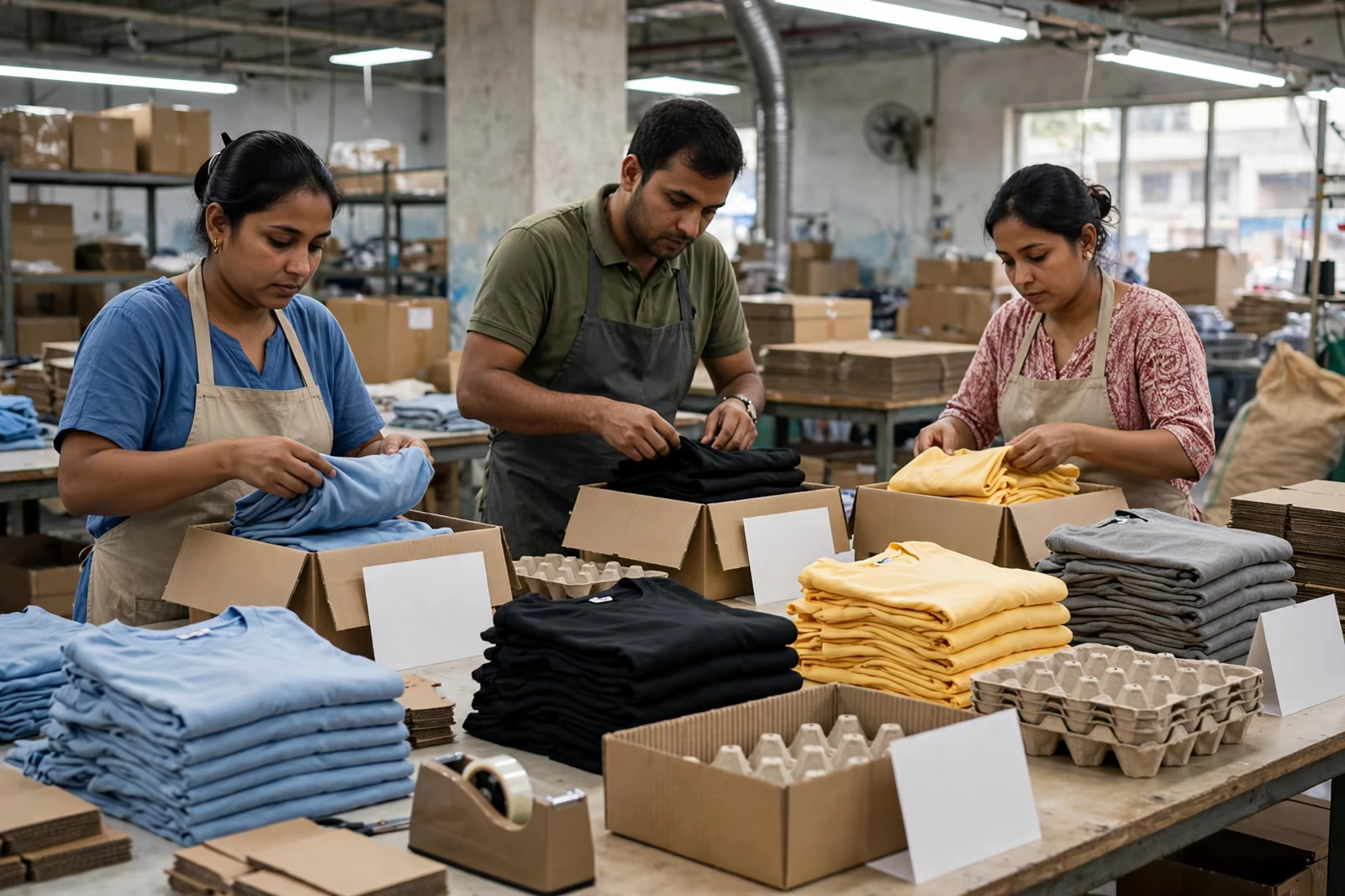
A buyer’s warehouse does not open cartons with curiosity; it scans them, shelves them and sends them onward at speed. A carton that cannot be identified at a glance, or whose contents do not match its label, stops that flow and generates charges, delays and phone calls. Carton packing is therefore not the last chore of production. It is the interface between the factory and the retailer’s entire logistics system.
The packing floors behind this guide work in Bangladesh, boxing export orders bound for retail buyers in the USA, the UK, Germany and Canada. Every retailer they serve packs differently, which is the first lesson of carton standards: there is no universal carton, only the specification in the order, read carefully and followed exactly.
Packing sits within the export operation described on our market area page, forms part of the range on our services page, and is confirmed in quotations from our get a quote page.
The Carton Is Part of the Product
A retailer buys garments delivered in a defined state: this many pieces, of these sizes, in this box, with these marks, scannable at goods-in. Anything that deviates is not a near miss; it is a non-conforming delivery, and many retail contracts attach chargebacks to packing errors as deliberately as to garment defects.
The factory’s interest matches the buyer’s. Cartons are handled roughly across a long journey by sea and road, stacked high in containers and warehouses. The carton protects the garments from crushing, damp and dirt, and its strength is chosen for the journey, not for the storeroom it leaves.
Treat the packing specification with the same respect as the tech pack: read it before production starts, price it into the order, and pack a reference carton for approval when the method is new.
Solid Packs: One Size, One Colour, One Carton
The simplest standard is the solid pack: a carton holding pieces of a single style, single colour and single size, in the quantity the buyer specifies. Distribution centres love solid packs because each box is a known unit; stock systems allocate whole cartons to stores without opening them.
Solid packing also simplifies the factory’s life. Cartons fill completely from one size run, counting is easy to verify, and the packing list stays clean. The discipline solid packs demand is accuracy at the fold table, because one wrong size folded into a carton silently converts a correct box into a claim.
Partial cartons close every size run in real orders. The standard response is honesty in marking: a short carton is labelled as exactly what it holds, never padded to the standard quantity or disguised among full cartons.
Ratio Packs: The Assortment Inside
A ratio pack holds an assortment, a fixed proportion of sizes and sometimes colours in each carton, matching how a store sells: more mediums than smalls, a spread the retailer has calculated from sales. Each carton is then a miniature of the whole order, and a store can receive one carton and have a sellable range.
Ratio packing multiplies the packing table’s work. Each carton is built piece by piece against its ratio card, counted twice, and verified before sealing, because an error inside a sealed ratio carton affects that store’s whole size range rather than one size.
Ratios must be confirmed in writing before packing begins, and the total order quantity has to divide by the ratio or someone must decide how the remainder packs. The decision belongs to the buyer; the factory’s job is to ask before the first carton closes, not after the last one.
Pre-Packs and Retail-Ready Cartons
Some retailers go further: pre-packs assembled for individual stores, each carton labelled for its destination store, sometimes with garments already priced, ticketed and folded for the shelf. The factory becomes the last stage of the retailer’s own distribution, and packing accuracy carries the store’s name on it.
Pre-packing demands the retailer’s data in good time: store allocations, ticket prices and barcode files. A factory can pack perfectly from correct data and still fail the delivery if the data arrived late or wrong, which is why packing data has deadlines in the order calendar like fabric and trims.
Carton Marks: What the Outside Must Say
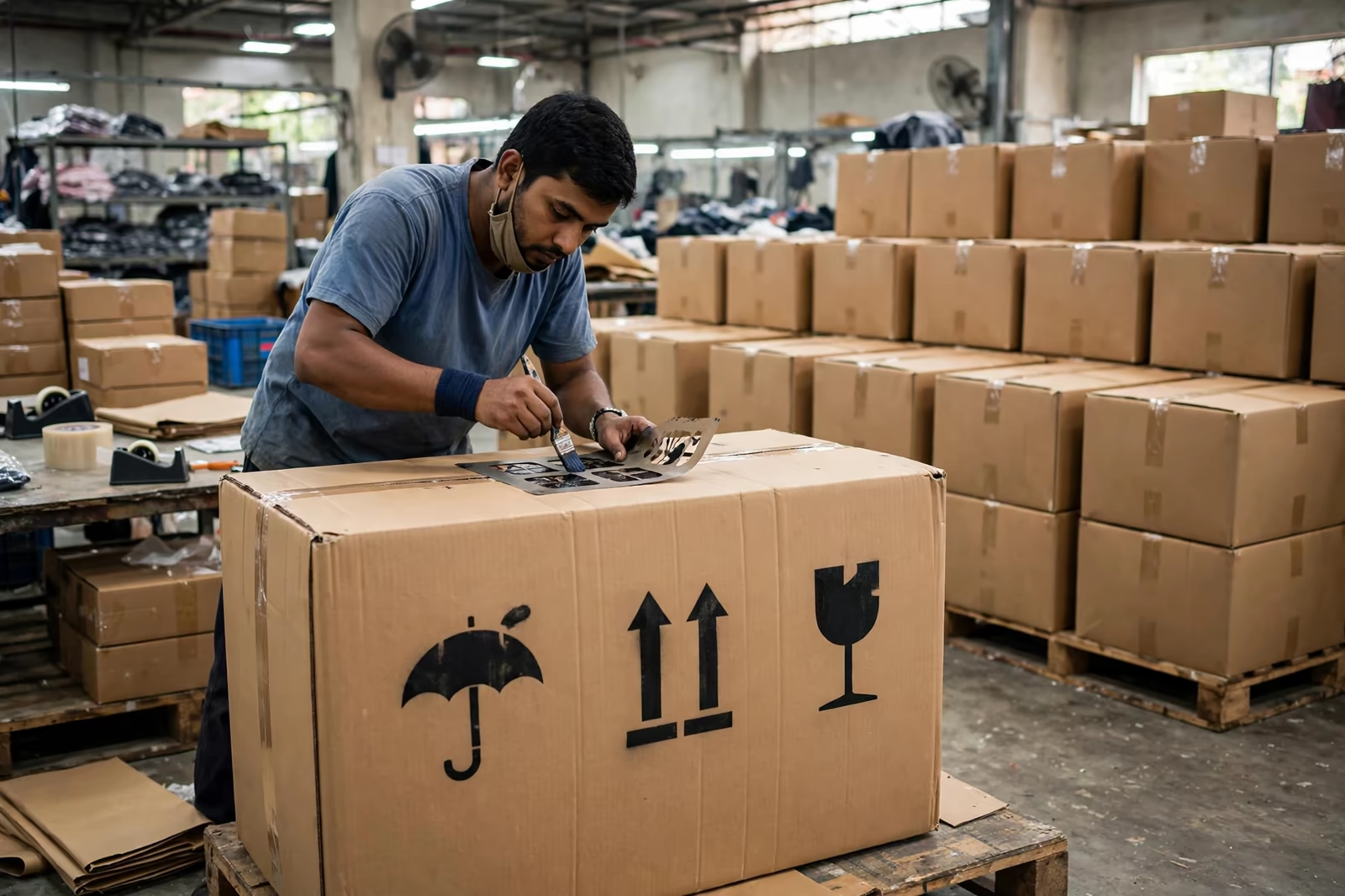
The marks printed on a carton are its identity papers: buyer and order numbers, style and colour codes, the carton number within the shipment, its contents by size, gross and net weights, dimensions, destination and handling marks. Warehouses scan or read these to route the box without opening it.
Marks are printed or stencilled to the buyer’s artwork, in the positions specified, on the sides specified. A mark on the wrong face is a warehouse problem multiplied by every carton in the shipment. Human-readable marks support the barcode, and both must agree with the packing list and with the carton’s actual contents.
Country of origin marking belongs here too: cartons for many markets must carry the origin statement their customs and retail rules require, printed where specified, before the container door closes rather than argued about at the destination port.
Size, Strength and Weight Limits
Cartons are specified by dimensions as well as board strength, because warehouses rack, stack and conveyor them by size. Oversize cartons jam systems designed around a standard; undersize cartons waste container space the buyer is paying to ship.
Weight limits protect the people who lift them and the garments inside them. An overfilled carton crushes its bottom layers into permanent creases and bursts at its seams in transit; a disciplined packing floor weighs cartons as it fills them and closes at the limit even when a few more pieces would fit.
Board quality matters by journey: sea freight and long storage demand stronger, moisture-resistant board than a short air shipment. The specification balances cost against the real route, and the factory should flag a spec that looks too weak for the journey the order will actually take.
Inside the Carton: Protection and Presentation
What surrounds the garments is specified too: polybags vented or sealed as required, tissue between layers where the fabric marks easily, silica gel or other moisture protection on sea shipments, and inner boards that keep folded garments crisp. Each element exists because a past shipment taught someone a lesson about damp containers or creased collars.
Cartons are packed firmly without force: garments settle in transit, and a loosely packed carton arrives with its contents slumped and creased, while a forced one arrives with pressure marks. The packer’s hands learn the difference, and a reference carton shows it.
Cartons and the Container: Packing for Volume
Freight is bought by volume as much as by weight, and carton dimensions decide how much of a container is garment and how much is air. Well-planned cartons tessellate: their sizes stack without gaps in the container and on the pallet, so the buyer ships product instead of voids. A carton size chosen carelessly can waste a visible share of every container the order ever fills.
This is why carton dimensions are engineering, not habit: the fold size, the pieces per carton and the box dimensions are planned together against the container’s internal measurements. Small adjustments, one more piece per carton or a centimetre off a dimension, compound across hundreds of cartons into real freight money.
Compression packing enters the same calculation for bulky knitwear and fleece, shrinking volume dramatically, and is used only where the fabric recovers its loft on opening, as the approved reference carton demonstrates.
The Packing List and Reconciliation
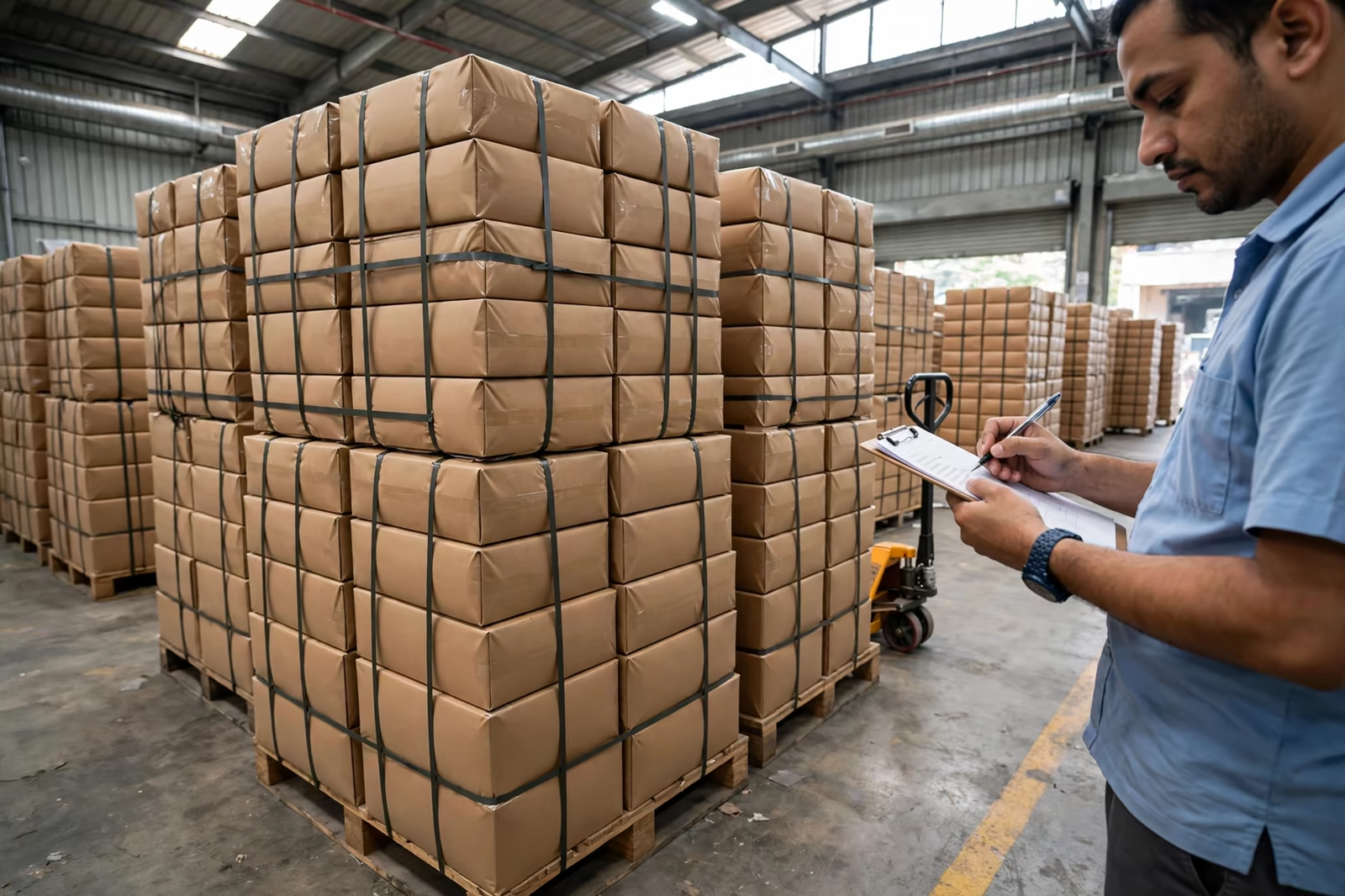
Every carton is numbered and its true contents recorded as it is sealed, building the packing list from the packing itself rather than from the plan. The list summarises the shipment: cartons, contents, quantities by size and colour, weights and dimensions, in the format the buyer’s system ingests.
Before the shipment closes, the list is reconciled against the order: totals by size and colour, shortfalls named, overages explained. A discrepancy found in the factory is a conversation; the same discrepancy found at a destination warehouse is a dispute, with the goods held hostage while it runs.
The list also travels into the shipping documents, so its accuracy carries customs and payment consequences beyond the warehouse. Packing paperwork is export paperwork.
What Buyers Should Specify
Send the full packing specification with the order: pack type, quantities per carton, ratios with remainder instructions, carton dimensions and board grade, mark artwork and positions, barcode requirements, inner packing details and weight limits. A packing manual from your warehouse is worth more than a paragraph of email prose.
Approve a reference carton when the method or the market is new, and confirm packing data deadlines for store allocations and tickets are in the order calendar. Then hold one rule firmly: no silent substitutions, in board, marks or ratios, without your written agreement.
Share your warehouse’s chargeback schedule too, not as a threat but as a map: it tells the factory exactly which packing errors your system punishes hardest, and a good packing floor will aim its double-checks at precisely those points.
Frequently Asked Questions
What is the difference between a solid pack and a ratio pack?
A solid pack holds one style, one colour and one size per carton, which suits distribution centres that allocate whole cartons to stores. A ratio pack holds a fixed assortment of sizes, and sometimes colours, in the proportions a store sells, so one carton gives a store a complete size range. Ratio packs take more care to build and verify, since each carton is assembled piece by piece against its ratio.
Why do retailers care so much about carton marks?
Because their warehouses move cartons, not garments. Marks and barcodes identify each box, its contents, order and destination, letting systems route and shelve it without opening it. A wrongly marked carton is effectively lost stock until someone opens and re-identifies it by hand, and retail contracts often charge that cost back to the supplier, which is why marks are printed strictly to the buyer’s artwork.
What happens when a carton is packed wrongly?
At best, rework: the carton is found in a warehouse audit and repacked or relabelled at the supplier’s cost. At worst, a store receives the wrong size range, sells out of sizes it actually holds under wrong labels, and the buyer faces returns and chargebacks. Factories prevent it with ratio cards, double counting, labels read against contents, and a packing list built from actual cartons and reconciled before shipment.
Who supplies the cartons and packing materials?
The factory sources them to the buyer’s specification: board grade and dimensions, printed marks, polybags, tissue and moisture protection are bought or made as part of the order’s packing operation, and their cost belongs in the quotation. Buyer-supplied items, such as retailer-specific tickets or bags, are nominated materials with their own lead times, and the order calendar treats them like any other nominated trim.