
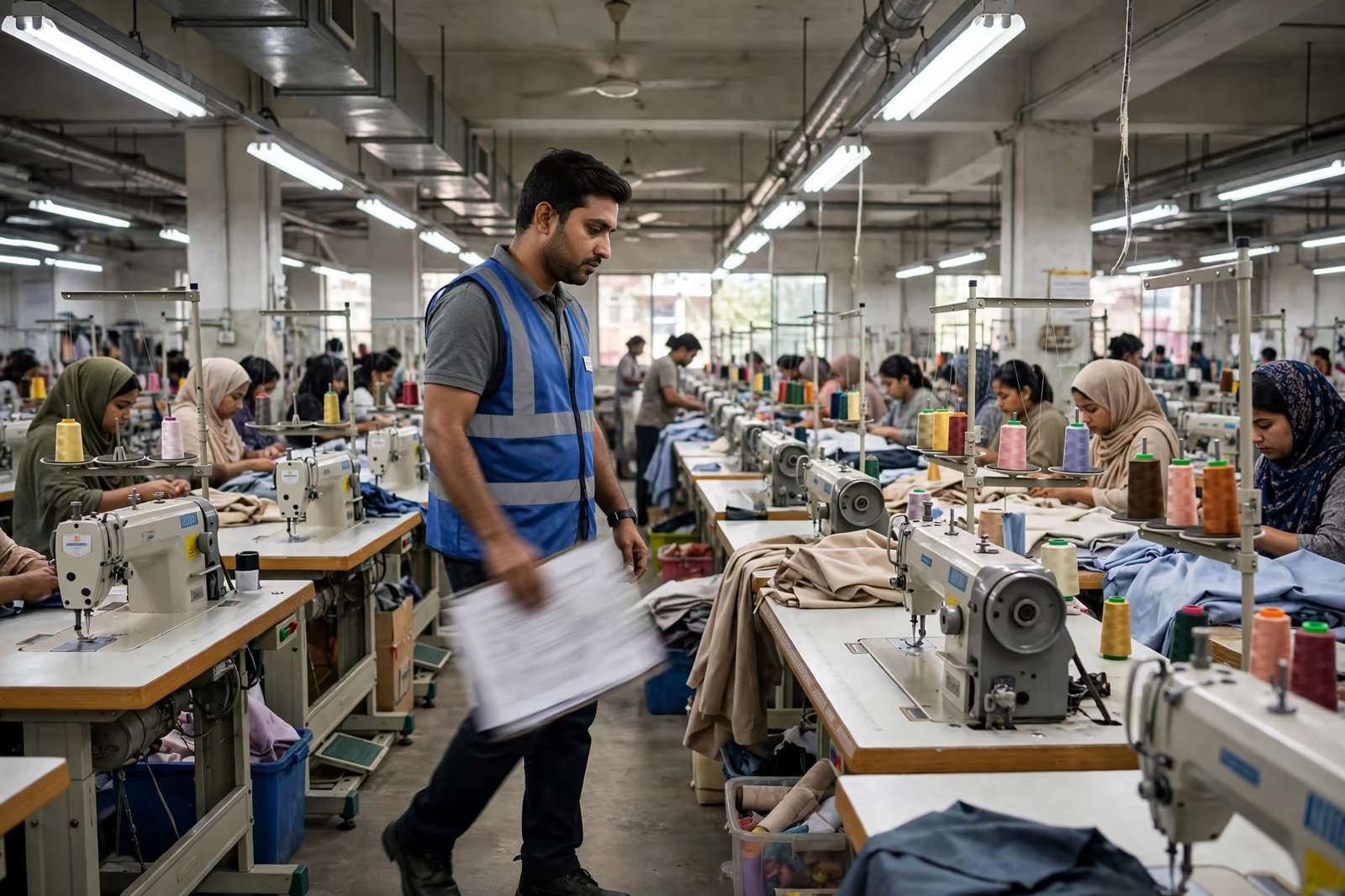
A factory audit is the closest a buyer gets to an X-ray before placing an order: a structured walk through the buildings, machines, documents and habits that will produce their clothes. This guide explains what a competent audit actually checks, line by line, and then the honest part most audit brochures skip, what an audit cannot see, and what to use instead for the gaps.
The factories behind this guide host buyer audits and third-party assessments for programmes shipping from Bangladesh to the USA, the UK, Germany, Canada and Australia, so the checklist below is written from the receiving end as much as the inspecting one.
Our own background is on our about us page, the production disciplines under audit sit in our services, and audit visits are arranged through our contact page.
Factory Identity and Legal Ground
Every audit starts with existence: business registration, export licence, factory licence and the match between the legal entity, the premises being walked and the company that will invoice you. Auditors photograph documents and verify that the address, ownership and scope on paper are the factory in front of them.
This layer sounds basic and eliminates a real class of disaster: the showroom factory, the borrowed premises, the trader presenting a partner’s floor as their own. It also establishes the legal counterparty for contracts and payments, which our payment safety guide treats as the foundation of safe first orders.
Utilities, building approvals and fire certification sit in the same drawer: the factory’s right to operate, evidenced and current.
The Production Floor: Machines and Maintenance
On the floor, the auditor counts and classifies machines by type against the factory’s claimed product range: a knitwear claim needs the knit machines, a woven claim the lockstitch and overlock fleet to match, with special operations, buttonhole, bartack, fusing, properly present or honestly subcontracted and declared.
Condition matters more than count. Maintenance logs, needle and blade control, machine calibration habits and the state of the spare fleet predict quality stability better than any polished sample. Auditors look for oil discipline, broken-needle records and whether machines idle broken in corners or cycle through repair.
Capacity arithmetic is sketched here too: lines, operators per line and working hours against claimed monthly output, the numbers our capacity planning guide unpacks.

Quality Systems in Practice
The quality section is where audits earn their fee. The auditor traces one order’s paperwork through the system: fabric inspection records on arrival, inline checks at the sewing stations, the final inspection procedure and its sampling standard, measurement records against the spec, and what happens to a failed lot, which is where systems either exist or evaporate.
Records are sampled, not admired: dates, signatures, defect classifications and re-inspection results should connect into a chain that a stranger can follow. A factory running genuine systems generates this paper as a by-product; a factory performing for the audit generates it the night before, and experienced auditors can smell the difference in the handwriting of a quarter’s worth of forms.
The needle policy, metal detection where children’s product is made, and lab testing routines for colourfastness and shrinkage round out the quality picture.
Social Compliance and Worker Safety
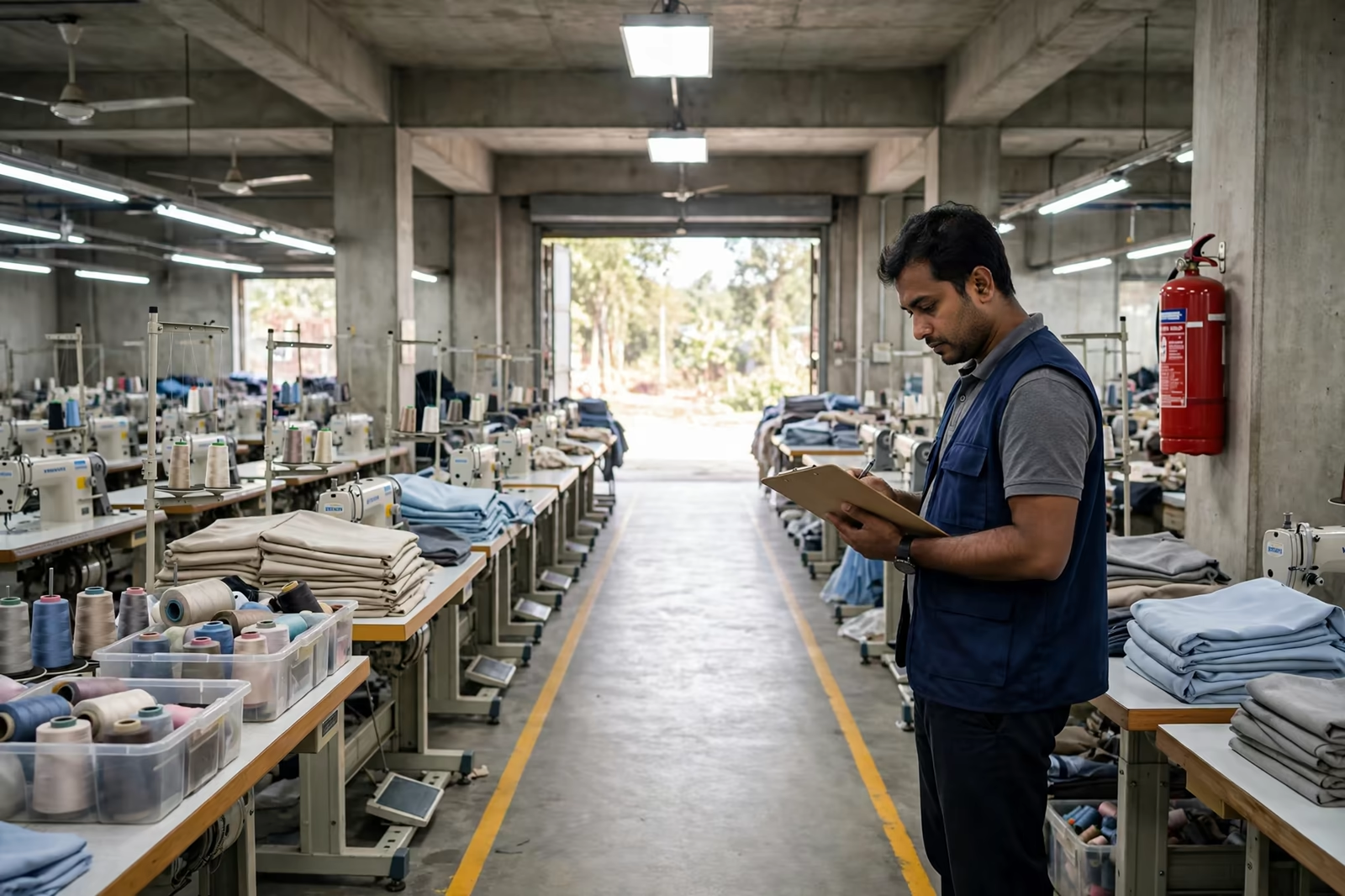
The compliance section checks the human infrastructure: working hours and wage records, age verification files, contracts, leave and overtime practice, checked against worker interviews conducted out of management’s hearing. Safety is walked physically: fire exits and drills, aisle widths, machine guards, needle and blade handling, chemical storage and the condition of dormitories and canteens where they exist.
Building and electrical safety carry their own inspection regimes in Bangladesh’s export sector, with corrective action plans tracked over time, so an auditor reads the factory’s open findings and closure evidence as carefully as the certificates on the wall.
For buyers whose own customers audit them in turn, this section is the licence to trade, and the one where “the certificate says” must always be followed by “the floor shows”.
Announced, Semi-Announced and Unannounced
How an audit is announced changes what it sees. Fully announced audits, the onboarding standard, give the factory fair warning to assemble documents, roster the right staff and present its genuine best system; they measure capability. Semi-announced audits, a window of weeks with the day unknown, measure nearer to normal operations and are the workhorse of buyer programmes.
Unannounced audits measure reality at its rawest and are usually reserved for follow-ups on serious findings, because they trade depth for surprise: key staff may be absent, records locked with the one person travelling. Mature programmes blend all three across a supplier’s life rather than treating one format as truth.
Whichever format, the walk should include unscripted time: an auditor who can wander the aisles, open a random carton and interview a self-chosen worker learns things the guided route past the showpiece lines never volunteers.
Materials, Stores and Subcontracting
Stores reveal process maturity quickly: fabric stored off the floor and identified by lot, trims controlled with issue records, accessories matched to orders rather than pooled vaguely. The auditor checks how incoming material is inspected before it enters production, because fabric defects discovered at cutting are the cheap kind.
Subcontracting is declared and mapped: which operations leave the building, embroidery, printing, washing, and to whom, with the same standards contractually flowing down. Undeclared subcontracting is an audit failure in any serious scheme, not because outside processes are wrong, most factories use specialists, but because invisible processes cannot be controlled.
Our services pages describe which processes we run and how they are followed, written to be checked in exactly this way.
Reading the Report Like a Buyer
Audit reports reward a particular reading style. Start with the findings, not the grade: a high overall score with a critical observation in fire safety or wage records is not a pass with a footnote, it is a factory with one serious problem and many tidy systems. Weight findings by what they would do to your orders and your own customers.
Then read for pattern. Single observations are events; the same weakness appearing across sections, records incomplete here, a procedure unwritten there, is a management system signal. And compare reports across time: a factory whose findings shrink and close on schedule is improving in the only direction that matters.
Ask for the underlying evidence behind anything you will rely on: the photograph of the exit route, the maintenance log extract, the corrective plan with dates. Reports summarise; evidence persuades.
Corrective Action: Where Audits Become Useful
An audit that ends in a report has spent money; an audit that ends in closed corrective actions has earned it. Every finding should leave with an owner, a fix and a date, and the buyer’s follow-up, evidence requested, deadlines tracked, re-audit booked where the finding was serious, is the mechanism that converts paper into change.
Factories reveal themselves here as clearly as on the floor. The good ones close actions early, send evidence unprompted and treat findings as free consulting. The struggling ones negotiate definitions, miss dates quietly and hope the buyer forgets; buyers who track a simple corrective-action register never have to rely on hope.
Escalation should be proportionate and pre-agreed: which findings pause new orders until closed, which merely ride the register. Predictability keeps the system honest on both sides.
What an Audit Misses: Behaviour Under Load
An audit is a photograph, not a film. It captures the factory on a prepared day, at whatever utilisation the season happens to hold, and it cannot show how the same floor behaves at full stretch in peak weeks, when overtime lengthens, temporary hands arrive and quality systems meet their real test.
It also cannot grade the unglamorous middle of production: how a problem order is handled at week six, whether bad news travels to the buyer early or late, and how the merchandising team communicates when the plan breaks. These decide programmes, and no checklist scores them, because they are behaviours over time rather than states on a day.
Financial depth is the third blind spot. Audits confirm a factory exists and operates properly; they rarely establish whether it can fund a large fabric buy comfortably or survive a buyer’s late payment, questions buyers must approach through references, banking instruments and order sizing instead.
Filling the Gaps: The Buyer’s Own Toolkit
The blind spots have known remedies. Behaviour under load is sampled by placing the trial order in a realistically busy window rather than the factory’s quietest month, and by running during-production inspections that watch the system working on your actual goods. Communication quality is tested deliberately during sampling: note response times, the honesty of bad news and whether commitments made in email match the calendar that follows.
References from other buyers in your product family remain the most underpriced evidence in sourcing, a twenty-minute call that can confirm or contradict a year’s audit narrative. Financial depth is managed structurally: order sizes grown in steps, payment staged against documents, banking instruments chosen so that neither side’s failure strands the other.
Combined with the audit, this toolkit turns supplier selection from an act of faith into an evidence file, which is all professional sourcing ever claims to be.
Frequently Asked Questions
What does a garment factory audit check?
Five layers: legal identity and licences matched against the actual premises; the production floor’s machines, condition and maintenance discipline against the claimed product range; quality systems traced through real records from fabric inspection to final inspection; social compliance and worker safety, records and floor together; and materials control plus declared subcontracting. A good audit follows one order’s paperwork through the whole system rather than admiring certificates.
What can a factory audit not tell me?
How the factory behaves under peak load, how it communicates when an order goes wrong mid-production, and whether it has the financial depth for large programmes. An audit is a prepared day, so cover the blind spots with trial orders, in-production inspections, references from other buyers and payment structures that keep your exposure behind evidence.
Should I use my own auditor or accept the factory’s existing audits?
Read the existing reports first, they are real evidence, and check their scope, date and who performed them. For a first significant programme, most buyers add their own or a trusted agency’s audit focused on their product and standards, because generic social audits do not test production capability. Either way, treat the audit as the start of verification, completed by samples and a trial order.
How often should a supplier factory be audited?
At onboarding, then on a cycle matched to the programme’s size and risk, commonly annually for ongoing production, with in-production and final inspections covering the ground between audits. Unannounced or short-notice visits, where the relationship allows them, correct the audit’s prepared-day bias. Any major change, new building, new product family, ownership change, should trigger a fresh look.