

A franchise sells sameness: the customer walks into a unit in another city and expects the same welcome, the same standard, the same shirt. Uniform consistency is where that promise is either kept or quietly broken, one franchisee’s local substitution at a time. This guide builds the system that keeps a hundred independently owned units dressed as one brand.
Franchise uniform programmes are produced to order in Bangladesh for franchisors and franchisees in the USA, the UK, Germany, Canada and Australia.
The anchor garment linked here is our classic pique polo shirt; brand programmes sit at brands, and terms at MOQ and production.
One Standard, Written Down
Consistency begins as a document before it is ever a garment: the uniform standard inside the brand manual, specifying each role’s pieces, colours by reference, branding placement measured, grooming rules stated, and the photographs that show correct wear. Vague standards get local interpretations; measured ones get compliance.
- Every garment specified by fabric, colour reference and fit.
- Branding placement charted per garment, not described loosely.
- Photographs of correct wear for every role.
- A change process, so updates reach every unit together.
The standard is written for the franchisee’s busiest manager, which means it must be usable at speed. It also carries the commercial logic openly, since franchisees comply better with standards they understand: the customer is buying the chain’s promise, and the uniform is where the promise is inspected first, before menu, decor or price are even considered.
The Approved-Supplier Model
Most franchise systems route uniform buying through approved supply, either a central programme franchisees order from, or a short list of approved suppliers working to the same specification. The model exists because the alternative, every unit buying locally against a description, produces a hundred near-matches that photograph as drift.
- Central specification, one interpretation of the brand.
- Ordering simple enough that compliance is the easy path.
- Price negotiated at system scale, fair to the smallest unit.
- Quality audited centrally, so units never grade their own homework.
Our franchise programmes run exactly this way, one specification held centrally, units ordering against it. The approved route must win on convenience as well as correctness: a franchisor portal or a simple order rhythm, programme pricing without per-order negotiation, and delivery a unit manager can plan around. Every friction in the approved route is a subsidy to the local alternative.
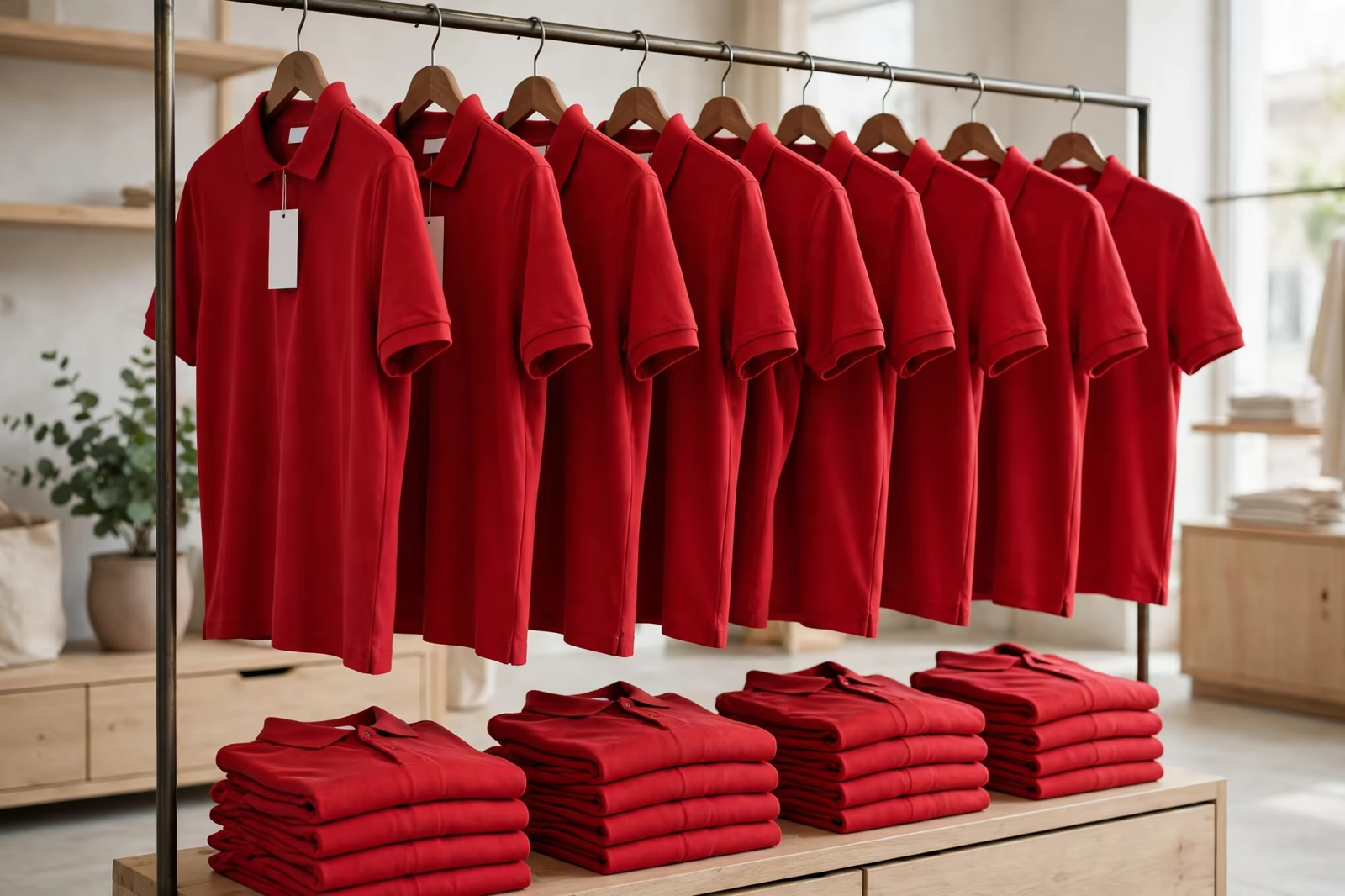
Colour and Branding Drift: The Enemy
Drift is gradual and deniable: a polo a shade lighter from a local printer, a logo a centimetre lower, an apron substituted during a stock-out that never got substituted back. Each unit’s drift is invisible locally and obvious in the brand’s photographs, mystery-diner reports and social feeds, where units sit side by side in a search grid. The standard fights drift with retained colour references, artwork held centrally, and audits that compare garments, not intentions.
Sun, laundry and time drift even compliant garments, which is why replacement cycles belong in the standard too.
The franchisor’s field team needs garment references in hand, swatches and placement charts, or audits become opinions. Drift also has a direction: it flows toward cheaper and easier, which is information about the programme’s pricing and convenience as much as about franchisee discipline.
Opening Kits for New Units
A new unit’s opening is the system’s easiest win: the whole team kitted from the standard before the doors open, photographed correctly from day one. Opening kits are defined per role against the unit’s opening roster curve, with spares for the hiring churn every opening suffers. Training in uniform matters more than it sounds: staff who learn the job dressed as the brand carry the standard into habit.
The franchisor’s launch team verifies kit against the standard during opening support, the cheapest audit there is. A unit that opens compliant tends to stay compliant, because habits form around what the first month normalised for everyone.
Our programme builds opening kits as a named product inside the system, ordered against the launch calendar like any other opening supply. The kit list doubles as the unit’s first spares pool and its first size-curve evidence, so the opening order teaches the system what the unit will need all year.
Top-Ups, Spares and the Small-Order Problem
Franchise uniform economics are dominated by small orders: three polos here, an apron set there, a new starter’s kit weekly. Programmes that only serve bulk leave units solving small needs locally, and drift enters through the smallest door. The system answers with:
- Top-up ordering against the central specification, no minimum drama.
- A unit-level spares pool defined per role and size curve.
- Starter kits pre-packed by role, ready before the person is.
- Delivery rhythms matched to how units actually reorder.
Small-order convenience is not a courtesy; it is the consistency mechanism itself. It also respects the franchisee’s economics honestly: a unit’s uniform spend is small per order and constant per year, and a programme priced and packed for that rhythm keeps the money inside the system where the brand controls what it buys.
Seasonal Pieces and Limited-Time Campaigns
Franchise brands run campaigns, and campaigns dress staff: holiday accents, promotional tees, limited-menu launch pieces. The system handles them as controlled exceptions, centrally designed and produced, time-boxed, with an exit rule that returns units to the standard when the campaign ends. Campaign pieces that never exit become unofficial uniform, and the standard quietly forks. Design discipline helps here: campaign pieces built on the standard’s base garments and colours extend the brand rather than interrupting it.
Quantities follow unit counts centrally, so no unit is left dressing a campaign in last year’s piece.
Our production handles campaign runs as programme events with the same artwork control as the core standard. Exit discipline is announced with the campaign itself, dates printed in the launch note, so returning to the standard feels like the plan, not a confiscation.

Audits: Checking Garments, Not Intentions
Consistency survives on verification: field visits that compare actual garments against retained references, photograph reviews, mystery-guest reports read with the uniform in mind. Audit findings feed the standard’s weak points, a garment that fades early gets respecified, a placement everyone moves gets re-charted honestly. The tone matters: audits framed as brand protection with supply help attached get cooperation; audits framed as policing get concealment.
- Garments compared against physical retained references.
- Colour drift and logo placement checked, not assumed.
- Replacement cycles verified alongside condition.
- Findings converted into specification fixes, not just faults.
A franchisor who never looks should not be surprised by what the search grid shows. Looked at kindly, most drift is a supply problem confessing itself, and the franchisor who fixes the supply route fixes the audit results a season later.
Multi-Country Systems
International franchises add climate and culture to the consistency problem: the same brand dressed for Gulf heat and Canadian winter, local dress norms respected inside one identity. The system answers with a layered standard, a global core that never changes, mark, colours, key pieces, plus approved regional variants documented as variants, not discovered as drift. Sizing converts inside the data; laundering realities differ by market and are specified per region under the same colour law.
Production in one programme keeps the core identical across borders, which local buying never achieves. Freight and lead times are planned per region inside the same calendar, so a winter launch in one hemisphere never starves a summer launch in the other, ever, anywhere in the world.
The variant list is short, written and owned by the brand team, and every variant photographs as family. Regional teams sometimes argue for more local freedom than the list allows; the standard’s answer is that the customer’s expectation crosses borders faster than any supply chain does.
When the Brand Refreshes
Rebrands are the standard’s stress test: hundreds of units changing dress together, old stock exiting without waste or leakage, the switchover window enforced kindly but firmly. Programmes plan it as a campaign in reverse, new standard sampled and photographed, opening-style kits for every unit, a defined date after which old dress is retired, and sell-through or return rules for remaining stock. Staff communication carries the why, since teams wear the change in public and answer for it.
Our refresh support treats every unit as a relaunch, with kits and calendars to match.
A refresh executed well is the brand’s most visible proof that the system works, for everyone watching. It is also the moment ageing units quietly rejoin the standard, since a relaunch kit resets every rail in the network at once, which is why smart franchisors time refreshes to harvest that effect deliberately rather than treating them purely as design events.
How We Run Franchise Programmes
Our franchise work holds the standard centrally and serves the units: one specification, artwork and colour references retained, opening kits, top-up routes and campaign runs inside one programme, audits supported with garment references. Franchisees order through the easy route because we build it to be easy; franchisors get consistency they can photograph.
- One central specification for every unit in the system.
- Opening kits and top-ups served at unit scale.
- Refresh and campaign runs managed as programme events.
The result is a network that looks like its own advertising, in every city, on the same day. That sameness is the franchise product itself; the food, the service and the rooms all sit inside it, judged through it.
Frequently Asked Questions
Who should pay for franchise uniforms?
Models vary by system: franchisees commonly buy uniforms as an operating cost inside the approved programme, while launch kits for new units are often bundled into the opening package. What matters for consistency is not who pays but that the route is approved supply, since a unit buying outside the programme is where drift begins, whatever the invoice says.
How do new franchise units get kitted?
Through an opening kit defined in the standard: role-by-role garments in the unit’s opening size curve, plus the spares pool and the wear photographs. Opening kits are ordered against the launch calendar so the team trains in the uniform it will open in, and the first photographs the brand ever sees are compliant ones.
How often should the uniform standard be updated?
On a planned cycle, not by drift: most systems review every few years or at a brand refresh, changing all units together with a defined switchover window and sell-through rules for old stock. Unplanned local changes are the enemy; planned system changes are how the brand stays current without fragmenting.
Can franchisees order small top-up quantities?
Yes, inside a programme built for it: units order top-ups against the central specification at programme pricing structures designed for many small orders, so a unit replacing three polos uses the same route as a unit opening fresh. That convenience is the compliance mechanism, approved supply must be easier than the local alternative.