
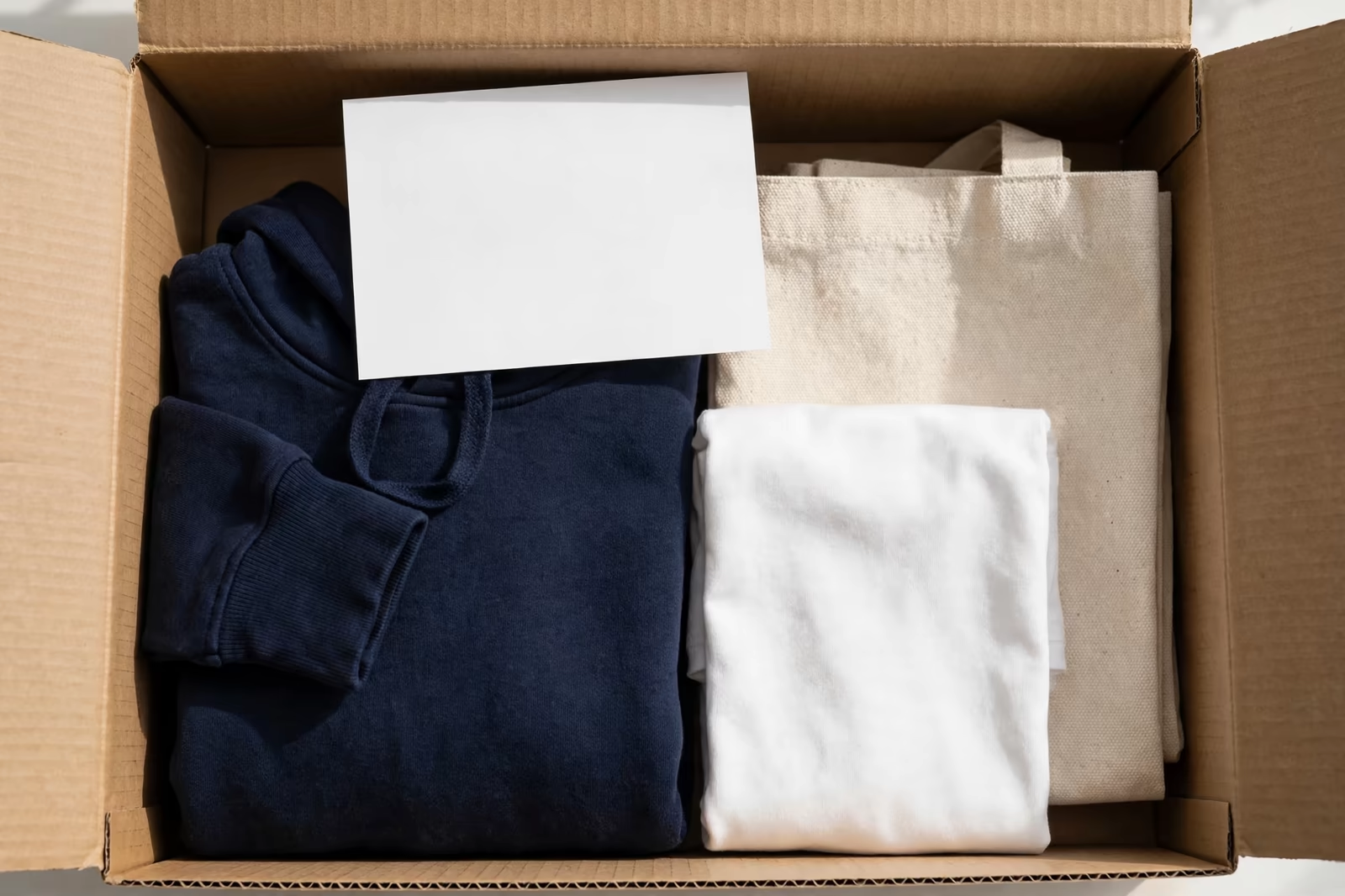
A first day sets a tone that months of management cannot undo, and the welcome kit is its physical form: the hoodie, tee and tote a new starter opens before their first shift, carrying the company’s mark and an unspoken message, we expected you, we prepared. This guide builds welcome kits that earn that moment instead of wasting it on a drawer of leftovers.
Employee welcome kits are produced to order in Bangladesh for employers in the USA, the UK, Germany, Canada and Australia.
The anchors linked here are our pullover hoodie and tote bag; programmes open at get a quote.
What Belongs in the Kit
A welcome kit works when every item is wanted. The proven core:
- A hoodie or sweatshirt in the house colour, the piece starters actually live in.
- A tee or polo carrying the mark at chest size, wearable from day one.
- A tote or gym bag that carries the kit itself and stays useful after.
- One small delight item (cap, beanie or notebook cover) chosen for the workforce, not the catalogue.
- A card, printed plainly, with the practical first-week information and a genuine welcome.
Everything else is negotiable; these five carry the psychology. Quality outranks quantity visibly: two pieces worn weekly beat six pieces binned politely. Colour choice deserves the same care as the uniform’s, since the kit is often the brand’s most-photographed garment.
Kits also forgive nothing in garment quality, because the starter has no loyalty yet to discount a scratchy collar or a print that cracks by week three. First garments are judged as evidence about the employer, fairly or not, which is why programmes build them to uniform standard rather than promotional standard, even when the pieces themselves are the friendliest in the whole building.
Sizing Without the Awkward Ask
Welcome kits meet the size problem at its most sensitive, a person who has not started yet. Programmes solve it kindly:
- Ask size on the offer paperwork, framed as kit preparation, never as a formality hurdle.
- Default to unisex fits with a honest curve stocked at the office for silent swaps.
- Pack the stated size plus a discreet exchange route (the spares rail) rather than a guessed second size.
- For remote starters, ship with a prepaid exchange path and say so on the card.
The goal is a first day spent working, not negotiating a hoodie exchange in front of new colleagues. Partners and families see these garments too, which quietly widens the audience the sizing care serves.
There is a data dividend here as well: sizes collected kindly at offer stage become the uniform programme’s opening dataset, sparing the measuring round that programmes without kits must run later. Requests are worded so the answer is a size, not an essay, unisex chest and waist language with a plain note that exchanges are free and instant, which they then are.
Branding the Moment, Not Just the Garments
The kit is a story told in objects: packaging that opens like a gift rather than a stores issue, the mark consistent across pieces, colours that match the workplace the starter is about to meet. Employer brands photograph this moment constantly, which argues for design care out of proportion to the kit’s cost. The card matters most of all: names signed by humans, the buddy or manager named, the first day’s plan in plain words.
Generic kits signal generic employers; specific kits, a tool-shaped extra for engineers, an apron for kitchen starters, signal attention.
Our private-label production keeps the whole kit under one identity, one colour standard, one delivery. Handwritten touches scale badly and photocopied signatures worse; the honest version is a real name, a real buddy, and print that was proofread by someone who cared.
There is also restraint in good branding: the mark present everywhere it should be and absent where it should not, since a starter’s personal bag plastered like a billboard reads as insecurity. The kit’s confidence is quiet, good cloth, clean print, correct colours, and one item, often the tote, designed to be carried in public with pride rather than hidden in a locker.

Remote and Hybrid Starters
Remote starters get no desk moment, so the posted kit carries the whole welcome. Programmes serving them add what distance removes:
- Delivery timed to the first week, tracked, with the manager notified it landed.
- The card carrying the human details a hallway would have supplied: buddy, first calls, where things live.
- Kit chosen for camera life, the hoodie and tee the team will see on screen for months.
- An exchange path that works by post without forms or phone calls.
Hybrid starters split the difference, kit waiting at whichever desk, home or office, hosts their first day. Time zones and start dates are logistics the tracking handles, not the starter.
Kits by Role: Office, Floor, Field
One kit rarely fits every role, and the variations are cheap to plan: office starters take the classic hoodie-and-tee core; floor and warehouse starters add the working layer they will actually wear, sometimes making the welcome piece and the first uniform piece the same garment in a friendlier colour; field and sales starters weight the bag and outer layer, since their office is a car. Role-flavoured extras do the signalling work, a quality tool roll for technicians, an apron for kitchen starters, a notebook sleeve for consultants.
The core identity stays identical across roles, so the company still reads as one employer.
Our programme documents hold the variants as one matrix, not as favours negotiated per hire. Seasonal starters inherit the season’s variant automatically, winter weight for January intakes, which is a small planning courtesy starters remember.
Stock, Spares and Growth Spikes
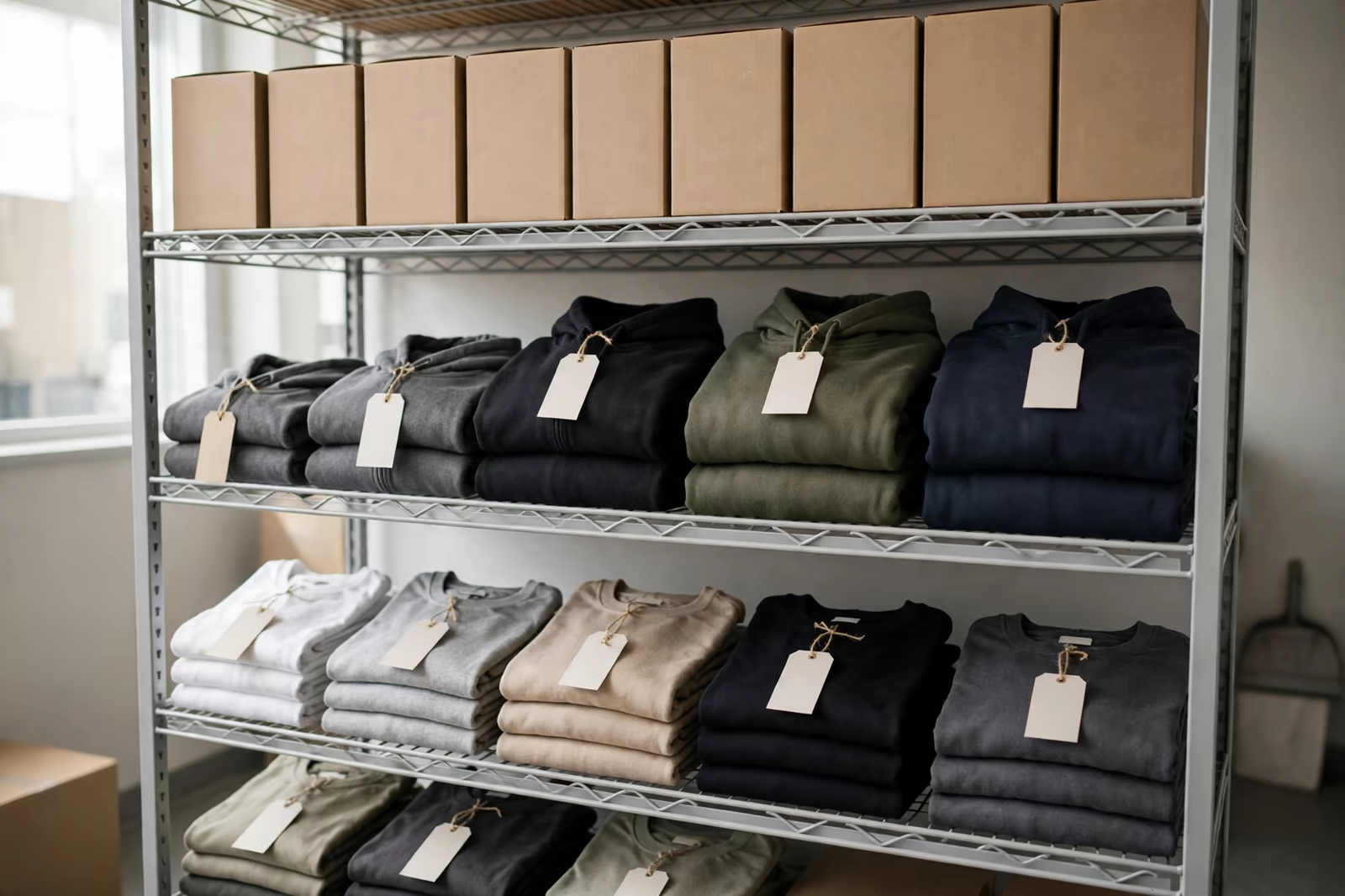
Welcome kits live or die on stock discipline: a small standing stock by size, replenished against hiring plans, so a Monday starter never waits for a production run. Growth spikes, graduate intakes, seasonal surges, site openings, are calendar events the stock plan reads in advance. Leavers and no-shows return unopened kits to stock untouched, which only works if packaging reseals cleanly, a detail specified at design stage.
Stock levels are reported like any other programme data: by size, by role variant, against the next quarter’s hiring plan. A named owner for the shelf, one person whose job includes the rail, prevents the slow drift into half sizes and good intentions that unmanaged kit stocks always suffer in the end, whatever the business.
When stock runs honest, the kit becomes invisible infrastructure, which is the compliment operations pays design. The failure everyone recognises, the starter wearing a predecessor’s returns, is a stock failure wearing a welcome’s clothes.
The Unboxing: Packaging That Respects the Moment
Packaging is the kit’s first sentence. The standards that work:
- A box or bag that opens without tools, tape wrestling or torn cardboard.
- Garments folded once, clean, in size order, the card on top where eyes land first.
- No loose fillers, vouchers for other brands or supplier paperwork diluting the moment.
- Materials the employer can defend, recycled and recyclable, matching the values the card claims.
None of this costs much; all of it is noticed. A kit that arrives like a delivery teaches the starter how the company treats details, including, eventually, them. Tissue, ribbon and theatre are optional; cleanliness, order and the card on top are not.
Budget: Where the Money Shows
Welcome kit budgets reward concentration: fewer, better pieces, produced properly with the mark applied well, out-perform sprawling kits assembled from promotional leftovers. The honest comparison is cost per worn piece across the starter’s first year, a framing that ends most arguments for volume. Programmes also cost the failure mode, the quality kit’s absence is paid in first impressions that no later spending fully repairs.
Bulk production under the uniform programme keeps unit costs sane without quality theatre.
Finance sees one line, per starter, predictable against hiring plans, which is how kits survive budget rounds. The line also disciplines design: every proposed addition must displace its cost in wear, not in novelty. Boards understand retention economics instinctively, and a kit that visibly belongs to a retention story defends itself.
Measuring Whether It Worked
Welcome kits can be evaluated like anything else: wear rates spotted in the workplace and on calls, exchange rates (low is good, zero usually means swaps were too awkward to attempt), starter feedback at thirty days, and the social photographs nobody staged. Programmes review contents annually against this evidence, retiring the item nobody wears no matter how beloved it was at the design meeting.
Manager feedback carries weight too, since managers watch the moment land.
The kit that survives review unchanged for years has usually earned it; the kit never reviewed is usually a museum. Photographs from company social channels give the review its evidence unasked, since starters post the moment themselves.
How We Build Welcome Kits
Our kits are produced as part of the employer’s wider programme: same identity documents, same colour standards, sizes drawn from the uniform data where it exists, contents and packaging specified together so the moment is designed, not accumulated. Growth-phase employers get stock planning against their hiring calendar; steady employers get a replenishment rhythm that keeps the shelf honest.
- One identity across kit and uniform, one production standard.
- Role variants held in a single programme matrix.
- Packaging specified with the garments, not after them.
The result is a first day that feels prepared, because it was. Employers tell us the kit’s return shows up in week-one language: starters who arrived expected describe the company differently from day one.
Frequently Asked Questions
How much should a welcome kit contain?
A tight core worn constantly beats a large kit of novelties: typically a hoodie or sweatshirt, a tee or polo, a bag, and one small role-flavoured extra, plus the welcome card. Programmes scale the contents to the workforce and the brand’s ambitions, but the test is use: if a piece will not be worn or carried weekly, it is packaging, not kit.
When should the kit arrive?
Ideally before or on the first day: posted to remote starters to land in their first week, waiting at the desk or locker for site starters. A kit delivered in month two is a uniform issue wearing a welcome costume, and everyone can tell the difference.
How are sizes handled for people who have not started?
Size is requested with the offer documents, unisex fits keep the curve forgiving, and office spares make exchanges silent and instant. The welcome card names the swap route casually, so a wrong size never becomes a first-week story.
Can welcome kits match our uniform programme?
Yes, and the strongest programmes do exactly that: same colours, same mark discipline, shared size data, so the welcome hoodie and the working uniform read as one employer. Kits are produced to the uniform programme’s documents, which also makes replenishment for growth phases straightforward.