
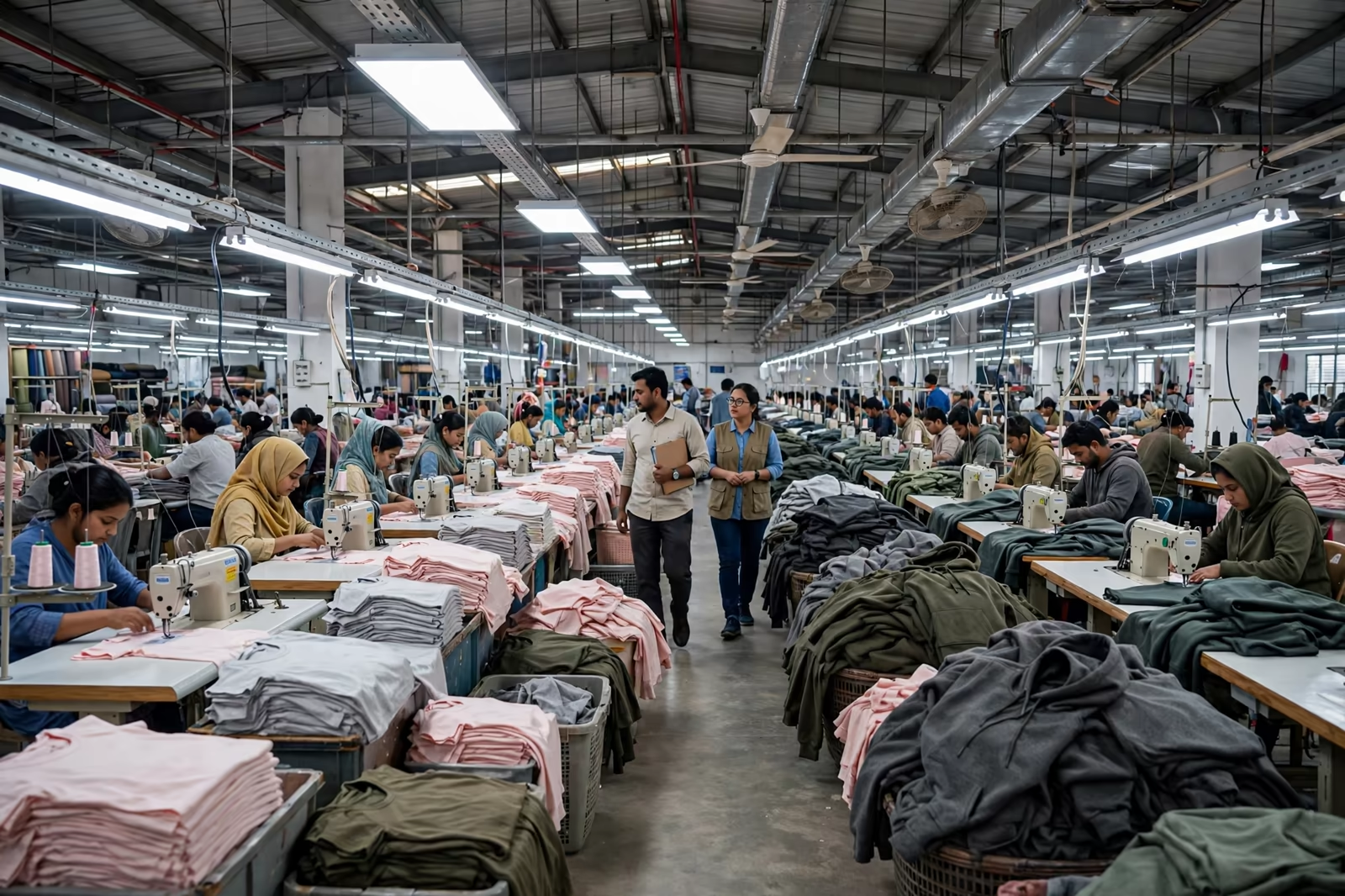
Early in a new relationship, factories ask a question that surprises some buyers: what do you expect to order over the coming seasons? It is not nosiness. It is capacity planning, the quiet arithmetic by which a factory decides how much of its cutting tables, sewing lines and fabric access your orders can rely on, and when.
The production teams behind this guide work in Bangladesh, planning capacity for export buyers in the USA, the UK, Germany, Canada and Australia. A forecast costs a buyer nothing and commits them to little, yet it shapes everything from line allocation to fabric booking, which is why factories ask for it before they need it.
Capacity connects with the order framework on our MOQ and production page, the terms on our payment terms page, and starts with a conversation through our get a quote page.
What Capacity Actually Means in a Factory
Capacity is not a single number. It is the product of lines available, operators skilled for a product type, machine attachments on hand, cutting and finishing throughput, and the weeks those resources are free. A factory may have open capacity for tees in a month when its jacket lines are fully committed, because capacity lives at the level of product and process, not buildings.
Capacity also has a memory. Styles the factory has run before sew faster, with fewer defects, than new constructions, so the same line produces different volumes depending on what it is making. Honest capacity conversations therefore talk in product terms, styles and quantities per season, not in abstract factory size.
Above all, capacity is perishable. An unbooked line week in a peak month does not wait; another buyer’s order takes it. That single fact explains most of what follows in this guide.
Why the Forecast Question Comes Early
A buyer’s forecast lets the factory plan in the buyer’s favour: reserve line space in the right weeks, warn when a planned order lands in a congested month, and prepare fabric and trims sourcing before the confirmed order arrives. Without any forward view, every order competes for whatever space happens to remain when it lands.
Forecasts also calibrate honesty about growth. A buyer expecting to double quantities next season needs a factory whose capacity can grow with them, or a second factory introduced in time, and both discoveries are cheaper made from a forecast than from a failed peak-season order.
The question is a sign of a planning factory. One that never asks is either empty, which raises its own questions, or improvising, which the buyer discovers at the worst moment.
What a Useful Forecast Contains
Useful forecasts are simple: product types, rough quantities per season, the months orders are likely to land, and any known peaks such as promotions or seasonal launches. They are labelled as estimates, because everyone in the trade knows forecasts move, and a clearly labelled estimate is worth more than a false precision nobody believes.
Direction matters more than decimals. A buyer expecting steady basics volumes tells a different capacity story from one planning short fashion drops, even at identical totals, because the line time, fabric strategy and risk differ. Two or three sentences of context beside the numbers give planners what they actually use.
Share also what would change the numbers: a new market opening, a retail listing under negotiation, a marketing push planned. Factories plan around scenarios happily when buyers name them as scenarios.

How Factories Use the Numbers
Planners convert forecasts into a load picture: expected orders spread over weeks, checked against line capacity by product type. Gaps and collisions appear months ahead, while they are still solvable by shifting a week, splitting a delivery or preparing a second line, rather than by overtime and apology.
Fabric strategy follows the same map. For repeat programmes, factories and mills plan greige and dyeing capacity around expected volumes, so forecast-backed orders find fabric routes warm while surprise orders queue behind planned ones. The forecast quietly buys priority in materials as well as in sewing.
None of this binds the buyer to order the forecast quantities. It binds the factory to have thought, which is the entire point.
Capacity Is Prepared, Not Found
Behind every reserved line week sits preparation that forecasts make possible: operators cross-trained for a buyer’s product type, attachments and machine settings for repeat styles kept ready, supervisors who know the buyer’s standards before the order lands. A forecast-backed re-order starts running sooner and steadier because the factory rehearsed for it.
The same foresight shapes investment. Factories expand lines, add specialised machines and train new teams against visible demand, and a buyer whose forecast contributed to that readiness benefits from it directly. Capacity, in other words, is not merely allocated; partly, it is built, and forecasts are one of the materials it is built from.
For the buyer, the lesson is timing. A forecast shared a season ahead can change what a factory is able to do; the same information shared at order placement can only change what it tries.
Peak Seasons: Where Forecasts Earn Their Keep
Every production country has its pressure seasons, when many buyers’ calendars collide and line space thins. In Bangladesh, the weeks before major shipping peaks and around the festival calendar are planned earliest and filled first, and buyers with forecasts on file are planned into them while casual orders take what is left.
A forecast also lets a factory give early, useful warnings: this quantity in that month needs the order confirmed by this date, or this style’s line is committed through that season. Warnings given months ahead are service; the same news at order placement is a crisis.
Buyers who have lived through a peak-season scramble rarely need convincing again. The forecast is the cheapest insurance in the buying calendar.
Seasonal calendars also differ by market: a buyer’s selling season in Australia runs against the northern calendar, and factories serving both hemispheres plan around both. A forecast that names the selling season, not only the order month, helps planners place the work where the factory’s year has room.
Small Buyers Forecast Too
Forecasts are not a big-buyer ceremony. A smaller brand ordering a few styles a season gives its factory the same planning gifts in miniature: the right weeks anticipated, fabric for a repeat style considered before the re-order lands, and honest early word if a planned month is filling.
Smaller volumes are also easier to strand. A large buyer’s order can sometimes be absorbed by shifting lines; a small order arriving unannounced in a peak month has fewer places to hide. The forecast is the small buyer’s seat reservation, and it matters proportionally more, not less.
The content scales down gracefully: three product types, rough quantities, likely months. Five honest lines in an email carry the whole value; formality was never the point.
When Reality Departs From the Forecast
Forecasts are wrong in detail almost by definition, and planning systems know it. Quantities drift, a style swaps for another, a launch moves a month. The forecast’s job was never prophecy; it was to reserve the shape and scale of the buyer’s needs, and shapes survive detail changes surprisingly well.
The professional habit is updating: a short revised note when the picture changes materially, so planners re-plan while re-planning is easy. A buyer whose volumes halve or double without a word teaches the factory to discount their next forecast, which quietly costs them the priority the forecast existed to buy.
Factories return the honesty in kind, telling buyers when their own capacity picture changes. Trust in this exchange, like trust in quality reporting, is built from forecasts that were treated respectfully on both sides.
Forecasts, Prices and Priorities
Visibility has commercial value, and buyers who provide it often find it reflected in the relationship’s economics: planners protect forecast-backed programmes when space tightens, fabric planning reduces the emergency purchases that inflate costs, and stable repeated work is simply cheaper to run than surprises.
This is not a discount scheme, and honest factories do not sell capacity promises for forecast paperwork. It is the natural arithmetic of planning: predictable demand is cheaper to serve well, and the saving shows up as reliability first and price second.
The buyer holding back a forecast to keep factories competing should weigh what the secrecy costs: no reserved space, no fabric strategy, no early warnings. Competition on price works best after capacity is secured, not instead of it.

Having the Conversation Well
The forecast conversation works best as a working discussion, not a form. The buyer shares direction and scale; the factory responds with its own map, which months are open, which are tight, where a week’s shift would help, and both sides leave knowing more than the numbers alone could say.
Ask the return questions: how far ahead does this factory plan, which periods fill first, what confirmation timing protects a planned order, what fabric decisions a forecast can warm up. The answers reveal the factory’s planning maturity more honestly than any brochure, and they turn the forecast from a favour into a shared tool.
Revisit it each season for an hour. Relationships that plan together rarely surprise each other, and in this trade the absence of surprises is most of what good service means.
Frequently Asked Questions
Am I committing to order what I forecast?
No. A forecast is a planning estimate, understood by every professional factory as directional rather than contractual. It reserves attention, line planning and fabric strategy; it does not create an obligation to place orders of those quantities. What factories ask in return is honesty and updates: tell them when the picture changes materially, and your forecasts keep the credibility that makes them useful.
How much detail should a forecast include?
Product types, approximate quantities per season, the months orders are likely to land, and known peaks such as promotions or launches, with a sentence or two of context about direction. You do not need style-level precision months ahead. Direction and scale, honestly labelled as estimates, give planners what they use; false precision impresses nobody and misleads planning.
Why does my factory ask about next season before this order ships?
Because capacity is booked forward and is perishable: line weeks in peak months go to the orders planned earliest. Asking early lets the factory reserve space, plan fabric, and warn you in good time if a planned order collides with a congested period. A factory that asks is planning on your behalf; the one that never asks may have nothing planned at all.
What happens if my forecast turns out wrong?
Very little, if you update it. Forecasts are expected to drift in detail; planners reserve the shape and scale of your needs, which survive quantity changes and style swaps. Send a short revision when the picture changes materially and the planning adjusts while adjustment is still easy. The only damaging forecast is a knowingly false one, given or withheld, because it spends the credibility future forecasts need.