
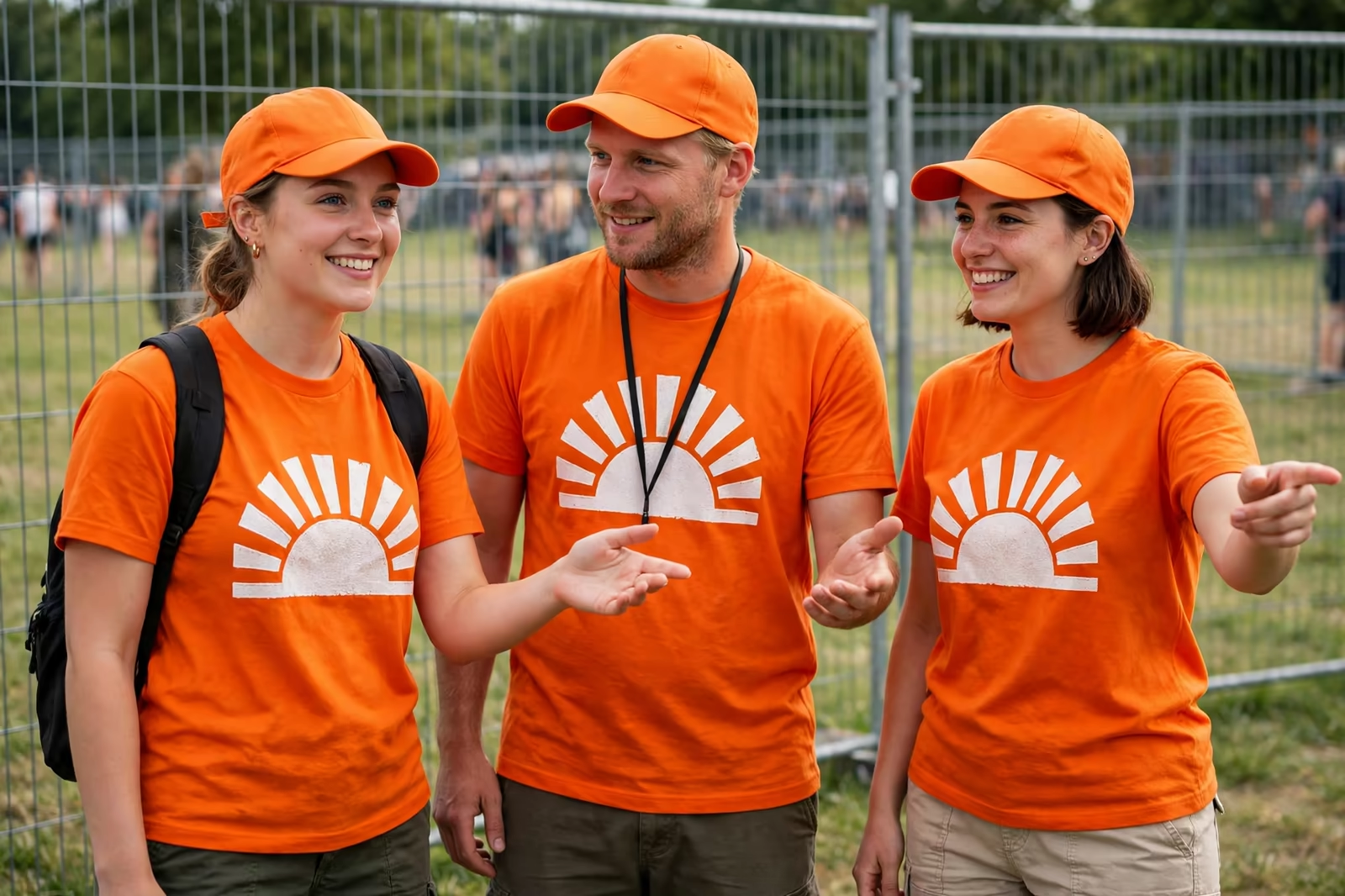
At any event, the crowd’s first question is always the same: who here works here? Event staff clothing answers it at a glance, tees, polos, caps and hi-vis that read as one team across a festival field, an exhibition hall or a stadium concourse. Organisers who spec the clothing as a system, colour, print and role coding, get staff who are findable, photographable and proud to be recognised.
Event staff clothing is produced to order in Bangladesh for organisers and agencies in the USA, the UK, Germany, Canada and Australia.
The core pieces linked here are our classic crew neck t-shirt, baseball cap and high-visibility vest.
The Identity System: Colour First, Print Second
Event identity is colour at distance and print at conversation range. A single strong garment colour, chosen against the venue’s palette and the crowd’s likely clothing, makes staff findable across a field; the printed logo, event name and role word do the close work. Colour choice is tested against photographs of past editions, because the staff will live in the event’s imagery for a year.
Contrast is the rule beneath all of it: print that whispers against the garment colour is decoration, not identification.
- One strong garment colour tested against the venue’s palette.
- Back prints sized for the across-the-hall read.
- Role words a stranger can parse at twenty paces.
- One system across tees, polos, caps and layers.
One identity system covers tees, polos, caps and outer layers, so weather never breaks the team’s look. The colour is also chosen against skin tones and hair, a mark that vanishes against half the team’s heads has failed before the gates open.
Role Coding Without Chaos
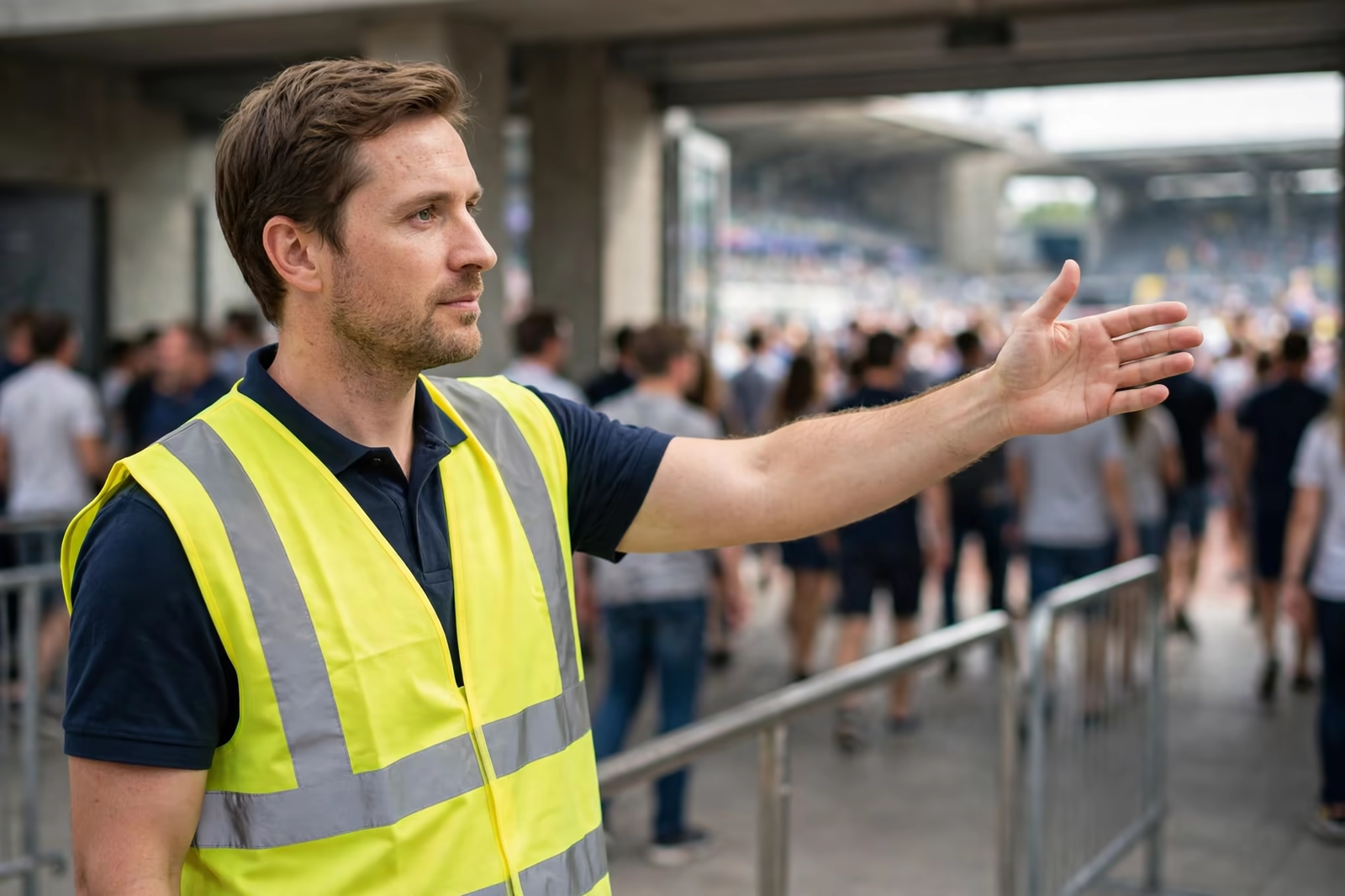
Big events run many teams, and colour coding by role is the organiser’s map made visible: one colour for public-facing info staff, another for production crew, hi-vis for safety and traffic roles, a distinct mark for medical and welfare. The coding is documented in the event’s own staff handbook and matched in production, garment colours and prints specified per role with quantities that reflect real rosters, including the reserves every roster actually uses.
Role words printed front and back survive radio shorthand: the crowd asks the shirt, not the person, and a well-coded shirt answers questions the wearer never hears.
Seniority and access coding, where venues need it, ride on lanyards and wristbands rather than extra garment variants, keeping the clothing system simple.
- Info, production, safety and medical coded by colour.
- Quantities against real rosters, reserves included.
- Role words printed front and back, readable at distance.
- Protected medical marks respected exactly as reserved.
Comfort Across a Long Event Day
Event days are marathons in disguise: setup at dawn, public hours in heat or hall air, breakdown after dark. Staff clothing earns its keep in breathability, fit range that dresses every body on the roster, and layering that adapts, tees under fleece under showerproof shells in one identity. Footwear is the crew’s own problem; everything above the ankle is the programme’s.
Fabric behaviour under sweat, sun and repeated days matters more here than in almost any other uniform family, and wicking finishes earn their specification on outdoor summer rosters.
Spares ride with the production office, because a coffee-soaked info tee helps nobody by the second hour. Multi-day events order per-day changes for public-facing roles, since a third-day tee tells its own story to the crowd.

Indoor Halls and Outdoor Fields
Venue changes the specification. Exhibition halls run warm and crowded, where breathable tees and polos carry the day and identity competes with a thousand booth graphics, arguing for stronger colour and bigger back prints. Outdoor fields add sun, wind and rain to the brief: caps earn their place, UV and weather enter the fabric conversation, and hi-vis roles multiply wherever vehicles and crowds mix.
Stadium and arena work blends both, concourse heat and open-bowl weather in the same shift, which is why bowl staff so often wear the layered version of the kit, fleece zipped over the tee.
The programme document names the venue conditions explicitly, since a tee specified for a hall fails a field in specific, predictable ways. Night events add reflectivity to the brief, prints and tapes that work under floodlights and headlights alike.
Weather Layers in One Identity
Events do not cancel for weather, so the identity system includes its layers from the first order: fleece or softshell in the identity colour for cold mornings, showerproof shells printed or badged to match, hi-vis that fits over the layers rather than instead of them. A team that starts the day matching and ends it in personal jackets has lost its findability by the hour it is needed most.
Layer quantities follow the climate honestly, full sets for outdoor crews, token sets for hall staff, and the forecast argued over like a production schedule, because it is one.
- Fleece or softshell in the identity colour for cold mornings.
- Showerproof shells badged to match the base kit.
- Hi-vis fitted over the layers, not instead of them.
- Layer sizes accounting for everything worn beneath.
Our workwear and outerwear ranges carry the event versions of these layers, specified in the same programme document as the tees. Layer sizing accounts for what sits beneath, a shell fitted over a tee alone strangles over fleece.
Volunteers, Agencies and Mixed Rosters
Many events dress people they do not employ: volunteers, agency staff, contractor crews. The clothing system handles the mix by designing for the least-known wearer, unisex fits in a wide honest curve, identity strong enough to confer belonging on day one, and return-and-reuse logic where the event recurs, since a volunteer’s tee kept as a souvenir is also next year’s recruitment poster.
Agency programmes add their own mark beside the event’s, dual branding specified so neither swallows the other.
Briefing packs include the size chart and the care basics, because mixed rosters wash mixed ways. Ownership rules are printed in the programme too, what is kept, what returns, what the event does with returns, settled before sentiment gets a vote.
Volunteer programmes feel the clothing emotionally in a way paid rosters do not: the tee is often the volunteer’s only pay, souvenir and proof of belonging in one garment, and its quality is remembered as the event’s gratitude made physical. Programmes that understand this spec volunteer pieces a step above the minimum, knowing the shirt will be worn for years in public, carrying the event’s name into streets the marketing never reaches.
The Production Office Kit: Spares, Swaps and Radios
On the day, clothing logistics live in the production office: spare tees in the middle sizes, a swap system for spills and weather, hi-vis for the roles that emerge mid-event, and a simple size-run stock sheet the office can read at speed. Programmes that plan this kit ship it in the same cartons logic as the main order, labelled by role and size so a busy office finds a medium INFO tee in the dark.
Radio harnesses and lanyard points are considered at sampling where crews wear them all day.
The unglamorous kit is what separates events that look organised from events that are. A labelling system on cartons, role by colour by size, is a production decision made months earlier, not a marker pen the night before.
Photographs, Sponsors and the Afterlife
Event clothing outlives the event in photographs, and sponsors know it: staff in frame are the media value nobody invoices. Print placement respects the camera, chest marks clean of lanyard clutter where possible, sponsor lockups placed by the agreement’s terms and proofed at real size, colours that reproduce honestly on phone cameras and broadcast alike.
After the event, surplus stock follows a planned path, next edition’s base, charity donation, or archive, rather than a warehouse corner.
Designing for the photograph is not vanity; for sponsored events it is part of the product. Back prints carry the widest audience of all, since staff face crowds and cameras photograph backs across arenas. They are also the crowd’s compass, the printed word a lost visitor follows through a concourse without ever speaking to its wearer at all, all day long, every day.
Ordering Timeline: Events Have Immovable Dates
An event date does not negotiate, so event clothing orders run on the harshest calendar in the uniform world: artwork and sponsor approvals first, because they gate print; quantities firmed against roster plans with the spares logic priced in; production and freight planned backwards from a delivery date that leaves the production office a working week, not a morning. Air freight rescues late decisions at a price every organiser recognises from experience.
Recurring events convert this year’s data, sizes used, spares consumed, into next year’s order, the programme improving annually.
Our event programmes open with the date and work backwards in writing, so risk is visible while it is still cheap. The written calendar names an artwork freeze date, the point after which sponsor changes cost real money and everyone knows it.
How We Build Event Clothing
Our event work starts from the identity system: colour chosen against the venue, prints specified by viewing distance, role coding documented, layers included, spares and office kit planned, all produced to order with the artwork proofed at full size before bulk. Agency and organiser programmes add dual branding and roster data handling inside the same discipline.
Samples are photographed, not just inspected, because the photograph is the event’s home turf.
- Artwork proofed at full size before bulk production.
- Spares and office kit planned inside the same order.
- Recurring events ordered from last edition’s size data.
The result is a team a stranger can read across a field, which is the entire job, and a crowd that never has to ask who works here.
Frequently Asked Questions
How many colours should an event use for staff?
One identity colour for the public-facing team, plus functional colours only where roles must be distinguished at distance: safety, medical, production. More than four or five garment colours usually signals a coding system the crowd cannot read anyway. The discipline is that every colour means something, and the meaning is printed or briefed, never assumed.
What print method suits event tees?
Screen print for the bold single or few-colour marks most events use, sharp at distance, durable across the event’s days and cheap at event quantities. Photographic or many-colour artwork moves to the transfer and digital methods covered in our printing guides. The choice is made from the artwork and the viewing distance, not from habit.
How are sizes handled for a roster that changes?
By a generous curve across unisex sizes with spares in the middle sizes, since event rosters churn until the gates open. Programmes collect sizes where rosters are stable, agencies and festivals with volunteer churn order the curve and fit on the day from the spares pool, which the programme plans rather than improvises.
Can the same identity carry to caps and hi-vis?
Yes, and it should: caps carry the mark at head height where crowds scan first, and hi-vis vests printed with role words keep safety staff inside the identity instead of outside it. One artwork set, one colour standard, applied across every garment family the event uses, is the whole method.