
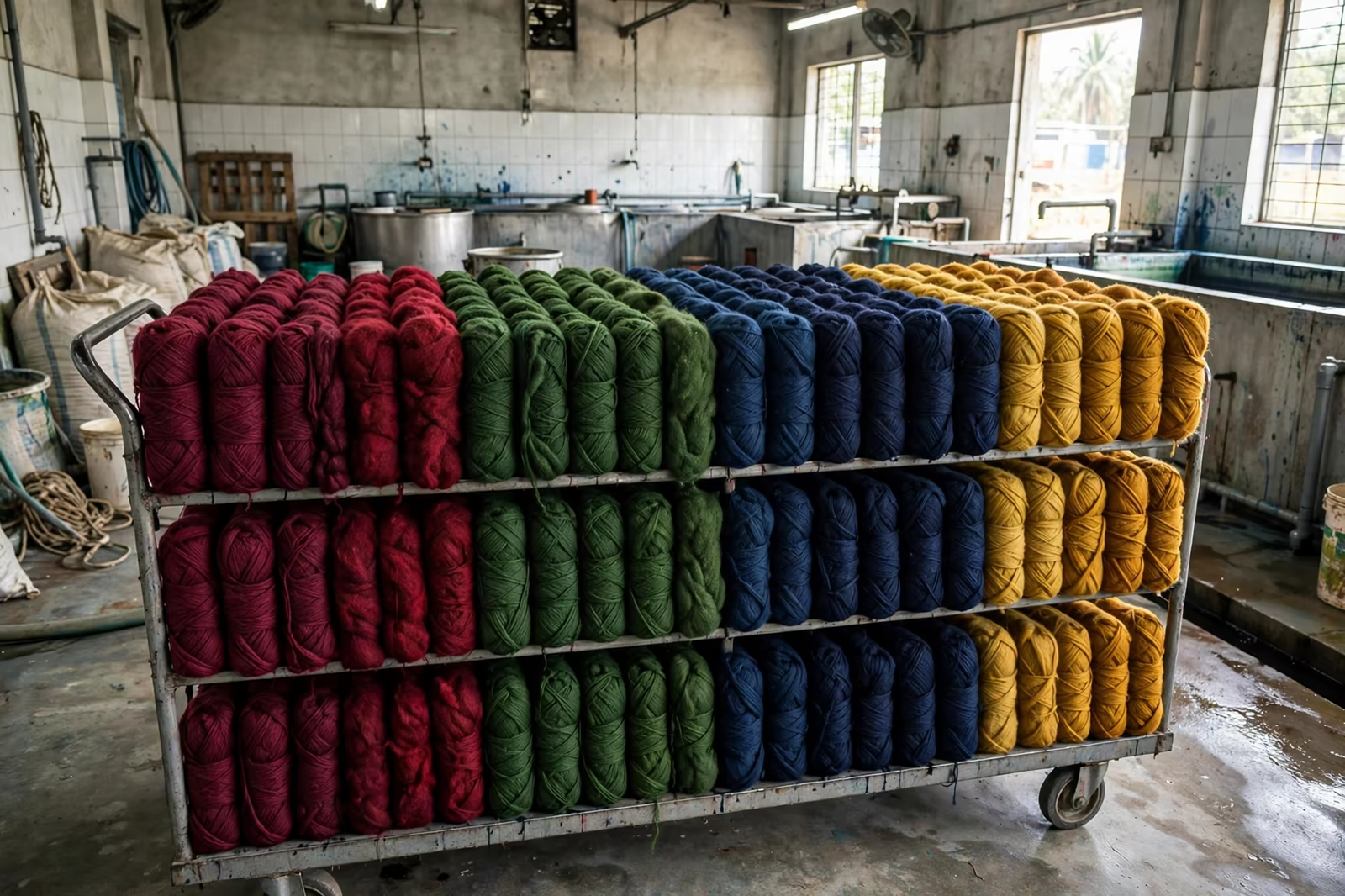
Every coloured garment earned its colour at one of four moments: inside the polymer itself, in the yarn, in the woven or knitted fabric, or on the finished garment. Those four moments, dope dyeing, yarn dyeing, piece dyeing and garment dyeing, are not interchangeable recipes. Each fixes what designs are possible, how colourfast the result runs, how fast a programme can react to a colour trend and what the whole thing costs. This guide compares them honestly.
The colour desk behind this guide runs all four routes on clothing made in Bangladesh for the USA, the UK, Germany, Canada and Australia.
The yarn-dyed showcase is our flannel shirt; the batch logic behind colour commitments lives on our MOQ and production page, inside the wider picture in our services.
Dope Dyeing: Colour Inside the Filament
Dope dyeing, also called solution dyeing, adds pigment to the polymer melt before synthetic filaments are extruded, so the colour is the fibre, all the way through. It belongs to man-made fibres, polyester above all, and it produces the most colourfast apparel fabrics in the trade: sunlight, washing, rubbing and chlorine meet pigment locked inside a filament rather than resting on its surface.
The constraints are equally structural. Colours are committed at fibre production scale, so the palette is narrower, minimum quantities are serious, and nobody pivots a dope-dyed programme mid-season because a new shade started trending. Shade development happens with the fibre producer, upstream of the mill.
Dope dyeing shines where fastness is survival: swimwear, outdoor and workwear, team colours that must survive years of sun and washing as one identical shade.
Yarn Dyeing: Colour Before the Cloth Exists
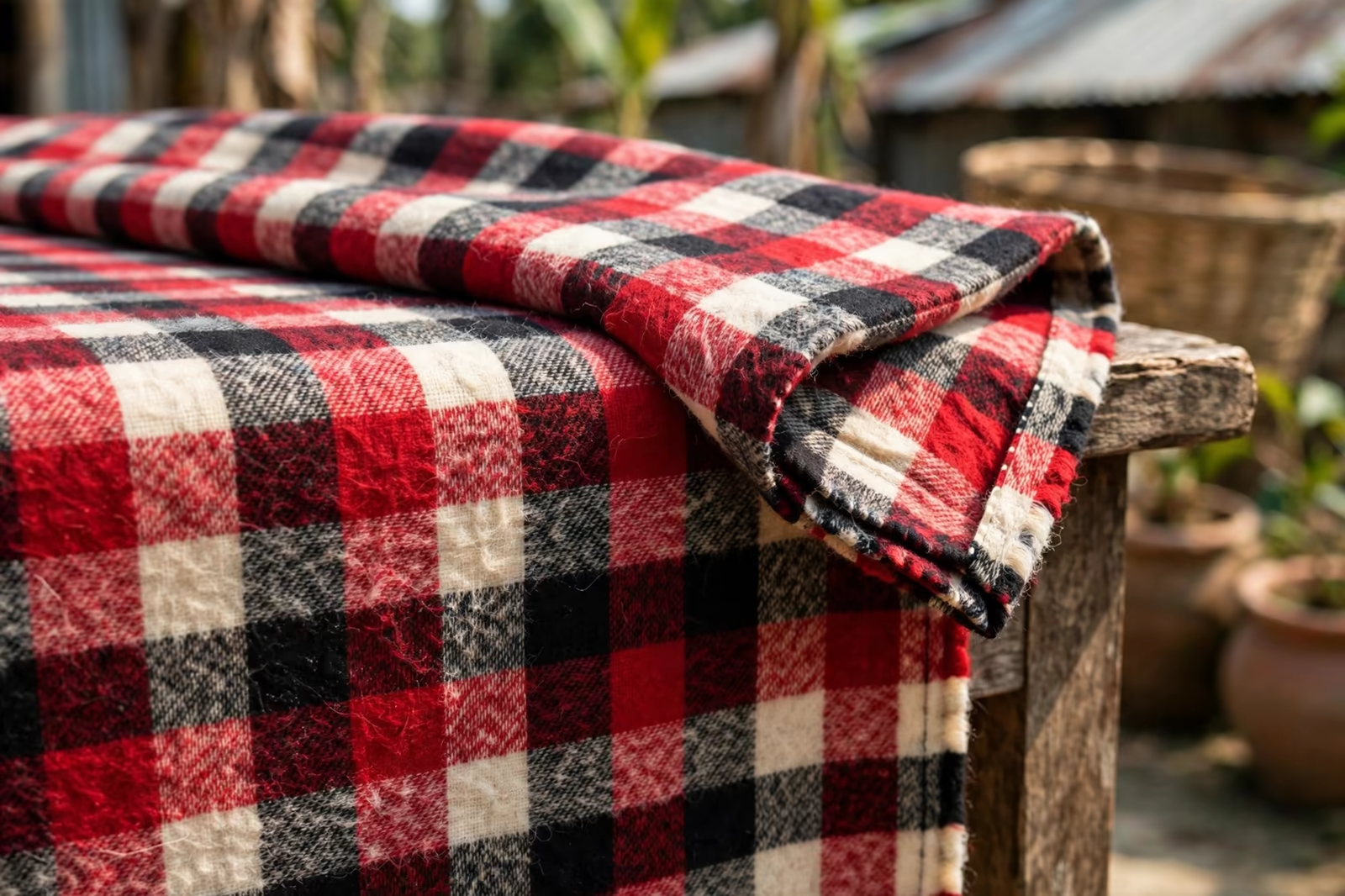
Yarn dyeing colours the yarn, on packages, hanks or beams, before knitting or weaving. It is the only route to true woven and knitted pattern colour: stripes that are stripes on both faces, checks, plaids, jacquards and melange effects where flecks of two shades share one yarn’s space. The flannel shirt in this guide’s links wears its checks because its yarns were dyed first.
The colour is fixed before the fabric exists, which brings discipline: yarn shades are committed early, changes ripple backward into dye house schedules, and every pattern colour is a separate dyed inventory the programme must balance.
Fastness is generally strong, since penetration into yarn packages is thorough and the dye never has to fight a finished fabric’s construction to reach its fibre.
Piece Dyeing: The Flexible Workhorse
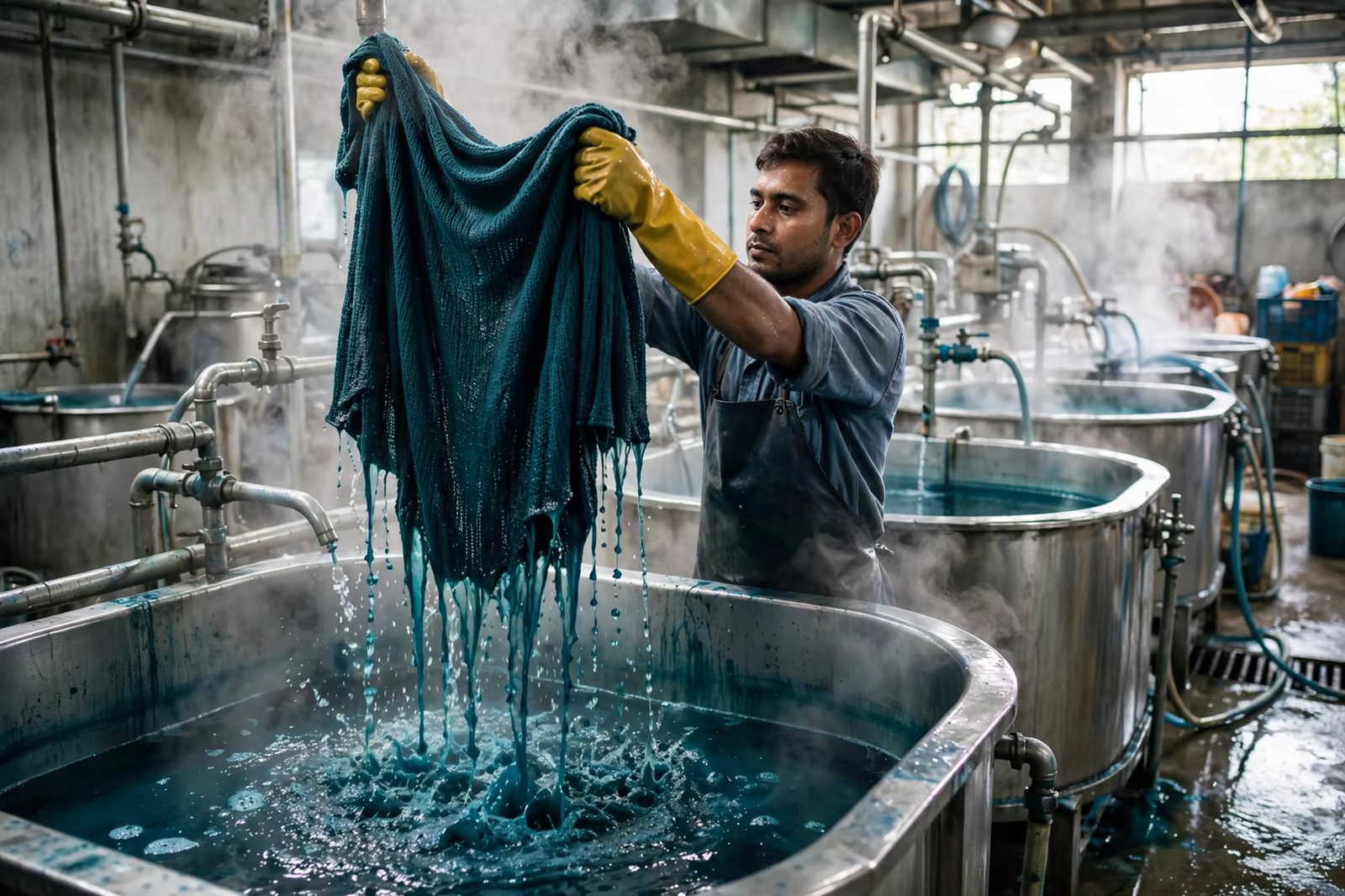
Piece dyeing colours the knitted or woven fabric after it exists, in jet, overflow or pad machines by the batch. It is the industry’s flexible default for solid colours: greige fabric can be stocked undyed by the mill, then dyed to the confirmed shade when the order lands, which is why it powers fast colour decisions and replenishment programmes.
The trade-offs are batch physics. Each dye lot is its own event, so shade can vary subtly between lots, the reason shade bands and lot discipline exist; deep constructions and blends need careful recipe work, and a cotton-polyester blend takes two dye families in one bath story because the fibres want different chemistry.
For solid-colour basics, uniforms and fashion colours chosen late, piece dyeing’s balance of speed, cost and breadth keeps it the default against which the others argue. It also absorbs the trade’s special effects gracefully: enzyme washes, softeners, moisture finishes and prints all build on a piece-dyed ground, which is one more reason solid programmes default to it.
Garment Dyeing: Colour Last of All
Garment dyeing colours the sewn garment itself, which inverts every assumption: production can sew ahead in undyed fabric and commit colour at the very end, closest to the selling season. The result has a character buyers of washed, lived-in aesthetics pay for: colour settles unevenly across seams, stitching and trims, giving the soft, slightly vintage hand that pigment and garment-dyed programmes are famous for.
The risks ride along: shrinkage must be fully settled before sewing or the garment dyes itself into another size, components from thread to labels must survive or accept the dye, and shade uniformity across a batch of finished garments is harder to police than across a roll of cloth.
It is a deliberate fashion tool and a late-decision tool, used knowingly in both cases, by buyers who have priced its risks rather than discovered them.
Cost and Minimums: Where Each Method Pays
The cost ranking is mostly a ranking of commitment size. Dope dyeing is cheapest per kilogram at genuine scale and dearest to start, because fibre producers run colour campaigns, not samples. Yarn dyeing adds its premium in handling: every colour is dyed, stored and balanced separately, and pattern programmes carry real inventory mathematics.
Piece dyeing prices flexibly by the batch, which is why our minimum order structure and most of the trade runs on it: undyed fabric waits, colour commits late, sizes of batches follow orders rather than fibre campaigns. Garment dyeing pays for its lateness with per-piece handling and the strictest pre-shrinking discipline.
Buyers should therefore compare methods at their own volume, not in the abstract; the cheapest method at ten tonnes can be the impossible one at five hundred pieces.
Colour Approval: Lab Dips Across All Methods
Whatever the route, colour is approved small before it is committed big: a lab dip, a yarn strike or a fibre sample judged under standard lighting against the buyer’s standard, increasingly with spectrophotometer readings and a numeric tolerance rather than eyes alone. The approved small thing then governs the bulk, checked again at first production.
The method changes what the dip proves: for piece dyeing it validates a recipe on the real fabric; for yarn dyeing it validates every pattern colour separately; for dope dyeing the approval happens a whole supply chain earlier, which is why its timelines feel geological to fashion buyers.
Metamerism, the shade that matches under shop light and quarrels under daylight, is the trap this discipline exists to catch before a container teaches it.
The Environmental Footprint, Compared Fairly
Dope dyeing is the lightest route by a wide margin: no dye bath, far less water and energy, and effluent barely touched by colour, because the pigment never leaves the filament. Piece and yarn dyeing carry the classic wet-processing footprint, water, heat and chemical load, which modern dye houses cut with low-liquor machines, heat recovery and better fixation, since unfixed dye is both pollution and wasted money.
Garment dyeing sits between: smaller batches and later commitment waste less coloured stock, against the same bath chemistry per kilogram. Fibre choice keeps its vote too: polyester’s disperse route and cotton’s reactive route ask different things of the effluent plant.
Environmental claims in this area should always name the mechanism, less water, less reprocessing, fewer unsold colours, rather than wearing a green adjective.
Fastness Testing: The Common Referee
However the colour arrived, the same referees judge it: wash fastness, light fastness, rubbing wet and dry, perspiration and, for swim, chlorinated water, each graded on the grey scales from our fabric testing guide. A method earns its reputation through these results on real programmes, not through its brochure.
Buyers should set fastness targets by end use, not by habit: a fashion tee and a lifeguard’s shirt live in different worlds of sun and water, and over-specifying fastness on the first wastes exactly the money under-specifying loses on the second.
Bulk fabric is tested before cutting on every serious programme, because colour discovered wrong after sewing is the most expensive colour in the building.
Matching Method to Product Families
The pattern settles quickly in practice. Checks, stripes and melanges: yarn dye. Solid basics, uniforms, fashion colours and replenishment: piece dye. Swim, outdoor, workwear and long-life team colours in synthetics: dope dye where volume allows. Washed, casual, vintage-hand ranges and late colour decisions: garment dye.
Hybrid programmes mix routes by component: a yarn-dyed check body with piece-dyed solid sleeves is ordinary merchandising, and the specification must name the route per component so fastness and shade behaviour stay predictable across the garment.
Our colour desk plans the route at costing stage, because a design priced on piece dyeing and later demanded as yarn dye has changed products mid-conversation. The same planning protects replenishment: a colour that must return identically season after season argues for the route whose shade control the programme can actually sustain.
Specifying the Dye Route in an Order
A complete colour specification names the dye route per component, the colour standard and its tolerance, the fastness targets with their test methods, and the approval chain: lab dip, first bulk, shade band. It also names the lighting colour will be judged under, because the standard lamp settles arguments that windows start.
Changes of route after costing are changes of product and price, and both sides should treat them that way in writing. The order file that carries the route forward unchanged is what lets the garment, its tests and its second season all wear the same colour.
Buyers comparing quotes should check the route is even the same; the cheapest colour on paper is often a different method wearing the same shade name, and the difference announces itself in the first wash, the first sun test or the first reorder.
Frequently Asked Questions
Which dyeing method has the best colourfastness?
Dope dyeing, for synthetic fibres, because the pigment sits inside the filament rather than on fibre surfaces, so washing, light and rubbing remove colour slowest. Behind it, well-executed yarn and piece dyeing both reach strong commercial fastness when recipes and fixation are right; fastness is ultimately proven by the standard wash, light and rub tests, not by the method’s name alone.
Why do stripes and checks need yarn dyeing?
Because the pattern in a true stripe or check is built from differently coloured yarns meeting in the construction, so the design shows identically on both faces and never prints, cracks or peels. Printing can imitate the look on one face only, which is a different product at a different price, as any buyer who has turned a shirt inside out knows.
What causes shade variation between dye lots?
Batch physics: water, temperature curves, dye lots, machine loading and the fabric’s own preparation vary slightly between runs, so colour lands slightly differently. The trade manages it with shade bands agreed in advance, lab dips before bulk, lot separation in cutting, and spectrophotometer readings against tolerance, rather than pretending variation can be abolished.
Can a cotton-polyester blend be dyed in one step?
The fibres need different dye families, disperse dyes for the polyester and reactive dyes for the cotton, so blend dyeing is a carefully sequenced one-bath or two-bath process using both. It is routine work for a competent dye house, and it is one reason blend fabrics cost more to colour well than either pure fibre alone.