
Colour fastness is where a garment’s promises meet the customer’s laundry. Every coloured product carries an invisible specification: how much its colour may change, and how much it stains its neighbours, under washing, light, rubbing and perspiration, graded on the grey scales of the ISO 105 test family. Set them too low and the returns write themselves; set them blindly high and the palette and price suffer. This guide sets the bars by product, and shows buyers how to hold them.
The fastness minimums in this guide come from colour work on clothing made in Bangladesh for the USA, the UK, Germany, Canada and Australia.
Performance colour lives on our performance training t-shirt; testing runs inside our services, and specifications are agreed through our contact page.
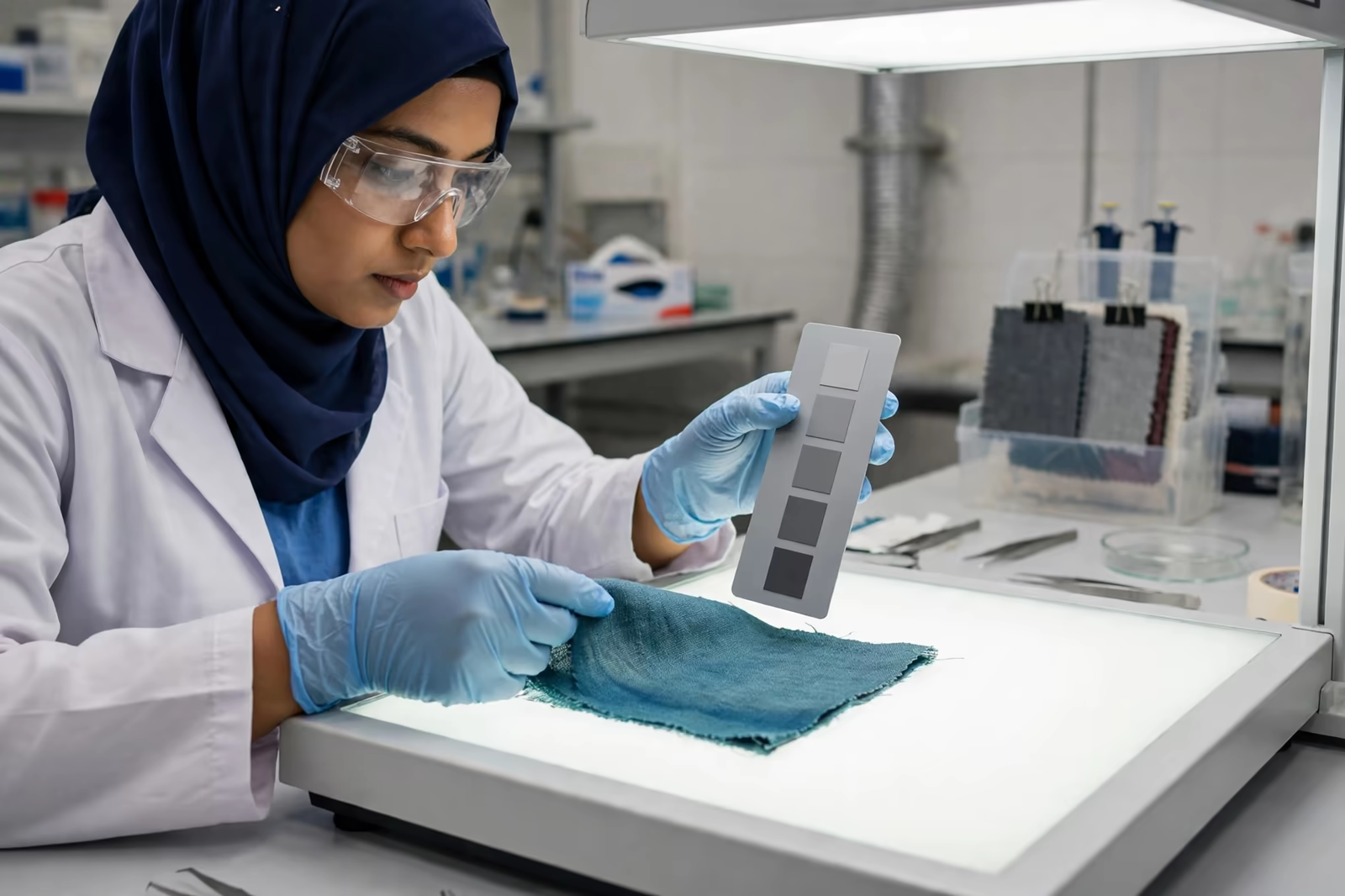
The Grey Scales: How Fastness Is Graded
Fastness results are graded from 1 to 5 on two grey scales: one for the specimen’s own colour change, one for the staining it leaves on adjacent undyed fabrics in the test. Five is no visible change; each step down is a standardised, visibly larger step, judged under controlled light against the scale’s paired chips, or read instrumentally.
The half grades matter commercially: the distance between 3 and 3-4 is the distance between a complaint and a compliment on many products, and specifications are written in these halves.
Every minimum in this guide is therefore a pair of numbers, change and staining, per test, per product. The scales also discipline arguments: a disputed result is re-judged against the same physical chips in any competent laboratory, which is why fastness quarrels end with evidence more often than most quality disputes do.
Washing Fastness: The Everyday Test
Wash fastness, tested under the ISO 105-C family at the garment’s care temperature, is the minimum customers enforce weekly. Dark and saturated shades are the stress case: deep navy, black and red carry the most dye available to move, and their staining grade onto the multifibre strip is where programmes pass or fail.
Buyers typically set the bar by shade depth: pale shades can honestly hold higher grades than saturated ones, and a specification that demands one number for every colour in the range is asking physics for favours.
Home-laundering reality also includes detergent chemistry and mixed loads, which is why the test’s multifibre neighbour, cotton, polyester, nylon and friends on one strip, predicts the white-shirt-in-the-same-wash disaster. First-wash behaviour deserves its own honesty: new garments of every quality release some loose dye early, and care guidance that says so plainly prevents more complaints than any grade.
Light Fastness: Sunlight as a Slow Solvent
Light fastness measures colour’s survival under sun, tested against blue wool references that fade at known rates. It is the slowest test and the one whose failures arrive latest, on the customer’s line, car seat or shop window, which makes it the easiest to under-specify and the hardest to forgive.
Exposure-critical products, swim, outdoor, workwear, children’s summer clothing, carry the highest light minimums; indoor and evening products can honestly run lower. Fibre and dye class set the ceiling: some dye families are constitutionally light-tough, others fade graciously whatever the recipe, a fact the development test exists to reveal.
Buyers should also remember that light and perspiration conspire on summer garments, which is why combined exposure testing exists for the categories that need it. Display matters too: stock that lives under retail lighting for a season is taking a light test nobody commissioned, and window-facing colours deserve their grades checked before the range is hung.
Rubbing Fastness: The Dry and Wet Pair
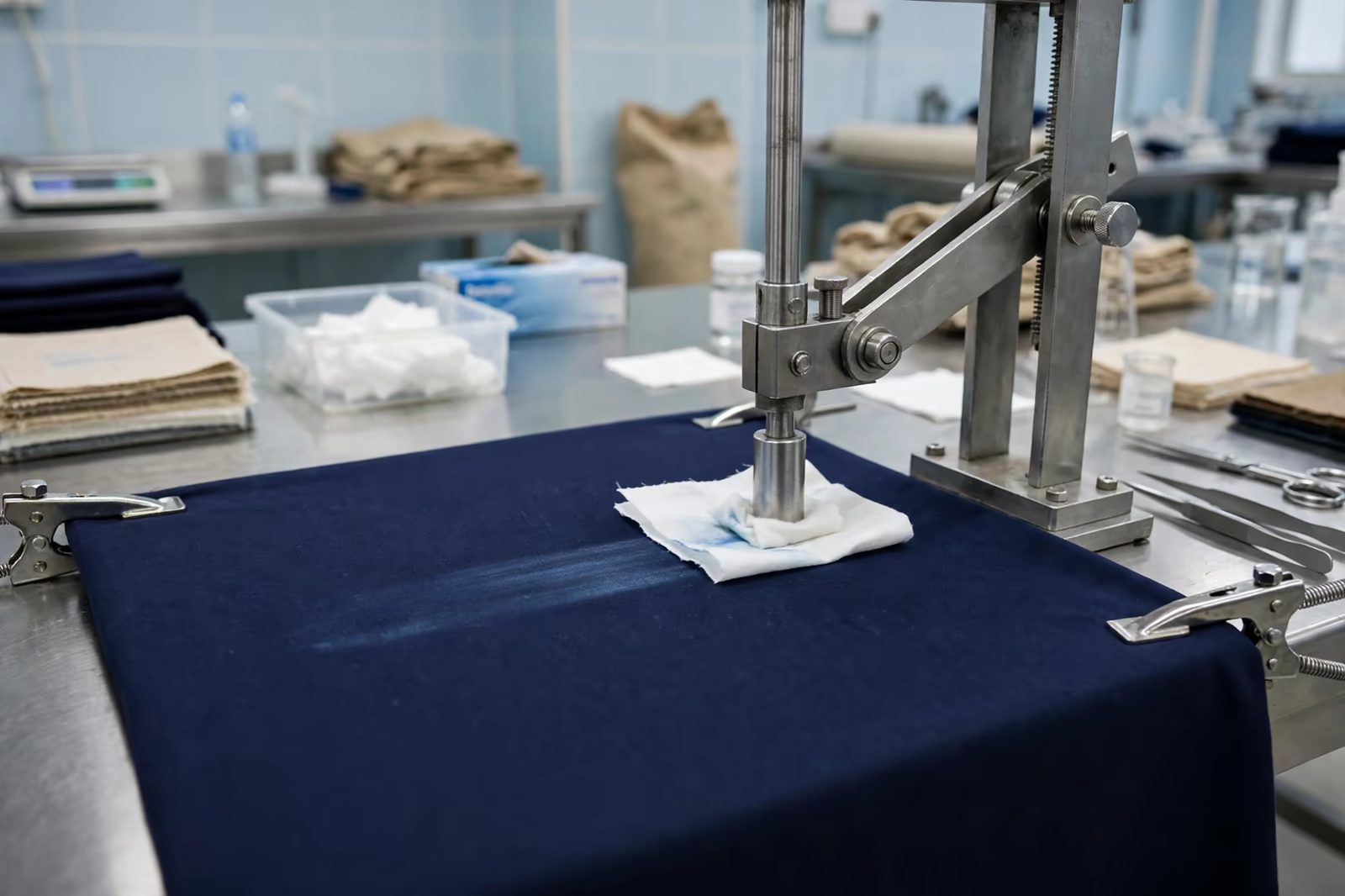
Rubbing, or crocking, fastness measures colour transferred by friction onto a white cloth, dry and wet, the wet grade almost always the weaker. It is the test of white trainers against dark denim, pale straps against saturated tees, and every customer’s thumb rubbed across a new garment in the shop.
Deep shades on cotton are the classic stress case, since surface dye that survived dyeing meets friction directly; pigment prints carry their own rubbing story, told in our screen printing guides. Denim’s famous crocking is accepted as character in jeans and would be a defect anywhere else, a reminder that minimums are set per product culture, not per laboratory pride.
Specifications should state both grades, dry and wet, since a fabric can pass one and embarrass on the other, sometimes within the same customer’s first week of wear. Construction helps or hurts here: pigment sitting on a fabric’s surface rubs sooner than dye inside its fibres, and resin-heavy finishes trade hand feel for exactly the surface behaviour this test measures.
Perspiration Fastness: Acid and Alkali
Human sweat is chemistry, acidic on some bodies and alkaline on others, and perspiration fastness tests both solutions because dyes can shift shade, not merely fade, under each. The visible failure is the underarm and collar zone changing colour or staining the skin-side of lighter layers, on exactly the garments worn hardest: shirts, sports tops, underwear, uniforms in hot climates.
Change of shade under perspiration surprises buyers most, because a garment can hold its dye and still turn a different colour exactly where it is worn closest.
Activewear and next-to-skin programmes therefore carry perspiration minimums as headline numbers, not footnotes. The test also protects the maker’s other colours: a perspiration-mobile dye on a contrast collar or binding will migrate onto its paler neighbour precisely where the body sweats.
Water, Sea and Chlorine: The Swim Tests
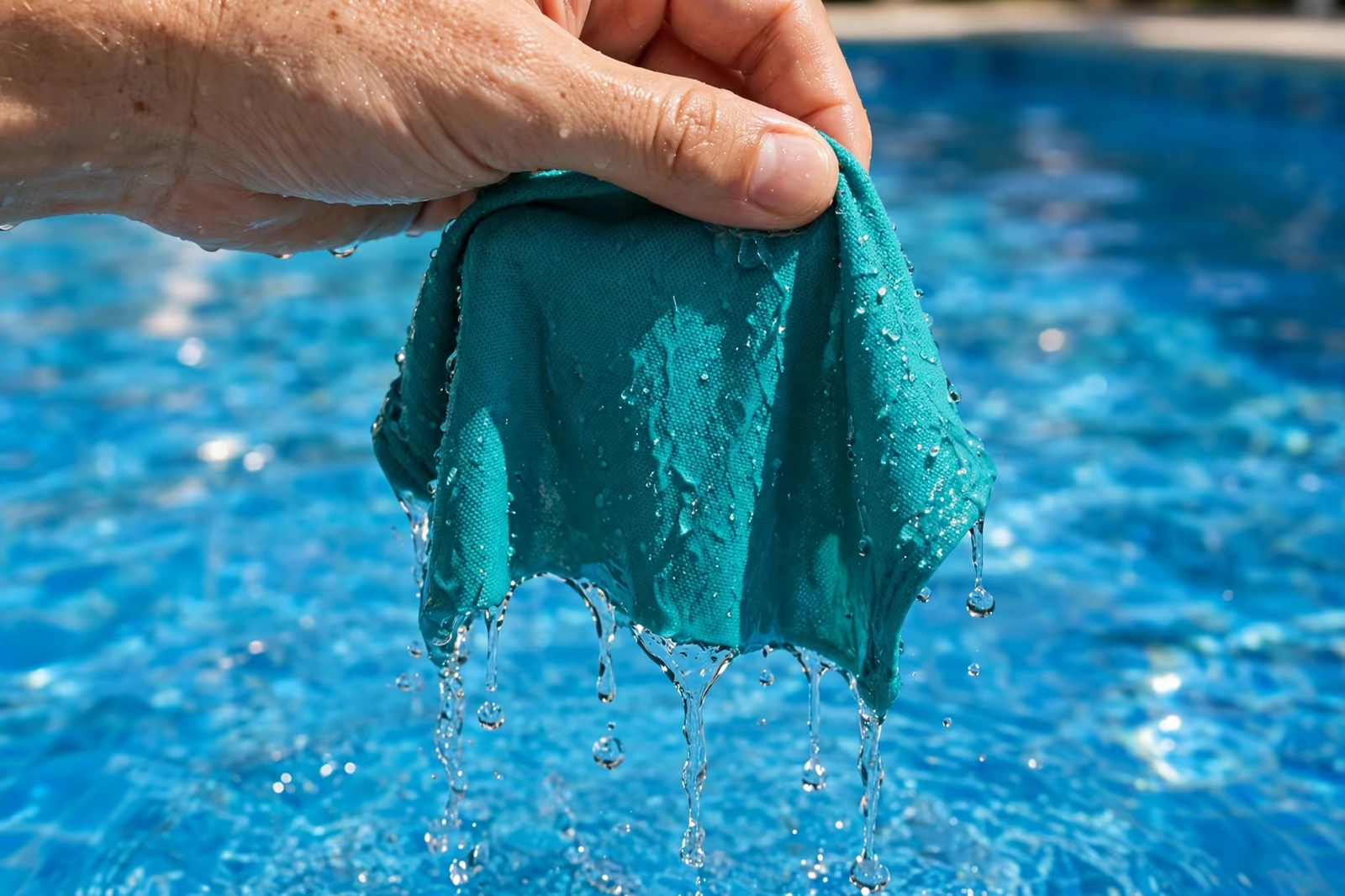
Specialised wet fastnesses guard the categories that live in water: water fastness for garments washed by weather and sport, seawater for beach ranges, chlorinated water for pool swimwear and team kit. Each solution attacks dye differently, and a fabric that laughs at seawater can surrender to chlorine in a month of training sessions.
The fibre story from our dyeing methods guide returns here: pigment locked inside dope-dyed filament resists all three best, which is why serious swim and outdoor programmes lean on it where volumes allow.
Buyers of promotional swim and outdoor products on shorter lives may set these bars lower knowingly; the sin is setting them absent-mindedly. Sunscreen and body oils join the assault team in real use, one more reason swim minimums are set as a bundle rather than cherry-picked test by test.
Minimums by Product Family
The working pattern across the trade sets the strictest combined bars on swimwear, activewear and children’s clothing, where exposure, sweat and washing frequency all peak together. Everyday fashion basics run strong wash and rubbing minimums with moderate light requirements. Workwear adds perspiration and high-temperature wash survival for industrial laundering. Dark denim and pigment-heavy fashion pieces negotiate their rubbing grades honestly, in writing, rather than pretending to numbers they cannot hold.
Two principles organise the table in every case: grade by shade depth within a family, and grade by the customer’s actual everyday use, not by the laboratory’s maximum available virtue.
Our specification packs set these minimums per style and shade at development, so the argument happens once, on paper, instead of per shipment. Children’s clothing deserves its strictness underlined: it is washed more often, at higher temperatures, by customers with the least patience in the market, and its colours are expected to survive siblings.
Setting Minimums Too High: The Other Failure
Impossible minimums do not produce impossible quality; they produce quiet cheating, narrowed palettes and prices carrying protection the product never needed. A pale fashion tee held to swimwear light grades loses colours from its range for no customer’s benefit, and a factory that signs any number put in front of it will fail the ones that matter along with the theatre.
The credible specification is the demanding-but-physical one, set from test evidence on the actual fibre and dye route, with the development results attached to the order file.
Buyers earn more fastness by choosing dye routes and fibres with high ceilings than by writing heroic numbers under weak ones.
Testing Protocol: Development, Bulk and Retest
The rhythm mirrors our fabric testing guide: every colourway tested at development against the style’s minimums; bulk fabric tested per colour before cutting, because dye lots drift; retests whenever shade, fibre, dye house or finish changes. Reports name the standard method, the laboratory and the date, and the results file travels with the order’s other evidence.
Failures are handled at fabric stage, where remedies exist: re-fixation, adjusted wash-off, recipe change, or an honest renegotiation of the grade for that particular shade.
Colour discovered wrong after sewing is the most expensive colour in the building, and fastness discovered wrong after shipping is worse.
Our Fastness Practice
Our colour work sets fastness minimums per product family and shade depth at specification stage, tests every colourway in development and every bulk colour before cutting, and keeps the reports in the order file beside the lab dips that approved the shade. Where a shade cannot reach a buyer’s requested grade on its fibre, the conversation happens at development, with alternatives offered, never after the container.
That sequence, minimums in writing, evidence in the file, is the whole of fastness management; the tests themselves are the easy part of the discipline.
Buyers comparing factories on colour should ask for a recent fastness file and watch how quickly it appears. A file that arrives in minutes, with methods and dates in order, describes a colour operation; one that arrives as adjectives describes a hope.
Frequently Asked Questions
What does a fastness grade of 4 mean?
On the 1-to-5 grey scales, grade 4 means slight change or staining, visible on close comparison against the standard scale but acceptable for most apparel uses. Grade 5 is no visible change; grade 3 is noticeable change. Buyers set minimums per test and product, commonly at 4 or 3-4 for wash fastness depending on shade depth.
Which fastness test matters most for swimwear?
Chlorinated water fastness, alongside light and wash: pool chemistry attacks dye directly, and a swimsuit lives in it. Seawater fastness joins the list for beach ranges. The fibre and dye route matter here, which is why synthetic swim fabrics are often dope dyed, locking the pigment inside the filament where chlorine reaches it slowest.
Why do dark colours stain more in testing?
Because deep shades carry more dye, and a share of it sits less firmly fixed, especially early in the garment’s life. The staining grade measures that mobile dye transferring to adjacent fabrics in the test. Good fixation, thorough wash-off after dyeing and honest minimums set per shade depth are how production keeps dark colours social.
Should buyers test every colour or every shipment?
Every colourway at development, because fastness is a property of the shade recipe, and bulk fabric per colour at production start, because dye lots vary. Retesting on shade changes, fibre changes and dye house changes keeps the file honest; a fastness claim is only ever as current as its last test.