
Sports T-Shirts Sewn in Bangladesh for Australian Clubs and Event Teams
Working as a sports t-shirts manufacturer, Siatex Bangladesh sews this panelled style to order for buyers in Australia, with regular supply also reaching the USA, the UK, Germany and Canada. Clubs and event organisers use it as a plain base for their own branding.
Running groups in New Zealand often order this same pattern in their own club colours, so senior and junior squads share one tidy look on race day. Event companies in Singapore choose the plain violet base for participant and staff shirts, then add their own print after delivery.
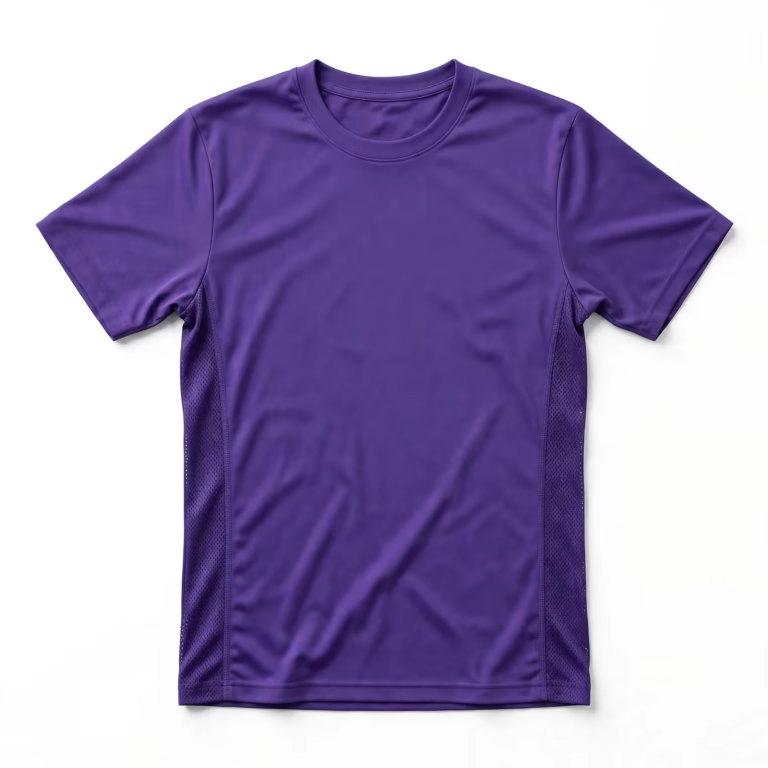
The shirt pictured here is a violet purple crew neck style with set in short sleeves. A slightly darker violet mesh panel runs down each side of the body, starting just below the arm and finishing at the hem. Flatlock seams join those panels to the front and back pieces.
As a supplier, wholesaler and exporter based in Bangladesh, we build each order around the buyer pattern instead of a fixed house block. Panel width, neck size and body length are decided at sampling, agreed in writing and then followed carefully through cutting, sewing and finishing.
Key choices available on this style:
- Crew neck cut to a regular round shape
- Set in short sleeves with flat hemmed edges
- Darker mesh side panels from underarm to hem
- Flatlock seams used at every panel join
- Panel shade matched or contrasted on request
- Longer body length added at the pattern stage
- Men, women and youth sizes from one pattern
- Buyer labels and tags fitted before packing
Every shirt in this range is made to order in Bangladesh, and no ready stock is held for the style. That keeps the body cloth, panel shade and size range tied to one approved brief, so every carton carries shirts that look consistent side by side.
Cut and Construction
The body is cut to a regular fit that sits easily over the shoulders and chest. Front and back pieces are shaped first, the shoulder line slopes gently into the armhole, and each side panel is cut as a separate piece.
The crew neck is finished with a collar band cut from ribbed knitting, stitched evenly around the opening and pressed so it lies flat. Sleeves are set into the armhole with the seam eased smoothly, then hemmed to a level finish on both sides.
Neck, Sleeves and Hem Finishing
Details at this stage decide how tidy the finished shirt looks on a rail. Shoulder seams are taped for a clean inside finish, panel joins are aligned at the underarm point, and the body hem is stitched straight so front and back sit level.
- Ribbed collar band stitched and pressed flat
- Taped shoulder seams with a neat inside finish
- Set in sleeves eased around the armhole seam
- Coverstitched hems on sleeves and body hem
- Threads trimmed and joins checked before pressing
You may send a block pattern, a size chart or a sample garment you already sell. Our pattern team grades the sizes from that reference, sews a sample in the main size and notes any fit change before bulk cutting.
Fabrics, Knit Structure and Side Panels
For the body, buyers usually pick a polyester single jersey with a fine, even knit and a smooth face. A pique knit is also offered, giving the surface a small textured pattern.
Cloth weight is chosen at sampling and written onto the order sheet, along with the knit type and the panel cloth. Once those points are approved, the same cloth specification is followed for the whole order.
Mesh Side Panels From Underarm to Hem
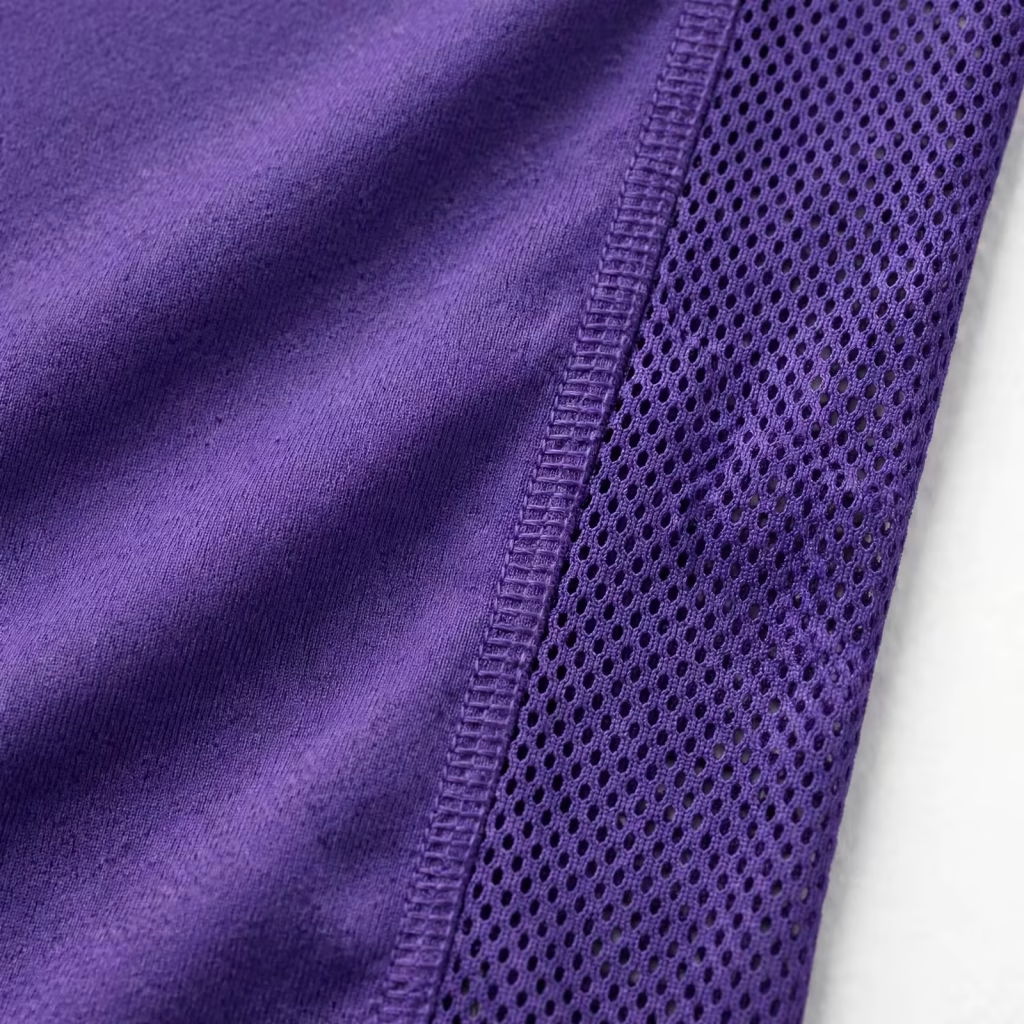
Each side panel is cut from an open mesh knit and placed between the front and back pieces, running from below the arm to the hem. The panel is joined with a flatlock stitch, which lays the two cloth edges flat beside each other under the thread.
Panel width follows your pattern rather than a standard house size. A narrow panel reads as a slim stripe down the side, while a wider panel becomes a clear feature of the design, especially in the darker shade shown on this violet style.
Colour Choices and Panel Pairings
Body colour and panel colour are approved together on one sewn sample, never as loose swatches judged apart. Seeing the two violet shades side by side on a finished shirt shows exactly how gentle or strong the pairing will look in daylight.
Bright shades are popular for event shirts because they stand out in a crowd and read clearly in photographs. Lighter shades give a fresh, clean look for summer programmes, while deeper club colours suit regular training wear and repeat weekly use.
The same pattern can be recoloured for each club or label in your range. Neck band, panel and body can share one shade, or the panel can carry an accent colour against the main club shade.
OEM and Private Label Supply
Much of our work is private label supply for buyers who sell under their own name. Clubs, gym ranges and event brands receive plain panelled shirts carrying their own labels, ready for their own print, embroidery or plain resale.
Branding from one buyer is never mixed with another order on the sewing floor. The label set named on your order sheet is fitted during making, then checked once more at the folding table before any shirt is bagged.
- Woven main label sewn at the back neck
- Size and care details placed inside the shirt
- Small hem label added for brand ranges
- Swing tags attached following your instruction sheet
- Event fold or retail fold, as you specify
- Carton wording printed to your own reference
Checking, Packing and Shipping to Australia
Checks run through the whole making process rather than sitting only at the end. Cloth is looked over before cutting, panel joins are inspected during sewing, and every finished shirt is measured, pressed and examined before it reaches the folding table.
As an exporter, we judge finished shirts against three references together: the approved sample, the size chart and your packing instruction. A shirt moves forward only when the garment, its labels and its packing all agree with that shared standard.
- Chest, body length and sleeve sizes measured
- Crew neck shape and collar stitching checked
- Side panels matched carefully on left and right
- Flatlock joins, hems and trimming inspected closely
- Shade compared beside the approved sample shirt
- Labels, folding and carton contents confirmed
Folded shirts are packed so the collar keeps its shape in transit, and cartons leave Bangladesh for Australia by the route agreed on your order. Export papers are prepared against the final carton list.
Step by Step Ordering
From Brief to Sample
Send us your sizes or pattern, the cloth you prefer, your colour references and a note on panel width and body length. We then sew a sample in the main size showing the crew neck, the mesh panels and the flatlock joins for your approval.
Sample comments are marked clearly and worked into the pattern before bulk cutting starts. Neck size, sleeve length and panel width can all be adjusted at this point, which is far easier than altering details once sewing is already under way.
Confirming Price and Making the Order
With the sample approved, the price is worked out from the final cloth, panel work, label set and packing method, then confirmed to you in writing. Nothing is added later for details that already formed part of the agreed specification.
Production then follows a fixed order: cloth inspection, cutting, panel joining, assembly, finishing, measuring, pressing and packing. Each stage is checked against the approved sample.
Ask for a Sample in Violet or Your Own Club Colour
The simplest way to judge this style is to hold a finished shirt and look at the panel joins closely. Send your colours, sizes and panel preference, and we will sew a sample that shows the construction plainly, stitch by stitch.
We are a family business, and that shows in how orders are handled: one clear contact, honest answers and careful attention to the sample you approved. Shirts are then made in Bangladesh to that same standard for your club, gym or event range.
Frequently Asked Questions
Why do buyers choose bright or light colours for summer event shirts?
Bright and light shades are easy to spot in a crowd and they photograph clearly, which helps events look lively in pictures. They also give a fresh fashion feel for summer ranges and separate staff, volunteers and participants at a glance.
Can running club shirts be made with a longer body length?
Yes, the body can be lengthened on the pattern so the shirt sits lower during a run and stays neatly in place over shorts. Tell us the extra length you want, we add it at grading and show the result on your approval sample.
Will a repeat order match the first approved sample exactly?
Yes, repeats are sewn against the first approved sample, which is kept as the reference for cloth, panel shade, sizing and labels. Each repeat is compared with that sample, so the new cartons match stock from the earlier order.
Can our woven label and swing tag set be fitted before packing?
Yes, your woven neck label, care details and swing tags are fitted as one set during making and finishing, following your instruction sheet. The set is checked again at folding, so shirts arrive labelled, tagged and ready for your own shelves or event tables.