
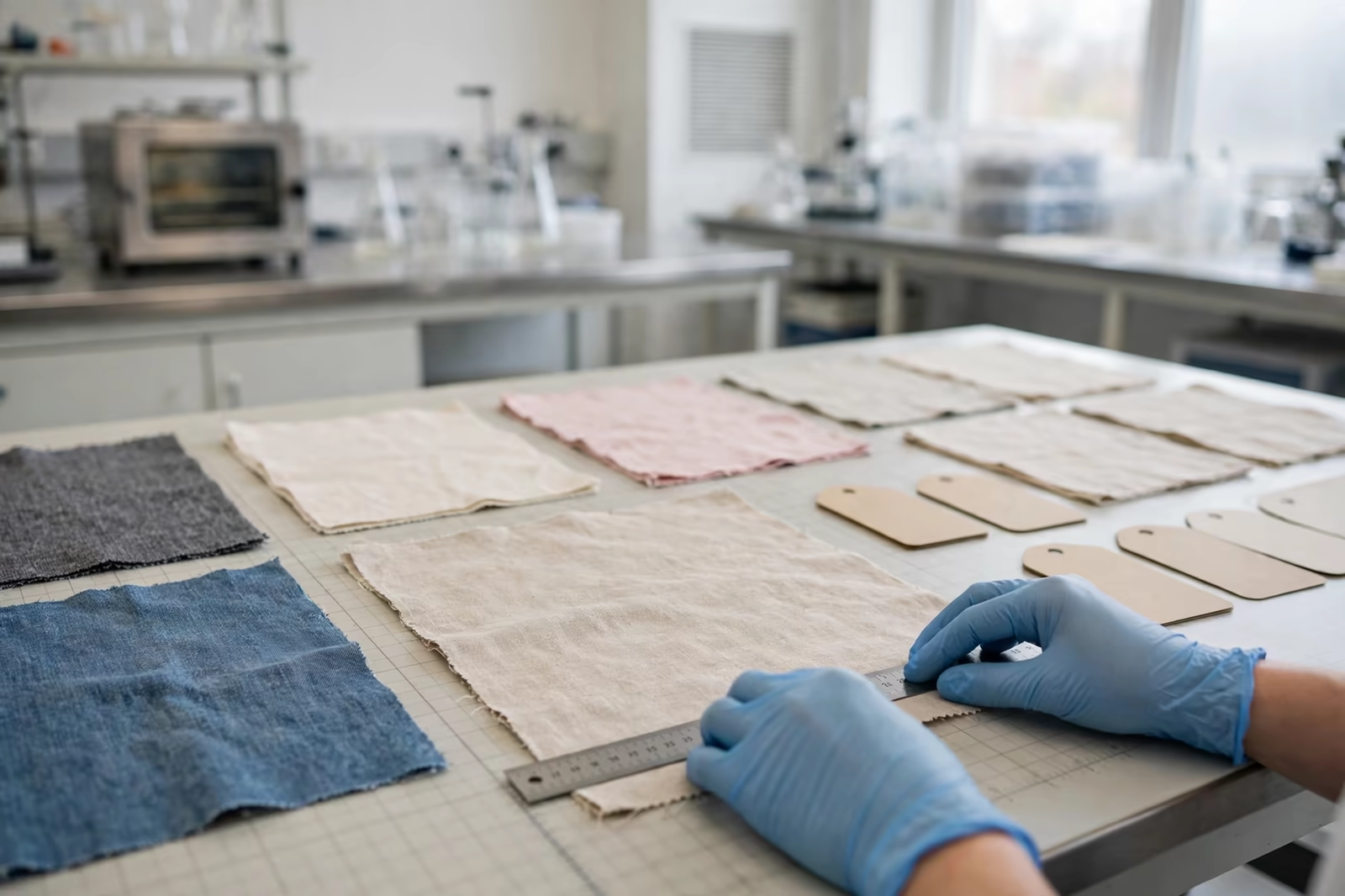
Every fabric claim in a sales conversation, soft, strong, colourfast, becomes a number in a test laboratory, and buyers who cannot read those numbers are negotiating blind. Four tests do most of the work in apparel: shrinkage, crocking, pilling and tensile strength, with colourfastness close behind. This guide explains what each test measures, how the results are reported and where a buyer should set the bar for their own range.
The fabrics desk behind this guide tests production fabric on clothing made in Bangladesh for the USA, the UK, Germany, Canada and Australia.
The testing sits inside our services, the programme mechanics on our MOQ and production page, and test requirements are agreed through our contact page.
Shrinkage: The Garment After Its First Washes
Shrinkage testing measures dimensional change: marked specimens of the fabric are washed and dried under the standard’s prescribed conditions, then measured again, and the change is reported as a percentage in warp and weft directions separately. A fabric can behave beautifully in one direction and disgrace itself in the other, which is why the two figures are never averaged away.
The number that matters commercially is the residual shrinkage after the garment maker’s processes: fabric may be pre-shrunk or finished to stabilise it, and pattern allowances are cut against the tested figure. Disputes about garments coming up small after washing are almost always disputes about which shrinkage figure the pattern was built on.
Buyers should specify the washing method in the test request, because a fabric washed gently in the test and boiled by consumers is a claim waiting to happen; test the care label you intend to print.
Crocking: Where the Colour Walks Away
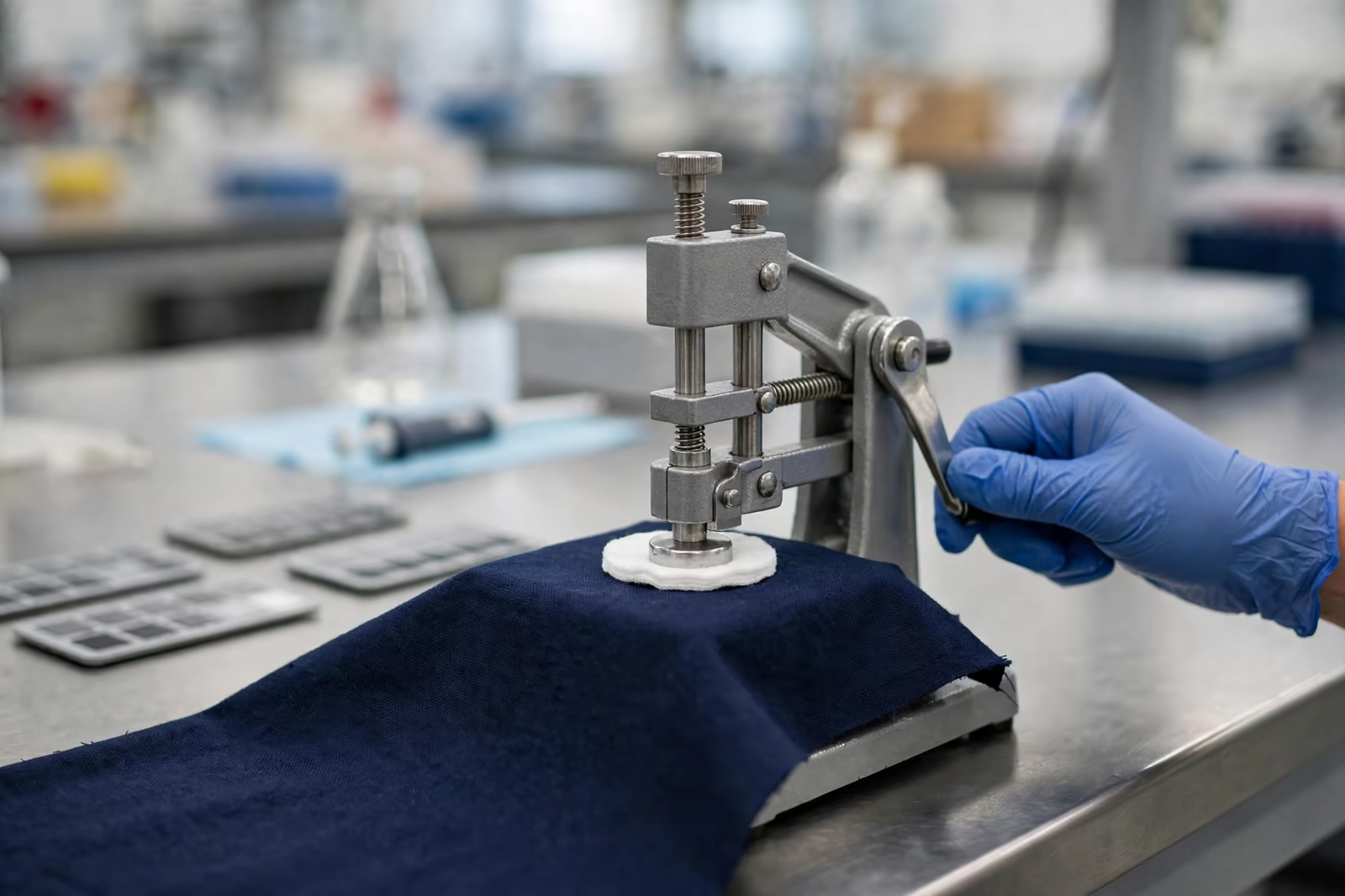
Crocking, or rubbing fastness, measures how much colour transfers from a fabric’s surface to a standard white cloth rubbed against it under controlled pressure, dry and then wet. Results are graded against the grey scale for staining, the five-step visual scale laboratories use across colourfastness work, with the top of the scale meaning no visible transfer.
Wet crocking is nearly always the weaker result, and deep saturated shades, indigo denim famously, are the habitual offenders. A dark garment that marks light upholstery, pale underlayers or a customer’s hands will generate returns no matter how handsome it looked on the rail.
The practical levers are dye selection, fixation and washing-off discipline at the dye house, plus honest shade planning: some colour and fibre combinations have known ceilings, and a competent mill will say so before the bulk is dyed.
Pilling: The Surface After Real Life
Pilling tests simulate wear: specimens are rubbed against themselves or a standard abradant in an instrument such as the Martindale, for a set number of cycles, and the surface is graded against photographic or written standards, again on a five-step scale from severe pilling to none. The little fibre balls that ruin a jumper’s second month are loose fibre ends worked free and tangled by friction.
Staple length, yarn twist, singeing and anti-pill finishes all move the result, which is why fibre choice at costing stage decides a garment’s appearance at month six. Blends behave differently from pure fibres, and a cheap short-staple yarn announces itself here before anywhere else.
Test at the cycle count your market’s wear reality implies, and grade the actual production fabric: a lab dip of premium yarn proves nothing about the bulk that followed it.
Tensile and Tear: How Strong Is Strong Enough
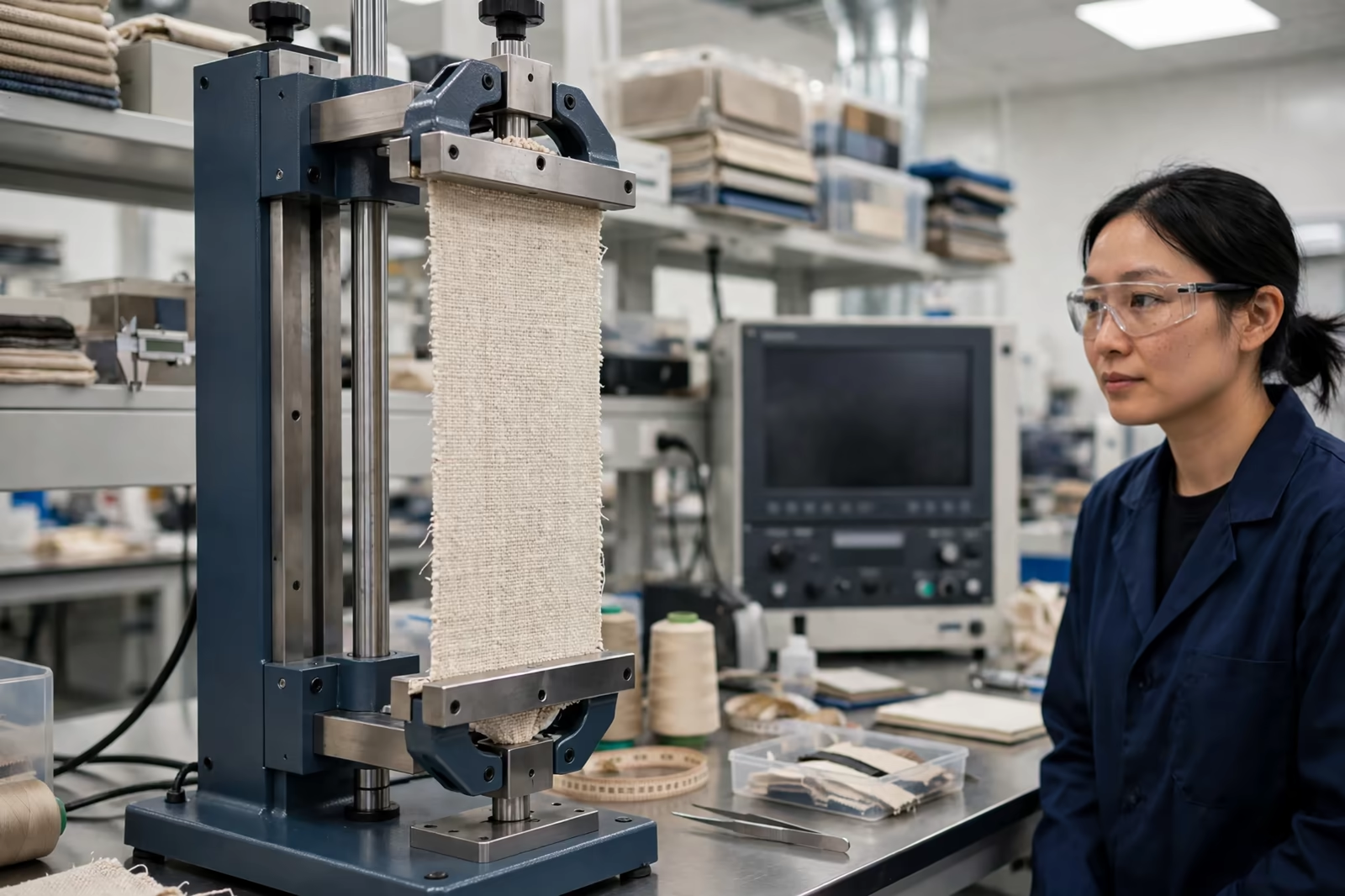
Tensile testing pulls a fabric strip until it breaks and records the force, in warp and weft; tear testing measures the force needed to propagate a rip already started. Together they predict seam survival, pocket-corner behaviour and whether a lightweight fashion fabric can survive its own garment’s construction and the wearer’s ordinary violence.
Strength is a system, not a slogan: yarn strength, weave density and finish all contribute, and some finishes that help one property tax another. Results belong next to the fabric’s weight and intended use; a voile and a canvas are not graded on the same expectations, and buyers write their minimums per product family.
Seam strength and seam slippage tests extend the same logic to the made garment, because the finest fabric fails its wearer if the seam opens under stress the cloth itself would have survived.
Colourfastness: Washing, Light and Perspiration
Beyond rubbing sits the wider fastness family. Wash fastness grades colour change and staining of adjacent fibres after a standardised wash; light fastness grades fading under controlled exposure, the test that decides whether a shop-window month ruins a shade; perspiration fastness checks acidic and alkaline sweat simulations, because garments live against skin chemistry, not distilled water.
Each reports on the same five-step grey-scale grammar, for change and for staining separately, which lets a buyer compare laboratories and seasons in one language. A shade can pass washing beautifully and fail light entirely; the range plan should weight the tests by how the garment will actually live.
Prints complicate everything pleasantly: the print paste is its own material with its own fastness, so printed styles are tested as printed, base cloth performance notwithstanding.
Spirality and Appearance After Washing
Knitted fabrics hold a private vice: spirality, the tendency of a washed garment’s side seams to twist around the body as the yarn’s stored torque relaxes. The test washes and measures the skew, and the causes live upstream in yarn twist, knitting tension and finishing; the cure, where one exists, is set before cutting.
Appearance retention testing grades the whole washed specimen: smoothness, seam puckering, print condition, the garment judged as its owner will judge it at the third wash. It is the least numerical and most commercial test in the file.
Programmes selling on quality should ask for appearance results alongside the hard numbers, because customers return garments that look tired, not garments whose tensile figures disappointed them.
The Supporting Cast: Weight, Slippage and Stretch
Three quieter tests complete the working picture. Fabric weight, verified as grams per square metre, confirms the bulk matches the approved quality, because weight drift is where quiet cost-saving hides. Seam slippage measures how far yarns slide apart at a stitched seam under load, the failure that opens little ladders beside seams on smooth filament fabrics.
Stretch and recovery testing, for elastane fabrics, measures extension under load and, more importantly, how completely the fabric returns; growth after wear is what makes knees bag and waistbands give up. Recovery figures belong in every leggings and skinny-fit specification.
None of these tests is exotic; all of them are cheap beside the returns they prevent, which is the arithmetic that built the standard test package in the first place. A buyer’s specification that names these properties explicitly, with limits per product family, converts testing from a courtesy into a contract, and contracts are what laboratories and mills both respect.
When to Test: Dips, Bulk and Garment Stage
Testing is staged like everything else in production. At development, candidate fabrics are screened so a doomed material never reaches sampling. At lab-dip and approval stage, the chosen quality is tested in full, establishing the baseline the order is bought against. At bulk stage, the actual production fabric is tested again, because mills vary and intentions are not evidence.
Garment-stage tests close the loop where construction matters: seam strength on made garments, appearance after washing, print durability on the finished article. A failure at bulk stage is a negotiation; a failure discovered by customers is a recall of reputation.
The test plan, which tests at which stages against which limits, belongs in the order file beside the size chart, agreed before production rather than argued after it. Buyers joining a programme mid-season should ask which stage the current evidence belongs to, because a development-stage pass attached to a bulk-stage problem is the oldest misunderstanding in the testing business.
Reading a Test Report Like a Professional
A report earns trust by specificity: the laboratory’s accreditation, the method references for each test, the fabric identity tied to a roll or lot, the conditions used, and results reported as measured, including the failures. A summary certificate without methods is a postcard, not evidence.
Read directionally: warp and weft separately, dry and wet separately, change and staining separately. Compare against your written limits, not against how the numbers feel, and compare bulk results against the approval baseline, because drift inside tolerance is still information.
File reports with the order’s other evidence and keep them for the destination’s retention expectations; when a claim arrives two seasons later, the report is the conversation.
Failed Results: The Conversation That Follows
Failures happen on real programmes, and the professional responses are limited: retest on a fresh specimen to exclude laboratory error, investigate the cause with the mill, adjust the process or the material, and if the property cannot be brought inside the limit, renegotiate the specification honestly or change the fabric.
What never appears on that list is shipping anyway and hoping. A known failed property is a documented liability travelling with the goods, and buyers discover this in claims files more often than anyone enjoys.
Handled openly, a failure usually costs days; handled quietly, it can cost the relationship, which is why our merchandisers raise test results, good and bad, in the same message rhythm, with the report attached and the options already thought through before the buyer has to ask.
Frequently Asked Questions
What shrinkage result should a buyer accept?
There is no universal figure: the acceptable residual shrinkage is written into each buyer’s specification, by fabric and product, and the pattern is cut with allowance against the tested result. What matters operationally is that the test uses the care conditions on the garment’s own label, reports warp and weft separately, and is run on the production fabric rather than a sample-room cousin.
Why is wet crocking always worse than dry?
Water swells fibres and lubricates the rubbing contact, so surface dye transfers more readily from a wet specimen than a dry one. Deep shades carry more surface colour to lose. Dye fixation quality and thorough washing-off after dyeing are the main controls, and dark shades deserve wet-crocking scrutiny in every test plan.
Can pilling be fixed after the fabric is made?
Partly. Singeing, shearing and anti-pill finishes can improve a made fabric’s grade, but the largest determinants, fibre length, yarn construction and blend, are set before the fabric exists. Buyers who care about month-six appearance specify pilling grades at fabric approval and test the bulk, because retrofitting surface quality is the expensive route.
Which laboratory should run the tests?
An accredited laboratory working to the international or destination-market standard methods your specification names, reporting full method references with results. For regulated properties, children’s wear chemistry above all, use laboratories the destination regime accepts. Keep reports tied to the exact bulk fabric identity so the evidence survives a dispute.