
Holiday apparel operates under the cruellest arithmetic in retail: the selling window is glorious, brief and absolutely final. A Christmas jumper unsold on the twenty-sixth of December is not stock; it is a memory with a price tag.
Yet programmes sell out every year, and they do it by design rather than by luck: the right garments, forecast against last year’s evidence, produced early enough to be calm, and designed with an escape route for whatever remains. This guide builds that programme for retailers and brands sourcing from a clothing manufacturer in Bangladesh for the USA, the UK, Germany, Canada and Australia.
Sell out does not mean order timidly. It means finishing the season with the shelves empty and the evidence richer, which is a planning achievement, not a purchasing accident, and in the trade it is recognised as the highest form of buying competence.
The Garments the Season Actually Buys
Holiday demand concentrates on a short list of garment families, worn at parties, photographed at gatherings and given as gifts. Programmes built around them carry the season; programmes built around novelty fragments of them do not.
- The Christmas jumper and its modern form, the festive sweatshirt
- Matching family pyjamas, the decade’s defining holiday category
- Party knitwear with a life beyond December
- Giftable small goods: socks, scarves, hats in festive colours
- Staff and event pieces for the retail season itself
- The novelty one-piece and costume-adjacent items, handled with care
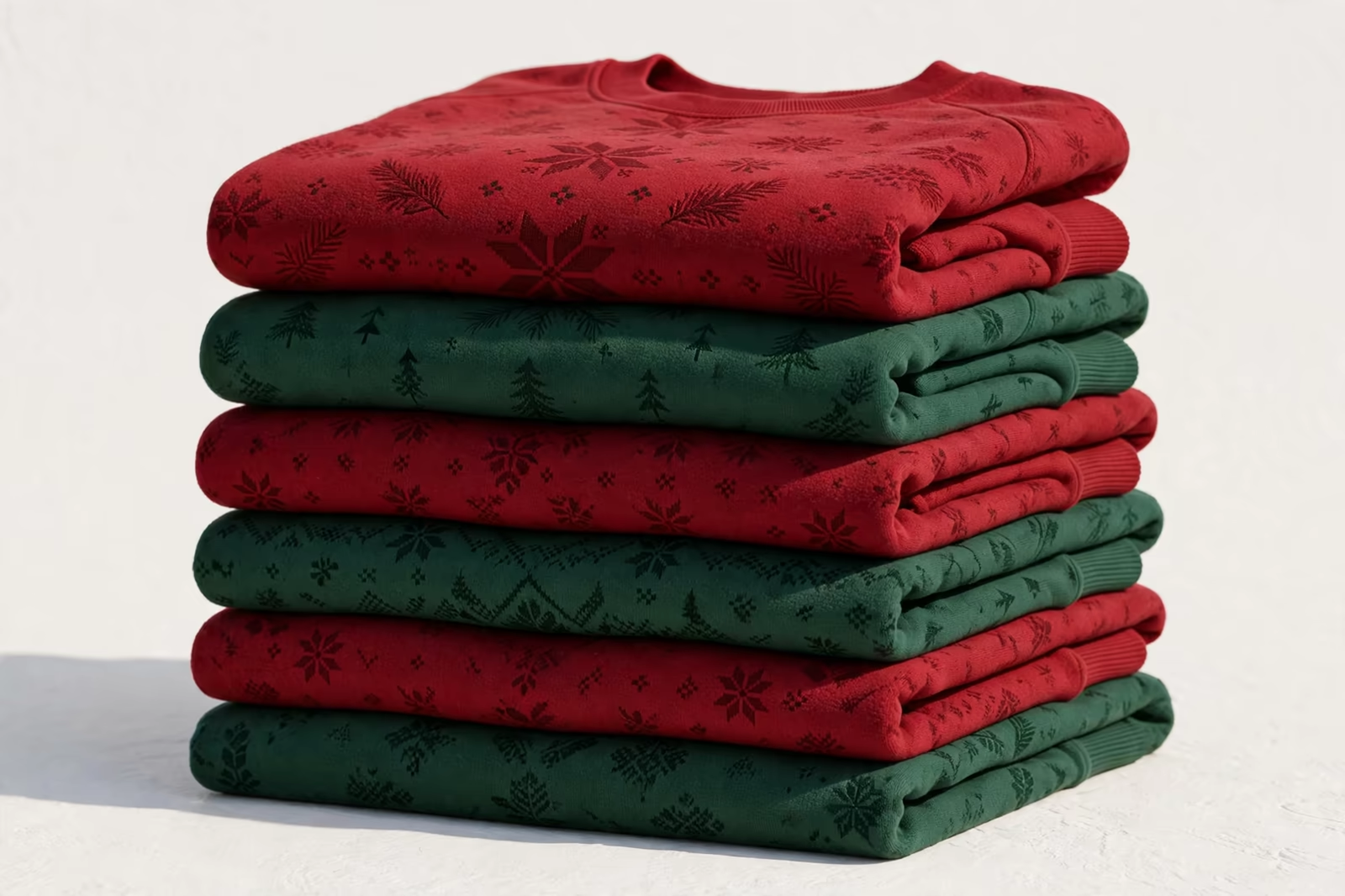
The crewneck sweatshirt in festive dress has quietly become the category’s workhorse: softer than the traditional jumper, easier to size as a gift, and easier to love in January.
Matching Family Pyjamas: The Anchor Category
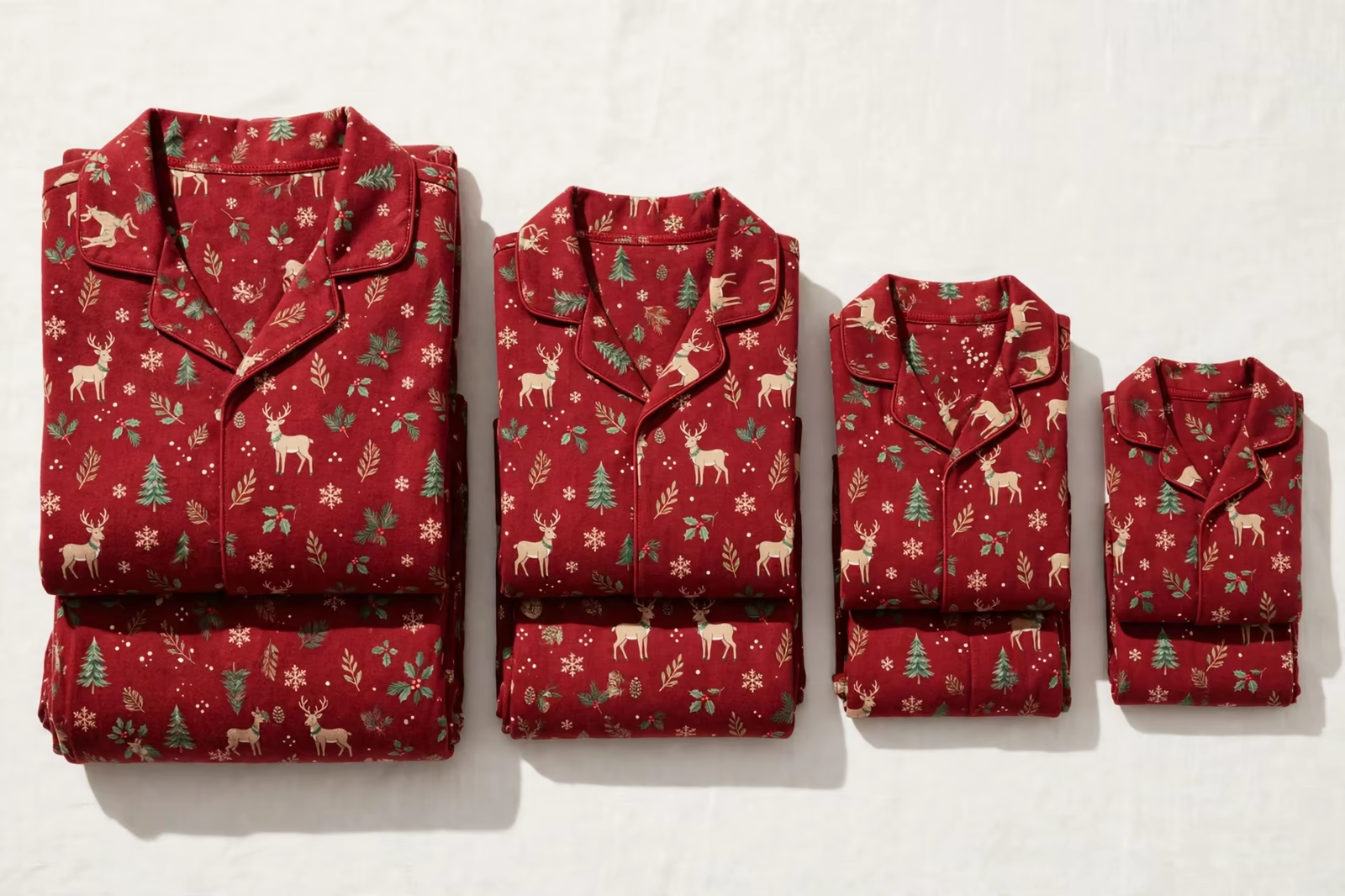
No holiday garment photographs like the family set: parents, children and occasionally a patient dog in one print, bought as a picture first and as sleepwear second. Its production logic is a size-curve problem unlike any other in apparel.
- One print across adult, child and infant sizes in a single programme
- The pajama set is the unit; it is sold as a set, never split
- Adult sizes drive the order; child sizes follow family arithmetic, not ratios
- Prints commissioned or licensed early; the artwork is the product
- Safety and labelling rules for children’s sleepwear govern the specification
- One production run for the family; split runs break the print match
Children’s nightwear carries flammability and labelling rules in several markets that must be designed in from the first sample, a point the programme ignores at the cost of the entire category.
Novelty Versus Wearable: The Season’s Real Decision
Every holiday range argues with itself about tone: loud novelty that sells on the joke, or wearable festive that sells on the garment. The programmes that sell out carry both, in a ratio decided by evidence rather than by taste.
- Novelty sells fast, photographs brilliantly and dies on Boxing Day
- Wearable festive sells longer and survives into the New Year wardrobe
- Gift buyers lean wearable; self-buyers and party groups lean novelty
- The loudest designs carry the shallowest stock depth, deliberately
- One design language across both keeps the range reading as a collection
Our standard minimum of 1,200 pieces per style in up to two colours disciplines this decision usefully: novelty depth is planned in real quantities, so the joke cannot quietly become the whole order.
Forecasting a Window That Forgives Nothing
Holiday forecasting starts from last year’s till data and adjusts for everything that changed: the calendar’s shape, the paydays, the weather’s promise and the range’s own differences. It is the most evidence-rich forecast in retail, which makes lazy versions of it inexcusable.
- Last year’s sell-through by garment, colour and week of the season
- The calendar read properly: which weekends the season actually contains
- Gift versus self-purchase split, because their curves peak differently
- Size curves from gift reality: buyers guess recipients’ sizes upward
- A planned sell-out point before the final weekend, not after it
- The leftover plan written before the order, not after the season
The planned sell-out point deserves emphasis. Programmes that aim to sell through by the season’s last full weekend price the final days calmly; programmes still holding depth in the last week discount in public and train their customers to wait.
Production Timing: Christmas Is Made in Summer
The garment industry’s oldest joke is also its truest sentence: Christmas is produced while everyone else is on the beach. The calendar works backwards from the warehouse date through freight and production, landing the decisions in the season nobody associates with tinsel.
- Artwork and print approvals completed before production capacity tightens
- Family sets produced as one programme so prints and shades match
- Freight planned for the peak season’s congestion, not the average week
- Warehouse intake and photography scheduled before the selling window opens
- A small reserve produced undated, ready for the design that runs early
Start through get a quote when the range is still a sketch and the previous season’s data is still warm. The programmes that sell out are recognisable by this habit alone: they are discussed earliest and worried about least.
The Leftover Plan: Designing the Escape Route
Even the best forecast leaves something, and the professional programme decides in advance what that something becomes. Leftovers are a design problem: which garments can survive the season’s end with their dignity and their margin intact.
- Undated winter designs roll into January cold-weather selling
- Festive-but-wearable pieces reprice gently instead of collapsing
- Family prints with neutral grounds return for other occasions
- True novelty leftovers exit through charity and staff channels, planned
- Every exit priced into the original margin calculation
A range designed with exits can be ordered bravely, because its downside is managed. A range without them is ordered fearfully, and fearful ordering manufactures the other failure: empty shelves in the season’s best week.
The boldest programmes go one step further and design the hero pieces to straddle the boundary: winter-warm, festively coloured, patterned with the season’s spirit but free of dates and slogans that expire. Those garments sell at full price in December and keep selling, honestly, until spring.
Gift Presentation: The Garment Is Only Half the Present
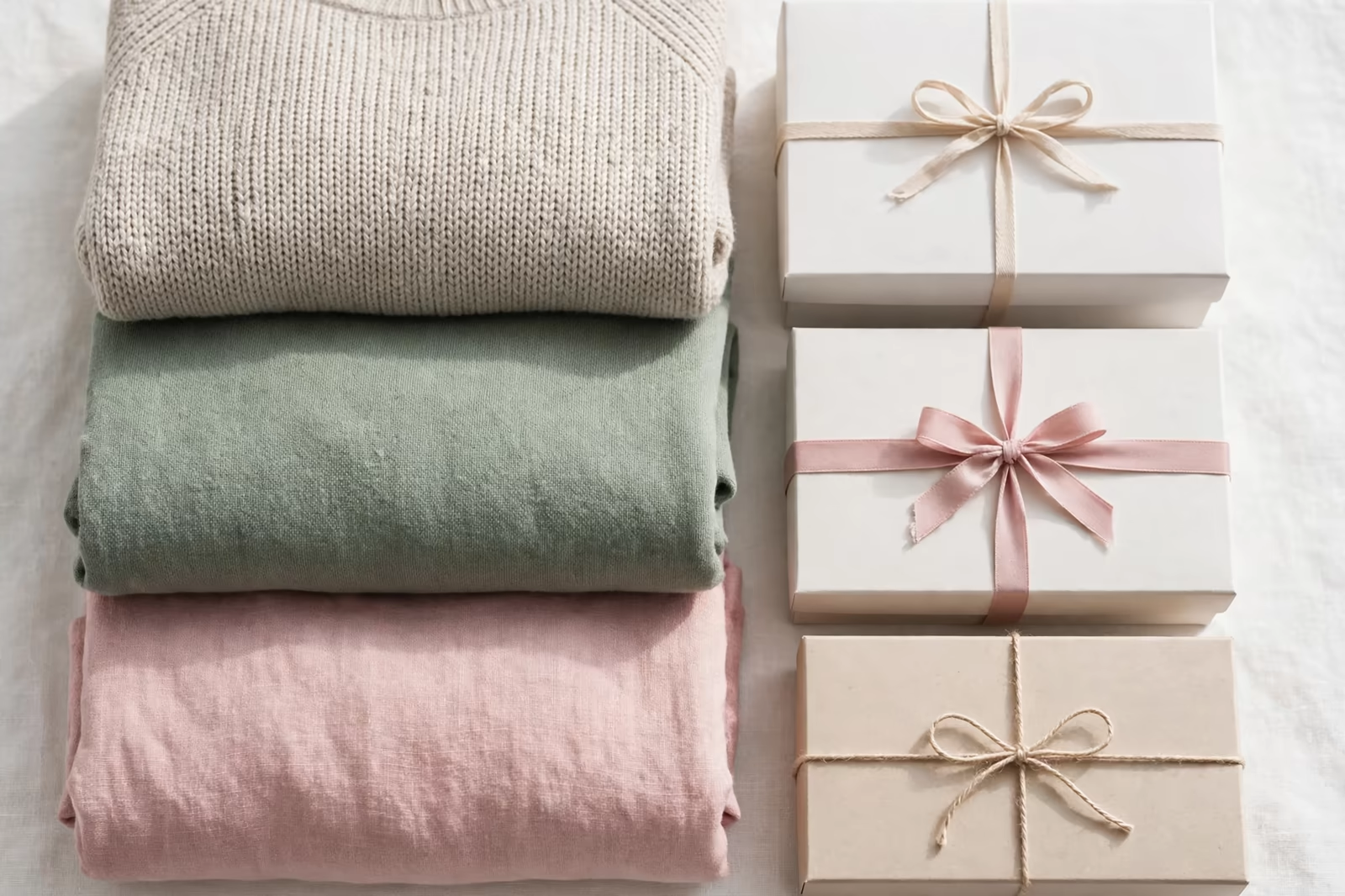
A large share of holiday apparel is bought to be given, which makes presentation part of the product. Programmes that understand this sell the same garment twice as well at the same price, because the buyer is purchasing the moment of giving as much as the cloth.
- Gift-ready folding and packaging specified at production, not improvised later
- Family sets presented as sets, boxed to be photographed unwrapped
- Size exchanges designed to be painless in the days after the holiday
- Garment quality that survives the recipient’s first honest inspection
- Branding the giver is proud of, restrained enough for the receiver
The exchange point is quietly decisive. Holiday gifts are exchanged at a rate no other category matches, and a programme sized and stocked for that week keeps customers that a rigid one donates to competitors.
Online programmes feel this twice over, because the gift arrives unseen and the presentation carries the entire first impression. The box, the fold and the card are reviewed by recipients who will never see the product page, and they judge the brand by exactly those three things.
The People Wearing the Season: Staff Programmes
Retail in December runs on staff who are themselves dressed by the season, and the staff programme is the holiday range’s overlooked sibling. It is ordered on the same calendar, produced in the same run, and judged in every customer’s photograph of the store.
- Festive staff pieces that signal the season without costume embarrassment
- Comfort engineered for the longest trading days of the year
- Sizes collected from the actual team, early and privately
- Enough sets per person to survive the season’s laundry reality
- Designs the team can keep wearing after the decorations come down
Staff who feel well dressed in December sell December better. The programme costs little beside the retail range and returns its value in every interaction of the busiest weeks of the year. Order it with the range itself, in the same production conversation, because December admits no second orders and a staff member dressed from the leftover rail is visible in every sense.
The Same Discipline, All Year Round
Christmas is the largest holiday programme, not the only one. Eid collections, Diwali dressing, Halloween, Valentine’s Day and national celebrations all run on the same arithmetic: a fixed date, a brief window, a forecast built from last year’s evidence and a leftover plan written in advance.
- Each market’s calendar mapped honestly, festival by festival
- Cultural fluency in the design work, never costume guessing
- The same garments-first discipline: anchors, then novelty, then exits
- Production slots booked against the whole year’s festivals at once
- Evidence filed per festival, so every year’s programme sharpens
Retailers serving diverse markets hold a genuine advantage here: their year contains more seasons, more windows and more chances to sell a well-planned programme. The factories that serve them well think in the same calendar, which is why the conversation starts with the year’s dates rather than with any single garment.
Frequently Asked Questions
When should holiday apparel be ordered?
Working backwards from the selling window through peak-season freight and production, which places the real decisions in the months when nobody is thinking about Christmas. Use the previous season’s data while it is fresh, lock artwork early, and treat the calendar as the first product the programme designs.
What sells better, novelty Christmas jumpers or wearable festive pieces?
Both, to different buyers on different curves. Novelty peaks early and socially; wearable sells steadily and gifts well. The selling-out programmes carry both in depths set by last year’s evidence, with novelty deliberately shallower because its value expires with the season. Watch the social curve as well: the loudest design of the year is usually anointed by photographs early in the season, which is one more reason its stock belongs in the opening deliveries rather than the last.
How do matching family pyjamas change the ordering?
The unit becomes the set, and the size curve becomes family arithmetic: adults anchor the order, children follow in matched sizes, and the whole family must come from one production run so print and shade agree. Build the set sizes from last year’s set sales or from a pre-order list wherever the channel allows it, because forecasting three generations of sizes in one guess is the one piece of arithmetic in the entire programme that nobody should attempt cold. Children’s sleepwear rules in each market shape the specification from the start.
Is aiming to sell out risky?
Aiming to sell out at the planned point is the opposite of risky: it prices the season honestly and protects margin. The risk sits at both extremes, mountains of leftovers or empty shelves in the peak week, and forecasting from evidence with a written leftover plan avoids both.